 kiruthika
Hook Introduction
One of the most famous restaurants in the world hasn’t held a Michelin star since 2019, and another legendary name stopped operating as a regular restaurant entirely in 2025. Fame and current status don’t always match in fine dining.
We combined verified 2026 Michelin Guide data with each restaurant’s real-world reputation to build an honest top 10, including exactly which ones are still Michelin-starred today and which ones aren’t.
Key Highlights (Quick Facts)
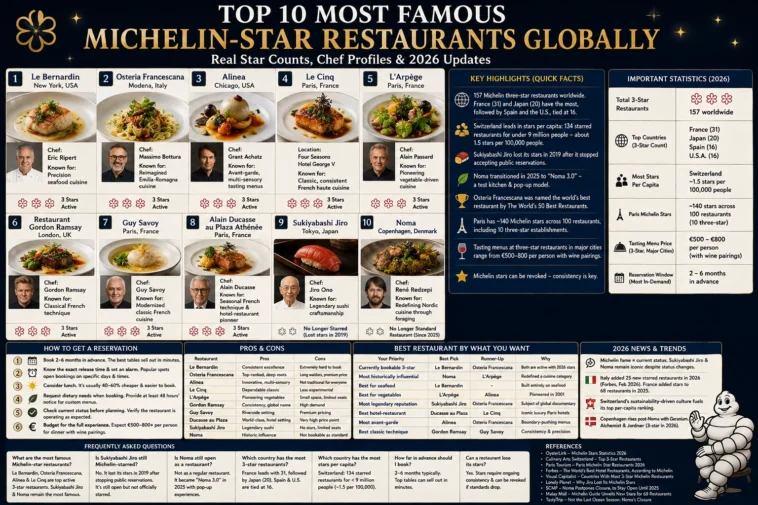
- There are 157 Michelin three-star restaurants worldwide, according to the most recent guide data, with France (31) and Japan (20) holding the most, followed by Spain and the United States, tied at 16.
- Switzerland ranks first globally in Michelin stars per capita, with 134 starred restaurants serving a population of under 9 million — roughly 1.5 stars per 100,000 people.
- Sukiyabashi Jiro, the Tokyo sushi restaurant made globally famous by the documentary Jiro Dreams of Sushi, lost its Michelin stars in 2019 because it stopped accepting public reservations — yet it remains one of the most recognized restaurant names on Earth.
- Noma, the Copenhagen restaurant that won the World’s 50 Best Restaurants title five times, stopped operating as a regular restaurant in 2025, transitioning into “Noma 3.0” — a test kitchen and occasional pop-up model rather than a standard reservation-based restaurant.
- Osteria Francescana, led by chef Massimo Bottura, was named the world’s best restaurant by Restaurant magazine’s World’s 50 Best Restaurants list and has consistently held three Michelin stars.
- Paris alone has roughly 140 Michelin stars across 100 restaurants, including 10 three-star establishments, according to the most recent France guide.
- Tasting menus at three-star restaurants in major cities like Paris commonly cost €500–800 per person, including wine pairings, with reservation windows of two to six months for the most in-demand tables.
- Michelin stars can be revoked, and maintaining them requires sustained consistency, not a one-time achievement, several restaurants featured in past “most famous” lists have since lost stars or closed entirely.
A Note on Fame vs. Current Michelin Status
This list is built around genuine global fame and cultural impact, not purely current star counts, which means being transparent about a real tension in this topic. Some of the most recognizable Michelin restaurant names in the world, including Sukiyabashi Jiro and Noma, no longer operate under the exact conditions that earned them their reputations, whether because they lost official Michelin recognition or transitioned away from being standard restaurants altogether.
We’ve clearly marked each entry’s current 2026 status, so you know exactly what you would be booking or, whether you could book it at all, if you tried to visit today.
The Top 10 Most Famous Michelin-Star Restaurants Globally
1. Le Bernardin (New York, USA)
Le Bernardin has been a fixture of elite New York dining for decades. Led by chef Eric Ripert, the restaurant is built around seafood served with clean, precise techniques that allow natural ocean flavors to take center stage. Its sourcing philosophy emphasizes sustainability and seasonality, with the team working directly with fish purveyors to create menus that evolve subtly rather than chase trends.
Signature dishes, including thinly sliced tuna served over foie gras, have become genuinely influential in shaping how American fine dining approaches seafood. The restaurant’s calm, polished dining room and carefully designed acoustics have also made it a benchmark for hospitality as much as food.
Current status (2026): Three Michelin stars, actively operating.
Chef: Eric Ripert.
Known for: Precision seafood cuisine.
2. Osteria Francescana (Modena, Italy)
Osteria Francescana, chef Massimo Bottura’s restaurant in Modena, has been named the world’s best restaurant multiple times by the World’s 50 Best Restaurants list and has consistently ranked among the global top five since 2010. Bottura’s cooking reimagines classic Italian regional recipes, sourcing Parmigiano-Reggiano and balsamic vinegar directly from local artisans, in ways that feel simultaneously familiar and genuinely surprising.
Beyond the restaurant itself, Bottura’s zero-waste cooking philosophy has directly inspired kitchens worldwide and extended into Food for Soul, a social project he founded that has served more than 1.5 million underrepresented and marginalized guests by transforming food waste into nourishing meals.
Current status (2026): Three Michelin stars, actively operating.
Chef: Massimo Bottura.
Known for: Reimagined traditional Emilia-Romagna cuisine.
3. Alinea (Chicago, USA)
Alinea, chef Grant Achatz’s Chicago restaurant, has built its three-Michelin-star reputation on creativity and precision that consistently challenge traditional perceptions of what a tasting menu can be. Its seasonally evolving menus engage the senses in genuinely unexpected ways, often incorporating theatrical, multi-sensory presentation elements alongside refined culinary techniques.
Alinea’s influence extends well beyond Chicago’s dining scene. It is frequently cited as one of the restaurants that helped establish American fine dining as genuinely world-class and innovative rather than simply following European traditions.
Current status (2026): Three Michelin stars, actively operating.
Chef: Grant Achatz.
Known for: Avant-garde, multi-sensory tasting menus.
4. Le Cinq (Paris, France)
Le Cinq, located inside the Four Seasons Hotel George V in Paris, is widely regarded as one of the most consistent classic restaurants among Paris’s three-star establishments — a reputation built on sustained excellence rather than experimental reinvention. Its setting inside one of Paris’s most storied luxury hotels adds to its status as a benchmark destination for high-end French dining.
As one of 10 three-star restaurants in Paris, according to the most recent guide, Le Cinq represents the kind of dependable, world-class classical French cuisine that continues to define what many diners expect from the absolute top tier of Parisian fine dining.
Current status (2026): Three Michelin stars, actively operating.
Location: Four Seasons Hotel George V, Paris.
Known for: Classic, consistently excellent French haute cuisine.
5. L’Arpège (Paris, France)
L’Arpège, chef Alain Passard’s restaurant, is frequently described as one of the most influential of Paris’s three-star establishments — largely because Passard pioneered a genuinely vegetable-driven approach to French haute cuisine beginning in 2001. This was a radical shift at the time for a chef operating at the highest level of classical French technique.
The restaurant offers a full vegetarian tasting menu on request, reflecting Passard’s continued commitment to vegetable-forward cooking as a serious culinary discipline rather than a compromise. This approach has since influenced fine-dining kitchens well beyond France.
Current status (2026): Three Michelin stars, actively operating.
Chef: Alain Passard.
Known for: Pioneering vegetable-driven French haute cuisine.
6. Restaurant Gordon Ramsay (London, England)
Restaurant Gordon Ramsay remains a cornerstone of London’s fine-dining scene and has held three Michelin stars for years. It is built on classical French techniques executed with the exacting precision for which Ramsay became globally known before his television career made him a household name well beyond the restaurant industry.
Its enduring three-star status, maintained over decades even as London’s fine-dining scene has grown considerably more competitive and diverse, reflects a level of operational consistency that Michelin inspectors specifically prioritize when awarding and maintaining the guide’s highest recognition.
Current status (2026): Three Michelin stars, actively operating.
Chef: Gordon Ramsay.
Known for: Classical French technique and exacting consistency.
7. Guy Savoy (Paris, France)
Guy Savoy’s eponymous Paris restaurant has maintained its three-star status for years and is known specifically for classic French dishes presented with a modern flair that distinguishes it from more purely traditional competitors. Its ambiance and service standards have made it a genuine staple of Paris’s luxury dining scene.
Savoy relocated the restaurant to the Monnaie de Paris, the city’s historic mint building along the Seine, adding a striking architectural setting to a menu built on decades of refined technique. This combination has helped the restaurant sustain its reputation even as Paris’s three-star landscape has evolved considerably around it.
Current status (2026): Three Michelin stars, actively operating.
Chef: Guy Savoy.
Known for: Modernized classic French cuisine and a riverside setting.
8. Alain Ducasse au Plaza Athénée (Paris, France)
Alain Ducasse is one of the most globally recognized names in fine dining, having built a genuine international empire by placing some of his best-known restaurants inside legendary hotels — a strategy he describes as mutually beneficial because “great hotels and great restaurants can make each other better.”
His flagship Paris restaurant at the Plaza Athénée emphasizes seasonal ingredients and refined techniques. Ducasse’s broader philosophy has directly shaped how many other chefs think about combining hotel hospitality with genuinely world-class independent dining rather than treating hotel restaurants as a secondary offering.
Current status (2026): Three Michelin stars, actively operating.
Chef: Alain Ducasse.
Known for: Seasonal French technique and pioneering the hotel-restaurant model.
9. Sukiyabashi Jiro (Tokyo, Japan)
Sukiyabashi Jiro is, by reputation, arguably the most famous sushi restaurant in the world — a tiny, 10-seat counter in a Tokyo subway station made globally iconic by the documentary Jiro Dreams of Sushi. Chef Jiro Ono, recognized by Guinness World Records as the oldest living Michelin three-star chef at the time of his award, built a reputation on simplicity, discipline, and decades of relentlessly refined technique.
Important status update: Sukiyabashi Jiro lost its Michelin stars in 2019, as reflected in the 2020 guide, specifically because it stopped accepting public reservations, a core requirement for Michelin recognition. It remains open and continues to be regarded by many food critics and past diners — including former U.S. President Barack Obama, who dined there in 2014 — as serving some of the finest sushi in the world. However, it is no longer an officially Michelin-starred restaurant as of 2026.
Current status (2026): No longer Michelin-starred; lost its stars in 2019 after no longer accepting public reservations.
Chef: Jiro Ono.
Known for: Globally iconic sushi craftsmanship and being the subject of Jiro Dreams of Sushi.
10. Noma (Copenhagen, Denmark)
Noma, chef René Redzepi’s Copenhagen restaurant, redefined fine dining around foraged, hyper-seasonal Nordic ingredients and won the World’s 50 Best Restaurants title five times, including a run from 2010 to 2012 and another win in 2021. Dishes such as edible pinecones and reindeer heart tartare made it one of the most influential and widely imitated restaurants of the past two decades.
Important status update: Noma stopped operating as a regular, reservation-based restaurant in 2025, transitioning instead into “Noma 3.0” — a test kitchen and product-development lab that occasionally hosts pop-up dining experiences in Copenhagen and abroad rather than functioning as a standard restaurant where diners can book a table at any time. Redzepi has described the traditional fine-dining restaurant model as ultimately unsustainable, citing demanding working conditions across the industry as a key factor in the decision.
Current status (2026): No longer a standard operating restaurant; transitioned to a test kitchen and occasional pop-up model in 2025.
Chef: René Redzepi.
Known for: Redefining Nordic cuisine through foraging and hyper-seasonality.
Important Statistics Table
| Rank | Restaurant | Location | Current 2026 Status | Known For |
| 1 | Le Bernardin | New York, USA | 3 stars, active | Precision seafood |
| 2 | Osteria Francescana | Modena, Italy | 3 stars, active | Reimagined Italian cuisine |
| 3 | Alinea | Chicago, USA | 3 stars, active | Avant-garde tasting menus |
| 4 | Le Cinq | Paris, France | 3 stars, active | Classic, consistent French cuisine |
| 5 | L’Arpège | Paris, France | 3 stars, active | Vegetable-driven haute cuisine |
| 6 | Restaurant Gordon Ramsay | London, UK | 3 stars, active | Classical French technique |
| 7 | Guy Savoy | Paris, France | 3 stars, active | Modernized classic French cuisine |
| 8 | Alain Ducasse au Plaza Athénée | Paris, France | 3 stars, active | Seasonal French technique |
| 9 | Sukiyabashi Jiro | Tokyo, Japan | No longer starred since 2019 | Legendary sushi craftsmanship |
| 10 | Noma | Copenhagen, Denmark | No longer a standard restaurant since 2025 | Redefining Nordic cuisine |
Sources: Michelin Guide, OysterLink 2026, Culinary Arts Switzerland 2026, Paris Tourism 2026, and Forbes 2026. Star counts and operating statuses reflect the most recently available 2026 data. Michelin Guide updates are released periodically throughout the year by region.
Step-by-Step: How to Actually Get a Reservation
- Book significantly further ahead than you’d expect. Three-star restaurants in major cities typically require reservations two to six months in advance, and the most in-demand tables can sell out within minutes of reservations opening.
- Know the exact reservation release time and set an alarm. Some restaurants, such as Paris’s Septime, open bookings a fixed number of days in advance at a specific time and sell out almost immediately.
- Consider lunch instead of dinner. Tasting menus at the same three-star restaurant are commonly 40–60% cheaper at lunch than at dinner, and lunch reservations are often easier to secure.
- Ask about dietary accommodations when booking, not upon arrival. Most three-star restaurants, including L’Arpège and Plénitude, can create a custom vegetarian or vegan tasting menu with 48 hours’ notice if you ask in advance.
- Check the current status before planning a trip around a specific restaurant. As this list shows, even globally famous names can change status significantly. Verify that a restaurant is still operating as expected before building a trip around it.
- Budget realistically for the full experience. Three-star dinners with wine pairings commonly cost €500–800 per person in major cities like Paris. Factor this into your trip planning well before you arrive.
Pros and Cons Table
| Restaurant | Pros | Cons |
| Le Bernardin | Consistent excellence and influential seafood techniques | Extremely difficult reservation availability |
| Osteria Francescana | Globally top-ranked and deeply rooted in regional traditions | Long waitlists and premium pricing |
| Alinea | Genuinely innovative, multi-sensory dining experience | Not a traditional dining experience for everyone |
| Le Cinq | Dependable classic excellence in an iconic setting | Less experimental than some competitors |
| L’Arpège | Pioneering vegetable-forward fine dining | Smaller, more intimate space limits availability |
| Restaurant Gordon Ramsay | Exacting consistency and a globally recognized name | High demand due to Ramsay’s mainstream fame |
| Guy Savoy | Striking riverside setting and refined classic techniques | Premium pricing typical of Paris three-star restaurants |
| Alain Ducasse au Plaza Athénée | World-class techniques and a luxury hotel setting | Very high price point |
| Sukiyabashi Jiro | Legendary reputation and unmatched sushi craftsmanship | No longer Michelin-starred and extremely limited seating |
| Noma | Historic influence on global fine dining | No longer bookable as a standard restaurant |
Comparison Table: Best Restaurant by What You Want
| Your Priority | Best Pick | Runner-Up | Why |
| Currently bookable three-star experience | Le Bernardin | Osteria Francescana | Both are actively operating with confirmed 2026 star status |
| Most historically influential | Noma | L’Arpège | Redefined an entire cuisine category, even if it is no longer a standard restaurant |
| Best for seafood specifically | Le Bernardin | — | Built entirely around precision seafood techniques |
| Best for vegetable-forward fine dining | L’Arpège | Alinea (seasonal menus) | Pioneered vegetable-driven haute cuisine in 2001 |
| Most legendary global reputation | Sukiyabashi Jiro | Osteria Francescana | Subject of a globally viewed documentary |
| Best hotel-restaurant combination | Alain Ducasse au Plaza Athénée | Le Cinq | Both are located inside iconic luxury Paris hotels |
| Most avant-garde dining experience | Alinea | Osteria Francescana | Multi-sensory, boundary-pushing tasting menus |
| Best for classic techniques done exceptionally | Restaurant Gordon Ramsay | Guy Savoy | Consistency and precision over experimentation |
2026 News and Trends
The clearest theme in 2026 is that Michelin fame and current status don’t always align. Sukiyabashi Jiro and Noma both remain among the most searched and recognized restaurant names globally, despite one losing its stars years ago and the other stepping away from standard restaurant operations entirely in 2025. This gap has become a genuine talking point in food media as travelers increasingly discover that a restaurant’s pop-culture fame doesn’t guarantee current bookability.
Italy added 25 new Michelin-starred restaurants for 2026, according to Forbes’ February 2026 coverage, reflecting the continued expansion of the guide’s recognition even as its most famous flagship names, such as Osteria Francescana, maintain their positions at the very top. France’s 2025 guide similarly recognized new talent, awarding stars to 68 restaurants at a single ceremony in Metz. Two restaurants — Christopher Coutanceau and Le Coquillage — were newly promoted to the three-star category.
Switzerland’s per-capita dominance continues to draw attention as a genuinely different Michelin story from the raw-number leaders, including France, Japan, Spain, and the United States. With roughly 1.5 stars per 100,000 people, Switzerland’s small population and exceptionally dense concentration of Michelin recognition reflect a national culinary culture built around sustainability and local, seasonal ingredients that align closely with the Michelin Guide’s current values.
Copenhagen’s dining scene has also had to reckon with life after Noma. Restaurants such as Geranium, Alchemist, and the newly three-starred Jordnær have stepped up to fill the visibility gap left by Noma’s transition. However, industry commentary suggests that it remains genuinely difficult for any single restaurant to fully replace Noma’s outsized cultural influence on the city’s culinary identity.
Conclusion
The most famous Michelin restaurants in the world aren’t always the ones you can actually book a table at today. Sukiyabashi Jiro and Noma prove that cultural fame and current Michelin status can diverge significantly, even for the most legendary names in fine dining. For a currently bookable three-star experience, Le Bernardin, Osteria Francescana, and Alinea remain among the most reliably world-class options available in 2026.
Whichever restaurant you’re pursuing, verify its current status before planning a trip, book months in advance, and budget realistically for what remains one of the most exclusive dining experiences on Earth.
References
OysterLink – Michelin Stars Statistics 2026: Global Data & Trends: https://oysterlink.com/spotlight/restaurant-michelin-stars-statistics/
Culinary Arts Switzerland – Top 3-Star Michelin Restaurants Around the World: https://www.culinaryartsswitzerland.com/en/news/3-star-michelin-restaurants/
Paris Tourism – Paris Michelin Star Restaurants: Best Guide for 2026: https://www.paristourism.org/paris-michelin-restaurants/
Forbes – The World’s Best Hotel Restaurants, According to Michelin: https://www.forbes.com/sites/jimdobson/2026/02/19/the-worlds-best-hotel-restaurants-according-to-michelin/
Visual Capitalist – Mapped: Countries With the Most Three-Star Michelin Restaurants: https://www.visualcapitalist.com/mapped-countries-with-the-most-three-star-michelin-restaurants/
Lonely Planet – Why the World’s Most Famous Sushi Restaurant Lost Its Michelin Stars: https://www.lonelyplanet.com/articles/sushi-restaurant-michelin-stars
South China Morning Post – World’s Best Restaurant Noma Postpones Closure, to Stay Open Until 2025: https://www.scmp.com/news/world/europe/article/3254282/worlds-best-restaurant-noma-stay-open-until-2025-it-eyes-return-kyoto-unfinished-business
Malay Mail – Michelin Guide Unveils New Stars for 68 Restaurants in France: https://malaymail.com/news/life/2025/04/02/michelin-guide-unveils-new-stars-for-68-restaurants-in-france/171644
TastyTrip – Not the Last Ocean Season: Noma’s Closure and Its Impact: https://www.tastytrip.com/en/noma-copenhagen/
FAQs
Restaurants such as Le Bernardin, Osteria Francescana, Alinea, and Le Cinq are among the most consistently recognized, currently active three-star restaurants. Meanwhile, Sukiyabashi Jiro and Noma remain arguably the most famous names overall despite each having a complicated current status.
No. Sukiyabashi Jiro lost its Michelin stars in 2019, as reflected in the 2020 guide, because it stopped accepting public reservations, a core Michelin requirement. It remains open and highly regarded by critics and past diners, but it is no longer officially recognized with Michelin stars.
Not in the traditional sense. Noma stopped operating as a standard, reservation-based restaurant in 2025, transitioning into “Noma 3.0” — a test kitchen and product-development lab that occasionally hosts pop-up dining experiences rather than functioning as a regularly bookable restaurant.
France leads with 31 three-star restaurants, followed by Japan with 20. Spain and the United States are tied at 16, according to the most recent Michelin Guide data cited in 2026 industry reporting.
Switzerland ranks first globally in Michelin stars per capita, with 134 starred restaurants serving a population of under 9 million people — roughly 1.5 stars per 100,000 residents.
Typically, you should book two to six months in advance for three-star restaurants in major cities. However, the most in-demand tables, such as Paris’s Septime, can sell out within minutes of reservations opening at a specific release time.
Yes. Michelin stars are not permanent. Restaurants must maintain sustained consistency to keep them, and stars can be revoked if standards decline or if a restaurant no longer meets Michelin’s requirements, such as no longer accepting public reservations, as happened with Sukiyabashi Jiro.

![Top 10 Best Chocolate Brands in the World 2026 Hook Introduction Ferrero just beat Nestlé, Hershey, and Lindt to claim third place among the world's biggest confectionery companies, and its 4.5% growth rate was the strongest of any major chocolate maker tracked in 2026. We compared verified 2026 revenue, growth, and heritage data across the chocolate brands actually dominating shelves and gift boxes worldwide, from mass-market giants to Belgian luxury houses. Key Highlights (Quick Facts) Ferrero ranks third among the world's biggest confectionery companies at an $18 billion global value, posting the strongest growth rate (4.5% CAGR) of any major chocolate maker tracked in 2026. Mars, Incorporated remains the largest confectionery manufacturer in the world by net sales, even though Reese's Peanut Butter Cups (a Hershey product) is frequently cited as the single top-selling candy brand globally. Mondelez International, owner of Cadbury, Milka, and Toblerone, reported $39.3 billion in revenue in FY2026, making it one of the largest snack companies in the world, not just a chocolate maker. Lindt & Sprüngli generated $7.44 billion in sales in FY2025, with 12.4% organic growth and $1.22 billion in operating income — among the strongest financial performances in the premium chocolate segment. The global chocolate market was valued at $48.20 billion in 2025 and is projected to reach $77.77 billion by 2035, growing at a 4.90% CAGR. Europe accounts for roughly 43-45.5% of global chocolate revenue, making it by far the largest chocolate-consuming and producing region in the world. Switzerland has one of the highest per-capita chocolate consumption rates globally, averaging 10-11 kilograms per person annually. Just three companies — Mars, Mondelez, and Ferrero — collectively control approximately 65% of the global confectionery market's total revenue. How We Ranked These Brands We weighed four things: verified global revenue and market value, recent growth momentum, heritage and craftsmanship reputation, and genuine global reach versus regional concentration. We deliberately included both mass-market giants and premium/luxury houses, since "best" means something different depending on whether you're grabbing a bar at checkout or buying a gift box for a special occasion. Figures come from company earnings reports and industry market-research firms including Expert Market Research and Global Growth Insights, cross-referenced against 2026 confectionery-industry news coverage. The Top 10 Best Chocolate Brands in the World 1. Mars, Incorporated (USA) Mars remains the largest confectionery manufacturer in the world by net sales, a position it's held for years thanks to a portfolio spanning M&M's, Snickers, Twix, Dove, and Galaxy, sold across virtually every country with a functioning retail sector. As a privately held company, Mars doesn't disclose detailed public financials the way its publicly traded competitors do, but industry analysts consistently rank it at or near the very top of global confectionery by scale. Interestingly, Mars' overall manufacturing dominance doesn't necessarily translate to owning the single best-selling individual candy brand; that distinction is frequently credited to Hershey's Reese's Peanut Butter Cups, illustrating how total company scale and individual product popularity can produce genuinely different "biggest" answers. Standout strength: Largest confectionery manufacturer globally by net sales. Key brands: M&M's, Snickers, Twix, Dove, Galaxy. 2. Ferrero (Italy) Ferrero delivered the most impressive growth story in confectionery for 2026, ranking third among the world's biggest confectionery companies at an $18 billion global value, beating out Nestlé, Hershey, and Lindt, while posting the strongest growth rate of any major player tracked, at 4.5% CAGR. Ferrero's portfolio includes Nutella, Kinder, Ferrero Rocher, Tic Tac, and Butterfinger, with Ferrero Rocher specifically dominating the global "gifting" segment through an "affordable luxury" positioning that's proven especially strong in markets like China, generating roughly $13 billion in revenue for that segment alone. The company's Kinder brand, created by Michele Ferrero and built specifically around child-friendly, parent-trusted products, has become one of the most successful multi-brand ecosystems in confectionery since its 1968 founding in Italy. Standout strength: Strongest growth rate (4.5% CAGR) among major chocolate companies. Key brands: Nutella, Kinder, Ferrero Rocher, Tic Tac. 3. Mondelez International (Global, HQ USA) Mondelez International, the parent company behind Cadbury, Milka, and Toblerone, reported $39.3 billion in revenue in FY2026, positioning it as one of the largest snack companies in the world broadly, not just within chocolate specifically. Its chocolate portfolio functions almost like a "European chocolate passport," as one 2026 industry analysis put it, Cadbury Dairy Milk dominates in Commonwealth nations, Toblerone's distinctive triangular peaks are a fixture of duty-free stores worldwide, and Milka holds strong regional loyalty from Germany through Austria and Eastern Europe. That said, regional brand fragmentation across so many distinct identities somewhat dilutes Mondelez's overall global volume leadership compared to more unified single-brand competitors. Standout strength: Broadest multi-regional brand portfolio in chocolate. Key brands: Cadbury, Milka, Toblerone. 4. Nestlé S.A. (Switzerland) Nestlé remains one of the foundational names in global chocolate, operating from Switzerland — a country with one of the highest per-capita chocolate consumption rates on Earth, averaging 10-11 kilograms per person annually. As one of the world's largest food and beverage companies overall, Nestlé's chocolate division benefits from immense manufacturing scale and distribution reach that few pure-play chocolate companies can match. Switzerland's broader chocolate industry, anchored by Nestlé alongside Lindt & Sprüngli and Barry Callebaut, has built a national reputation for quality and precision that continues to shape how "Swiss chocolate" is perceived as a premium category worldwide, independent of any single brand. Standout strength: Massive global manufacturing scale, anchored in Swiss chocolate heritage. Key brands: Nestlé chocolate range, KitKat (in most global markets). 5. Lindt & Sprüngli (Switzerland) Lindt & Sprüngli posted $7.44 billion in sales in FY2025, with an impressive 12.4% organic growth rate and $1.22 billion in operating income — among the strongest financial performances of any chocolate company tracked in 2026, premium or mass-market. Founded in 1845, Lindt pioneered advanced conching techniques that fundamentally transformed chocolate smoothness and remain foundational to how premium chocolate is manufactured today. Its portfolio spans Lindor truffles (famous for their signature melt-in-the-middle centers), Lindt Excellence bars, and — notably — it also owns Ghirardelli and Russell Stover, meaning Lindt's actual market reach extends well beyond what the flagship Lindt name alone suggests. Standout strength: Strongest organic growth (12.4%) among premium chocolate makers; pioneered modern conching technique. Key brands: Lindt, Lindor, Ghirardelli, Russell Stover. 6. The Hershey Company (USA) Hershey remains the dominant American chocolate name, and while Mars leads confectionery manufacturing by overall net sales, Hershey's Reese's Peanut Butter Cups is frequently cited as the single top-selling candy brand globally by individual product — a genuinely different kind of leadership than total company scale. Hershey's broader portfolio, including Kit Kat (in the US market specifically), Kisses, and its namesake milk chocolate bars, has built deep multi-generational brand loyalty in North America, even as the company faces increasing competition from premium and craft chocolate makers gaining share in categories Hershey has historically dominated. Standout strength: Reese's Peanut Butter Cups is the top-selling individual candy brand globally. Key brands: Hershey's, Reese's, Kisses. 7. Godiva (Belgium) Godiva has been synonymous with luxury, elegance, and gifting since its founding in Brussels in 1926, named after the legendary noblewoman Lady Godiva. The brand built its reputation on premium truffles, pralines, chocolate gift boxes, and seasonal collections, positioning itself firmly in the gifting and self-indulgence category rather than everyday mass-market chocolate. As part of the Belgian chocolate tradition — a country that exports to more than 150 countries and hosts other renowned houses like Neuhaus, Leonidas, and Guylian — Godiva represents the internationally best-known face of Belgian chocolate craftsmanship, balancing rich cocoa flavor with smooth textures that appeal to both casual buyers and dedicated chocolate collectors. Standout strength: Most globally recognized name in Belgian luxury chocolate. Key products: Truffles, pralines, premium gift boxes. 8. Ghirardelli Chocolate Company (USA) Ghirardelli occupies a distinctive position as an American chocolate brand with genuine premium credibility, known specifically for its reliable, high-quality chocolate squares that have become a staple in both everyday and gifting contexts across the US. Though now owned by Switzerland's Lindt & Sprüngli, Ghirardelli maintains its own distinct brand identity and San Francisco heritage. Its accessible premium positioning — genuinely better quality than typical mass-market bars, but priced and distributed for everyday purchase rather than pure luxury gifting — has made it one of the most consistently recommended "step-up" chocolate brands in comparative reviews. Standout strength: Best-regarded accessible-premium American chocolate brand. Key products: Chocolate squares, baking chocolate, chocolate sauces. 9. Ritter Sport (Germany) Ritter Sport represents German chocolate craftsmanship at meaningful commercial scale, generating an estimated $733 million in annual sales in Germany alone. Its distinctive square-shaped bars and wide range of flavor varieties have made it one of the most recognizable European chocolate brands, alongside a growing commitment to sustainable and ethically sourced Alpine milk. Germany's broader chocolate market, valued at over $12 billion and producing more than 1.3 million metric tons annually, is anchored significantly by Ritter Sport alongside August Storck and German operations of Ferrero and Lindt, reflecting the country's position as one of Europe's most important chocolate-producing markets. Standout strength: Distinctive branding and strong domestic German market performance. Key products: Square-format chocolate bars in extensive flavor varieties. 10. Patchi (Lebanon / Middle East) Patchi rounds out the list as the leading premium chocolate brand across the Middle East, particularly prominent in the UAE and Saudi Arabia's rapidly growing luxury confectionery markets. The UAE's chocolate market is growing at roughly 5-6% annually, and Saudi Arabia's chocolate market alone exceeds $1 billion, with Patchi positioned as a genuine premium leader alongside international names like Ferrero, Lindt, and Godiva operating in the same region. Patchi's emphasis on elaborate gift packaging and presentation reflects the Middle East market's particularly strong demand for premium gifting chocolate, a category that accounts for a significant share of regional chocolate spending and continues to grow alongside rising disposable incomes across the Gulf states. Standout strength: Leading premium chocolate brand across the Middle East gifting market. Key products: Elaborately packaged pralines and gift assortments. Important Statistics Table Rank Brand Country 2026 Financial Signal Category 1 Mars, Incorporated USA Largest confectionery maker by net sales Mass-market 2 Ferrero Italy $18B value; strongest growth (4.5% CAGR) Premium/mass hybrid 3 Mondelez International USA/Global $39.3B revenue (FY2026) Mass-market 4 Nestlé S.A. Switzerland Major global food/beverage scale Mass-market 5 Lindt & Sprüngli Switzerland $7.44B sales; 12.4% organic growth (FY2025) Premium 6 The Hershey Company USA Reese's = top-selling individual candy brand Mass-market 7 Godiva Belgium Est. 1926; leading Belgian luxury export Luxury/gifting 8 Ghirardelli USA Owned by Lindt; accessible-premium leader Accessible premium 9 Ritter Sport Germany ~$733M annual sales in Germany alone Mid-premium 10 Patchi Lebanon/MEA Leading premium brand in $1B+ Saudi market Luxury/gifting Sources: Expert Market Research 2026, RankRed 2026, ConfectioneryNews 2026, Global Growth Insights 2026, Global Brands Magazine 2026. Revenue figures reflect most recently reported fiscal-year data as of 2026; some privately held companies (Mars, Patchi) don't disclose full public financials. Step-by-Step: How to Choose the Right Chocolate Brand for the Occasion Identify the occasion first. Everyday snacking favors Hershey's, Mars, or Cadbury; gifting and special occasions favor Godiva, Lindt, or Patchi. Match your budget to the right tier. Ghirardelli and Ritter Sport offer genuine step-up quality without full luxury pricing; Godiva and Patchi sit at the premium gifting end. Consider the recipient's regional taste preferences. Cadbury Dairy Milk resonates strongly in Commonwealth countries; Ferrero Rocher performs especially well as a gift in Asian markets, particularly China. Check for specific dietary or sourcing preferences. Several major brands, including Ritter Sport and Lindt, have made public commitments to sustainable and ethical cocoa sourcing worth checking if this matters to you. Think about format needs. Baking or dessert-making favors Ghirardelli's baking chocolate line; elaborate gift presentation favors Godiva or Patchi's packaging-forward approach. Don't assume company size equals individual product popularity. Mars leads by total company scale, but Hershey's Reese's is frequently the single top-selling candy brand — the "best" answer depends on what you're actually measuring. Pros and Cons Table Brand Pros Cons Mars, Incorporated Massive global scale and availability Privately held; less financial transparency than public competitors Ferrero Strongest growth momentum, strong gifting positioning Premium pricing relative to standard mass-market bars Mondelez International Broadest multi-regional brand portfolio Regional brand fragmentation dilutes single-brand identity Nestlé S.A. Enormous manufacturing scale and distribution Chocolate is one of many divisions, less specialized focus Lindt & Sprüngli Strongest organic growth among premium makers Premium pricing limits mass-market footprint The Hershey Company Deep North American brand loyalty Facing growing competition from premium/craft chocolate Godiva Iconic luxury gifting reputation Premium price point, less everyday accessibility Ghirardelli Genuine quality step-up at accessible pricing Less internationally known than European luxury houses Ritter Sport Distinctive branding, strong sustainability commitments Smaller global footprint than the largest multinationals Patchi Leading Middle East premium gifting brand Less globally recognized outside the MEA region Comparison Table: Best Chocolate Brand by What You Need Your Need Best Pick Runner-Up Why Everyday affordable chocolate Mars/Hershey's Cadbury Widest availability at accessible pricing Premium gifting Godiva Patchi Iconic luxury gift-box reputation Best growth/momentum brand Ferrero Lindt & Sprüngli Strongest 2026 CAGR among major chocolate makers Baking and dessert use Ghirardelli Lindt Dedicated baking chocolate lines, reliable melt quality Swiss milk chocolate specifically Lindt Nestlé Pioneered conching; strongest premium Swiss reputation Middle East/Gulf gifting market Patchi Ferrero Rocher Regional premium leader with elaborate packaging Distinctive flavor variety Ritter Sport Milka (Mondelez) Extensive square-format flavor range Largest overall company Mars, Incorporated Mondelez International Largest confectionery manufacturer by net sales 2026 News and Trends The clearest 2026 storyline is Ferrero's surprising rise to third place among the world's biggest confectionery companies, beating Nestlé, Hershey, and Lindt at an $18 billion valuation while posting the strongest growth rate (4.5% CAGR) of any major player tracked — a genuine shift in the competitive order among chocolate's biggest names. Consolidation of market power continues at the very top: Mars, Mondelez, and Ferrero collectively control roughly 65% of the entire global confectionery market's revenue, reinforcing how concentrated this industry remains even as premium and craft chocolate brands gain visibility in specific niches. Regional gifting markets are becoming a genuine growth battleground, particularly in the Middle East, where the UAE and Saudi Arabia's premium chocolate markets are both expanding at 5-6% annually, driven by rising disposable incomes and strong demand for elaborately packaged gifting chocolate — a trend benefiting both international names like Ferrero and Godiva and regional leaders like Patchi. Consumer preferences are also shifting within the category itself: 2026 industry analysis points to growing demand for plant-based and low-sugar chocolate options, a renewed focus on rich sensory textures and experiences, and the rise of what one report calls "minorstone" moments — using chocolate to celebrate smaller, personal, everyday achievements rather than only major milestone occasions. Conclusion Mars remains the largest chocolate company in the world by scale, but Ferrero's standout 2026 growth and Lindt's strong premium-segment performance show real movement at the top of an industry many assume is static. Whether you're after everyday chocolate, premium gifting, or the fastest-growing brand in the category, this year's rankings offer a genuinely different answer depending on what you're measuring. References Expert Market Research – Top 9 Chocolate Companies Worldwide | Best Brands 2026: https://www.expertmarketresearch.com/blogs/top-chocolate-companies RankRed – 14 Top Chocolate Brands [As of 2026]: https://www.rankred.com/top-chocolate-brands/ ConfectioneryNews – Biggest Confectionery Companies 2026 Announced: https://www.confectionerynews.com/Article/2026/01/14/biggest-confectionery-companies-2026-announced/ Global Growth Insights – Here's the Top 14 List of Chocolate Companies 2026: https://www.globalgrowthinsights.com/blog/here-s-the-top-14-list-of-chocolate-companies-2026-global-growth-insights-1272 Global Brands Magazine – Top 10 Most Consumed Chocolate Brands - 2026 Guide: https://www.globalbrandsmagazine.com/worlds-most-consumed-chocolate-brands/ Accio – Top Selling Chocolate in the World 2026: https://www.accio.com/business/top-selling-chocolate-in-the-world Accio – Top Selling Candy in the World 2026: https://www.accio.com/business/what-is-the-top-selling-candy-in-the-world Carian Bistro – Best Chocolate Brands Compared: Godiva vs Lindt vs Carian's: https://www.carianbistro.com/blogs/news/best-chocolate-brands-compared-2026 UseTorg – 25 Best Chocolate Brands in the World (2026 Ranked): https://usetorg.com/blog/best-chocolate-in-the-world Frequently Asked Questions What is the best chocolate brand in the world in 2026? There's no single universal answer — Mars remains the largest confectionery manufacturer by net sales, Ferrero posted the strongest growth (4.5% CAGR) among major players, and Lindt & Sprüngli leads on organic growth (12.4%) within the premium segment specifically. What is the best-selling individual chocolate/candy brand globally? Hershey's Reese's Peanut Butter Cups is frequently cited as the top-selling individual candy brand globally by unit sales, even though Mars, Incorporated remains the largest confectionery company overall by total net sales across its full portfolio. Which chocolate brand is growing fastest in 2026? Ferrero posted the strongest growth rate among major confectionery companies tracked in 2026, at 4.5% CAGR, helping it climb to third place globally by value, ahead of Nestlé, Hershey, and Lindt. What is the best luxury or gifting chocolate brand? Godiva remains the most globally recognized luxury chocolate brand for gifting, particularly in Western markets, while Ferrero Rocher dominates the "affordable luxury" gifting segment globally, and Patchi leads the premium gifting category specifically across the Middle East. Which country produces the best chocolate? Switzerland and Belgium are the two countries most associated with premium chocolate craftsmanship — Switzerland for smooth, precisely conched milk chocolate (Lindt, Nestlé), and Belgium for pralines and hand-finished truffles (Godiva, Neuhaus, Guylian). How big is the global chocolate market in 2026? The global chocolate market was valued at $48.20 billion in 2025 and is projected to reach $77.77 billion by 2035, growing at a 4.90% compound annual growth rate, with Europe accounting for roughly 43-45.5% of total global chocolate revenue. Do a few companies control most of the global chocolate market? Yes. Mars, Mondelez, and Ferrero collectively control approximately 65% of the entire global confectionery market's revenue, reflecting a highly consolidated industry even amid growing competition from premium and craft chocolate brands in specific niches.](https://top10-best.com/wp-content/uploads/2026/08/ChatGPT-Image-Aug-1-2026-11_22_01-AM-150x150.png)

GIPHY App Key not set. Please check settings