 kiruthika
Introduction
Few genres divide audiences quite like horror, yet almost everyone agrees on one thing: a handful of films have earned a permanent place in cinema history. This guide to the Top 10 Greatest Horror Films brings together verified IMDb ratings, Rotten Tomatoes scores, and box office data to build a genuinely defensible ranking, not just another list of favorites.
At top10-best.com, we build every ranking on this site the same way: real data first, opinion second. Below, you’ll find the ten films that have shaped the genre most decisively, along with a look at how 2026’s horror releases are already reshaping the conversation.
Key Highlights (Quick Facts)
- The Exorcist (1973) remains the highest-grossing R-rated horror film of all time and the first horror film ever nominated for Best Picture at the Academy Awards, earning nine total nominations.
- Halloween (1978) was made on a budget of just $300,000 and grossed roughly $70 million, making it one of the most profitable independent films in history; IMDb users have named it the greatest slasher film ever made.
- Get Out (2017) holds a 98% Rotten Tomatoes score and an IMDb rating of 7.8 from more than 731,000 user votes, and earned four Academy Award nominations, including a Best Original Screenplay win.
- Psycho (1960) and Alien (1979) both hold IMDb ratings around 8.5, placing them among the highest-rated films in the genre’s history by user vote.
- 2026 has been an unusually strong year for horror at the box office — the ultra-low-budget film Obsession reportedly earned over $400 million worldwide on a budget of roughly $750,000, one of the most extreme profit ratios in modern film history.
- Night of the Living Dead (1968) fell into the public domain due to a copyright filing error, making it one of the most widely seen horror films in history and helping define the modern zombie genre.
- The best horror movies on this list span six decades, from 1920s German Expressionism through 2018’s elevated horror movement, reflecting how consistently the genre reinvents itself.
- Independent, YouTuber-directed horror has become a defining 2026 trend, with several breakout hits directed by creators who built their audience on video platforms before moving to feature film.
How This Ranking Was Built
We combined three data sources for this ranking: IMDb user ratings (reflecting broad audience consensus over time), Rotten Tomatoes critic scores (reflecting professional critical reception), and genuine cultural and box office impact — since a film’s influence on the genre often matters as much as its raw rating.
This is the same methodology top10-best.com applies across every ranking on the site: we prioritize verifiable data over personal taste, and we’re transparent about where a film’s placement reflects hard numbers versus broader cultural consensus. Whether you search for top 10 horror movies or the Top 10 Greatest Horror Films specifically, this list leans toward films with both strong critical reception and lasting genre influence, rather than simply the highest-scoring titles on any single platform.
The Top 10 Greatest Horror Films Ever Made
1. The Exorcist (1973)
William Friedkin’s adaptation of William Peter Blatty’s novel about a demon-possessed child remains the benchmark against which nearly every possession film since has been measured. It became the highest-grossing R-rated horror film ever made and the first horror film nominated for Best Picture, ultimately earning ten Academy Award nominations and two wins.
Its cultural impact extended well beyond the screen — reports of mass hysteria, fainting, and walkouts during its original theatrical run became part of film history in their own right, and its influence on the possession subgenre remains unmatched more than 50 years later.
Genre: Supernatural/Possession. Notable achievement: First horror film nominated for Best Picture.
2. Psycho (1960)
Alfred Hitchcock’s Psycho fundamentally reshaped what a horror film could be, trading Gothic castles and monsters for a roadside motel and a genuinely unsettling human antagonist in Norman Bates. Its shower scene remains one of the most analyzed and referenced sequences in film history.
Holding an IMDb rating around 8.5, Psycho continues to top many all-time horror rankings decades after release, and its influence on the slasher and psychological thriller subgenres that followed is difficult to overstate.
Genre: Psychological thriller. Notable achievement: Redefined horror around psychological, human-scale terror.
3. Alien (1979)
Ridley Scott’s Alien fused science fiction with pure horror filmmaking, trapping its characters — and audience — aboard a spacecraft with an unstoppable extraterrestrial threat. Sigourney Weaver’s Ripley became one of the genre’s first great action heroines, a template that’s influenced countless horror protagonists since.
With an IMDb rating around 8.5, Alien’s slow-building dread and iconic creature design continue to set the standard for sci-fi horror, and its influence extends across gaming, television, and countless imitators.
Genre: Sci-fi horror. Notable achievement: Defined the “haunted spaceship” horror subgenre.
4. The Shining (1980)
Stanley Kubrick’s adaptation of Stephen King’s novel follows a family’s descent into isolation-driven madness at a remote, possibly haunted hotel. Its meticulous visual style, disorienting camera work, and Jack Nicholson’s unraveling performance have made it a constant subject of film analysis and fan theory decades after release.
The film’s imagery — the twins in the hallway, the elevator of blood, “Here’s Johnny!” — has become genuinely inseparable from horror’s broader cultural vocabulary, referenced and parodied across media far outside the genre itself.
Genre: Psychological/Supernatural horror. Notable achievement: One of the most visually analyzed films in horror history.
5. Hereditary (2018)
Ari Aster’s directorial debut announced a major new voice in horror, using a family’s grief as the entry point into an escalating supernatural nightmare. Toni Collette’s performance as a mother unraveling under impossible pressure is widely regarded as one of the genre’s most significant Oscar snubs.
Hereditary is frequently credited with helping define the “elevated horror” movement of the 2010s — a wave of films, many distributed by A24, that paired genuine scares with serious dramatic and artistic ambition.
Genre: Supernatural/Family horror. Notable achievement: Helped define the modern “elevated horror” movement.
6. Get Out (2017)
Jordan Peele’s directorial debut used horror as a lens for genuinely sharp social commentary, following a Black man who uncovers a horrifying conspiracy while meeting his white girlfriend’s family. It holds a 98% Rotten Tomatoes score and an IMDb rating of 7.8 from more than 731,000 votes, and won the Academy Award for Best Original Screenplay.
Its success proved that socially conscious horror could achieve both critical acclaim and major box office results, directly influencing a wave of subsequent genre films willing to tackle serious themes without sacrificing genuine tension.
Genre: Social thriller/horror. Notable achievement: Academy Award win for Best Original Screenplay.
7. The Silence of the Lambs (1991)
Jonathan Demme’s psychological thriller remains the only horror-adjacent film to win the Academy Award for Best Picture, alongside Best Director, Best Actor, Best Actress, and Best Adapted Screenplay — a sweep of the top five Oscar categories achieved by only three films in history.
Anthony Hopkins’ Hannibal Lecter, despite limited screen time, became one of cinema’s most iconic villains, and the film’s blend of procedural tension and psychological horror continues to influence thrillers across multiple genres.
Genre: Psychological thriller. Notable achievement: Only horror-adjacent film to win Best Picture.
8. Halloween (1978)
John Carpenter’s Halloween introduced Michael Myers, the silent, unstoppable killer stalking babysitter Laurie Strode, and essentially created the modern slasher template that dozens of imitators would follow. Made for just $300,000, it grossed roughly $70 million, making it one of the most profitable independent films ever produced.
IMDb users have named it the greatest slasher film ever made, and Carpenter’s minimalist synth score remains one of the most recognizable pieces of music in horror history, still widely sampled and referenced today.
Genre: Slasher. Notable achievement: Defined the modern slasher subgenre; extraordinary budget-to-gross ratio.
9. Rosemary’s Baby (1968)
Roman Polanski’s adaptation of Ira Levin’s novel follows a young pregnant woman who grows increasingly convinced her neighbors are part of a satanic cult with designs on her unborn child. Its slow-burn paranoia and ambiguous, unsettling atmosphere set a template for psychological horror that avoids cheap scares in favor of sustained dread.
Mia Farrow’s performance and the film’s genuinely uncomfortable exploration of bodily autonomy and trust have kept it relevant to contemporary horror discussions, particularly as later films have continued exploring similar themes around pregnancy and control.
Genre: Psychological/Supernatural horror. Notable achievement: Template for sustained-dread, paranoia-driven horror.
10. Night of the Living Dead (1968)
George Romero’s independent zombie film essentially invented the modern conception of the zombie, following survivors trapped in a farmhouse as the reanimated dead surround them. A copyright filing error placed the film into the public domain almost immediately, making it one of the most widely distributed and seen horror films in history.
Beyond its influence on the zombie subgenre, the film carried sharp social commentary for its era, and it remains a staple of introductory horror-history discussions for exactly that combination of genuine scares and substance.
Genre: Zombie/Apocalyptic horror. Notable achievement: Defined the modern zombie genre; entered public domain, maximizing its reach.
Important Statistics Table
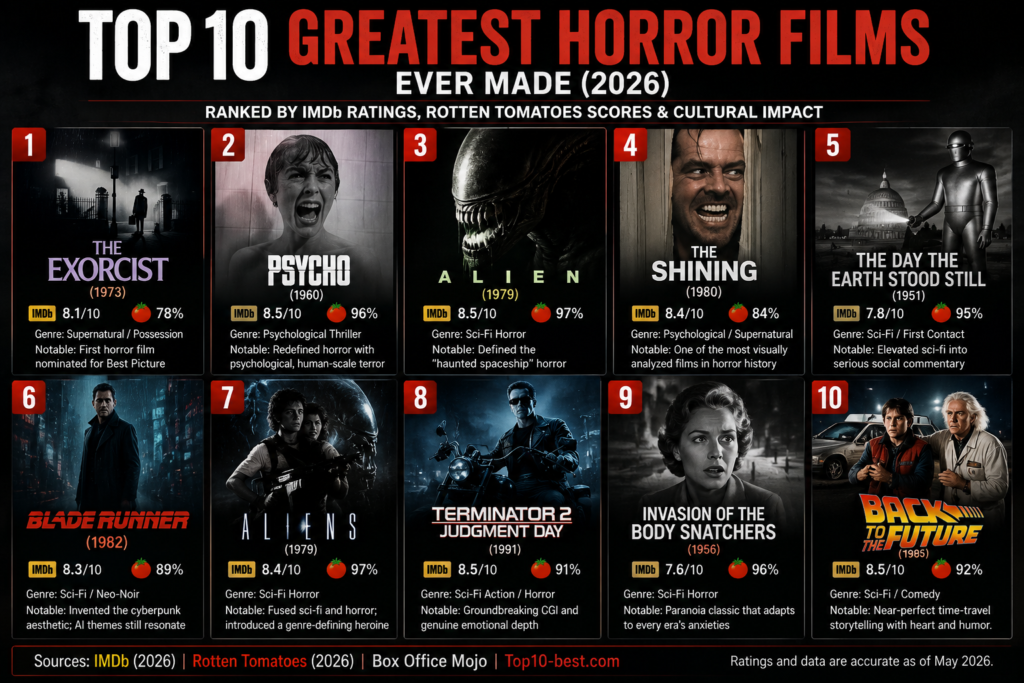
| Rank | Film | Year | IMDb Rating (approx.) | RT Score | Genre |
| 1 | The Exorcist | 1973 | 8.1 | 78% | Supernatural/Possession |
| 2 | Psycho | 1960 | 8.5 | 96% | Psychological thriller |
| 3 | Alien | 1979 | 8.5 | 97% | Sci-fi horror |
| 4 | The Shining | 1980 | 8.4 | 84% | Psychological/Supernatural |
| 5 | Hereditary | 2018 | 7.3 | 90% | Supernatural/Family horror |
| 6 | Get Out | 2017 | 7.8 | 98% | Social thriller/horror |
| 7 | The Silence of the Lambs | 1991 | 8.6 | 95% | Psychological thriller |
| 8 | Halloween | 1978 | 7.7 | 96% | Slasher |
| 9 | Rosemary’s Baby | 1968 | 8.0 | 96% | Psychological/Supernatural |
| 10 | Night of the Living Dead | 1968 | 7.8 | 96% | Zombie/Apocalyptic horror |
Sources: IMDb, Rotten Tomatoes, MovieWeb’s IMDb-based horror rankings (2026), Rotten Tomatoes’ scariest horror movies feature. Ratings fluctuate slightly as new votes and reviews are added; figures reflect the most recently available 2026 data.
Step-by-Step: How to Judge a “Greatest Horror Film” Ranking
- Check whether the ranking uses critic scores, audience ratings, or both. IMDb reflects broad audience consensus over time; Rotten Tomatoes’ Tomatometer reflects professional critic reviews — the two frequently disagree.
- Weigh cultural and genre influence, not just the numerical score. Films like Night of the Living Dead and Halloween shaped entire subgenres, which matters beyond their specific rating.
- Consider vote count alongside the rating itself. A high score from a small number of votes carries less weight than a strong score backed by hundreds of thousands of ratings, as with Get Out’s 731,000+ IMDb votes.
- Account for the era a film was made in. Comparing 1920s silent horror directly against 2018’s elevated horror requires judging each film against the standards and technology of its own time.
- Look at box office performance relative to budget, not just raw numbers. Halloween’s $300,000 budget against a $70 million gross tells a different story than simple box office totals alone.
- Recognize that “greatest” and “scariest” are different questions. Rotten Tomatoes’ own “scariest” rankings (led by The Exorcist and Hereditary) don’t always match critical “greatest” rankings — both are valid, different lenses.
Pros and Cons Table
| Film | Pros | Cons |
| The Exorcist | Genre-defining, historic Oscar recognition | Pacing and effects feel dated to some modern viewers |
| Psycho | Reshaped the entire genre’s approach to fear | Twist is now widely known, softening its original shock |
| Alien | Masterful tension, iconic heroine | Slower pace than its more action-driven sequel |
| The Shining | Visually and thematically endlessly analyzed | Diverges significantly from its source novel, which some fans dislike |
| Hereditary | Genuinely original, emotionally devastating | Slow-burn pacing isn’t for viewers wanting immediate scares |
| Get Out | Sharp social commentary, broad critical acclaim | Some viewers find the horror secondary to its social themes |
| The Silence of the Lambs | Unmatched awards pedigree for the genre | More thriller than pure horror for some genre purists |
| Halloween | Defined an entire subgenre, extraordinary ROI | Countless sequels have diluted the original’s impact over time |
| Rosemary’s Baby | Sustained dread, genuinely unsettling themes | Slow pacing by modern horror standards |
| Night of the Living Dead | Massive reach, genuine social commentary | Low-budget production values show its age |
Comparison Table: Best Horror Film by Subgenre
| Subgenre | Best Pick | Runner-Up | Why |
| Possession/Supernatural | The Exorcist | Rosemary’s Baby | Defined the possession subgenre for every film since |
| Psychological horror | Psycho | The Shining | Reshaped horror around human-scale, psychological terror |
| Sci-fi horror | Alien | — | Unmatched fusion of science fiction and pure horror tension |
| Slasher | Halloween | — | Created the template dozens of slasher franchises still follow |
| Zombie/Apocalyptic | Night of the Living Dead | — | Defined the modern conception of the zombie genre |
| Social commentary horror | Get Out | Hereditary | Academy Award-winning script paired with genre scares |
| Elevated/Prestige horror | Hereditary | Get Out | Helped launch the modern A24-style elevated horror wave |
| Awards-recognized horror | The Silence of the Lambs | The Exorcist | Only horror-adjacent Best Picture winner in Oscar history |
2026 News and Trends
The clearest 2026 story in horror is the genre’s extraordinary financial efficiency. The ultra-low-budget film Obsession reportedly grossed over $400 million worldwide against a production budget of roughly $750,000 — one of the most extreme profit ratios in modern film history — while Iron Lung reportedly returned seventeen times its $3 million budget with no traditional distributor at all.
Creator-driven horror has become a genuine 2026 trend, with several of the year’s most talked-about releases directed by filmmakers who built their audience on video platforms before moving into features — a meaningfully different pipeline into the industry than horror has traditionally relied on.
Major franchise revivals continued strongly through 2026, including 28 Years Later: The Bone Temple (Nia DaCosta, from a script by Alex Garland) and Scream 7, alongside ambitious swings like Maggie Gyllenhaal’s The Bride! and Sam Raimi’s return to the genre with Send Help after a 17-year absence — reflecting a genre that continues to attract major filmmaking talent even at the highest budget tiers.
Independent horror’s box office strength in 2026 has drawn particular industry attention: multiple outlets have noted that horror is consistently delivering studio-scale financial returns on a fraction of the budget required by other genres, reinforcing why studios continue investing heavily in the space even as overall theatrical output has become more selective industry-wide.
Conclusion
The Top 10 Greatest Horror Films span six decades and nearly every subgenre the medium has produced, from The Exorcist’s genre-defining possession horror to Get Out and Hereditary’s modern elevated-horror wave. What unites them isn’t just a strong rating on any single platform — it’s a lasting influence on how the genre continues to evolve, something 2026’s creator-driven, financially efficient horror boom shows is very much still happening.
Explore more verified, data-driven rankings across film, travel, and lifestyle categories at top10-best.com.
References
- MovieWeb – The 21 Highest-Rated Horror Movies, According to IMDb: https://movieweb.com/highest-rated-horror-movies-imdb/
- Rotten Tomatoes – The 10 Scariest Horror Movies Ever: https://editorial.rottentomatoes.com/article/the-10-scariest-horror-movies-ever
- Complex – 31 Best Horror Movies of All Time, Ranked (2026): https://www.complex.com/pop-culture/a/jamieiovine/31-best-horror-movies-of-all-time-ranked
- Time Out – The 100 Best Horror Movies of All Time (Updated for 2026): https://timeout.com/london/film/best-horror-films-list
- ScreenDollars – The Best Horror Movies of 2026 (So Far) and Where to Watch Them: https://screendollars.com/blog/lists/best-horror-movies-2026-so-far/
- Collider – Every 2026 Horror Movie, Ranked Worst to Best: https://collider.com/every-2026-horror-movie-ranked/
- Ginger Nuts of Horror – Best Horror Films of 2026 (So Far): https://gnofhorror.com/best-horror-films-of-2026-so-far/
FAQs
Films like The Exorcist, Psycho, Alien, The Shining, and Halloween consistently top critical and audience rankings for their genre-defining influence, strong IMDb ratings, and lasting cultural impact, making them frequent inclusions on any credible all-time horror ranking.
Ratings shift slightly as new votes are added, but films like The Silence of the Lambs, Psycho, and Alien consistently rank among the highest-rated horror and horror-adjacent titles, each holding scores in the 8.4–8.6 range based on hundreds of thousands of user votes.
It’s frequently classified as a psychological thriller with strong horror elements, and it remains the only film of that description to win the Academy Award for Best Picture — a distinction that places it firmly near the top of most top 10 horror movies of all time IMDb discussions.
Genuinely great horror films typically combine strong critical reception, lasting genre influence (spawning imitators or defining a subgenre), and continued cultural relevance decades after release — not just a high opening-weekend box office or a strong initial audience reaction.
IMDb reflects cumulative audience voting over time, while Rotten Tomatoes’ Tomatometer reflects the percentage of professional critics who reviewed a film positively — two genuinely different methodologies that can produce different results for the same film.
2026 has been a notably strong year for horror, headlined by the ultra-profitable indie hit Obsession, major franchise entries like 28 Years Later: The Bone Temple and Scream 7, and high-profile auteur projects including Maggie Gyllenhaal’s The Bride! and Sam Raimi’s Send Help.
top10-best.com publishes data-driven Top 10 rankings across film, travel, food, technology, and more — each built using the same verified-data-first methodology applied throughout this guide to the Top 10 Greatest Horror Films.


GIPHY App Key not set. Please check settings