 kiruthika
Buying a car is easy. Buying a car you won’t regret owning five years later is much harder.
A big touchscreen or a punchy engine can sell a car on the lot. Reliability is what determines how often you’re at the shop, how much you spend on repairs, and whether the car still feels like a smart buy at 100,000 miles.
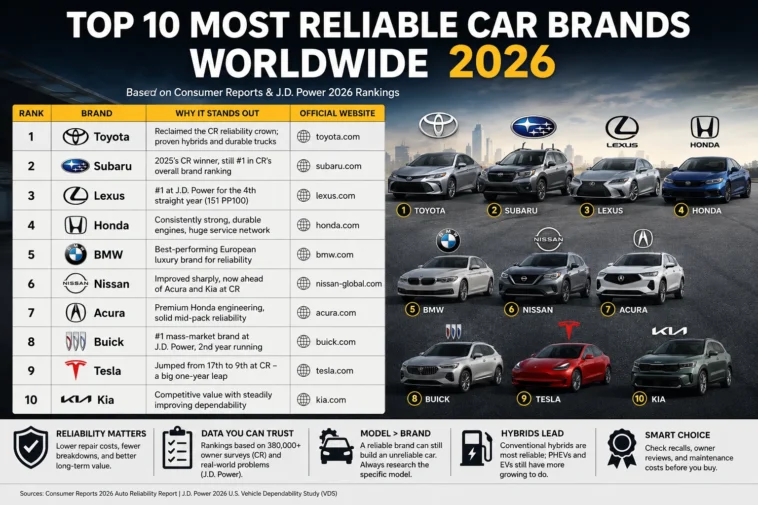
For 2026, Toyota reclaimed the top spot in Consumer Reports’ predicted-reliability rankings after Subaru held it in 2025, with Lexus close behind in third. Meanwhile, Lexus topped J.D. Power’s 2026 Vehicle Dependability Study for the fourth year running, with Buick as the top mass-market brand for the second year in a row. Two different studies, two slightly different winners — which is exactly why there’s no single global reliability ranking. Consumer Reports measures predicted reliability using owner survey data across 380,000 vehicles; J.D. Power measures actual problems reported by owners of three-year-old vehicles. This list blends both, plus real-world ownership factors, into one practical ranking.
What Makes a Brand Reliable in 2026?
A dependable car needs a proven engine and transmission, fewer mechanical and electrical issues, reasonable repair costs, strong parts availability, and a track record of durable models. That’s gotten harder to guarantee as vehicles get more complex — driver-assistance systems, big infotainment screens, hybrid and battery tech all add potential failure points. Notably, J.D. Power found industry-wide dependability actually declined in 2026, with the average vehicle now showing 204 problems per 100 vehicles (PP100), up from 202 the year before — the worst since the study’s 2022 redesign. Infotainment glitches and software updates were the biggest culprits.
Top 10 Most Reliable Car Brands in 2026
| Rank | Brand | Why It Stands Out |
| 1 | Toyota | Reclaimed the CR reliability crown; proven hybrids and durable trucks |
| 2 | Subaru | 2025’s CR winner, still #1 in CR’s overall brand ranking |
| 3 | Lexus | #1 at J.D. Power for the 4th straight year (151 PP100) |
| 4 | Honda | Consistently strong, durable engines, huge service network |
| 5 | BMW | Best-performing European luxury brand for reliability |
| 6 | Nissan | Improved sharply, now ahead of Acura and Kia at CR |
| 7 | Acura | Premium Honda engineering, solid mid-pack reliability |
| 8 | Buick | #1 mass-market brand at J.D. Power, 2nd year running |
| 9 | Tesla | Jumped from 17th to 9th at CR — a big one-year leap |
| 10 | Kia | Competitive value with steadily improving dependability |
Editorial ranking, not a single official source. Reliability varies by model, engine, and model year.
Toyota — Back on Top
Toyota reclaimed the #1 spot at Consumer Reports with a score of 66, edging past Subaru (63) and Lexus (60). The comeback came down to real fixes: the redesigned Camry moved from average to above-average predicted reliability, the Tacoma’s once-shaky 2024 redesign smoothed out, and even the long-troubled Tundra V6 climbed into average territory. Six Toyota models landed among CR’s ten most reliable cars this year. Best for: long-term owners and hybrid buyers who want proven engineering over flash.
Subaru — Consistency Without the Hype
Subaru dropped to second in predicted reliability but still holds the overall #1 spot in CR’s broader brand ranking, which factors in owner satisfaction, safety, and repair costs alongside reliability. The Forester’s hybrid scored above average, though the gas version came in only average, pulling the brand down slightly. Subaru still leans on shared, proven components and standard all-wheel drive across most of its lineup. Best for: families and drivers who deal with rough weather or roads.
Lexus — The Dependability Champion
Third at Consumer Reports, but first overall at J.D. Power for a fourth consecutive year, with just 151 problems per 100 vehicles — comfortably ahead of Cadillac (175) and Porsche (182). The Lexus IS took J.D. Power’s Most Dependable Model award outright, and Lexus grabbed three of Toyota Motor Corporation’s eight total model-level awards (IS, UX, and GX). Not every Lexus is bulletproof, though — CR has flagged the GX’s reliability slipping to average in recent data. Best for: buyers who want a luxury badge without a luxury-sized repair bill.
Honda — Everyday Dependability
Honda held steady at fourth in CR’s rankings behind Toyota, Subaru, and Lexus. Its real strength is scale: a massive global service network and deep parts availability make ownership painless almost anywhere. The Civic and Accord remain the backbone of that reputation. Best for: first-time buyers and daily commuters who want low-drama ownership.
BMW — Reliability Beats the Stereotype
BMW landed fifth at CR with a score of 58, and CR specifically called it the benchmark among luxury brands. That doesn’t erase the reality that luxury repair costs still run higher than a Camry or Civic — but the old “German luxury equals constant repairs” stereotype doesn’t hold up as well as it used to. Best for: drivers who want performance without a major dependability trade-off.
Nissan, Acura, Buick, Tesla, and Kia
The back half of the top 10 has some real surprises. Nissan jumped ahead of Acura and Kia in CR’s rankings this year, a notable improvement for a brand not usually associated with reliability talk. Acura still offers Honda’s engineering DNA with a premium edge, landing in the seventh spot. Buick quietly took the #1 mass-market crown at J.D. Power for the second year straight, at 160 PP100 — proof that reliability data and brand buzz don’t always move together. Tesla posted the single biggest jump of the year at CR, leaping from 17th to 9th place, a meaningful signal that EV reliability is maturing. And Kia rounds out the list with steadily improving dependability and some of the strongest value-for-money in the segment.
The Real Lesson: Buy the Model, Not Just the Badge
A reliable brand can still build an unreliable car. Toyota’s overall score is excellent, but individual models still swing widely based on engine, transmission, and model generation — the Tundra and Tacoma both needed several years to shake off early problems. Before buying any 2026 vehicle, check the exact model, engine, and transmission; recall history; owner complaints; expected maintenance costs; and how mature the platform actually is. That last point matters most for brand-new redesigns and EVs, which simply haven’t accumulated enough long-term data yet.
Hybrids vs. EVs: What the 2026 Data Shows
Conventional hybrids continue to be some of the most reliable vehicles on sale, which is a big reason Toyota’s lineup performs so well. Plug-in hybrids are a different story — J.D. Power found PHEVs at 281 PP100, the worst of any powertrain type and up 39 points year-over-year, while battery-electric vehicles rose to 237 PP100. Gas-only vehicles actually improved slightly, dropping to 198 PP100, the best of any powertrain category. The takeaway isn’t that electrification is inherently unreliable — it’s that newer, less-proven technology still carries more risk than a platform that’s been refined for years.
Final Verdict
There’s no single “most reliable brand” in 2026 — Toyota leads predicted reliability, Lexus leads real-world dependability, and Subaru leads overall satisfaction. What the data does make clear is that Asian manufacturers still dominate most reliability rankings, though Buick and Tesla’s strong showings prove that reputation and data don’t always line up. Before you buy, look past the badge and check the specific model’s actual track record — that’s the step that saves the most money in the long run.
FAQs
Toyota ranks first in Consumer Reports’ 2026 predicted-reliability rankings, while Lexus ranks first in J.D. Power’s 2026 Vehicle Dependability Study.
Both are highly reliable, but they lead different studies. Toyota ranks first for predicted reliability, while Lexus leads J.D. Power’s real-world dependability study.
Yes. Conventional hybrids continue to perform strongly in reliability studies, particularly models using mature hybrid technology. However, newer plug-in hybrids can have more reported problems.
BMW ranks fifth in Consumer Reports’ 2026 predicted-reliability rankings and is the highest-ranked European luxury brand, although maintenance and repair costs can still be higher than mainstream brands.
No. Reliability can vary significantly between models, engines, transmissions, and model years. Always check the specific vehicle’s reliability history, recalls, owner complaints, and maintenance costs before buying.


GIPHY App Key not set. Please check settings