 kiruthika
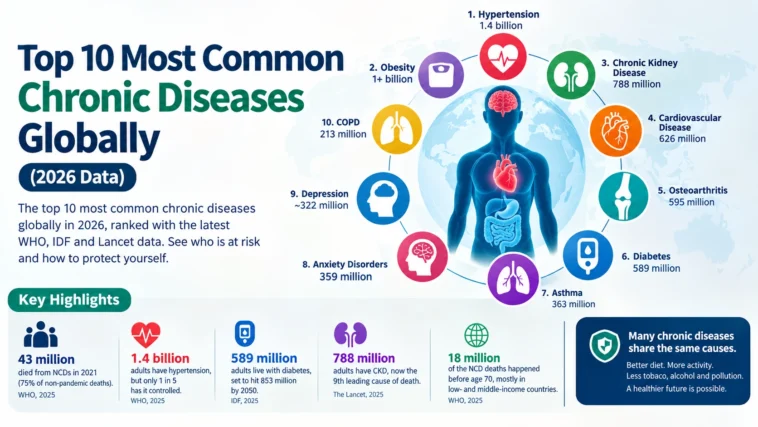
Here’s a number that stops most people: 1.4 billion adults live with high blood pressure, and most of them don’t have it under control. That is just the first entry on our list of the top 10 most common chronic diseases globally.
Chronic diseases are slow, long-lasting and often silent. The good news? Many of them share the same few causes, so one set of habits can lower your risk for several at once.
Most common chronic diseases worldwide, ranked by people living with each condition (WHO, IDF, Lancet/GBD data).
Key Highlights
- Noncommunicable diseases (NCDs) killed at least 43 million people in 2021, about 75% of non-pandemic deaths (WHO, 2025).
- 18 million of those deaths happened before age 70, and 82% of them in low- and middle-income countries (WHO, 2025).
- Hypertension affects 1.4 billion adults, but only about 1 in 5 has it controlled (WHO Global Hypertension Report, 2025).
- 589 million adults live with diabetes, set to hit 853 million by 2050 (IDF Diabetes Atlas, 2025).
- Chronic kidney disease now affects 788 million adults and is the 9th leading cause of death (The Lancet, 2025).
- Heart disease and stroke killed 19.8 million people in 2022, about 32% of all deaths (WHO, 2025).
- In December 2025, the UN adopted its first declaration covering NCDs and mental health together.
What Counts as a Chronic Disease?
WHO describes chronic diseases (also called NCDs) as conditions that last a long time, progress slowly and don’t spread from person to person. They come from a mix of genes, body chemistry, environment and daily habits.
The “big four” are heart disease, cancer, chronic lung disease and diabetes. But mental health conditions, joint disease and kidney disease are just as widespread.
How We Ranked the Most Common Chronic Diseases Globally
We ranked each condition by how many people are living with it, using the newest official estimate available. Most figures come from WHO fact sheets updated in 2025–2026, the IDF Diabetes Atlas, and Global Burden of Disease (GBD) studies in The Lancet and JACC.
One honest caveat: these studies measure different years (2020 to 2024). So treat close rankings, like asthma vs anxiety, as roughly tied.
The Top 10 Most Common Chronic Diseases Globally
1. Hypertension (High Blood Pressure) – 1.4 billion people
According to the WHO Global Hypertension Report 2025, 1.4 billion adults had hypertension in 2024. Only just over one in five had it under control.
It’s called a silent killer for a reason. You usually feel nothing until a heart attack, stroke or kidney problem shows up.
2. Obesity – over 1 billion people
WHO (December 2025) counts 890 million adults and 160 million children and teens living with obesity. That’s 1 in 8 people on Earth.
WHO now classes obesity as a chronic, relapsing disease, not a willpower issue. Adult obesity has more than doubled since 1990.
3. Chronic Kidney Disease (CKD) – 788 million people
A major GBD study in The Lancet (November 2025) found 788 million adults had CKD in 2023, up from 378 million in 1990. That’s about 1 in 7 adults.
CKD caused 1.48 million deaths in 2023. Most people don’t know they have it, because early stages have no symptoms.
4. Cardiovascular Disease (Heart Disease & Stroke) – 626 million people
The GBD 2023 study in JACC (2025) estimated 626 million people living with cardiovascular disease, double the 1990 figure.
It is also the world’s No. 1 killer. WHO says 19.8 million people died from it in 2022, and 85% of those deaths were heart attacks and strokes.
Which chronic diseases kill the most people each year? Heart disease and stroke lead by a wide margin (WHO, IDF, Lancet).
5. Osteoarthritis – 595 million people
The GBD study in The Lancet Rheumatology found 595 million people had osteoarthritis in 2020, or 7.6% of the world’s population.
The knee is the most common site. Cases of knee osteoarthritis are projected to rise about 75% by 2050 as people live longer and carry more weight.
6. Diabetes – 589 million adults
The IDF Diabetes Atlas (11th edition, 2025) reports 589 million adults aged 20–79 with diabetes. That’s 1 in 9 adults.
Here’s the scary part: over 250 million of them don’t know they have it. Diabetes causes over 3.4 million deaths each year.
7. Asthma – 363 million people
WHO says asthma affected about 363 million people in 2023 and caused 442,000 deaths. It’s the most common chronic disease in children.
Most asthma deaths happen in low- and lower-middle-income countries. Proper inhalers could prevent many of them.
8. Anxiety Disorders – 359 million people
According to WHO, 359 million people had an anxiety disorder in 2021, making it the most common mental disorder in the world.
Only about 1 in 4 people with anxiety get any treatment, even though therapy works well.
The treatment gap: most people with chronic conditions never get proper control or care (WHO 2025–2026).
9. Depression – about 322 million people
WHO’s September 2026 fact sheet estimates 322 million people live with depression. About 5.2% of adults are affected, and women are roughly 1.5 times more likely to have it than men.
Even in high-income countries, only about one third of people with depression get treatment.
10. COPD (Chronic Obstructive Pulmonary Disease) – 213 million people
A GBD 2021 analysis estimated 213 million people living with COPD. WHO ranks it the 4th leading cause of death, with 3.5 million deaths in 2021.
Smoking and air pollution, including smoke from cooking fuels, are the main causes.
Honourable mention: Cancer
Cancer didn’t make the “most common” cut by our method, but it is the second-deadliest chronic disease. WHO’s July 2026 fact sheet reports nearly 10 million cancer deaths in 2024. Lung, breast, colorectal and prostate are the most common types.
Important Statistics Table
| Rank | Chronic disease | People affected | Year of data | Source |
| 1 | Hypertension | 1.4 billion adults | 2024 | WHO (2025) |
| 2 | Obesity | 890M adults + 160M youth | 2022 | WHO (2025) |
| 3 | Chronic kidney disease | 788 million adults | 2023 | The Lancet (2025) |
| 4 | Cardiovascular disease | 626 million | 2023 | JACC / GBD (2025) |
| 5 | Osteoarthritis | 595 million | 2020 | Lancet Rheumatology (2023) |
| 6 | Diabetes | 589 million adults | 2024 | IDF (2025) |
| 7 | Asthma | 363 million | 2023 | WHO (2026) |
| 8 | Anxiety disorders | 359 million | 2021 | WHO (2026) |
| 9 | Depression | ~322 million | 2023 | WHO (2026) |
| 10 | COPD | 213 million | 2021 | GBD 2021 |
Comparison: Common vs Deadly
Being common and being deadly aren’t the same thing. This table shows the difference.
| Disease | People affected | Deaths per year | Biggest problem |
| Heart disease & stroke | 626M | 19.8M (2022) | Late detection |
| Cancer | — | ~10M (2024) | Late diagnosis |
| COPD | 213M | 3.5M (2021) | Smoking, dirty air |
| Diabetes | 589M | 3.4M+ | 250M+ undiagnosed |
| CKD | 788M | 1.48M (2023) | No early symptoms |
| Asthma | 363M | 442K (2023) | Poor inhaler access |
| Osteoarthritis | 595M | Rarely fatal | Pain and disability |
Pros and Cons of Today’s Main Treatments
| Approach | Pros | Cons |
| Lifestyle change (diet, activity, no tobacco) | Cheap, helps many diseases at once | Hard to stick with; needs supportive surroundings |
| Generic medicines (BP pills, statins, inhalers) | Affordable, proven, widely studied | Often unavailable in low-income countries |
| GLP-1 medicines for obesity and diabetes | Strong weight and sugar results; WHO guideline (2025) | Costly in many markets; long-term use needed |
| Screening and early testing | Catches silent diseases like CKD and diabetes | Many people never get checked |
| Talk therapy for anxiety and depression | Effective first-line care | Trained staff in short supply |
Step-by-Step: How to Lower Your Risk
WHO links most chronic disease deaths to the same handful of risk factors. Here’s a simple plan.
- Check your numbers. Get blood pressure, blood sugar and cholesterol tested at least once a year after 30.
- Ask for a kidney test if you have diabetes or high blood pressure. A simple urine test can catch CKD early.
- Quit tobacco. It’s the single biggest move for your heart, lungs and cancer risk.
- Eat less salt, sugar and processed fat. Add more vegetables, fruit, beans and whole grains.
- Move every day. Even a brisk 30-minute walk counts.
- Limit alcohol and protect your sleep.
- Talk to someone if low mood or worry lasts more than two weeks.
Five shared risk factors drive most chronic diseases globally: tobacco, poor diet, inactivity, alcohol and air pollution.
2026 News and Trends in Chronic Disease
- A historic UN declaration. On 15 December 2025, the UN General Assembly adopted its first political declaration covering NCDs and mental health together, by 175 votes to 2. It sets 2030 targets: 150 million fewer tobacco users, 150 million more people with blood pressure controlled, and 150 million more with access to mental health care.
- Dementia joins the NCD agenda. For the first time, the UN text names Alzheimer’s and dementia as part of the NCD response.
- WHO backs GLP-1 drugs. In December 2025, WHO issued its first global guideline on GLP-1 medicines for treating adult obesity.
- Fresh 2026 data. WHO updated its cancer (July 2026), depression (September 2026) and anxiety (September 2026) fact sheets. A Global Status Report on Cancer 2026 is also in progress.
- Kidney disease moves up. CKD is now the 9th leading cause of death, and experts are pushing for routine urine testing.
The trend is clear. Governments are finally treating chronic disease as one connected problem, not ten separate ones.
Conclusion
The top 10 most common chronic diseases globally affect billions of people, but they’re not random. Most share the same causes: blood pressure, weight, blood sugar, tobacco and inactivity.
Get your numbers checked this year. It’s the simplest step, and it could catch a silent disease before it catches you.
Medical disclaimer: This article is for general information only and is not a substitute for advice from a qualified doctor.
References
- World Health Organization – Noncommunicable diseases fact sheet (2025): https://www.who.int/news-room/fact-sheets/detail/noncommunicable-diseases
- World Health Organization – Uncontrolled high blood pressure puts over a billion people at risk (2025): https://www.who.int/news/item/23-09-2025-uncontrolled-high-blood-pressure-puts-over-a-billion-people-at-risk
- World Health Organization – Global report on hypertension 2025: https://www.who.int/publications/i/item/9789240115569
- World Health Organization – Obesity and overweight fact sheet (2025): https://www.who.int/news-room/fact-sheets/detail/obesity-and-overweight
- World Health Organization – Cardiovascular diseases fact sheet (2025): https://www.who.int/news-room/fact-sheets/detail/cardiovascular-diseases-(cvds)
- World Health Organization – Cancer fact sheet (2026): https://www.who.int/news-room/fact-sheets/detail/cancer
- World Health Organization – Depressive disorder fact sheet (2026): https://www.who.int/news-room/fact-sheets/detail/depression
- World Health Organization – Anxiety disorders fact sheet (2026): https://www.who.int/news-room/fact-sheets/detail/anxiety-disorders
- World Health Organization – Asthma fact sheet: https://www.who.int/news-room/fact-sheets/detail/asthma
- World Health Organization – COPD fact sheet: https://www.who.int/news-room/fact-sheets/detail/chronic-obstructive-pulmonary-disease-(COPD)
- International Diabetes Federation – IDF Diabetes Atlas, 11th edition (2025): https://diabetesatlas.org/
- University of Glasgow / The Lancet – Chronic kidney disease now affects more than 780 million people (2025): https://www.gla.ac.uk/news/headline_1223348_en.html
- JACC / GBD 2023 – Global burden of cardiovascular diseases 1990–2023 (PubMed, 2025): https://pubmed.ncbi.nlm.nih.gov/40990886/
- IHME – Global burden of osteoarthritis 1990–2020 and projections to 2050: https://healthdata.org/research-analysis/library/global-regional-and-national-burden-osteoarthritis-1990-2020-and
- GBD 2021 COPD analysis, Respiratory Research (PMC, 2025): https://pmc.ncbi.nlm.nih.gov/articles/PMC11697803/
- United Nations Digital Library – Political Declaration on NCDs and mental health, A/RES/80/117 (2025): https://digitallibrary.un.org/record/4097012
- World Health Organization – Global guideline on GLP-1 medicines for obesity (2025): https://www.who.int/news/item/01-12-2025-who-issues-global-guideline-on-the-use-of-glp-1-medicines-in-treating-obesity
FAQs
High blood pressure (hypertension) is the most common. WHO estimates 1.4 billion adults had it in 2024, and only about one in five had it under control.
Cardiovascular disease. WHO reports 19.8 million deaths in 2022, around 32% of all deaths worldwide. Cancer comes second with nearly 10 million deaths in 2024.
According to WHO (2025), noncommunicable diseases killed at least 43 million people in 2021. That’s about 75% of all non-pandemic deaths worldwide.
Many can be. WHO says tobacco, unhealthy diet, inactivity, harmful alcohol use and air pollution drive most NCD deaths. WHO also estimates about 38% of cancers are preventable.
Yes. WHO classifies obesity as a chronic, relapsing disease. In 2022, 890 million adults and 160 million children and teens were living with obesity.
CKD is closely tied to diabetes, high blood pressure and high body weight, which are all rising. It has no early symptoms, so most people find out late.
They are now treated that way. The December 2025 UN declaration groups mental health with NCDs, and anxiety and depression together affect hundreds of millions of people.


GIPHY App Key not set. Please check settings