 kiruthika
There’s a specific kind of article you’ve probably scrolled past a dozen times: “Top AI Model of 2026,” with a single winner crowned based on one benchmark score, as if intelligence were a 100-meter dash. It isn’t. A model can write flawless code and still stumble on a video-editing task. Another can chew through a thousand-page report without breaking a sweat, then cost you a small fortune doing it.
So instead of picking a winner, here’s a working map of the ten most powerful AI models actually shaping this year, what each one is genuinely good at, where it falls short, and who should bother caring. If you’ve been hunting for a real, honest AI model comparison instead of a marketing page dressed up as a ranking, this is built to be that.
What “powerful” even means right now
A year or two ago, “powerful” mostly meant “gives good answers.” That bar has moved. The models below get judged on a wider set of things: how they handle multi-step reasoning, how well they write and debug real software, whether they can operate a computer or browse the web on your behalf, how much text or video they can process at once, and, increasingly, whether they can coordinate other AI agents to get something genuinely large done without a human babysitting every step.
That last one matters more than people realize. The shift from “tell me how to do this” to “just do it and show me what changed” is the actual story of 2026, more than any single benchmark leap.
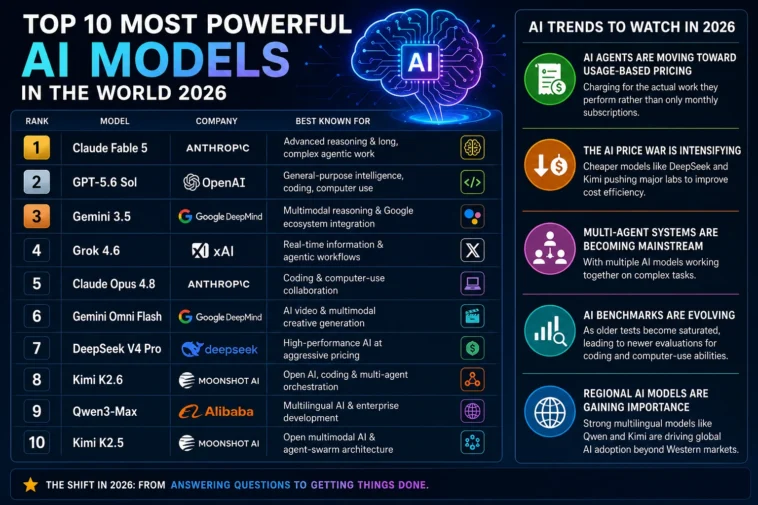
1. Claude Fable 5 (Anthropic)
Anthropic’s top model, launched mid-2026, and the one that currently sets the pace for anything involving genuinely long, complicated work, reading through a messy unfamiliar codebase, hunting down a bug, patching it across several files, and testing the result without needing hand-holding at every step. What’s notable isn’t that it’s smart in a vacuum; it’s that its edge over rivals actually widens as a task gets longer and messier, which is the opposite of how a lot of models behave. Best suited to software engineering, research synthesis, and the kind of open-ended professional work that doesn’t fit neatly into a single prompt.
2. GPT-5.6 Sol (OpenAI)
OpenAI’s flagship, and probably the single most versatile model on this list. It’s built for the full spread of knowledge work, coding, security research, science, browsing, even operating a computer directly, and its top-tier “ultra” setting can split a big job across multiple parallel agents working at once. What’s made GPT-5.6 genuinely interesting isn’t raw scale, though; OpenAI has spent real effort squeezing more useful output from every token instead of just building bigger. That’s the difference between a model that’s technically brilliant and one you can actually afford to run all day.
3. Gemini 3.5 (Google DeepMind)
Google unveiled the Gemini 3.5 line at I/O 2026 with a specific pitch: intelligence that acts, not just answers. That’s a real shift in framing, and it shows in how the model’s built, strong multimodal reasoning across text, images, and math, wired directly into Search, Workspace, Android, and Cloud. If your daily work already lives inside Google’s ecosystem, Gemini’s advantage isn’t really about beating rivals on a leaderboard; it’s that it’s already sitting inside the tools you open every morning.
4. Grok 4.6 (xAI)
Grok’s evolution has been fast, from a social-platform novelty into a genuine frontier contender. The August 2026 release jumped meaningfully on Artificial Analysis’s Intelligence Index, landing it in the same competitive tier as the models above it. Its real differentiator is access to X’s live information stream, which matters a lot if your work involves tracking fast-moving events or public conversation in real time. It’s also pricing itself aggressively, which is worth knowing if budget is a real constraint rather than an afterthought.
5. Claude Opus 4.8 (Anthropic)
Fable 5 sits above it now, but Opus 4.8 is still a genuinely strong developer-focused model, introduced with real improvements to judgment and reliability over its predecessor, particularly on multi-step coding and computer-use tasks. Anthropic’s whole Opus lineage has leaned into being a collaborator that reasons about a project rather than just spitting out isolated code snippets, and 4.8 continues that pattern.
6. Gemini Omni Flash (Google DeepMind)
Not every serious model is chasing text reasoning. Omni Flash, introduced in May 2026, is built around a different question entirely: can an AI understand mixed input, text, image, audio, video — and make something back? You can hand it a video, describe a change in plain language, and iterate through conversation rather than a traditional editing timeline. That’s a meaningfully different relationship with a tool than typing into a chat box, and Google’s own testing shows it performing strongly across video editing and text-to-video work specifically.
7. DeepSeek V4 Pro (DeepSeek)
DeepSeek’s whole identity is built around a genuinely disruptive question: does frontier AI actually need to cost what the big labs charge? The V4 family launched with a million-token context window, and the August-released V4 Pro variant scored meaningfully higher than its lighter sibling on independent benchmarking. Its real significance isn’t the raw number, though — it’s the pressure a genuinely competitive, much cheaper model puts on everyone else’s pricing.
8. Kimi K2.6 (Moonshot AI)
Chinese AI labs have moved from “interesting alternative” to “genuine frontier competitor” fast, and Moonshot’s Kimi line is a clear example. K2.6 is currently their most capable model, native multimodal support, real coding and agent capability, a 256K context window. Its predecessor, K2.5, got real attention for something more architecturally interesting: an “agent swarm” that could coordinate up to 100 sub-agents and well over a thousand tool calls on a single complex task, cutting execution time dramatically versus one model working alone. That’s a genuinely different bet on how AI should scale,l not one model thinking harder, but many smaller ones dividing the work.
9. Qwen3-Max (Alibaba)
Worth knowing about specifically because it breaks the usual OpenAI-Google-Anthropic framing entirely. Alibaba’s largest model handles reasoning, coding, and instruction-following solidly, but its real strength is multilingual capability, genuinely important given that AI adoption is accelerating hardest right now in markets where English isn’t the default language. If you’re building for a global, non-English-first audience, Qwen deserves a serious look that a lot of “top AI model” lists skip entirely.
10. Kimi K2.5 (Moonshot AI)
Still worth including even with K2.6 now ahead of it, mostly because of that agent-swarm architecture mentioned above, trained on roughly 15 trillion mixed visual and text tokens, built as genuinely multimodal from the ground up rather than bolting vision on as an afterthought. As AI systems keep drifting from “chatbot” toward “autonomous digital worker,” the multi-agent approach K2.5 pioneered looks less like a curiosity and more like a preview of where things are heading.
How they stack up, side by side
If you’re comparing the best AI models 2026 has to offer and just want the quick version before deciding where to click next:
| Rank | Model | Company | Best Known For |
| 1 | Claude Fable 5 | Anthropic | Advanced reasoning & long, complex agentic work |
| 2 | GPT-5.6 Sol | OpenAI | General-purpose intelligence, coding, computer use |
| 3 | Gemini 3.5 | Google DeepMind | Multimodal reasoning & Google ecosystem integration |
| 4 | Grok 4.6 | xAI | Real-time information & agentic workflows |
| 5 | Claude Opus 4.8 | Anthropic | Coding & computer-use collaboration |
| 6 | Gemini Omni Flash | Google DeepMind | AI video & multimodal creative generation |
| 7 | DeepSeek V4 Pro | DeepSeek | High-performance AI at aggressive pricing |
| 8 | Kimi K2.6 | Moonshot AI | Open AI, coding & multi-agent orchestration |
| 9 | Qwen3-Max | Alibaba | Multilingual AI & enterprise development |
| 10 | Kimi K2.5 | Moonshot AI | Open multimodal AI & agent-swarm architecture |
So which one should you actually use?
Depends entirely on the job. For the strongest general reasoning, start with Claude Fable 5 or GPT-5.6 Sol. For coding specifically, those two remain the obvious picks, with Kimi and DeepSeek as genuinely capable, cheaper alternatives. If your life already runs on Google’s tools, Gemini’s integration advantage is hard to argue with. For actual video and creative work, Gemini Omni Flash is the one built for that job specifically, not a text model with image generation bolted on. And if cost is the real constraint, not a talking point, an actual constraint, DeepSeek and Kimi deserve serious evaluation before you default to the big three.
The bigger shift underneath all this
The interesting story in 2026 isn’t that models got smarter, though they did. It’s that they got more useful in a specific way, moving from answering questions to actually doing things, checking their own work, and telling you what changed. That’s a genuinely different relationship between a person and a tool than existed even two years ago.
FAQs
charging for the actual work they perform rather than only monthly subscriptions.
with cheaper models like DeepSeek and Kimi pushing major labs to improve cost efficiency.
with multiple AI models working together on complex tasks.
as older tests become saturated, leading to newer evaluations for coding and computer-use abilities.
especially models like Qwen and Kimi that offer strong multilingual and non-Western capabilities.


GIPHY App Key not set. Please check settings