 kiruthika
Hook Introduction
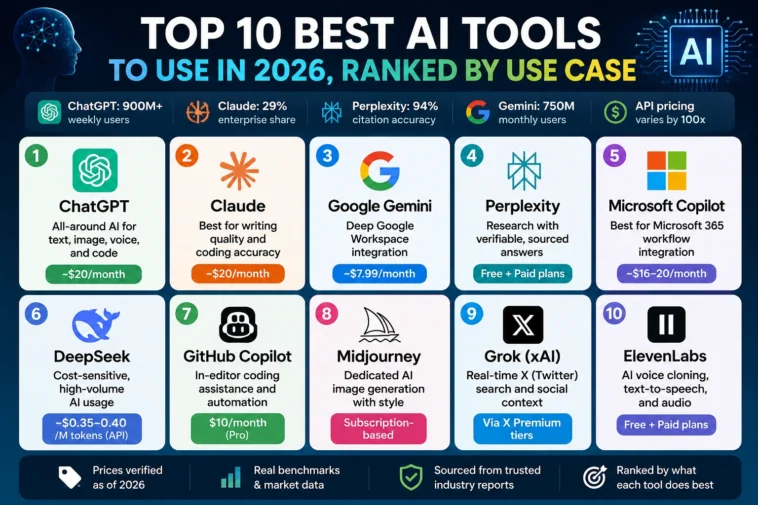
ChatGPT more than doubled its weekly user base in a single year, from 400 million to over 900 million — while a rival AI tool grew its enterprise market share nearly three times faster on a percentage basis over the same period.
We pulled verified 2026 pricing, benchmark, and market-share data across chatbots, coding assistants, research tools, and creative AI to rank the ten best AI tools actually worth using right now, based on what each one is genuinely best at rather than which has the loudest marketing. This guide to the top 10 best AI tools available today is built on verified, sourced data rather than a single vendor’s marketing claims.
Key Highlights (Quick Facts)
- ChatGPT surpassed 900 million weekly active users in 2026, according to OpenAI, more than doubling from roughly 400 million a year earlier, and holds an estimated 60.4% market share (a third-party tracking estimate, not an OpenAI-published figure) with over 50 million paid subscribers.
- Claude is growing its enterprise market share faster than any other major AI assistant, expanding at roughly 14% quarterly and now holding an estimated 29% of the enterprise AI segment, according to First Page Sage’s March 2026 market data.
- The AI assistant market overall was valued between $312 and $375 billion as of April 2026, according to Fortune Business Insights estimates — a market-sizing figure, distinct from any individual company’s user or revenue share within it.
- Perplexity has grown approximately 800% year-over-year (self-reported growth rate) and reports roughly 94% citation accuracy in its research-focused answers, positioning it as the leading dedicated AI research tool.
- Google Gemini reached 750 million monthly users and offers the lowest-priced paid entry point among major chatbots at roughly $7.99/month, alongside deep Google Workspace integration.
- API pricing varies by roughly 100x across major models — from budget options around $0.10 per million input tokens up to premium frontier models priced around $10.00 per million tokens, according to SurePrompts’ June 2026 pricing comparison.
- AI agent tools have moved from launch to genuine operational billing in 2026, with Microsoft Agent 365, Copilot Cowork, ChatGPT Work, and Claude Cowork all reaching general availability between May and July 2026, typically billed by usage on top of a base subscription.
- Free tiers across every major chatbot remain genuinely usable in 2026, though they typically route users to faster, lower-effort models rather than each provider’s flagship, which matters most for complex, multi-step tasks.
How This Ranking Was Built
This list combines verified 2026 pricing (checked directly against official provider pages), independent benchmark results (including SWE-bench and GPQA Diamond scores where publicly reported), and market-share data from trackers including First Page Sage and Fortune Business Insights. Rather than crowning one single “best” AI tool, we’ve ranked entries based on genuine category leadership — the tool that’s actually strongest for a specific kind of work, since no single assistant currently dominates every category simultaneously.
It’s worth noting upfront that benchmark scores across different providers aren’t always directly comparable, since testing methodologies differ and the industry is actively rebuilding standard benchmarks as older ones become saturated by newer, more capable models. We’ve flagged this where relevant rather than presenting every number as a precise, apples-to-apples comparison.
It’s also worth being direct about what “market share” means in this space, since it isn’t one consistent measurement. Figures like OpenAI’s estimated 60.4% share or Claude’s estimated 29% of the enterprise segment come from third-party trackers using different underlying methods — web traffic, self-reported user counts, enterprise adoption surveys, or revenue estimates — rather than a single audited industry-wide standard. We’ve cited each figure’s specific source and, where a company has published its own number directly (like OpenAI’s 900 million weekly active user figure), noted that distinction from third-party estimates explicitly.
The Top 10 Best AI Tools to Use in 2026
1. ChatGPT (OpenAI)
ChatGPT remains the most widely used AI assistant in the world by a wide margin, having surpassed 900 million weekly active users in 2026, according to OpenAI’s own published figures — more than double its roughly 400 million users just a year earlier. Third-party trackers estimate OpenAI holds roughly 60.4% overall market share with more than 50 million paid subscribers, reflecting its position as the default choice for the general public specifically.
Its breadth remains its core strength: ChatGPT Plus covers text, image generation, voice, and code within a single subscription, with no significant functional gaps that would push most users toward a second tool. The GPT-5.6 family (Sol, Terra, and Luna) became generally available July 9, 2026; per OpenAI’s own published system-card data, GPT-5.6 Sol scores 64.6% on SWE-Bench Pro, a figure independently confirmed across multiple 2026 benchmark trackers.
Pricing: Free tier available; ChatGPT Plus starts at approximately $20/month. Best for: Breadth — one tool covering text, images, voice, and code without switching apps. Market position: 900M+ weekly users (OpenAI-reported), ~60.4% market share (third-party estimate).
2. Claude (Anthropic)
Claude has built a genuine reputation specifically for writing quality, coding accuracy, and nuanced instruction-following, and it’s currently the fastest-growing major AI assistant by enterprise adoption, expanding its enterprise market share at approximately 14% quarterly according to First Page Sage’s March 2026 data — now holding an estimated 29% of that specific segment (a third-party market-tracking estimate).
At the frontier level, Anthropic released Claude Opus 5 on July 24, 2026, reporting 79.2% on SWE-bench Pro in its own published system card — a genuine 10-point improvement over the prior Opus 4.8 (69.2%), positioning it among the strongest available models specifically for repository-level coding work, though Anthropic’s own data shows its top-tier Fable 5 model still narrowly leads that same benchmark at 80.0%. Multiple 2026 marketing-content comparisons have also specifically credited Claude with the strongest writing quality among major models, though outlets note it can trail rivals on raw speed or very large context windows depending on the specific task.
Pricing: Free (Claude Haiku); Claude Pro ~$20/month (£16). Best for: Writing quality, coding accuracy, and nuanced long-document analysis. Market position: Fastest-growing enterprise share (~14% quarterly, per First Page Sage), ~29% enterprise segment share (third-party estimate).
3. Google Gemini
Google Gemini has reached 750 million monthly users and offers the most accessible paid entry point among the major chatbots, with plans starting around $7.99/month — a genuinely lower price floor than ChatGPT Plus or Claude Pro’s roughly $20/month tier.
Its core advantage lies in deep, native integration with Google Workspace (Docs, Sheets, Gmail) for users already embedded in that ecosystem, alongside strong price-to-performance value from the Gemini 2.5 Flash tier specifically, which SurePrompts’ June 2026 pricing analysis identifies as offering the best price-to-performance ratio of any mainstream model for typical everyday tasks.
Pricing: Free (Gemini 1.0 Pro); paid plans from ~$7.99/month. Best for: Google Workspace users; best price-to-performance ratio for everyday tasks. Market position: 750M monthly users.
4. Perplexity
Perplexity has established itself as the leading dedicated AI research tool, reporting approximately 94% citation accuracy in its answers and growing at roughly 800% year-over-year — a genuinely explosive growth rate relative to the broader, more mature chatbot market.
Unlike ChatGPT, Claude, or Gemini, Perplexity doesn’t train its own foundation models, instead pairing multiple third-party models (including Claude, GPT, and Mistral) with live web search to prioritize sourced, verifiable answers over raw conversational capability. Its Comet browser, offering free access across iOS, Android, Windows, and Mac, has become a significant part of its broader product strategy in 2026.
Pricing: Free tier available (GPT-4-class models); paid tiers for advanced research. Best for: Research specifically requiring verifiable, sourced answers. Market position: ~800% year-over-year growth.
5. Microsoft Copilot
Microsoft Copilot has carved out a clear, specific niche as the strongest AI tool for users embedded in Microsoft 365 — Word, Excel, PowerPoint, and Outlook — simplifying existing workflows without requiring users to leave the Microsoft ecosystem or learn an entirely separate tool.
Its free tier, available directly in Windows and Edge and powered by GPT-4o, requires no separate account, making it one of the more frictionless free AI options for casual users specifically. Copilot Cowork, its agentic offering, reached general availability worldwide on June 16, 2026, billed through Copilot Credits at one cent each on a pay-as-you-go basis.
Pricing: Free (Windows/Edge integration); Microsoft 365 Copilot ~$16-20/month. Best for: Users whose work already lives inside Word, Excel, PowerPoint, and Outlook. Notable 2026 development: Copilot Cowork agentic tier (GA June 16, 2026).
6. DeepSeek
DeepSeek has positioned itself as the clear price leader among frontier-class AI models, with API pricing around $0.35-0.40 per million tokens — dramatically undercutting premium models that can run as high as $10.00 per million tokens for the priciest mainstream options.
Its V4 model family, shipped in 2026, has specifically won head-to-head cost-efficiency comparisons in scenarios where raw budget matters more than the highest possible output quality, though Improvado’s 2026 marketing-content testing notes DeepSeek can lose ground when fact-checking overhead ends up exceeding the API cost savings it provides.
Pricing: Roughly $0.35-0.40 per million tokens (API), among the lowest of any frontier-class model. Best for: Cost-sensitive, high-volume use cases where budget outweighs peak output quality. Standout strength: Clear price leader among frontier-class models.
7. GitHub Copilot
GitHub Copilot remains the leading dedicated AI coding assistant, built specifically around in-editor code completion, refactoring, and debugging workflows rather than general-purpose conversation. GitHub’s official pricing lists a free tier at $0, Copilot Pro at $10/month, Pro+ at $39/month, and Max at $100/month, giving it a genuinely accessible entry point relative to several other specialized tools on this list.
Cursor, a separate AI-native code editor, has emerged as a notable alternative built around automatically “routing” different coding tasks to whichever underlying model performs best for that specific job — both tools reflect a broader 2026 pattern of AI coding assistants increasingly operating agentically rather than through simple autocomplete, taking on larger, more autonomous chunks of a development workflow.
Pricing: Free tier available; Copilot Pro $10/month, Pro+ $39/month, Max $100/month. Best for: In-editor coding assistance, refactoring, and increasingly autonomous development workflows. Notable alternative: Cursor, for task-based model routing.
8. Midjourney
Midjourney remains one of the most widely used dedicated AI image generation tools, prized specifically for the distinctive artistic quality and stylistic control of its output relative to more general-purpose multimodal chatbots that also happen to generate images as a secondary feature. Sourced comparisons list it without a free tier as of their publication dates, but AI product pricing and free-access policies change frequently — verify current plan details directly on Midjourney’s official site before making a purchasing decision.
Its continued relevance in 2026, even as ChatGPT, Gemini, and other general assistants have significantly improved their own native image generation capabilities, reflects genuine ongoing demand for a tool built and refined specifically around visual creative work rather than image generation as an add-on feature.
Best for: Dedicated, high-quality AI image generation with distinctive artistic control. Standout strength: Purpose-built specifically for visual creative work, not a secondary chatbot feature.
9. Grok (xAI)
Grok has built a genuinely distinctive position among major AI assistants through native, real-time integration with X (formerly Twitter), giving it direct access to live social conversation and breaking-news content that competitors without a comparable social-platform relationship generally can’t match as directly.
Its Grok 4.3 release reflects xAI’s continued focus on this specific competitive angle — real-time search and social context — rather than attempting to directly match every general-purpose capability of the more established, broader-scope competitors ranked above it.
Best for: Real-time social/news context specifically tied to X (Twitter) activity. Standout strength: Native real-time X search integration no other major assistant offers as directly.
10. ElevenLabs
ElevenLabs has established itself as a leading dedicated AI voice and audio tool, offering a genuinely usable free tier alongside paid options for more advanced voice cloning, text-to-speech, and audio generation work specifically.
Its continued relevance reflects a broader 2026 pattern: as general-purpose chatbots add more built-in multimodal capabilities, dedicated tools built specifically around one format (voice and audio, in ElevenLabs’ case) continue finding real demand from users who need genuinely professional-grade output in that specific medium rather than a general assistant’s secondary audio feature.
Pricing: Free tier available; paid tiers for advanced voice/audio work. Best for: Professional-grade AI voice cloning, text-to-speech, and audio generation.
Important Statistics Table
| Rank | Tool | Free Tier? | Starting Paid Price | Best For |
| 1 | ChatGPT | Yes | ~$20/month | All-around AI, breadth across text, image, voice, code |
| 2 | Claude | Yes | ~$20/month | Writing quality, coding accuracy |
| 3 | Google Gemini | Yes | ~$7.99/month (verify current pricing before publishing) | Google Workspace integration |
| 4 | Perplexity | Yes | Paid plans available | Research with verifiable, sourced answers |
| 5 | Microsoft Copilot | Yes | Varies by plan (~$16-20/month for M365 Copilot) | Microsoft 365 workflow integration |
| 6 | DeepSeek | Yes | API pricing varies (~$0.35-0.40/M tokens) | Cost-sensitive, high-volume use |
| 7 | GitHub Copilot | Yes | $10/month (Copilot Pro) | In-editor coding assistance |
| 8 | Midjourney | Verify current plan before publishing | Subscription-based | Dedicated AI image generation |
| 9 | Grok | Yes (via X) | Varies by X Premium tier | Real-time X/social context |
| 10 | ElevenLabs | Yes | Paid plans available | AI voice cloning and audio generation |
Sources: Match-vs.com (April 2026), MoreOnlineTools (August 2026), Spliiit (April 2026), Ivee.jobs (June 2026), Improvado (August 2026), SurePrompts (June 2026), DataNorth AI (August 2026), GitHub’s official Copilot pricing page. Pricing verified against official provider pages as of each source’s publication date; AI pricing and free-tier limits change frequently, so verify current terms directly with each provider — particularly Gemini and Midjourney — before publishing or subscribing. Market-share and adoption figures (60.4%, 29%, 94%, 800%) are third-party tracking estimates using different measurement methods (web traffic, enterprise adoption surveys, citation sampling, and self-reported growth), not directly comparable to one another or officially confirmed by the companies themselves unless specifically noted.
Step-by-Step: How to Choose the Right AI Tool for Your Task
- Identify whether you need breadth or depth. ChatGPT Plus covers the widest range of tasks in one subscription; Claude Pro offers more depth specifically on writing and long-document reasoning.
- Check what ecosystem you’re already using. Gemini makes the most sense if you live in Google Workspace; Microsoft Copilot makes the most sense if you live in Word, Excel, and Outlook.
- Match the task to the tool’s actual strength, not its overall popularity. Perplexity’s sourced, verifiable answers matter more for research; DeepSeek’s low API cost matters more for high-volume automated tasks.
- Start with free tiers before committing to a paid plan. Every major chatbot’s free tier remains genuinely usable in 2026, though it typically routes you to a faster, lower-effort model rather than the flagship — fine for drafting, weaker for complex agentic work.
- Consider whether you actually need a dedicated specialist tool. Midjourney’s image generation and ElevenLabs’ voice work still outperform general chatbots’ built-in multimodal features for genuinely professional-grade creative output.
- Reassess as agentic AI billing models mature. With Copilot Cowork, ChatGPT Work, and Claude Cowork all now billing by usage on top of a base subscription, factor in genuine expected usage volume, not just the advertised base price, before committing.
Pros and Cons Table
| Tool | Pros | Cons |
| ChatGPT | Broadest single-tool coverage, largest user base | Depth on nuanced writing/reasoning can trail specialized rivals |
| Claude | Strongest writing quality, fastest enterprise growth | Smaller consumer user base than ChatGPT |
| Google Gemini | Lowest paid entry price, deep Workspace integration | Free tier lacks Workspace integration specifically |
| Perplexity | High citation accuracy, genuinely fast growth | Doesn’t train its own foundation models |
| Microsoft Copilot | Seamless Microsoft 365 integration, frictionless free tier | Less compelling outside the Microsoft ecosystem specifically |
| DeepSeek | Dramatically lower API cost than premium rivals | Can lose cost advantage once fact-checking overhead is factored in |
| GitHub Copilot | Purpose-built for in-editor coding workflows, accessible $10/month entry | Less useful for general, non-coding tasks |
| Midjourney | Distinctive, high-quality dedicated image generation | No free tier; subscription required from the start |
| Grok | Unique real-time X/social integration | Narrower general-purpose capability than broader rivals |
| ElevenLabs | Professional-grade dedicated voice/audio output | Less relevant for users who don’t specifically need audio work |
Comparison Table: Best AI Tool by Use Case
| Your Priority | Best Pick | Runner-Up | Why |
| All-around daily use | ChatGPT | Gemini | Broadest single-tool coverage across text, image, voice, code |
| Writing and long-document analysis | Claude | ChatGPT | Widely credited with the strongest writing quality among major models |
| Budget-conscious paid plan | Google Gemini | DeepSeek (API use) | Lowest starting price among major chatbot subscriptions (~$7.99/mo) |
| Research requiring sourced answers | Perplexity | — | ~94% citation accuracy, purpose-built for verifiable research |
| Microsoft 365 users | Microsoft Copilot | ChatGPT | Native integration with Word, Excel, PowerPoint, Outlook |
| High-volume, cost-sensitive API use | DeepSeek | Gemini 2.5 Flash | Roughly $0.35-0.40 per million tokens, among the lowest available |
| Coding-focused work | Claude / GitHub Copilot | ChatGPT | Claude Opus 5 reports 79.2% on SWE-bench Pro, per Anthropic’s own published data |
| AI image generation | Midjourney | ChatGPT (built-in) | Purpose-built artistic quality and stylistic control |
| Real-time social/news context | Grok | Perplexity | Native, direct X (Twitter) integration |
| Voice/audio generation | ElevenLabs | — | Professional-grade dedicated voice cloning and text-to-speech |
2026 News and Trends
The clearest 2026 storyline is the genuine divergence between consumer popularity and enterprise adoption growth. ChatGPT’s 900 million weekly users make it the overwhelming choice for the general public, but Claude’s roughly 14% quarterly enterprise growth rate — now an estimated 29% of the enterprise AI segment — suggests professional and business users are increasingly making a different choice than casual consumers.
AI agent products moved from launch hype to genuine operational billing in 2026. Microsoft Agent 365 reached general availability May 1, Copilot Cowork followed worldwide June 16, ChatGPT Work launched July 9, and Claude Cowork reached web and mobile July 7 — all four following the same underlying pattern of agentic features billed by consumption on top of a base subscription, reflecting the industry’s shift from experimental agent demos to real, metered product usage.
The frontier model race continued accelerating throughout 2026. GPT-5.5 replaced GPT-5.4 on April 23, the GPT-5.6 family became generally available July 9, and Claude shipped both Opus 5 and its most capable model, Fable 5, by late July — a pace of major model releases that’s kept benchmark comparisons genuinely difficult to standardize, with the industry actively rebuilding testing standards as older benchmarks become saturated by increasingly capable models.
API pricing has become a genuinely important competitive battleground, not just consumer subscription pricing. The roughly 100x spread between budget options like Gemini 2.5 Flash-Lite (~$0.10 per million input tokens) and premium frontier models (~$10.00 per million tokens) means the “best” tool increasingly depends on matching a specific task’s actual complexity to the appropriately priced model, rather than defaulting to the most expensive available option for every task.
Conclusion
The best AI tool in 2026 genuinely depends on what you’re trying to do — ChatGPT’s breadth, Claude’s writing and coding depth, Gemini’s price-to-performance value, and Perplexity’s research accuracy each represent a real, different kind of leadership rather than one tool simply beating the rest across the board. With enterprise adoption and consumer popularity increasingly telling different stories, and AI agent billing maturing into genuine operational cost, the smartest approach for most people is matching the specific tool to the specific task rather than searching for one single winner.
References
- Match-vs.com – Best AI Tools 2026: ChatGPT vs Claude vs Gemini vs Perplexity: https://match-vs.com/en/blog/best-ai-tools-2026
- MoreOnlineTools – Best AI Tools 2026: ChatGPT, Claude, Gemini and Alternatives Compared: https://www.moreonlinetools.com/en/blog/best-ai-tools-2026-guide/
- Spliiit – Top AI Tools of 2026: A Comparison of ChatGPT, Gemini, and Midjourney: https://www.spliiit.com/en/blog/meilleurs-outils-ia-comparatif-abonnements
- Ivee.jobs – The Best AI Subscription: ChatGPT, Claude & Gemini Compared: https://ivee.jobs/blog/best-ai-subscription-2026-2/
- Improvado – Claude vs ChatGPT vs Gemini: Best AI Comparison 2026: https://improvado.io/blog/claude-vs-chatgpt-vs-gemini-vs-deepseek
- SurePrompts – Best AI Model in 2026: ChatGPT vs Claude vs Gemini Compared: https://sureprompts.com/blog/complete-guide-ai-models-2026
- DataNorth AI – Top 10 Best AI Tools for 2026: Q3 Ranking: https://datanorth.ai/blog/top-10-ai-tools-for-2026
FAQs
There’s no single universal answer, since the right tool depends on the task. ChatGPT leads on breadth and popularity with over 900 million weekly users; Claude leads on writing quality and enterprise growth; Gemini offers the best price-to-performance ratio; and Perplexity leads specifically for research requiring verifiable, sourced answers.
By enterprise adoption specifically, Claude is growing the fastest among major AI assistants, at roughly 14% quarterly according to First Page Sage’s March 2026 data. By overall percentage growth, Perplexity has grown approximately 800% year-over-year, reflecting its rapid expansion from a smaller starting base.
Many users do combine tools — for example, using Claude for writing, ChatGPT for images and voice, and Copilot for Office-specific tasks — but paying for multiple plans adds up quickly. Most people find one solid subscription sufficient to start, using free tiers from other tools for occasional, secondary needs.
Among major chatbot subscriptions, Google Gemini offers the lowest starting paid price at roughly $7.99/month. Among API pricing specifically, DeepSeek offers among the lowest rates at roughly $0.35-0.40 per million tokens, dramatically undercutting premium frontier models.
Perplexity doesn’t train its own foundation models. Instead, it pairs multiple third-party models (including Claude, GPT, and Mistral) with live web search, prioritizing sourced, verifiable answers over the general conversational capability that ChatGPT, Claude, and Gemini are each built around directly.



GIPHY App Key not set. Please check settings