 kiruthika
Hook Introduction
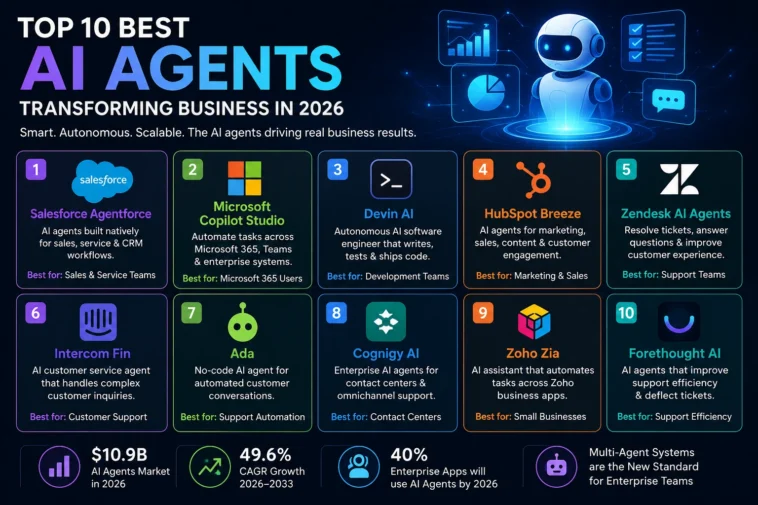
Your competitor probably isn’t hiring more people this year, they’re deploying AI agents instead. The global AI agents market has jumped to roughly $10.9 billion in 2026 and is on a 49.6% annual growth pace, according to Grand View Research. So the real question isn’t whether to use one. It’s which AI agent actually fits your business, and which ones are just chatbots wearing a fancier name tag.
Table of Contents
- Key Highlights
- What Makes an AI Agent Different From a Chatbot
- The Top 10 Best AI Agents Transforming Business
- Important Statistics Table
- How to Choose the Right AI Agent for Your Business (Step-by-Step)
- Pros and Cons Table
- Comparison Table: Top 10 AI Agents at a Glance
- Current 2026 Trends in Business AI Agents
- FAQs
- References
Key Highlights (Quick Facts)
- The global AI agents market sits at roughly $10.9 billion in 2026, and Grand View Research projects it will hit $182.9 billion by 2033 on a 49.6% CAGR.
- Salesforce Agentforce now offers a free entry tier called Salesforce Foundations, plus usage-based Flex Credits at roughly $0.10 per action and $2-per-conversation pricing for customer-facing agents.
- Under 10% of Salesforce’s own customers have scaled Agentforce past a pilot stage, and enterprise rollouts often take 5 to 11 months, per independent reporting from My AskAI.
- Microsoft Copilot Studio bills usage in Copilot Credits, at roughly $0.01 per credit pay-as-you-go, or $200 for a 25,000-credit monthly pack.
- Gartner predicts 40% of enterprise applications will embed task-specific AI agents by the end of 2026, up from under 5% in 2025.
- Multi-agent collaboration — where separate agents handle support, data, and workflow tasks inside one platform — is becoming the standard architecture for enterprise teams rather than a single do-everything bot.
- The core difference between a chatbot and an AI agent is action: chatbots deflect and answer, while true AI agents can process refunds, update CRM records, and complete multi-step workflows without a human stepping in.
What Makes an AI Agent Different From a Chatbot
Before ranking the list, it helps to know what actually separates a genuine AI agent from a glorified FAQ bot.
Autonomy and Action
A real AI agent plans, decides, and acts with minimal oversight. It doesn’t just answer “where’s my order” — it can look up the order, update the record, and issue a refund on its own.
Tool and System Connectivity
An agent that can’t touch your CRM, your inbox, or your database is really just a chatbot with better manners. The strongest platforms connect natively to tools like Salesforce, HubSpot, Zendesk, Slack, and SAP.
Context and Memory
Traditional bots match keywords to scripts. Agents use natural language processing to hold context across a full conversation, and sometimes across multiple sessions, so the customer never has to repeat themselves.
Governance and Guardrails
Enterprise buyers increasingly ask about audit trails, permission scoping, and human-in-the-loop checkpoints before letting an agent take real action on customer accounts or financial data.
The Top 10 Best AI Agents Transforming Business
Here’s our researched, no-fluff ranking of the AI agents actually delivering value for business teams right now.
1. Salesforce Agentforce
Best for: Salesforce-native sales and service teams
Pricing: Free entry through Salesforce Foundations, Flex Credits around $500 per 100,000 credits (about $0.10 per action), or $2 per customer-facing conversation. Per-user licenses start near $5/month.
Why it stands out: Agentforce ships with pre-built templates for service, sales, and field operations, and it’s deeply wired into Salesforce’s own data layer. The catch is that it works best when your business already runs on Salesforce — outside that ecosystem, the value drops fast, and most advanced deployments need Data Cloud, which can push first-year costs into the 150,000–600,000 range for mid-market teams.
2. Microsoft Copilot Studio
Best for: Microsoft 365-centric organizations
Pricing: Pay-as-you-go at roughly $0.01 per Copilot Credit, or a prepaid pack of 25,000 credits for about $200/month. A standalone tenant license also runs near $200/month for teams on E3 or E5.
Why it stands out: Copilot Studio connects to more than 1,400 pre-built connectors through the Power Platform, reaching Salesforce, SAP, ServiceNow, Zendesk, and Google Workspace without writing API code. For teams already living inside Teams and SharePoint, it’s genuinely the fastest path to a working internal agent.
Image: A business dashboard showing live AI agent activity across support tickets and workflows — enterprise teams now track agent performance the same way they track headcount output.
3. Devin AI
Best for: Engineering and product teams needing autonomous coding help
Pricing: Subscription-based developer tiers, positioned as a premium coding agent.
Why it stands out: Reviewers consistently describe Devin as the closest thing available today to a junior engineer that works around the clock. It can plan a coding task, write the code, test it, and iterate without constant hand-holding, making it a strong fit for teams that need to move fast on technical backlog.
4. Sierra
Best for: Consumer-facing customer support at scale
Pricing: Enterprise custom pricing.
Why it stands out: Sierra is built specifically for conversational customer support that needs to feel natural, not scripted. It’s frequently named alongside Ada, Forethought, and Intercom Fin as one of the leading dedicated customer-service agents in 2026, with a focus on resolution rather than simple deflection.
5. Zapier Agents
Best for: Operations and marketing teams already using Zapier
Pricing: Task-based, drawing from the same quota as standard Zaps; plans scale with usage.
Why it stands out: Zapier Agents let you build agents that take action across more than 9,000 connected apps using plain natural language instructions. One tested example had a lead-qualifying agent reading form submissions and posting enriched alerts to Slack in under 25 minutes, with existing Gmail, Slack, and Salesforce connections carrying over automatically.
6. n8n
Best for: Technical teams that want open, flexible agent orchestration
Pricing: Free self-hosted option; paid cloud plans scale with usage.
Why it stands out: n8n supports genuine multi-agent collaboration, letting separate agents handle distinct steps of a complex workflow instead of forcing one model to do everything. It’s a favorite among teams that want more control over how agents are wired together than a fully no-code platform allows.
7. Arahi AI
Best for: Small and mid-market businesses without engineering resources
Pricing: Free tier available; paid plans start around $49/month and scale with usage.
Why it stands out: Arahi ships with 1,500+ app integrations and a marketplace of 200+ pre-built agent templates for common jobs like lead scoring, email triage, and competitive research. Time-to-first-value is measured in hours rather than weeks, which matters a lot for teams with no dedicated automation staff.
Image: A support team monitoring live chat conversations handled partly by an AI agent — resolution speed, not just response speed, is now the metric that matters most.
8. Ada
Best for: High-volume customer service deflection and resolution
Pricing: Enterprise custom pricing based on conversation volume.
Why it stands out: Ada is consistently named among the top dedicated customer support agents in 2026, built to handle large volumes of repetitive service requests while escalating complex cases to human agents cleanly, without losing conversation context.
9. Intercom Fin
Best for: SaaS and product-led companies already using Intercom
Pricing: Usage-based, tied to resolutions rather than raw conversation count.
Why it stands out: Fin is built directly into the Intercom platform many SaaS support teams already use, so it can pull from existing help center content and past tickets immediately. That head start on knowledge base grounding tends to reduce hallucinated answers compared to agents starting from a blank slate.
10. TinyAgents
Best for: SMBs needing sales, support, and marketing automation without a dev team
Pricing: Around $49/month for the no-code platform.
Why it stands out: TinyAgents builds forms, databases, workflows, and email into one connected no-code system, which is a genuine differentiator for small teams that don’t want to stitch together four separate tools. A lead submitted through a form can be enriched, scored, logged in a CRM, and routed automatically without a single Zap or script.
Important Statistics Table
| AI Agent | Category | Starting Price | Best For |
| Salesforce Agentforce | CRM / Service | Free tier, then $2/conversation or Flex Credits | Salesforce-native teams |
| Microsoft Copilot Studio | Enterprise / Internal | ~$0.01/credit, $200/25K credits | Microsoft 365 organizations |
| Devin AI | Coding | Premium subscription | Engineering teams |
| Sierra | Customer support | Custom enterprise | Consumer support at scale |
| Zapier Agents | Workflow automation | Usage/task-based | Existing Zapier users |
| n8n | Orchestration | Free self-hosted / paid cloud | Technical, multi-agent workflows |
| Arahi AI | All-in-one no-code | Free tier, from $49/month | SMBs without engineers |
| Ada | Customer support | Custom enterprise | High-volume deflection |
| Intercom Fin | Customer support | Usage-based (per resolution) | SaaS product teams |
| TinyAgents | No-code operations | ~$49/month | SMB sales/support/marketing |
How to Choose the Right AI Agent for Your Business (Step-by-Step)
- Identify the single costliest bottleneck first — a repetitive support queue, slow lead qualification, or a coding backlog — instead of trying to automate everything at once.
- Check what systems the agent actually connects to, since an agent that can’t reach your CRM or helpdesk is still just answering questions, not resolving them.
- Match the platform to your existing stack, because Agentforce shines inside Salesforce and Copilot Studio shines inside Microsoft 365, but both lose value fast outside their home ecosystem.
- Estimate real usage volume before picking a pricing model, since credit-based and per-conversation pricing can swing your monthly bill wildly depending on traffic.
- Start with a narrow pilot, not a company-wide rollout, given that under 10% of Agentforce customers have scaled past pilot stage according to independent reporting.
- Confirm governance and human-in-the-loop options before letting any agent take action on financial data, refunds, or customer records.
- Measure resolution rate, not just response rate, since the entire point of an agent over a chatbot is that it finishes the task, not just answers the question.
Pros and Cons Table
| AI Agent | Pros | Cons |
| Salesforce Agentforce | Deep Salesforce data integration, generous free tier | Value drops sharply outside Salesforce, slow rollout timelines |
| Microsoft Copilot Studio | 1,400+ connectors, strong Microsoft 365 fit | Credit billing can get complex to forecast at scale |
| Devin AI | Genuinely autonomous coding execution | Premium pricing, best suited to technical teams only |
| Sierra | Natural, resolution-focused conversations | Custom enterprise pricing, less transparent cost |
| Zapier Agents | Fast setup using existing Zapier connections | Shares task quota with regular Zaps, can burn through allowance |
| n8n | Flexible, supports true multi-agent workflows | Requires more technical setup than no-code rivals |
| Arahi AI | Huge integration count, fast time-to-value | Newer platform, smaller track record than legacy vendors |
| Ada | Strong at high-volume deflection | Less ideal for highly complex, nuanced conversations |
| Intercom Fin | Learns fast from existing help center content | Tied closely to the Intercom ecosystem |
| TinyAgents | All-in-one no-code system for small teams | Fewer enterprise-grade integrations than bigger platforms |
Comparison Table: Top 10 AI Agents at a Glance
| AI Agent | Deployment Style | Ideal Company Size | Key Strength |
| Salesforce Agentforce | No-code + Data Cloud | Mid-market to enterprise | Native CRM context |
| Microsoft Copilot Studio | Low-code | Enterprise | Microsoft 365 integration |
| Devin AI | Autonomous coding agent | Any size with a dev team | End-to-end code execution |
| Sierra | Managed/custom | Enterprise | Conversational support quality |
| Zapier Agents | No-code | SMB to mid-market | 9,000+ app connections |
| n8n | Low-code / self-hosted | Technical teams | Multi-agent orchestration |
| Arahi AI | No-code | SMB | Pre-built agent marketplace |
| Ada | Managed/custom | Enterprise | High-volume ticket deflection |
| Intercom Fin | Native add-on | SaaS companies | Help-center grounded answers |
| TinyAgents | No-code | SMB | Forms, CRM, and email in one |
Image: A close-up of a laptop screen showing an AI coding assistant writing and testing code automatically — autonomous coding agents are becoming standard tools inside engineering teams.
Current 2026 Trends in Business AI Agents
The AI agent space keeps shifting fast, and a few patterns stand out clearly right now.
Multi-Agent Systems Are Replacing the “One Bot Does Everything” Model
Instead of a single generalist AI, businesses are increasingly running separate agents for support, data analysis, and workflow tasks inside the same platform, each handling what it’s best at, with orchestration tools like n8n and Forethought leading that shift.
Enterprise Adoption Is Outpacing Real Deployment
Gartner expects 40% of enterprise applications to embed task-specific AI agents by the end of 2026, but real-world numbers from platforms like Agentforce show adoption at scale still lags behind the pilot stage for most customers.
Consumption-Based Pricing Has Become the Norm
Both Salesforce and Microsoft now bill primarily through credits or per-action pricing rather than flat seat licenses, which makes agents cheaper to test but harder to forecast at scale.
Voice Agents Are Going Mainstream
Salesforce’s Agentforce Voice went generally available with partners including Amazon Connect, Genesys, and Five9, though as of early 2026 it remains limited to US and Canada markets — a sign voice-based agents are still maturing regionally.
Governance Is Becoming a Buying Criterion, Not an Afterthought
As agents get real permission to touch customer data and financial records, enterprise buyers are pushing vendors harder on audit trails, human-in-the-loop checkpoints, and permission scoping before signing contracts.
Conclusion
The best AI agent for your business depends far less on which platform has the flashiest demo and far more on which system already runs your data. Teams inside Salesforce or Microsoft 365 will get the fastest, cheapest wins from Agentforce or Copilot Studio, while smaller teams without a dev team should look hard at no-code options like Arahi AI or TinyAgents. Whichever direction you go, start with one narrow, costly bottleneck, measure the resolution rate honestly, and expand only once the numbers back it up.
References
- Grand View Research — Global AI Agents Market Size and Growth Report, 2026
- Gartner — Enterprise Application AI Agent Adoption Forecast, 2026
- Salesforce — Official Agentforce Pricing Page
- My AskAI — Salesforce Agentforce: Features, Pricing & Limits (2026)
- Default.com — Salesforce Agentforce Features & Pricing (2026 Review)
- Software Finder — Salesforce Agentforce Pricing Guide 2026
- Microsoft — Microsoft 365 Copilot Pricing and Copilot Studio Plans
- A Guide to Cloud & AI — Microsoft Copilot Studio Guide & Pricing (2026)
- CloudZero — Microsoft Copilot Studio Pricing In 2026
- Arahi AI — Best AI Agents for Business 2026: 12 Platforms Ranked
- Gamut — 9 Best AI Agents in 2026 (Tested & Compared)
- TinyCommand — Best AI Agents for Business in 2026 (Ranked by Use Case)
- Emergent.sh — 7 AI Agents for Business I Use in 2026
- ChatBot.com — Best AI Agents in 2026: What Actually Works
FAQs
A chatbot follows scripts and matches keywords to pre-written responses, while an AI agent uses natural language processing to understand intent, hold context, and take autonomous action like processing a refund or updating a CRM record.
Arahi AI and TinyAgents are both built as no-code platforms with pre-built templates, letting small teams deploy agents for lead scoring, email triage, and customer routing without hiring a developer.
Pricing varies widely by platform and usage model. Salesforce Agentforce starts free through Foundations before scaling to roughly $2 per conversation, while Microsoft Copilot Studio bills around $0.01 per credit, so actual monthly cost depends heavily on your conversation or action volume.
Not fully. Agents like Ada and Sierra handle high-volume, repetitive requests well, but complex or emotionally sensitive cases still get escalated to human agents, and most successful deployments keep humans in the loop for edge cases.
It depends on your existing stack. Copilot Studio fits organizations already running Microsoft 365 and Teams, while Agentforce fits businesses whose core data and workflows already live inside Salesforce; both lose significant value if deployed outside their native ecosystem.
It’s an architecture where multiple specialized AI agents, each handling a distinct task like support, data analysis, or workflow routing, work together inside one platform instead of relying on a single general-purpose agent to do everything.


GIPHY App Key not set. Please check settings