 kiruthika
Thinking about launching a startup abroad, or just curious which nations are actually pulling ahead in the innovation race? You are in the right place.
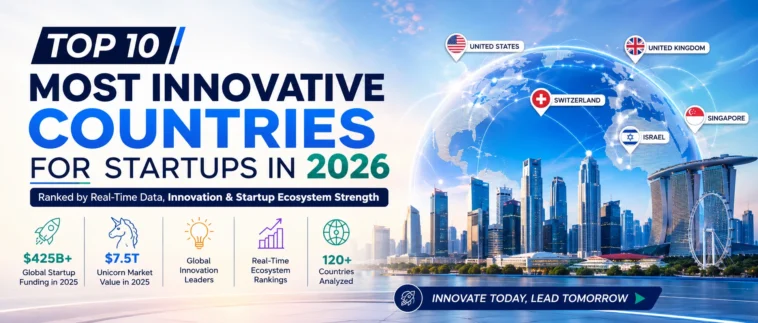
We dug through the freshest 2026 data , from StartupBlink’s Global Startup Ecosystem Index to WIPO’s Global Innovation Index, to find the most innovative countries for startups this year. No guesswork, no outdated “best of” lists recycled from 2022. Just real numbers, real growth rates, and real founder-friendly conditions.
Key Highlights and Quick Facts
- The United States ranks 1st globally for startups in 2026, with a StartupBlink ecosystem score of 314.096 and a total ecosystem value of roughly US$9.1 trillion, according to StartupBlink’s Global Startup Ecosystem Index 2026.
- Switzerland remains the world’s most innovative economy overall for the 15th year running on the WIPO Global Innovation Index (GII) 2025, scoring 66.0 out of 100.
- China entered the GII top 10 for the first time in 2025, becoming the only middle-income economy in the top 30.
- Global venture and growth funding hit US$425 billion across more than 24,000 companies in 2025, up 30% year-over-year, per Crunchbase data.
- Singapore posted the fastest growth rate among the global top 10 startup countries in 2026, at 24.4% annual ecosystem growth.
- The Crunchbase Unicorn Board was worth close to US$7.5 trillion by the end of 2025, up more than $2 trillion from 2024.
- Australia made the biggest jump in the 2026 rankings, climbing three places to re-enter the global top 10.
- Uzbekistan was the fastest-growing startup ecosystem in the world in 2026, up an astonishing 227.3% year-over-year, showing that innovation leadership is spreading well beyond the usual names.
[Image: San Francisco Bay Area skyline, the heart of the world’s top-ranked startup ecosystem] Caption: San Francisco Bay Area remains the single most valuable startup hub on earth, anchoring the US at #1 for innovative startup countries.
What Makes a Country “Innovative” for Startups
Here’s the honest truth: “innovative” means different things depending on who you ask. A government economist looks at patents and R&D spending. A founder looks at how fast they can register a company and raise a seed round.
So for this list, we blended both lenses. We leaned mainly on the StartupBlink Global Startup Ecosystem Index 2026, which tracks over 120 countries and 1,500+ cities using startup quantity, ecosystem quality, and business environment as its three pillars. We cross-checked it against the WIPO Global Innovation Index 2025, which measures broader national innovation capacity across institutions, research, infrastructure, and creative output.
The result is a list that reflects where startups are actually being built, funded, and scaled right now, not just where R&D budgets happen to be large.
The Top 10 Most Innovative Countries for Startups in 2026
This ranking is based primarily on the StartupBlink Global Startup Ecosystem Index 2026 total score, which combines startup activity, ecosystem quality, and business environment.
1. United States
The US isn’t just ahead, it’s pulling further away. Its 2026 ecosystem score of 314.096 is now nearly four times the United Kingdom’s, up from 3.7 times last year. The country’s ecosystem value sits around $9.1 trillion, and it grew 23.6% in the past year alone, fueled heavily by AI investment. The US had 33 cities in the global top 100 in 2026, led by the San Francisco Bay Area, still the single most valuable startup hub on the planet.
2. United Kingdom
London keeps Britain firmly at #2 globally and #1 in Europe, a spot it has held for six straight years. The UK’s score (80.114) is nearly double Sweden’s, and London’s own score is 16 times higher than Manchester, its nearest domestic rival. Growth has slowed to 13.2%, suggesting the ecosystem is maturing rather than exploding.
3. Israel
Nicknamed the “Startup Nation” for good reason, Israel holds 3rd place for the sixth year running. It grew 15% in 2026 despite ongoing regional pressures, and Tel Aviv climbed to 7th globally among startup cities, its best position in five years. Israel ranks 2nd in the world specifically for Software & Data startups.
[Image: Tel Aviv skyline at dusk, home to Israel’s dense startup and tech-hub network] Caption: Tel Aviv is Israel’s startup engine, helping the country hold onto its “Startup Nation” reputation in 2026.
4. Singapore
Singapore is the momentum story of this list. It jumped from 10th place in 2021 to 4th in 2026, and its 24.4% annual growth rate is the fastest among the entire global top 10. It now ranks 2nd worldwide in both Fintech and Ecommerce & Retail, and Singapore City just cracked the global top 10 city rankings for the first time.
5. Canada
Canada holds steady at 5th, but growth has cooled to just 9%, the slowest pace in the top 10. Still, Toronto’s return to the global top 20 (its best in six years) shows there’s fresh energy underneath the numbers. Canada leads globally in Edtech, Energy & Environment, and Transportation startups.
6. Sweden
Sweden is the top-ranked country in the entire European Union, sitting 6th globally for a third straight year. Stockholm remains the leading Nordic hub, even after slipping one spot to 25th globally. Sweden also punches well above its population size in R&D intensity, a strength that shows up clearly in the WIPO Global Innovation Index too.
7. Germany
Europe’s biggest economy holds 7th place for the fourth consecutive year. Berlin remains the country’s flagship hub, though both Berlin and Munich actually contracted slightly this year — the real growth is happening in mid-sized German cities, 13 of which grew more than 30%.
[Image: Berlin startup district, Germany’s leading innovation hub] Caption: Berlin anchors Germany’s startup scene, even as smaller German cities post the fastest growth in the ecosystem.
8. Switzerland
Switzerland climbed one spot to 8th in 2026, completing a four-year recovery after bottoming out at 12th in 2022. Interestingly, it’s the only country in the global top 10 without a single city in the world’s top 50, its strength is spread across many mid-sized hubs rather than one mega-city. Switzerland also happens to top WIPO’s overall Global Innovation Index for the 15th year running.
9. Australia
Australia made the single biggest leap of any top-15 country in 2026, jumping three places from 12th to 9th. Sydney entered the global top 30, and Melbourne climbed eight spots with 37.8% growth. Australia’s strongest sector is Ecommerce & Retail, where it ranks 5th globally.
10. Netherlands
Rounding out the list, the Netherlands holds 10th place for a second year straight, and it’s the EU’s 3rd-ranked ecosystem behind Sweden and Germany. Amsterdam remains Europe’s 5th-ranked startup city, and the country’s strongest niche is Hardware & IoT.
Important Startup and Innovation Statistics
| Metric | Figure | Source & Year |
| Global VC and growth funding | US$425 billion across 24,000+ companies | Crunchbase, 2025 |
| Global VC funding (broader count) | US$469–512 billion | CB Insights / PitchBook-KPMG, 2025 |
| Total value of unicorn companies worldwide | ~US$7.5 trillion | Crunchbase, end of 2025 |
| Global venture exit value | US$549.2 billion | Crunchbase, 2025 |
| US share of global VC funding | 64% (~$274 billion) | Crunchbase, 2025 |
| Europe VC funding | Nearly US$68 billion | CB Insights, 2025 |
| Asia VC funding | ~US$53 billion | CB Insights, 2025 |
| Top 10 startup countries’ average annual growth | 16.7% | StartupBlink GSEI, 2026 |
| Fastest-growing top-10 country | Singapore, +24.4% | StartupBlink GSEI, 2026 |
| Global R&D growth rate | 2.9% (slowest since 2010) | WIPO GII, 2025 |
How the Rankings Are Calculated (Step by Step)
- Gather ecosystem data. StartupBlink pulls data on startup counts, funding events, coworking spaces, accelerators, and unicorns from over 1,500 cities.
- Score three pillars. Each country gets scored on Quantity (startup activity), Quality (ecosystem impact and outcomes), and Business Environment (ease of starting and scaling a company).
- Adjust for population. Country-level rankings, unlike city rankings, are adjusted for population size, so smaller nations with dense ecosystems can still rank highly.
- Add Ecosystem Value. New in 2026, this metric estimates the financial value of each ecosystem based on startup valuations and exits recorded since 2006.
- Cross-check with innovation data. Broader innovation capacity — patents, R&D spending, institutions — is separately measured by WIPO’s Global Innovation Index across 139 economies and 78 indicators.
- Publish and compare year-over-year. Both indexes track growth and rank changes annually, letting analysts see who is climbing and who is slipping.
Pros and Cons of Building a Startup in a Top-Ranked Country
| Pros | Cons |
| Easier access to venture capital and follow-on funding | Cost of living and office space is often very high |
| Strong talent pools and university-industry links | Intense competition for hiring and customer attention |
| Mature legal, banking, and IP protection systems | Visa and immigration rules can still be complex for founders |
| Established exit pathways (IPOs, acquisitions) | Market saturation in mature sectors like fintech and SaaS |
| Access to accelerators, mentors, and corporate partners | Regulatory compliance can be heavier in mature markets |
Innovation Index vs Startup Ecosystem Ranking: A Comparison
Innovation capacity and startup-friendliness don’t always line up perfectly. Here’s how the same country can rank differently depending on which lens you use.
| Country | StartupBlink Rank 2026 | WIPO GII Rank 2025 | What This Tells You |
| United States | 1 | 3 | Massive VC and unicorn activity, slightly behind on infrastructure input |
| United Kingdom | 2 | 6 | Strong startup output relative to its innovation inputs |
| Israel | 3 | 14 | Outsized startup density for its innovation input level |
| Singapore | 4 | 5 | Balanced strength across both innovation and startups |
| Switzerland | 8 | 1 | World’s top innovation economy, but a smaller startup scene |
| Sweden | 6 | 2 | Deep R&D base translating well into startup activity |
2026 Trends Shaping Global Startup Innovation
AI is absorbing most of the capital. Five companies, OpenAI, Anthropic, Scale AI, xAI, and Project Prometheus, raised a combined $84 billion in 2025, roughly a fifth of all global venture capital tracked by Crunchbase.
The US lead is widening, not shrinking. Its gap over the UK grew from 3.7x to nearly 4x in a single year, driven largely by AI megadeals concentrated in the Bay Area.
Middle-income economies are climbing fast. WIPO’s GII 2025 flags India, Türkiye, Vietnam, the Philippines, Indonesia, Morocco, Albania, and Iran as the fastest-climbing middle-income innovators since 2013, a trend that startup investors are watching closely for the next wave of hubs.
Smaller, agile ecosystems are surging. Uzbekistan’s 227.3% annual growth and Thailand’s 62.6% growth show that innovation leadership is no longer limited to a handful of legacy hubs.
Exits are back. Global venture exit value hit $549.2 billion in 2025, more than $200 billion above 2024, as IPO windows reopened and strategic acquisitions picked up pace.
[Image: Singapore business district skyline, Asia-Pacific’s fastest-growing startup hub in 2026] Caption: Singapore posted the fastest growth rate of any global top-10 startup country in 2026.
References
- WIPO — Global Innovation Index 2025 Results, wipo.int
- StartupBlink — Global Startup Ecosystem Index 2026, startupblink.com
- StartupBlink — Best Cities for Startups and Entrepreneurs 2026, startupblink.com
- StartupBlink — Fastest Growing Countries for Startups 2026, startupblink.com
- Crunchbase News — Global Venture Funding Report 2025
- CB Insights — State of Venture 2025 Report
- Dealroom — Global Venture Capital Deep Dive, dealroom.co
- Visual Capitalist — Ranked: The World’s Most Innovative Countries in 2025
- Voronoi — Top 10 Countries in Global Innovation Index 2025
- World Bank — Doing Business and Entrepreneurship Data, worldbank.org
- OECD — Science, Technology and Innovation Outlook, oecd.org
- Statista — Venture Capital and Startup Statistics, statista.com
FAQs
The United States ranks 1st globally for startups in 2026 according to StartupBlink’s Global Startup Ecosystem Index, with a score nearly four times higher than the second-ranked United Kingdom.
Switzerland tops the WIPO Global Innovation Index for the 15th consecutive year in 2025, leading in creative outputs and ranking in the top five for nearly every innovation pillar measured.
Among the global top 10, Singapore grew the fastest at 24.4% annually. Looking beyond the top 10, Uzbekistan was the fastest-growing ecosystem worldwide at 227.3%.
Yes. China entered the WIPO Global Innovation Index top 10 for the first time in 2025, leads the world in patent filings, and is projected to become the top global R&D spender.
The United Kingdom leads Europe overall at 2nd place globally, while Sweden is the top-ranked country within the European Union specifically, at 6th globally.
Crunchbase counted $425 billion in global venture and growth funding in 2025, up 30% from 2024, making it the third-highest funding year on record after 2021 and 2022.
Not exactly. A country like Switzerland can top general innovation rankings while ranking lower on pure startup activity, because startup indexes weigh venture funding and company formation more heavily than broad R&D metrics.


GIPHY App Key not set. Please check settings