 kiruthika
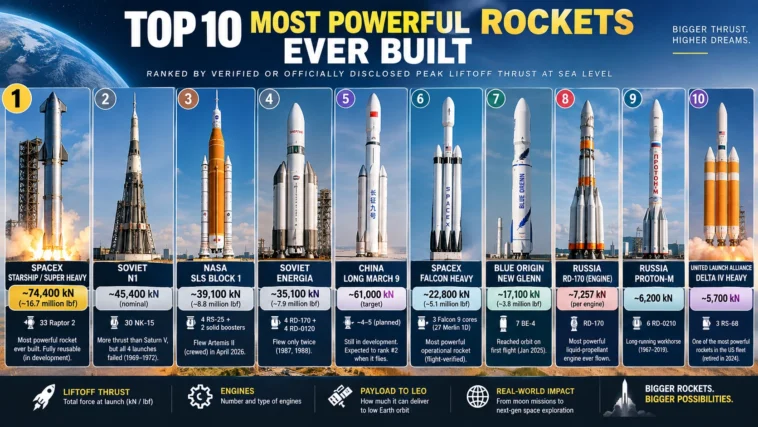
Which is the most powerful rocket in the world? As of 2026, it’s SpaceX’s Super Heavy booster, and it’s not particularly close. It produces roughly twice the liftoff thrust of the Saturn V that carried astronauts to the Moon.
We ranked the top 10 most powerful rockets ever built in the world using peak liftoff thrust at sea level, the same metric space agencies and manufacturers use to compare launch vehicles. Some of these rockets flew perfectly. One never reached orbit at all. Here’s the full list, backed by real numbers.
Key Highlights
- SpaceX’s Super Heavy booster produces approximately 74,400 kN (about 16.7 million pounds) of liftoff thrust, the most powerful rocket ever built.
- The Soviet N1 produced more thrust on paper than the Saturn V, but failed all four of its launches between 1969 and 1972.
- NASA’s SLS generates roughly 39,100 kN of thrust and flew its first crewed mission, Artemis II, in April 2026.
- The Saturn V remains the most powerful rocket to ever successfully carry humans beyond low Earth orbit, with a 13-for-13 launch success record.
- China’s Long March 9, still in development, targets around 61,000 kN of thrust, which would rank it second on this list once it flies.
- Falcon Heavy is currently the most powerful operational rocket whose full payload performance has been flight-verified.
- Blue Origin’s New Glenn reached orbit on its first flight in January 2025, producing about 17,100 kN of thrust from 7 BE-4 engines.
- The Russian RD-170 remains the most powerful liquid-propellant rocket engine ever flown, at about 7,257 kN of thrust per engine.
How Rocket Power Is Actually Measured
“Powerful” isn’t one number, it depends on what you’re measuring. This list ranks rockets by peak total thrust at sea level at the moment of liftoff, added up across every engine firing at once. That’s the figure that determines whether a rocket can even lift its own weight off the launch pad.
Payload capacity to low Earth orbit (LEO) is used as a tiebreaker and for context, since thrust alone doesn’t tell you how much cargo a rocket can actually deliver. A rocket with lower thrust but better efficiency, like the Saturn V, can sometimes out-lift a higher-thrust vehicle on a per-flight basis.
The Top 10 Most Powerful Rockets Ever Built
Ranked by verified or officially disclosed peak liftoff thrust at sea level.
1. SpaceX Starship / Super Heavy
Thrust: ~74,400 kN (~16.7 million lbf) | Engines: 33 Raptor 2
Super Heavy is the first stage of SpaceX’s fully reusable Starship system, and it’s the undisputed answer to “what is the most powerful rocket launcher in the world” right now. Its 33 Raptor 2 engines each produce roughly 2,256 kN at sea level, combined, that’s more than double the Saturn V’s total thrust.
As of 2026, Starship has completed multiple integrated test flights from Starbase, Texas, including booster catches by the launch tower’s mechanical arms. It hasn’t yet completed a fully operational orbital mission with commercial payload deployment, but its liftoff thrust is confirmed from real flight data. The target payload to LEO with in-orbit refueling is 100 to 150 tonnes.
2. Soviet N1
Thrust: ~45,400 kN (nominal) | Engines: 30 NK-15
The N1 was the USSR’s answer to Saturn V, the Soviet moon rocket. Its first stage packed 30 NK-15 engines into two concentric rings, producing more thrust on paper than any American rocket of its era.
In practice, all four N1 test launches between 1969 and 1972 failed before reaching orbit. Its second flight caused one of the largest non-nuclear explosions in history when the vehicle fell back onto the pad. The program was cancelled in 1974. It ranks this high purely on theoretical thrust — not on flight success.
3. NASA Space Launch System (SLS) Block 1
Thrust: ~39,100 kN (~8.8 million lbf) | Engines: 4 RS-25 + 2 solid rocket boosters
SLS is NASA’s super-heavy lift rocket for the Artemis lunar program. Four shuttle-heritage RS-25 engines combine with two five-segment solid rocket boosters, which alone contribute roughly 32,000 kN of the total thrust.
SLS first flew uncrewed on Artemis I in November 2022, then carried four astronauts around the Moon on Artemis II in April 2026, its first crewed flight. Block 1 can lift approximately 95 tonnes to LEO.
4. Soviet Energia
Thrust: ~35,100 kN (~7.9 million lbf) | Engines: 4 RD-170 + 4 RD-0120
Energia was the Soviet Union’s heavy-lift counterpart to the Space Shuttle stack. Four strap-on boosters powered by RD-170 engines, still the most powerful liquid-propellant rocket engines ever flown, combined with a hydrogen-fueled core stage to produce roughly 35,100 kN at liftoff.
Energia flew only twice: once in 1987 carrying the Polyus platform, and once in 1988 launching the uncrewed Buran space shuttle. The program ended with the Soviet Union’s collapse, but RD-170 derivatives still power rockets today.
5. Saturn V
Thrust: ~34,500 kN (~7.76 million lbf) | Engines: 5 F-1
The Saturn V remains the most powerful rocket ever to successfully carry a crewed payload beyond low Earth orbit. Its five F-1 engines — each producing about 6,770 kN, making it the most powerful single-chamber liquid-fuel engine ever flown — powered every crewed Apollo Moon mission.
Thirteen Saturn V rockets flew between 1967 and 1973 with a perfect success record, including Apollo 11’s historic 1969 Moon landing and the launch of the Skylab space station. Its verified payload to LEO, about 140 tonnes, actually exceeds SLS Block 1’s figure per flight.
6. Long March 9 (China)
Thrust: ~61,000 kN (planned) | Engines: ~30 YF-215 (planned)
China’s Long March 9 has been redesigned multiple times, and its current architecture is a fully reusable super-heavy lifter conceptually similar to Starship. Disclosed targets put its thrust around 61,000 kN, aiming for roughly 150 tonnes to LEO.
It hasn’t flown yet. China’s space program has publicly targeted a first flight around 2030, so every figure here reflects an announced goal rather than flight-verified performance, which is why it ranks below vehicles that have actually launched.
7. SpaceX Falcon Heavy
Thrust: ~22,800 kN (~5.1 million lbf) | Engines: 27 Merlin 1D
Falcon Heavy is essentially three Falcon 9 first stages strapped together, with 27 Merlin 1D engines producing a combined 22,800 kN at liftoff. It first flew in February 2018, famously launching a Tesla Roadster on a heliocentric trajectory.
Falcon Heavy lifts about 63.8 tonnes to LEO in fully expendable mode. It’s flown national security payloads and NASA’s Psyche asteroid probe, and it currently holds the title of the most powerful operational rocket with fully flight-verified payload performance.
8. Blue Origin New Glenn
Thrust: ~17,100 kN (~3.8 million lbf) | Engines: 7 BE-4
New Glenn is Blue Origin’s answer to heavy-lift orbital launch. Seven methane-fueled BE-4 engines produce roughly 17,100 kN combined. It reached orbit successfully on its first flight in January 2025 from Cape Canaveral.
New Glenn is designed for first-stage reuse via ocean landing, targeting up to 25 flights per booster. Its payload to LEO is around 45 tonnes. The same BE-4 engine also powers United Launch Alliance’s Vulcan Centaur rocket.
9. Long March 5B (China)
Thrust: ~10,600 kN (~2.4 million lbf) | Engines: 2 YF-77 + 8 YF-100
Long March 5B is China’s heaviest operational launcher and the vehicle responsible for lofting the core modules of the Tiangong space station. Its thrust comes from two hydrogen-fueled core engines plus eight kerosene engines across four side boosters.
It has launched all three Tiangong station modules along with China’s Chang’e-5 lunar sample-return mission, and delivers roughly 25 tonnes to LEO.
10. SpaceX Falcon 9 Block 5
Thrust: ~7,600 kN (~1.7 million lbf) | Engines: 9 Merlin 1D
Falcon 9 Block 5 is the least powerful rocket on this list by thrust, but arguably the most consequential launch vehicle of the modern era. Nine Merlin 1D engines produce roughly 7,600 kN at liftoff, and the rocket surpassed 400 successful launches in early 2026.
It has launched the entire Starlink constellation, most NASA crew and cargo missions to the ISS, and dozens of commercial and national-security payloads. Some individual boosters have flown more than 20 times.
Important Statistics Table
| Metric | Data Point | Source |
| Starship/Super Heavy liftoff thrust | ~74,400 kN (~16.7M lbf) | SpaceX vehicle specifications, 2026 |
| SLS Block 1 liftoff thrust | ~39,100 kN (~8.8M lbf) | NASA SLS reference, 2026 |
| Saturn V liftoff thrust | ~34,500 kN (~7.76M lbf) | NASA Saturn V archive |
| Saturn V launch success rate | 13/13 (100%) | NASA history office |
| N1 launch success rate | 0/4 (0%) | NASA NSSDCA / Roscosmos archives |
| Falcon 9 total successful launches | 400+ (as of early 2026) | SpaceX launch data, 2026 |
| RD-170 engine thrust | ~7,257 kN per engine | Historical engine specifications |
| F-1 engine thrust | ~6,770 kN per engine | NASA Marshall Space Flight Center |
| New Glenn first successful orbital flight | January 2025 | Blue Origin, 2025 |
| Artemis II crewed lunar flyby | April 2026 | NASA Artemis program, 2026 |
How Rocket Thrust Is Calculated: Step-by-Step
- Measure thrust per engine at sea level, since atmospheric pressure affects how efficiently an engine performs at liftoff versus in the vacuum of space.
- Multiply by the number of engines firing simultaneously during the initial liftoff phase.
- Add solid rocket booster contributions if present, SLS’s two boosters alone contribute more thrust than most rockets on this list produce in total.
- Confirm with real flight telemetry where available, rather than relying only on manufacturer specifications.
- Cross-check payload-to-LEO figures as a secondary measure, since raw thrust doesn’t always translate directly into how much cargo a rocket can deliver.
- Flag rockets that haven’t flown, like Long March 9, since undemonstrated figures carry more uncertainty than flight-verified numbers.
Pros and Cons Table
| Rocket | Pros | Cons |
| Starship/Super Heavy | Highest thrust ever built, designed for full reuse | Hasn’t completed a full operational payload mission yet |
| N1 | Highest theoretical thrust of its era | Failed all four launches, never reached orbit |
| SLS Block 1 | Proven crewed lunar capability, high payload | Expensive, expendable, limited flight cadence |
| Energia | Extremely powerful engines, still influential today | Only flew twice, program cancelled |
| Saturn V | Perfect flight record, highest per-flight LEO payload | Retired since 1973, not reusable |
| Long March 9 | Would rank #2 if built as planned | Hasn’t flown, first launch not expected before 2030 |
| Falcon Heavy | Most powerful flight-verified operational rocket | Limited launch cadence compared to Falcon 9 |
| New Glenn | Reached orbit on its first attempt, reusable | Newer program, smaller flight history |
| Long March 5B | Proven space station launch record | Uncontrolled core-stage reentries have drawn concern |
| Falcon 9 Block 5 | Most-launched orbital rocket in history, reusable | Lowest thrust on this list |
Comparison Table
| Rocket | Operator | Thrust (kN) | Payload to LEO | Status |
| Starship/Super Heavy | SpaceX | ~74,400 | ~100–150 t (target) | Test campaign |
| N1 | USSR | ~45,400 | ~95 t (target) | Retired, 0/4 success |
| SLS Block 1 | NASA | ~39,100 | ~95 t | Operational |
| Energia | USSR | ~35,100 | ~100 t | Retired, 2 flights |
| Saturn V | NASA | ~34,500 | ~140 t | Retired, 13/13 success |
| Long March 9 | China (CASC) | ~61,000 (planned) | ~150 t (planned) | In development |
| Falcon Heavy | SpaceX | ~22,800 | ~63.8 t | Operational |
| New Glenn | Blue Origin | ~17,100 | ~45 t | Operational |
| Long March 5B | China (CASC) | ~10,600 | ~25 t | Operational |
| Falcon 9 Block 5 | SpaceX | ~7,600 | ~22.8 t | Operational |
2026 News and Trends
2026 has been a landmark year for super-heavy launch vehicles. NASA’s SLS flew its first crewed mission, Artemis II, in April 2026, sending four astronauts on a lunar flyby and marking the biggest step toward returning humans to the Moon since Apollo.
SpaceX’s Starship program continued its test campaign through 2026, refining booster catches and Starship reentry techniques at Starbase, though a fully operational orbital payload mission had not yet been completed as of this writing. Meanwhile, Blue Origin’s New Glenn — which reached orbit successfully on its very first flight in January 2025 — has continued flying through 2026, establishing itself as a legitimate second heavy-lift competitor in the US market.
China’s Long March 9 program remains the one to watch longer-term. If its fully reusable variant flies as currently planned, its disclosed thrust target of roughly 61,000 kN would make it the second most powerful rocket ever built, behind only Starship’s Super Heavy.
References
- NASA — Saturn V Reference, nasa.gov/history/saturn-v
- NASA — Space Launch System Reference, nasa.gov/reference/space-launch-system
- SpaceX — Starship Vehicle Specifications, spacex.com/vehicles/starship
- SpaceX — Falcon Heavy Specifications, spacex.com/vehicles/falcon-heavy
- SpaceX — Falcon 9 Specifications, spacex.com/vehicles/falcon-9
- Blue Origin — New Glenn Overview, blueorigin.com/new-glenn
- NASA NSSDCA Spacecraft Database (N1, Energia), nssdc.gsfc.nasa.gov
- CNSA / CASC — Long March Family Publications, cnsa.gov.cn/english
- SpaceOdysseyHub — “Top 10 Most Powerful Rockets of All Time, Ranked by Thrust (2026)”
- WION — “Ranked by Thrust: Top 10 Most Powerful Rockets Ever Built”
- Nubia Magazine — “Top 10 Most Powerful Rockets 2026: What’s Launching Us Further”
- Interesting Engineering — “SpaceX’s Starship: The World’s Most Powerful Rocket Explained”
FAQs
As of 2026, SpaceX’s Super Heavy booster is the most powerful rocket ever built, producing approximately 74,400 kN (about 16.7 million pounds) of liftoff thrust.
In order of peak liftoff thrust: SpaceX Starship/Super Heavy, the Soviet N1, NASA’s SLS, the Soviet Energia, the Saturn V, China’s Long March 9 (in development), SpaceX Falcon Heavy, Blue Origin’s New Glenn, China’s Long March 5B, and SpaceX Falcon 9 Block 5.
No. SpaceX’s Super Heavy now produces roughly twice the liftoff thrust of the Saturn V. However, Saturn V remains the most powerful rocket that has ever flown crews successfully to the Moon.
Because this ranking is based on peak liftoff thrust, not mission success. The N1’s 30-engine first stage produced more thrust on paper, even though it failed all four of its test launches.
Starship has completed multiple high-energy test flights and demonstrated booster catches and reentry, but as of 2026 it has not yet completed a fully operational orbital mission with a commercial payload.


GIPHY App Key not set. Please check settings