 kiruthika
Introduction
Some ideas break your brain a little. The mind-bending physics discoveries on this list did exactly that — they took things everyone thought were obvious and proved them wrong.
Quantum objects that behave as though they take several possible paths at once. Time that runs slower when you move faster. Space itself stretching like a rubber sheet.
None of this is science fiction. All ten entries below are backed by experiments, published papers and hard numbers. And several of them made fresh headlines in 2026.
The double-slit interference pattern — the simplest demonstration of wave-particle duality in physics.
Key Highlights and Quick Facts
- The 2025 Nobel Prize in Physics went to John Clarke, Michel Devoret and John Martinis for showing quantum tunnelling in a hand-sized electrical circuit (NobelPrize.org, 2025).
- The LIGO-Virgo-KAGRA catalogue GWTC-5.0, released 26 May 2026, brought total confirmed gravitational-wave detections to 390 (LIGO Scientific Collaboration, 2026).
- CERN’s Large Hadron Collider logged its final Run 3 collision on 27 June 2026 and entered a four-year upgrade shutdown (ATLAS Collaboration, 2026).
- JWST confirmed MoM-z14, a galaxy seen just 280 million years after the Big Bang, in a peer-reviewed result published January 2026 (NASA / Scientific American, 2026).
- The Fermilab Muon g-2 experiment released its final result on 3 June 2025 with a precision of 127 parts per billion (Fermilab, 2025).
- KATRIN set the tightest lab limit on neutrino mass at 0.45 eV in Science, April 2025.
- The Hubble tension — 67 vs 73 km/s/Mpc — is still unresolved as of 2026 (Astronomy & Astrophysics, 2026).
- Einstein doubted two ideas on this list. He was wrong about both.
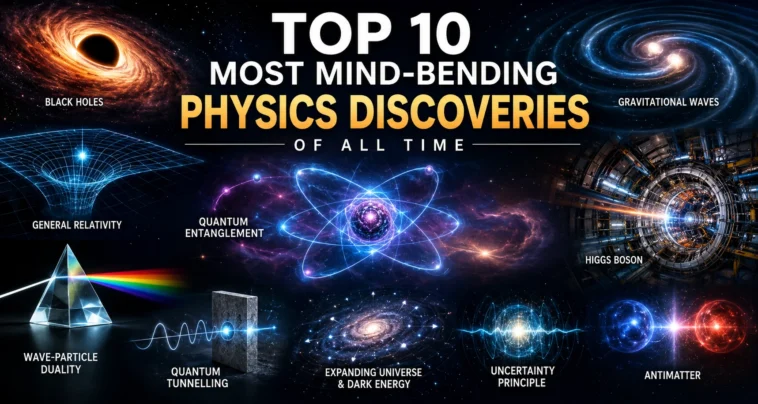
The Top 10 Most Mind-Bending Physics Discoveries
1. Quantum Entanglement (1935–2022)
Two particles get linked. Measure one, and the result is correlated with the measurement of the other, even across enormous distances.
Einstein hated this. He called it “spooky action at a distance” and assumed it meant quantum theory was incomplete.
He lost that argument. John Clauser, Alain Aspect and Anton Zeilinger won the 2022 Nobel Prize for experiments proving entanglement is real.
One thing gets misreported constantly: entanglement cannot be used to send information faster than light. The correlations only become visible once both sides compare notes over an ordinary channel. Relativity survives intact.
What entanglement does enable is tamper-evident communication. China’s Micius satellite distributed entangled photon pairs across 1,200 km in 2017, and in March 2025 a Nature paper reported a 12,900 km quantum key distribution link between China and South Africa using the Jinan-1 microsatellite.
2. Wave-Particle Duality (1801–1927)
Fire single electrons at two slits, one at a time. They still build up an interference pattern — as if each electron went through both slits.
Watch which slit they take, and the pattern vanishes.
Thomas Young showed the effect with light in 1801. Davisson and Germer confirmed it for electrons in 1927. It remains the cleanest reason to say the everyday rules simply don’t apply down there.
3. General Relativity (1915)
Gravity isn’t a force pulling you down. It’s the shape of space and time.
Einstein’s field equations predicted that starlight would bend around the Sun. Arthur Eddington’s 1919 eclipse expedition measured exactly that, and Einstein became a household name overnight.
Here’s the practical payoff: your phone’s GPS corrects for relativistic time dilation every second. Skip that correction and navigation drifts by kilometres a day.
4. Gravitational Waves (2015)
Collide two black holes and spacetime itself ripples outward.
LIGO caught the first ripple on 14 September 2015 — a signal that stretched its 4 km detector arms by a fraction of a proton’s width.
The field has scaled fast. According to the LIGO Scientific Collaboration, the GWTC-5.0 catalogue released in May 2026 added 161 new signals, bringing the running total to 390 detections. One event, GW231123, involved two black holes each around 130 times the Sun’s mass.
LIGO’s 4 km interferometer arms detect spacetime ripples thousands of times smaller than a proton.
5. Quantum Tunnelling (1928–2025)
A particle hits a barrier it doesn’t have enough energy to cross. Sometimes it just appears on the other side.
This isn’t a loophole. Quantum tunnelling helps make nuclear fusion in stars possible, and it’s also used in technologies such as flash memory and scanning tunnelling microscopes.
The 2025 Nobel Prize in Physics recognised John Clarke, Michel Devoret and John Martinis for showing the same trick in a superconducting circuit made of billions of atoms. Their work became the foundation of modern quantum computing.
6. The Expanding Universe and Dark Energy (1929–1998)
Edwin Hubble found that distant galaxies are racing away from us. The universe has a size and a history.
Then in 1998, two teams found something stranger: that expansion is speeding up. Dark energy appears to account for roughly 68–70% of the universe’s total energy budget, and nobody knows what it is.
The plot thickened again with DESI. Its DR2 release showed a statistical preference for evolving dark energy over a fixed cosmological constant, at significances of roughly 3 to 4 sigma depending on the dataset combination. If it holds, the standard model of cosmology needs rewriting.
7. Black Holes and the Event Horizon (1916–2022)
Karl Schwarzschild solved Einstein’s equations in 1916 and found a region where escape becomes impossible. Even for light.
Nobody believed such objects actually existed for decades.
Then the Event Horizon Telescope photographed one. M87* in 2019, then Sagittarius A* at our own galaxy’s centre in May 2022 — a black hole four million times the Sun’s mass, 27,000 light-years away.
8. The Higgs Boson (2012)
Why does anything have mass at all?
The Higgs field, proposed in 1964, gives particles mass as they move through it. ATLAS and CMS confirmed the Higgs boson on 4 July 2012.
The scale of the follow-up work is huge. CERN says the LHC produced roughly 55 million Higgs bosons, and the High-Luminosity upgrade should deliver around 380 million when it restarts in 2030.
CERN’s CMS detector, one of two experiments that confirmed the Higgs boson in 2012.
9. Heisenberg’s Uncertainty Principle (1927)
You cannot know a particle’s exact position and exact momentum at the same time. Not because instruments are bad — because nature doesn’t store both values.
That’s a limit on reality, not on measurement.
The consequences run deep through quantum field theory and the behaviour of matter at microscopic scales. It’s why atoms don’t collapse, and why quantum systems always carry a residual “zero-point” energy.
It also sets the stage for precision tests of the Standard Model. Fermilab’s Muon g-2 experiment measured how a muon wobbles in a magnetic field to a precision of 127 parts per billion, published as its final result on 3 June 2025.
10. Antimatter (1928–1932)
Paul Dirac’s equations had a second solution he couldn’t explain: particles with opposite charge. He predicted them anyway.
Carl Anderson found the positron in cosmic rays in 1932.
Every particle now has a known antiparticle. The unsolved half of the story is why the early universe produced slightly more matter than antimatter — because without that tiny imbalance, nothing would exist.
Important Statistics Table
| Discovery | Key Number | Year | Source |
| Gravitational waves | 390 confirmed detections (GWTC-5.0) | 2026 | LIGO Scientific Collaboration |
| Higgs bosons produced at the LHC | ~55 million | 2012–2026 | CERN |
| Higgs bosons expected at HL-LHC | ~380 million | 2030s | CERN Courier |
| Muon magnetic anomaly precision | 127 parts per billion | 2025 | Fermilab |
| Neutrino mass upper limit | < 0.45 eV | 2025 | Science / KATRIN |
| Earliest confirmed galaxy | 280 million years after Big Bang | 2026 | NASA / JWST |
| Hubble constant (early universe) | 67.4 km/s/Mpc | 2020 | Planck Collaboration |
| Hubble constant (local ladder) | ~73 km/s/Mpc | 2026 | Astronomy & Astrophysics |
| Sagittarius A* mass | ~4 million solar masses | 2022 | Event Horizon Telescope |
| LHC ring circumference | ~26.7 km (usually rounded to 27 km) | — | CERN |
How a Wild Idea Becomes Accepted Physics
Most mind-bending physics discoveries follow the same five steps.
- Someone spots a gap. An equation gives a strange extra solution, or an experiment refuses to match theory.
- A prediction gets made. Good theories say what you should see, not just what you’ve already seen.
- An experiment tests it. This is usually the slow part — Einstein waited four years for Eddington, and gravitational waves took a century.
- Independent teams repeat it. One result is a claim. Two labs on different continents make it a finding.
- The community settles on 5 sigma. In particle physics that’s the standard threshold, meaning about a 1-in-3.5-million chance of a fluke.
Pros and Cons of Living in the Quantum Age
| Pros | Cons |
| MRI scanners, GPS, lasers and transistors all come from this physics | The maths is genuinely inaccessible without years of training |
| Quantum computing could transform drug and materials design | Quantum machines threaten current encryption standards |
| We can now observe black hole mergers directly | Experiments cost billions — the HL-LHC upgrade alone runs about $1.5 billion |
| Cosmology has become a precision science | Dark matter and dark energy remain unidentified after decades |
| Global collaborations train thousands of researchers | Results are easily distorted by pop-science headlines |
Classical vs Quantum vs Relativity: A Comparison
| Feature | Classical Physics | Quantum Mechanics | General Relativity |
| Best scale | Everyday objects | Atoms and smaller | Stars, galaxies, cosmos |
| Nature of prediction | Exact | Probabilistic | Exact but geometric |
| View of gravity | A pulling force | Not included | Curved spacetime |
| Key figure | Isaac Newton | Werner Heisenberg | Albert Einstein |
| Status in 2026 | Accurate approximation | Passes every test | Passes every test |
| Main gap | Fails at small scales | Doesn’t include gravity | Breaks down inside black holes |
The awkward truth? Quantum mechanics and general relativity are both right, and they don’t fit together. Solving that is physics’ biggest open job.
2026 Physics News and Trends
The LHC went quiet. ATLAS confirmed the collider’s final Run 3 protons circulated at 05:52 on 27 June 2026. Long Shutdown 3 has begun, with 1.2 km of accelerator components being replaced. Beams return around 2030.
Europe committed to a successor. The CERN Council agreed in May 2026 to advance the 91 km Future Circular Collider, subject to raising roughly 15.3 billion Swiss francs.
Gravitational-wave astronomy matured. GWTC-5.0 in May 2026 more than doubled the catalogue. A shorter observing run is expected to begin in late 2026.
Dark energy stayed unsettled. New DESI DR2 Lyman-alpha results published in July 2026 continued testing the evolving dark energy model. DESI’s extension runs from June 2026 to December 2028.
Quantum error correction kept scaling. Google’s Willow chip previously showed “below-threshold” error correction, where adding qubits reduces the overall error rate. IBM has publicly stated it is targeting verified quantum advantage by the end of 2026 using its 120-qubit Nighthawk processor. Treat vendor roadmaps as targets, not delivered results.
Neutrino hunting entered a new phase. KATRIN began installing its TRISTAN detector in 2026 to search for sterile neutrinos, a dark matter candidate.
JWST’s deep fields let astronomers confirm galaxies from within 300 million years of the Big Bang.
Conclusion
The mind-bending physics discoveries on this list share one thing: every single one was resisted before it was accepted. Entanglement, curved spacetime, an accelerating universe — all sounded absurd until the data arrived.
With the HL-LHC upgrade underway, DESI extended through 2028 and gravitational-wave catalogues growing every year, the next entry on this list is probably already being measured.
References
- NobelPrize.org — Nobel Prize in Physics 2025 press release (2025)
- LIGO Scientific Collaboration — GWTC-5.0 / O4b catalogue release, 26 May 2026
- MIT News — New catalog more than doubles gravitational-wave detections, March 2026
- CERN / ATLAS Collaboration — ATLAS Enters the HiLumi Era, 29 June 2026
- Physics Today — Future Circular Collider approval coverage, June 2026
- Fermilab — Muon g-2 final measurement announcement, 3 June 2025
- U.S. Department of Energy — Muon g-2 magnetic anomaly release, 2025
- Science (AAAS) — Direct neutrino-mass measurement based on 259 days of KATRIN data, April 2025
- DESI / Lawrence Berkeley National Laboratory — DR2 results and Lyman-alpha update, 2025–2026
- NASA Science — James Webb Space Telescope distant galaxy results, 2024–2026
- Scientific American — JWST spots most distant galaxy ever, January 2026
- Event Horizon Telescope Collaboration — First image of Sagittarius A*, May 2022
- CERN Courier — Fermilab’s final word on muon g-2, July 2026
- Physics World — KATRIN sets tighter limit on neutrino mass, 2025
- Science News — CERN shutters the Large Hadron Collider, June 2026
- Nature — Microsatellite-based real-time quantum key distribution (Jinan-1, China–South Africa), 19 March 2025, DOI 10.1038/s41586-025-08739-z
- Science (AAAS) — Satellite-based entanglement distribution over 1200 kilometers (Micius), 2017
FAQs
Quantum entanglement usually takes the top spot. It shows that two particles can share a linked state regardless of distance, a result confirmed by experiments that won the 2022 Nobel Prize in Physics.
No. Entangled particles show correlated measurement results, but those correlations only become visible when both parties compare their results over a normal, light-speed channel. No usable information travels faster than light.
Yes. He rejected quantum entanglement as “spooky action at a distance” and initially resisted the idea of an expanding universe. Experiments later supported both.
Yes. The LIGO-Virgo-KAGRA collaboration’s GWTC-5.0 catalogue, released in May 2026, brought the confirmed total to 390 events, and a further observing run is planned for late 2026.
The LHC stopped colliding protons on 27 June 2026 for a planned four-year upgrade. The High-Luminosity LHC will deliver far more collisions per second when it restarts around 2030.


GIPHY App Key not set. Please check settings