 Balakumar L
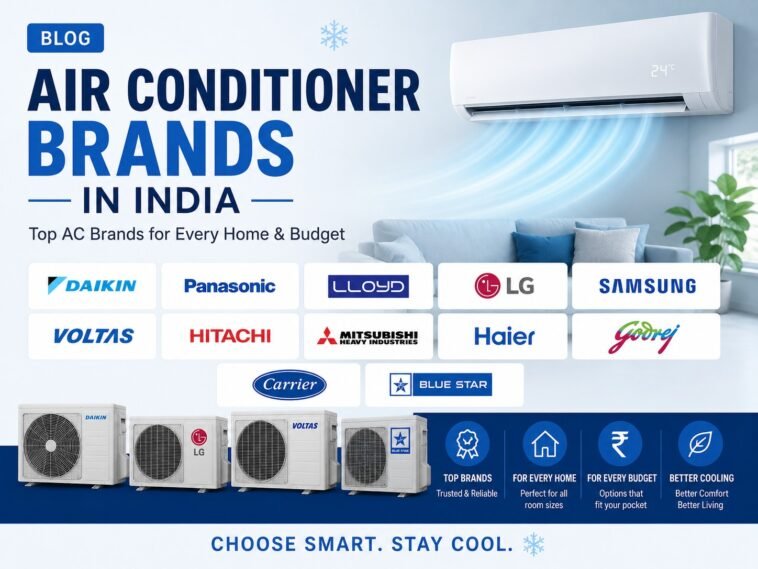
As global temperatures continue to rise, finding the right cooling solution has moved from a luxury to a necessity. The Indian air conditioning market has evolved rapidly, with 2026 seeing a massive shift toward AI-integrated cooling and ultra-high energy efficiency. Whether you are battling the dry heat of North India or the humid coastal air of the South, choosing the right brand can mean the difference between a massive electricity bill and a comfortable summer.
The Indian AC market is projected to grow at a staggering CAGR of nearly 15% through 2034, fueled by rapid urbanization and the increasing affordability of inverter technology. In this guide, we break down the top 10 air conditioner brands in India based on market share, cooling performance, and after-sales reliability.
Table of Contents
- Key Highlights & Quick Facts
- Top 10 Air Conditioner Brands in India
- Important Market Statistics
- Step-by-Step Guide: How to Choose Your AC
- Pros and Cons Comparison
- Current Trends in 2026
- Frequently Asked Questions
1. Key Highlights / Quick Facts
- Market Leader: Voltas remains the top-selling brand in India, particularly in the budget and mid-range segments.
- Efficiency Champion: Panasonic leads 2026 with the highest ISEER (Indian Seasonal Energy Efficiency Ratio) ratings, reaching up to 5.80.
- Best for Extreme Heat: Daikin and Blue Star are the preferred choices for regions where ambient temperatures cross 50°C.
- Technology Shift: Over 80% of new sales in 2026 are Inverter ACs, as consumers move away from fixed-speed models to save on power.
- Smart Features: AI-enabled cooling and Wi-Fi control are now standard in almost all mid-to-premium models.
2. Top 10 Air Conditioner Brands in India
1. Voltas (A TATA Product)
Voltas is widely considered the “people’s brand” in India. Being an Indian company under the Tata Group, they design products specifically for the harsh local climate. Their 2026 “Adjustable Inverter” range allows users to switch between multiple tonnages (e.g., 1.5 ton to 1 ton) depending on the number of people in the room.
- Best For: Reliability and widespread service network.
2. LG (Life’s Good)
LG has dominated the “Smart AC” segment. Their Dual Inverter technology uses two rotary cylinders to reduce vibration and noise, making them some of the quietest units available. Their “Ocean Black Protection” is a game-changer for coastal cities like Mumbai or Chennai, preventing coil corrosion from salty air.
- Best For: Low noise levels and smart home integration.
3. Daikin
Daikin is a Japanese giant known for industrial-grade cooling. HVAC engineers often recommend Daikin for its “Swing Compressor” technology, which reduces friction and lasts longer than standard compressors. Their build quality is often cited as the best in the industry.
- Best For: Heavy-duty usage and long-term durability.
4. Blue Star
Blue Star started as a commercial cooling company, and that DNA shows in their residential units. They offer some of the most powerful “Turbo Cooling” features that can bring down room temperature in minutes, even during a 48°C Delhi afternoon.
- Best For: Faster cooling in extremely hot climates.
5. Panasonic
In 2026, Panasonic has emerged as the leader in air purification and energy savings. Their MirAIe platform offers advanced AI schedules, while their Nanoe-G technology filters out bacteria and PM 2.5 particles, essentially acting as an air purifier and AC in one.
- Best For: Energy efficiency and indoor air quality.
6. Samsung
Samsung’s Bespoke AI series is perfect for the modern aesthetic. Their unique “WindFree” technology uses thousands of micro-holes to disperse air evenly, preventing that uncomfortable cold draft hitting your face.
- Best For: Stylish design and advanced AI features.
7. Hitachi
Hitachi is famous for its “Tropical Inverter” technology. Their units are designed to maintain 100% cooling capacity even when the outside temperature is soaring. The Hitachi Sumo series is particularly popular for large halls and master bedrooms.
- Best For: High-ambient cooling performance.
8. Lloyd (A Havells Brand)
Lloyd has gained significant market share by offering premium features like 5-in-1 convertible cooling at a price point lower than LG or Samsung. Their service through the Havells network is excellent in Tier-2 and Tier-3 cities.
- Best For: Value for money.
9. Haier
Haier is at the forefront of the “Self-Clean” revolution. Their Frost Self-Clean technology freezes the evaporator coil to trap dust and then melts it away, ensuring the AC stays efficient without frequent manual servicing.
- Best For: Low maintenance and innovative features.
10. Godrej
Godrej focuses on “Green” cooling. They were among the first to move entirely to eco-friendly refrigerants like R290 and R32. Their ACs are known for robust anti-corrosive coatings and affordable 5-star models.
- Best For: Environmentally conscious buyers on a budget.
3. Important Statistics Table
The Indian AC market in 2026 reflects a sophisticated consumer base that prioritizes long-term savings over initial cost.
| Metric | 2025 Data | 2026 Estimate |
| Market Size (Value) | $6.15 Billion | ~$7.07 Billion |
| Inverter AC Market Share | 72% | 84% |
| Highest Average ISEER | 5.40 | 5.80 |
| Leading Region (Sales) | North India (29%) | North India (31%) |
| Top 3 Brands Share | ~45% (Voltas, LG, Daikin) | ~48% |
4. Step-by-Step Guide: How to Choose Your AC
Selecting an AC isn’t just about picking a brand; it’s about matching the machine to your room.
- Calculate Tonnage: Use the 100 sq. ft. rule. A 1-ton AC is usually enough for 100 sq. ft., while 150 sq. ft. requires a 1.5-ton unit.
- Check the Star Rating: If you use your AC for more than 4 hours a day, a 5-star inverter AC will pay for its higher price in electricity savings within 2 years.
- Verify the Coil Material: Always opt for 100% Copper coils. They are easier to repair and have better heat exchange properties than aluminum.
- Evaluate After-Sales Service: Check which brand has a service center closest to your PIN code. Brands like Voltas and LG have the widest reach.
- Look for 2026 Trends: Prioritize units with PM 2.5 filters and convertible cooling modes.
5. Pros and Cons Comparison
| Brand | Major Pros | Major Cons |
| Voltas | Affordable; Massive service reach | Lacks some ultra-premium features |
| LG | Extremely quiet; Excellent smart app | Cooling can struggle in 52°C+ heat |
| Daikin | Incredible build quality; High durability | Slightly higher upfront cost |
| Panasonic | Best energy savings; Top-tier filtration | App can be complex for some users |
| Blue Star | Powerful airflow; Strong commercial tech | Industrial look/design |
6. Current Trends in 2026
- AI-Driven Cooling: ACs now use sensors to detect the number of people in a room and adjust the airflow direction and temperature automatically to save power.
- Hyper-Efficiency: With the BEE (Bureau of Energy Efficiency) tightening norms, 5-star ACs in 2026 are nearly 15% more efficient than those from 2023.
- Eco-Friendly Refrigerants: A total phase-out of older, ozone-depleting refrigerants is nearly complete, with R32 becoming the industry standard.
- Voice Control: Integration with Matter (the smart home standard) allows users to control ACs across different ecosystems like Apple Home, Google Home, and Alexa seamlessly.
7. Frequently Asked Questions (FAQs)
Q1: Which is better, a 3-star or a 5-star AC?
A 5-star AC is roughly 20–25% more energy-efficient than a 3-star model. If you use your AC heavily (summers in India), the 5-star model is a much better investment.
Q2: Is an Inverter AC worth the extra cost?
Yes. Unlike fixed-speed ACs that turn on and off, inverter compressors run at variable speeds. This results in consistent cooling, less noise, and significantly lower electricity bills.
Q3: Which brand has the best after-sales service in India?
Voltas and LG generally rank highest due to their extensive service networks that cover both urban and rural areas.
Q4: How often should I service my AC?
For the Indian climate, it is recommended to do a basic filter cleaning every 15 days and a professional wet service twice a year (before and after the peak summer season).
Q5: Can I run a 1.5-ton AC on a home inverter?
Most standard home inverters cannot handle the startup load of an AC. You would need a high-capacity solar inverter or a specific “AC-ready” power backup system.
References
- Bureau of Energy Efficiency (BEE) – India
- Department of Consumer Affairs – India
- International Energy Agency (IEA) – Cooling Reports
- IMARC Group – India AC Market Analysis
Air Conditioner Buying Guide 2026
This video provides a practical breakdown of the latest 2026 AC models, comparing real-world cooling performance and energy efficiency between top brands like Daikin, LG, and Panasonic.



GIPHY App Key not set. Please check settings