 kiruthika
Hook Introduction
Some restaurants make you sign a legal waiver before they’ll serve you phaal curry, a dish nicknamed “the world’s hottest curry” that regularly measures over a million Scoville units.
We compared verified Scoville data and traditional culinary sources to rank the ten spiciest dishes people actually eat around the world, not raw peppers eaten as a dare, but real dishes with genuine culinary traditions behind them.
Key Highlights (Quick Facts)
- Phaal curry, an Anglo-Bangladeshi dish credited to a Birmingham curry house, is nicknamed “the world’s hottest curry” and has measured as high as 1.2 million Scoville Heat Units (SHU) — hotter than many raw habaneros.
- The Scoville scale, developed by pharmacist Wilbur Scoville in 1912, measures capsaicin concentration; modern testing uses High-Performance Liquid Chromatography (HPLC) for far more precise results than the original taste-test method.
- Some restaurants serving phaal curry require customers to sign a consent form before eating it, given the dish’s genuinely extreme heat level.
- Pepper X, tested at 2,693,000 SHU by Winthrop University in South Carolina, has officially overtaken the Carolina Reaper (2.2 million SHU) as the world’s hottest pepper, and both increasingly show up in extreme-heat dish preparations.
- Samyang’s Buldak fire noodles publish their Scoville rating directly on the packaging, with standard variants around 4,404 SHU — roughly between Tabasco sauce and a jalapeño, while limited-release versions climb toward 13,000 SHU.
- Traditional spicy dishes often layer heat through multiple techniques — fermented chilies for deeper capsaicin concentration, combinations of fresh and dried peppers, and numbing agents like Sichuan peppercorns that create a completely different sensation than pure capsaicin heat.
- Many extremely spicy dishes traditionally pair heat with cooling elements like coconut milk, yogurt, or citrus, reflecting centuries of culinary refinement rather than heat for its own sake.
- Genuine medical risks from extremely spicy food are generally limited to specific groups: people with GERD, severe acid reflux, cardiovascular conditions, capsaicin sensitivity, and young children.
A Quick Safety Note Before You Read Further
This article is meant to celebrate spicy food traditions from around the world, not encourage risky eating challenges. Several dishes on this list are genuinely extreme by design, and a few restaurants require waivers specifically because reactions can include intense pain, vomiting, or, in rare cases, more serious complications for people with underlying health conditions.
If you have GERD, acid reflux, a cardiovascular condition, or a known sensitivity to capsaicin, it’s worth talking to a doctor before attempting anything at the top end of this list. And if you do try one of these dishes, have dairy (milk or yogurt) on hand rather than water, capsaicin is fat-soluble, not water-soluble, so water alone won’t meaningfully cut the heat.
How We Ranked These Dishes
We weighed three things: documented or widely reported Scoville heat levels specific to the prepared dish (not just the raw pepper), the strength of the dish’s traditional culinary reputation, and genuine cultural and regional significance, since a dish’s fame as “extremely spicy” usually reflects real culinary history, not just a modern social-media stunt.
We focused on dishes with an actual traditional or commercial identity, meals people genuinely cook and eat, rather than raw pepper-eating challenges or novelty stunt foods with no real culinary tradition behind them.
The Top 10 Spiciest Dishes in the World
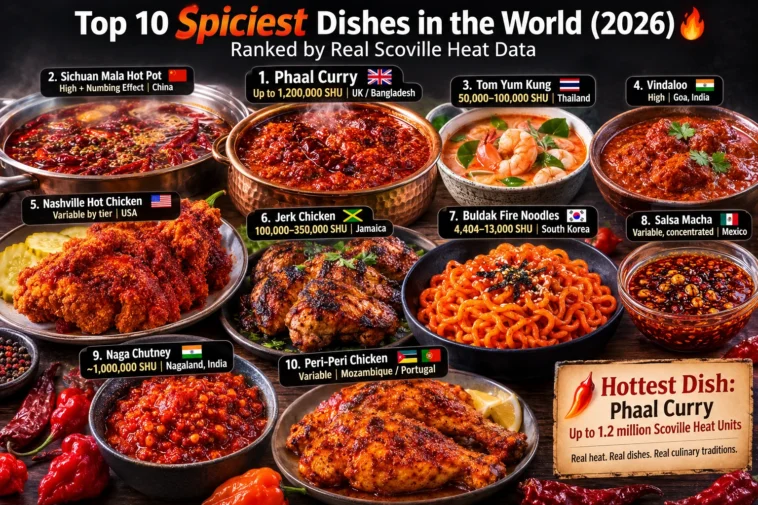
1. Phaal Curry (United Kingdom / Bangladesh)
Phaal curry holds the reputation as “the world’s hottest curry,” an Anglo-Bangladeshi dish credited to a Birmingham curry house that’s since spread to curry restaurants well beyond the UK. It’s traditionally made using as many as 10 different types of chili pepper, including bhut jolokia (ghost pepper) and naga chili, pushing measured heat as high as 1.2 million Scoville Heat Units.
The dish’s reputation is serious enough that some restaurants require customers to sign a consent waiver before ordering it, a level of formal caution rarely seen attached to a menu item. Despite the extreme heat, phaal is still built as a genuine curry, layered with real spice complexity rather than heat alone, distinguishing it from pure pepper-eating challenges.
Heat level: Up to ~1.2 million SHU. Origin: Birmingham, UK (Anglo-Bangladeshi cuisine). What it is: An extremely hot curry made with up to 10 chili varieties.
2. Sichuan Mala Hot Pot (China)
Sichuan mala hot pot delivers a genuinely different kind of heat than most dishes on this list, “mala” literally translates to “numbing and spicy,” combining fiery chili oil with Sichuan peppercorns, which create a distinctive tingling, numbing sensation on top of standard capsaicin burn.
This dual-sensation heat, burning plus numbing simultaneously, is part of what makes Sichuan cuisine’s approach to spice culinarily distinct from most other spicy food traditions worldwide, and it’s built around communal cooking, with diners cooking meat, vegetables, and noodles directly in the bubbling, chili-laden broth at the table.
Heat level: Variable, often very high, plus numbing peppercorn effect. Origin: Sichuan Province, China. What it is: Communal hot pot with chili oil and numbing Sichuan peppercorns.
3. Tom Yum Kung (Thailand)
Tom yum kung is Thailand’s iconic hot and sour soup, built on a base of lemongrass, galangal, kaffir lime leaves, and, crucially, bird’s eye chilies, among the hottest chilies commonly used in everyday Southeast Asian cooking, typically ranging from 50,000 to 100,000 SHU per pepper.
What sets tom yum apart from purely punishing heat is genuine flavor balance: the dish layers sour (lime juice), salty (fish sauce), and aromatic herbal notes alongside the chili heat, making it a dish that’s famous worldwide for complexity as much as spiciness, typically served with shrimp as the traditional protein.
Heat level: High, driven by bird’s eye chilies (50,000-100,000 SHU per pepper). Origin: Thailand. What it is: Hot and sour soup with shrimp, lemongrass, and chili.
4. Vindaloo (Goa, India)
Vindaloo originated in Goa, India, evolving from a Portuguese pork-and-wine-vinegar dish into a distinctly Indian curry built around vinegar, red chili peppers, garlic, and a complex spice blend. Traditional Goan vindaloo leans on dried red chilies for both color and serious heat, distinguishing it from the milder, tomato-heavy versions often served at Western Indian restaurants.
Authentic vindaloo is considerably spicier than the commercialized versions most diners outside India encounter, and its vinegar base gives it a distinctive tang that sets it apart from most other extremely spicy curries on this list, reflecting its unique Portuguese-Indian culinary fusion history.
Heat level: High, especially in authentic Goan preparations. Origin: Goa, India (Portuguese-Indian fusion). What it is: Vinegar-based chili curry, traditionally made with pork.
5. Nashville Hot Chicken (United States)
Nashville hot chicken is fried chicken coated in a cayenne-pepper-loaded paste, applied after frying to create an intensely spicy, deep-red crust that’s become one of the most recognized American contributions to global spicy food culture. Its origin story is famously specific: legend credits it to a woman’s revenge recipe for an unfaithful partner, intended to punish him with extreme spice.
Most Nashville hot chicken restaurants offer graduated heat levels, from mild to “extra hot” or “shut the front door” tiers that push well into genuinely painful territory, giving diners meaningful control over their heat exposure in a way many other dishes on this list don’t offer.
Heat level: Variable by tier, top tiers genuinely extreme. Origin: Nashville, Tennessee, USA. What it is: Fried chicken coated in a cayenne-based hot paste.
6. Jerk Chicken (Jamaica)
Jerk chicken is built around Scotch bonnet peppers, close relatives of habaneros, typically ranging from 100,000 to 350,000 SHU, combined with allspice, thyme, and a marinade traditionally applied well before cooking over pimento wood for a distinctive smoky flavor alongside the chili heat.
The dish’s Scotch bonnet base gives it a genuinely fruity, slightly sweet heat profile that distinguishes it from the drier, more purely fiery character of many other dishes on this list, reflecting Jamaica’s specific culinary tradition of balancing intense spice with aromatic, herb-forward complexity.
Heat level: High, driven by Scotch bonnet peppers (100,000-350,000 SHU). Origin: Jamaica. What it is: Marinated, smoke-grilled chicken with Scotch bonnet heat.
7. Buldak Fire Noodles (South Korea)
Samyang’s Buldak (“fire chicken”) noodles are the most globally recognized commercial spicy noodle brand, and unlike many dishes on this list, the company publishes exact Scoville ratings directly on the packaging — Original Buldak sits around 4,404 SHU, roughly between Tabasco sauce and a standard jalapeño, while limited-release variants like “3x Spicy” push toward 13,000 SHU.
Buldak’s viral popularity through social media eating challenges has made it one of the most widely attempted “extreme spice” foods among younger consumers globally, even though its actual Scoville rating sits considerably below several traditional dishes elsewhere on this list, a reminder that perceived intensity and measured heat don’t always align perfectly.
Heat level: ~4,404 SHU (Original); up to ~13,000 SHU (3x Spicy limited release). Origin: South Korea. What it is: Spicy instant stir-fry noodles, published Scoville rating.
8. Salsa Macha (Mexico)
Salsa macha is a Mexican chili oil condiment built from dried chilies, often morita, guajillo, or árbol, toasted and blended with oil, nuts, and seeds, delivering a rich, textured heat that’s meant to be drizzled over dishes rather than eaten as a standalone item, giving it a different role in a meal than most dishes on this list.
Its fermented and toasted preparation technique concentrates capsaicin in a way that raw chili preparations don’t, and it’s increasingly recognized internationally as a distinctly Mexican approach to chili oil, standing alongside Chinese chili oil and other global hot-oil condiment traditions.
Heat level: Variable, concentrated by toasting and oil infusion. Origin: Mexico. What it is: Toasted dried-chili oil condiment.
9. Naga Chutney / Bhut Jolokia Preparations (Nagaland, India)
Nagaland, in northeastern India, is the traditional home of the bhut jolokia (ghost pepper), which measures around 1 million SHU and was, until relatively recently, certified as the world’s hottest chili by Guinness World Records. Traditional Naga cuisine incorporates ghost pepper directly into chutneys and pork preparations, representing one of the few culinary traditions built specifically around this particular extreme chili.
Unlike phaal curry, which imports the ghost pepper into an Anglo-Bangladeshi dish, Naga chutney preparations reflect the pepper’s genuine indigenous culinary home, where it’s used not as a novelty but as an integral part of everyday regional cooking.
Heat level: ~1 million SHU (ghost pepper base). Origin: Nagaland, India. What it is: Ghost pepper chutney, traditionally paired with pork and rice.
10. Peri-Peri Chicken (Mozambique / Portugal)
Peri-peri chicken is built around the African bird’s eye chili (peri-peri), brought into Portuguese culinary tradition through colonial-era trade routes between Mozambique and Portugal, creating a distinctly Afro-Portuguese fusion dish that’s since spread globally through commercial chains.
The traditional peri-peri marinade combines the chili with garlic, lemon, and herbs, and while commercial versions served internationally are often toned down considerably, authentic peri-peri preparations in Mozambique and parts of Southern Africa can reach genuinely serious heat levels well beyond what most diners encounter at global chain restaurants bearing the name.
Heat level: Variable, authentic versions notably hotter than commercial exports. Origin: Mozambique/Portugal (Afro-Portuguese fusion). What it is: Grilled chicken marinated in African bird’s eye chili sauce.
Important Statistics Table
| Rank | Dish | Approx. Heat Level | Origin | Primary Chili Used |
| 1 | Phaal Curry | Up to 1.2 million SHU | UK/Bangladesh | Bhut jolokia, naga chili (blend of 10) |
| 2 | Sichuan Mala Hot Pot | High + numbing effect | China | Sichuan chili oil + peppercorns |
| 3 | Tom Yum Kung | High (50,000-100,000 SHU peppers) | Thailand | Bird’s eye chili |
| 4 | Vindaloo | High | Goa, India | Dried red chilies |
| 5 | Nashville Hot Chicken | Variable by tier | USA | Cayenne pepper |
| 6 | Jerk Chicken | High (100,000-350,000 SHU) | Jamaica | Scotch bonnet |
| 7 | Buldak Fire Noodles | ~4,404-13,000 SHU (published) | South Korea | Gochugaru + chili blend |
| 8 | Salsa Macha | Variable, concentrated | Mexico | Morita, guajillo, árbol |
| 9 | Naga Chutney | ~1 million SHU | Nagaland, India | Bhut jolokia (ghost pepper) |
| 10 | Peri-Peri Chicken | Variable, authentic > commercial | Mozambique/Portugal | African bird’s eye chili |
Sources: Erudus 2026, Drool Recipes 2026, NoodleDex 2026, Casa Flake 2025, Oro del Salento 2026. Scoville figures for prepared dishes vary by preparation and recipe; figures represent typical or documented ranges rather than a single fixed measurement.
Step-by-Step: How to Safely Try Extremely Spicy Food
- Start lower on this list, not at #1. Buldak noodles or a mild-tier Nashville hot chicken are far more approachable starting points than phaal curry or Naga chutney.
- Eat a real meal beforehand, never on an empty stomach. Extreme capsaicin on an empty stomach significantly increases the risk of nausea and discomfort.
- Keep dairy nearby, not water. Capsaicin is fat-soluble, so milk, yogurt, or a dairy-based lassi will cut the heat far more effectively than water, which just spreads the capsaicin around your mouth.
- Know your own risk factors before attempting the top-tier dishes. GERD, acid reflux, cardiovascular conditions, and known capsaicin sensitivity are all reasons to be genuinely cautious with anything above moderate heat.
- Never eat extreme-heat dishes as a solo dare with no one else present. Rare but real medical complications have occurred with extreme chili challenges, having someone else around matters.
- Respect posted consent forms and heat warnings. If a restaurant asks you to sign a waiver before serving a dish, that’s a genuine signal about real risk, not just marketing.
Pros and Cons Table
| Dish | Pros | Cons |
| Phaal Curry | Genuine culinary complexity, not just heat | Extreme even by “very spicy” standards; some restaurants require waivers |
| Sichuan Mala Hot Pot | Unique dual heat-plus-numbing sensation | Can be overwhelming for those unfamiliar with peppercorn numbing |
| Tom Yum Kung | Well-balanced flavor alongside heat | Bird’s eye chilies can still catch unprepared diners off guard |
| Vindaloo | Distinctive tangy vinegar-chili balance | Authentic versions much spicier than Western restaurant norms |
| Nashville Hot Chicken | Graduated heat tiers let you control intensity | Top tiers are genuinely, seriously hot |
| Jerk Chicken | Complex, smoky, herb-forward flavor | Scotch bonnet heat can surprise those expecting mild “jerk seasoning” |
| Buldak Fire Noodles | Published Scoville rating, widely available | Actual heat lower than its viral reputation suggests |
| Salsa Macha | Versatile condiment, adjustable heat by amount used | Easy to underestimate concentration and over-apply |
| Naga Chutney | Authentic, traditional use of the ghost pepper | Extremely hot; less internationally available |
| Peri-Peri Chicken | Widely available, adjustable heat levels commercially | Commercial versions often much milder than authentic originals |
Comparison Table: Spiciest Dish by Region
| Region | Signature Spiciest Dish | Heat Style | Primary Chili |
| South Asia (India/Bangladesh) | Phaal Curry / Vindaloo | Complex, layered curry heat | Bhut jolokia, dried red chilies |
| East Asia (China) | Sichuan Mala Hot Pot | Burning + numbing combination | Chili oil + Sichuan peppercorns |
| Southeast Asia (Thailand) | Tom Yum Kung | Balanced sour-spicy-aromatic | Bird’s eye chili |
| North America (USA) | Nashville Hot Chicken | Graduated, controllable heat tiers | Cayenne pepper |
| Caribbean (Jamaica) | Jerk Chicken | Smoky, fruity, herb-forward heat | Scotch bonnet |
| East Asia (South Korea) | Buldak Fire Noodles | Published, precise commercial heat | Gochugaru chili blend |
| Latin America (Mexico) | Salsa Macha | Toasted, concentrated condiment heat | Morita, guajillo, árbol |
| Northeast India (Nagaland) | Naga Chutney | Pure, traditional ghost pepper heat | Bhut jolokia |
| Southern Africa (Mozambique) | Peri-Peri Chicken | Marinated, herb-and-citrus heat | African bird’s eye chili |
2026 News and Trends
The clearest 2026 trend in extreme-spice food is the shift toward precise, published measurement. Brands like Samyang now print exact Scoville ratings directly on packaging, and modern pepper testing increasingly relies on High-Performance Liquid Chromatography (HPLC) rather than the original 1912 taste-test method — a move toward genuine scientific precision in an area long dominated by marketing claims and folklore.
The pepper-breeding arms race continues too: Pepper X, verified at 2,693,000 SHU by Winthrop University, has officially overtaken the Carolina Reaper as the world’s hottest pepper, and its increasing availability to farmers and chefs is likely to influence a new wave of extreme-heat dish experimentation over the next few years.
At the same time, food science commentary increasingly emphasizes that heat is a tool, not a goal — the dishes that endure culturally, from phaal curry to jerk chicken, tend to be the ones that layer genuine flavor complexity alongside extreme heat, rather than relying on capsaicin alone. Multiple 2026 food-science sources specifically note that fermented chilies, dual fresh-and-dried pepper combinations, and cooling counterpoints like coconut milk or citrus remain the techniques separating celebrated spicy dishes from pure pain-based novelty food.
Conclusion
Phaal curry’s reputation as “the world’s hottest curry” holds up under real Scoville measurement, but the more interesting story across this list is how differently cultures approach extreme heat — Sichuan’s numbing mala, Jamaica’s smoky Scotch bonnet, and Korea’s precisely published commercial ratings all represent genuinely distinct culinary traditions, not just a race toward pain.
Whichever dish you’re brave enough to try, start below your assumed tolerance, keep dairy nearby, and remember that the best versions of these dishes balance real flavor complexity alongside their heat.
References
- Erudus – The Spiciest Foods List: https://erudus.com/editorial/the-food-agenda/the-spiciest-foods-list
- Drool Recipes – What Is the Spiciest Food: The World’s Hottest Dishes Ranked by Scoville: https://droolrecipes.com/spiciest-food/
- NoodleDex – Top 10 Spiciest Noodles in the World: 2026 Scoville Ranking: https://www.noodledex.com/guides/spiciest-noodles-ranked
- Casa Flake – Hottest Pepper in the World 2026: Top 10 Ranked by Scoville: https://casaflake.com/blogs/the-spice-journal/hottest-pepper-in-the-world-the-complete-2025-guide
- Oro del Salento – Top 10 Spiciest Chili Peppers in the World (2026 Scoville Ranking): https://www.orodelsalento.com/en/news/the-10-most-spicy-chili-peppers-in-the-world/
- FrutPlanet – 11+ Hottest Chillies in the World 2026: Ranked by Scoville: https://frutplanet.com/hottest-chillies-in-the-world-today/
- In the Kitchen with Alexandra – The Top 10 Spiciest Foods from Around the World: https://inthekitchenwithalexandra.com/blogs/pikliz-perfected/the-top-10-spiciest-foods-from-around-the-world
FAQs
Phaal curry is widely nicknamed “the world’s hottest curry,” with measured heat reaching as high as 1.2 million Scoville Heat Units — hot enough that some restaurants require customers to sign a consent waiver before ordering it.
The Scoville scale measures capsaicin concentration, the compound responsible for a pepper’s heat. Developed in 1912 by pharmacist Wilbur Scoville, it originally relied on a taste-test method; modern testing uses High-Performance Liquid Chromatography (HPLC) for far more precise, lab-verified results.
Regular chili heat comes purely from capsaicin, which creates a burning sensation. Sichuan “mala” heat combines that burning with Sichuan peppercorns, which create a distinct numbing or tingling sensation — a genuinely different, dual sensory experience unique to Sichuan cuisine.
By measured Scoville rating, Original Buldak noodles sit around 4,404 SHU — roughly between Tabasco sauce and a jalapeño, considerably milder than several traditional dishes on this list, despite their significant viral reputation for extreme spice.
Dairy products like milk or yogurt work far better than water, since capsaicin is fat-soluble rather than water-soluble. Water alone tends to just spread the capsaicin around your mouth rather than neutralizing it.
For most healthy adults, extremely spicy food causes intense but temporary discomfort rather than lasting harm. However, genuine medical risks are more significant for people with GERD, severe acid reflux, cardiovascular conditions, capsaicin sensitivity, and young children, so caution is warranted for these groups specifically.
Pepper X, tested at 2,693,000 Scoville Heat Units by Winthrop University in South Carolina, has officially overtaken the Carolina Reaper (2.2 million SHU) as the current record holder for the world’s hottest pepper.


![Top 10 Best Chocolate Brands in the World 2026 Hook Introduction Ferrero just beat Nestlé, Hershey, and Lindt to claim third place among the world's biggest confectionery companies, and its 4.5% growth rate was the strongest of any major chocolate maker tracked in 2026. We compared verified 2026 revenue, growth, and heritage data across the chocolate brands actually dominating shelves and gift boxes worldwide, from mass-market giants to Belgian luxury houses. Key Highlights (Quick Facts) Ferrero ranks third among the world's biggest confectionery companies at an $18 billion global value, posting the strongest growth rate (4.5% CAGR) of any major chocolate maker tracked in 2026. Mars, Incorporated remains the largest confectionery manufacturer in the world by net sales, even though Reese's Peanut Butter Cups (a Hershey product) is frequently cited as the single top-selling candy brand globally. Mondelez International, owner of Cadbury, Milka, and Toblerone, reported $39.3 billion in revenue in FY2026, making it one of the largest snack companies in the world, not just a chocolate maker. Lindt & Sprüngli generated $7.44 billion in sales in FY2025, with 12.4% organic growth and $1.22 billion in operating income — among the strongest financial performances in the premium chocolate segment. The global chocolate market was valued at $48.20 billion in 2025 and is projected to reach $77.77 billion by 2035, growing at a 4.90% CAGR. Europe accounts for roughly 43-45.5% of global chocolate revenue, making it by far the largest chocolate-consuming and producing region in the world. Switzerland has one of the highest per-capita chocolate consumption rates globally, averaging 10-11 kilograms per person annually. Just three companies — Mars, Mondelez, and Ferrero — collectively control approximately 65% of the global confectionery market's total revenue. How We Ranked These Brands We weighed four things: verified global revenue and market value, recent growth momentum, heritage and craftsmanship reputation, and genuine global reach versus regional concentration. We deliberately included both mass-market giants and premium/luxury houses, since "best" means something different depending on whether you're grabbing a bar at checkout or buying a gift box for a special occasion. Figures come from company earnings reports and industry market-research firms including Expert Market Research and Global Growth Insights, cross-referenced against 2026 confectionery-industry news coverage. The Top 10 Best Chocolate Brands in the World 1. Mars, Incorporated (USA) Mars remains the largest confectionery manufacturer in the world by net sales, a position it's held for years thanks to a portfolio spanning M&M's, Snickers, Twix, Dove, and Galaxy, sold across virtually every country with a functioning retail sector. As a privately held company, Mars doesn't disclose detailed public financials the way its publicly traded competitors do, but industry analysts consistently rank it at or near the very top of global confectionery by scale. Interestingly, Mars' overall manufacturing dominance doesn't necessarily translate to owning the single best-selling individual candy brand; that distinction is frequently credited to Hershey's Reese's Peanut Butter Cups, illustrating how total company scale and individual product popularity can produce genuinely different "biggest" answers. Standout strength: Largest confectionery manufacturer globally by net sales. Key brands: M&M's, Snickers, Twix, Dove, Galaxy. 2. Ferrero (Italy) Ferrero delivered the most impressive growth story in confectionery for 2026, ranking third among the world's biggest confectionery companies at an $18 billion global value, beating out Nestlé, Hershey, and Lindt, while posting the strongest growth rate of any major player tracked, at 4.5% CAGR. Ferrero's portfolio includes Nutella, Kinder, Ferrero Rocher, Tic Tac, and Butterfinger, with Ferrero Rocher specifically dominating the global "gifting" segment through an "affordable luxury" positioning that's proven especially strong in markets like China, generating roughly $13 billion in revenue for that segment alone. The company's Kinder brand, created by Michele Ferrero and built specifically around child-friendly, parent-trusted products, has become one of the most successful multi-brand ecosystems in confectionery since its 1968 founding in Italy. Standout strength: Strongest growth rate (4.5% CAGR) among major chocolate companies. Key brands: Nutella, Kinder, Ferrero Rocher, Tic Tac. 3. Mondelez International (Global, HQ USA) Mondelez International, the parent company behind Cadbury, Milka, and Toblerone, reported $39.3 billion in revenue in FY2026, positioning it as one of the largest snack companies in the world broadly, not just within chocolate specifically. Its chocolate portfolio functions almost like a "European chocolate passport," as one 2026 industry analysis put it, Cadbury Dairy Milk dominates in Commonwealth nations, Toblerone's distinctive triangular peaks are a fixture of duty-free stores worldwide, and Milka holds strong regional loyalty from Germany through Austria and Eastern Europe. That said, regional brand fragmentation across so many distinct identities somewhat dilutes Mondelez's overall global volume leadership compared to more unified single-brand competitors. Standout strength: Broadest multi-regional brand portfolio in chocolate. Key brands: Cadbury, Milka, Toblerone. 4. Nestlé S.A. (Switzerland) Nestlé remains one of the foundational names in global chocolate, operating from Switzerland — a country with one of the highest per-capita chocolate consumption rates on Earth, averaging 10-11 kilograms per person annually. As one of the world's largest food and beverage companies overall, Nestlé's chocolate division benefits from immense manufacturing scale and distribution reach that few pure-play chocolate companies can match. Switzerland's broader chocolate industry, anchored by Nestlé alongside Lindt & Sprüngli and Barry Callebaut, has built a national reputation for quality and precision that continues to shape how "Swiss chocolate" is perceived as a premium category worldwide, independent of any single brand. Standout strength: Massive global manufacturing scale, anchored in Swiss chocolate heritage. Key brands: Nestlé chocolate range, KitKat (in most global markets). 5. Lindt & Sprüngli (Switzerland) Lindt & Sprüngli posted $7.44 billion in sales in FY2025, with an impressive 12.4% organic growth rate and $1.22 billion in operating income — among the strongest financial performances of any chocolate company tracked in 2026, premium or mass-market. Founded in 1845, Lindt pioneered advanced conching techniques that fundamentally transformed chocolate smoothness and remain foundational to how premium chocolate is manufactured today. Its portfolio spans Lindor truffles (famous for their signature melt-in-the-middle centers), Lindt Excellence bars, and — notably — it also owns Ghirardelli and Russell Stover, meaning Lindt's actual market reach extends well beyond what the flagship Lindt name alone suggests. Standout strength: Strongest organic growth (12.4%) among premium chocolate makers; pioneered modern conching technique. Key brands: Lindt, Lindor, Ghirardelli, Russell Stover. 6. The Hershey Company (USA) Hershey remains the dominant American chocolate name, and while Mars leads confectionery manufacturing by overall net sales, Hershey's Reese's Peanut Butter Cups is frequently cited as the single top-selling candy brand globally by individual product — a genuinely different kind of leadership than total company scale. Hershey's broader portfolio, including Kit Kat (in the US market specifically), Kisses, and its namesake milk chocolate bars, has built deep multi-generational brand loyalty in North America, even as the company faces increasing competition from premium and craft chocolate makers gaining share in categories Hershey has historically dominated. Standout strength: Reese's Peanut Butter Cups is the top-selling individual candy brand globally. Key brands: Hershey's, Reese's, Kisses. 7. Godiva (Belgium) Godiva has been synonymous with luxury, elegance, and gifting since its founding in Brussels in 1926, named after the legendary noblewoman Lady Godiva. The brand built its reputation on premium truffles, pralines, chocolate gift boxes, and seasonal collections, positioning itself firmly in the gifting and self-indulgence category rather than everyday mass-market chocolate. As part of the Belgian chocolate tradition — a country that exports to more than 150 countries and hosts other renowned houses like Neuhaus, Leonidas, and Guylian — Godiva represents the internationally best-known face of Belgian chocolate craftsmanship, balancing rich cocoa flavor with smooth textures that appeal to both casual buyers and dedicated chocolate collectors. Standout strength: Most globally recognized name in Belgian luxury chocolate. Key products: Truffles, pralines, premium gift boxes. 8. Ghirardelli Chocolate Company (USA) Ghirardelli occupies a distinctive position as an American chocolate brand with genuine premium credibility, known specifically for its reliable, high-quality chocolate squares that have become a staple in both everyday and gifting contexts across the US. Though now owned by Switzerland's Lindt & Sprüngli, Ghirardelli maintains its own distinct brand identity and San Francisco heritage. Its accessible premium positioning — genuinely better quality than typical mass-market bars, but priced and distributed for everyday purchase rather than pure luxury gifting — has made it one of the most consistently recommended "step-up" chocolate brands in comparative reviews. Standout strength: Best-regarded accessible-premium American chocolate brand. Key products: Chocolate squares, baking chocolate, chocolate sauces. 9. Ritter Sport (Germany) Ritter Sport represents German chocolate craftsmanship at meaningful commercial scale, generating an estimated $733 million in annual sales in Germany alone. Its distinctive square-shaped bars and wide range of flavor varieties have made it one of the most recognizable European chocolate brands, alongside a growing commitment to sustainable and ethically sourced Alpine milk. Germany's broader chocolate market, valued at over $12 billion and producing more than 1.3 million metric tons annually, is anchored significantly by Ritter Sport alongside August Storck and German operations of Ferrero and Lindt, reflecting the country's position as one of Europe's most important chocolate-producing markets. Standout strength: Distinctive branding and strong domestic German market performance. Key products: Square-format chocolate bars in extensive flavor varieties. 10. Patchi (Lebanon / Middle East) Patchi rounds out the list as the leading premium chocolate brand across the Middle East, particularly prominent in the UAE and Saudi Arabia's rapidly growing luxury confectionery markets. The UAE's chocolate market is growing at roughly 5-6% annually, and Saudi Arabia's chocolate market alone exceeds $1 billion, with Patchi positioned as a genuine premium leader alongside international names like Ferrero, Lindt, and Godiva operating in the same region. Patchi's emphasis on elaborate gift packaging and presentation reflects the Middle East market's particularly strong demand for premium gifting chocolate, a category that accounts for a significant share of regional chocolate spending and continues to grow alongside rising disposable incomes across the Gulf states. Standout strength: Leading premium chocolate brand across the Middle East gifting market. Key products: Elaborately packaged pralines and gift assortments. Important Statistics Table Rank Brand Country 2026 Financial Signal Category 1 Mars, Incorporated USA Largest confectionery maker by net sales Mass-market 2 Ferrero Italy $18B value; strongest growth (4.5% CAGR) Premium/mass hybrid 3 Mondelez International USA/Global $39.3B revenue (FY2026) Mass-market 4 Nestlé S.A. Switzerland Major global food/beverage scale Mass-market 5 Lindt & Sprüngli Switzerland $7.44B sales; 12.4% organic growth (FY2025) Premium 6 The Hershey Company USA Reese's = top-selling individual candy brand Mass-market 7 Godiva Belgium Est. 1926; leading Belgian luxury export Luxury/gifting 8 Ghirardelli USA Owned by Lindt; accessible-premium leader Accessible premium 9 Ritter Sport Germany ~$733M annual sales in Germany alone Mid-premium 10 Patchi Lebanon/MEA Leading premium brand in $1B+ Saudi market Luxury/gifting Sources: Expert Market Research 2026, RankRed 2026, ConfectioneryNews 2026, Global Growth Insights 2026, Global Brands Magazine 2026. Revenue figures reflect most recently reported fiscal-year data as of 2026; some privately held companies (Mars, Patchi) don't disclose full public financials. Step-by-Step: How to Choose the Right Chocolate Brand for the Occasion Identify the occasion first. Everyday snacking favors Hershey's, Mars, or Cadbury; gifting and special occasions favor Godiva, Lindt, or Patchi. Match your budget to the right tier. Ghirardelli and Ritter Sport offer genuine step-up quality without full luxury pricing; Godiva and Patchi sit at the premium gifting end. Consider the recipient's regional taste preferences. Cadbury Dairy Milk resonates strongly in Commonwealth countries; Ferrero Rocher performs especially well as a gift in Asian markets, particularly China. Check for specific dietary or sourcing preferences. Several major brands, including Ritter Sport and Lindt, have made public commitments to sustainable and ethical cocoa sourcing worth checking if this matters to you. Think about format needs. Baking or dessert-making favors Ghirardelli's baking chocolate line; elaborate gift presentation favors Godiva or Patchi's packaging-forward approach. Don't assume company size equals individual product popularity. Mars leads by total company scale, but Hershey's Reese's is frequently the single top-selling candy brand — the "best" answer depends on what you're actually measuring. Pros and Cons Table Brand Pros Cons Mars, Incorporated Massive global scale and availability Privately held; less financial transparency than public competitors Ferrero Strongest growth momentum, strong gifting positioning Premium pricing relative to standard mass-market bars Mondelez International Broadest multi-regional brand portfolio Regional brand fragmentation dilutes single-brand identity Nestlé S.A. Enormous manufacturing scale and distribution Chocolate is one of many divisions, less specialized focus Lindt & Sprüngli Strongest organic growth among premium makers Premium pricing limits mass-market footprint The Hershey Company Deep North American brand loyalty Facing growing competition from premium/craft chocolate Godiva Iconic luxury gifting reputation Premium price point, less everyday accessibility Ghirardelli Genuine quality step-up at accessible pricing Less internationally known than European luxury houses Ritter Sport Distinctive branding, strong sustainability commitments Smaller global footprint than the largest multinationals Patchi Leading Middle East premium gifting brand Less globally recognized outside the MEA region Comparison Table: Best Chocolate Brand by What You Need Your Need Best Pick Runner-Up Why Everyday affordable chocolate Mars/Hershey's Cadbury Widest availability at accessible pricing Premium gifting Godiva Patchi Iconic luxury gift-box reputation Best growth/momentum brand Ferrero Lindt & Sprüngli Strongest 2026 CAGR among major chocolate makers Baking and dessert use Ghirardelli Lindt Dedicated baking chocolate lines, reliable melt quality Swiss milk chocolate specifically Lindt Nestlé Pioneered conching; strongest premium Swiss reputation Middle East/Gulf gifting market Patchi Ferrero Rocher Regional premium leader with elaborate packaging Distinctive flavor variety Ritter Sport Milka (Mondelez) Extensive square-format flavor range Largest overall company Mars, Incorporated Mondelez International Largest confectionery manufacturer by net sales 2026 News and Trends The clearest 2026 storyline is Ferrero's surprising rise to third place among the world's biggest confectionery companies, beating Nestlé, Hershey, and Lindt at an $18 billion valuation while posting the strongest growth rate (4.5% CAGR) of any major player tracked — a genuine shift in the competitive order among chocolate's biggest names. Consolidation of market power continues at the very top: Mars, Mondelez, and Ferrero collectively control roughly 65% of the entire global confectionery market's revenue, reinforcing how concentrated this industry remains even as premium and craft chocolate brands gain visibility in specific niches. Regional gifting markets are becoming a genuine growth battleground, particularly in the Middle East, where the UAE and Saudi Arabia's premium chocolate markets are both expanding at 5-6% annually, driven by rising disposable incomes and strong demand for elaborately packaged gifting chocolate — a trend benefiting both international names like Ferrero and Godiva and regional leaders like Patchi. Consumer preferences are also shifting within the category itself: 2026 industry analysis points to growing demand for plant-based and low-sugar chocolate options, a renewed focus on rich sensory textures and experiences, and the rise of what one report calls "minorstone" moments — using chocolate to celebrate smaller, personal, everyday achievements rather than only major milestone occasions. Conclusion Mars remains the largest chocolate company in the world by scale, but Ferrero's standout 2026 growth and Lindt's strong premium-segment performance show real movement at the top of an industry many assume is static. Whether you're after everyday chocolate, premium gifting, or the fastest-growing brand in the category, this year's rankings offer a genuinely different answer depending on what you're measuring. References Expert Market Research – Top 9 Chocolate Companies Worldwide | Best Brands 2026: https://www.expertmarketresearch.com/blogs/top-chocolate-companies RankRed – 14 Top Chocolate Brands [As of 2026]: https://www.rankred.com/top-chocolate-brands/ ConfectioneryNews – Biggest Confectionery Companies 2026 Announced: https://www.confectionerynews.com/Article/2026/01/14/biggest-confectionery-companies-2026-announced/ Global Growth Insights – Here's the Top 14 List of Chocolate Companies 2026: https://www.globalgrowthinsights.com/blog/here-s-the-top-14-list-of-chocolate-companies-2026-global-growth-insights-1272 Global Brands Magazine – Top 10 Most Consumed Chocolate Brands - 2026 Guide: https://www.globalbrandsmagazine.com/worlds-most-consumed-chocolate-brands/ Accio – Top Selling Chocolate in the World 2026: https://www.accio.com/business/top-selling-chocolate-in-the-world Accio – Top Selling Candy in the World 2026: https://www.accio.com/business/what-is-the-top-selling-candy-in-the-world Carian Bistro – Best Chocolate Brands Compared: Godiva vs Lindt vs Carian's: https://www.carianbistro.com/blogs/news/best-chocolate-brands-compared-2026 UseTorg – 25 Best Chocolate Brands in the World (2026 Ranked): https://usetorg.com/blog/best-chocolate-in-the-world Frequently Asked Questions What is the best chocolate brand in the world in 2026? There's no single universal answer — Mars remains the largest confectionery manufacturer by net sales, Ferrero posted the strongest growth (4.5% CAGR) among major players, and Lindt & Sprüngli leads on organic growth (12.4%) within the premium segment specifically. What is the best-selling individual chocolate/candy brand globally? Hershey's Reese's Peanut Butter Cups is frequently cited as the top-selling individual candy brand globally by unit sales, even though Mars, Incorporated remains the largest confectionery company overall by total net sales across its full portfolio. Which chocolate brand is growing fastest in 2026? Ferrero posted the strongest growth rate among major confectionery companies tracked in 2026, at 4.5% CAGR, helping it climb to third place globally by value, ahead of Nestlé, Hershey, and Lindt. What is the best luxury or gifting chocolate brand? Godiva remains the most globally recognized luxury chocolate brand for gifting, particularly in Western markets, while Ferrero Rocher dominates the "affordable luxury" gifting segment globally, and Patchi leads the premium gifting category specifically across the Middle East. Which country produces the best chocolate? Switzerland and Belgium are the two countries most associated with premium chocolate craftsmanship — Switzerland for smooth, precisely conched milk chocolate (Lindt, Nestlé), and Belgium for pralines and hand-finished truffles (Godiva, Neuhaus, Guylian). How big is the global chocolate market in 2026? The global chocolate market was valued at $48.20 billion in 2025 and is projected to reach $77.77 billion by 2035, growing at a 4.90% compound annual growth rate, with Europe accounting for roughly 43-45.5% of total global chocolate revenue. Do a few companies control most of the global chocolate market? Yes. Mars, Mondelez, and Ferrero collectively control approximately 65% of the entire global confectionery market's revenue, reflecting a highly consolidated industry even amid growing competition from premium and craft chocolate brands in specific niches.](https://top10-best.com/wp-content/uploads/2026/08/ChatGPT-Image-Aug-1-2026-11_22_01-AM-150x150.png)
GIPHY App Key not set. Please check settings