 kiruthika

Hook Introduction
Portugal just did something no country has managed before: it took both the #1 and #2 spots on the same global dessert ranking, with two custard tarts so similar that most people can’t tell them apart by looks alone.
TasteAtlas released its 2025/26 ranking of the world’s 100 best desserts based on over 160,000 user ratings. Here’s the official top 10, plus the real stories behind each one.
Key Highlights (Quick Facts)
- Portugal claimed both the #1 and #2 spots on TasteAtlas’s 2025/26 world dessert ranking, Pastel de Belém in first place, and its close relative Pastel de Nata in second.
- The ranking is based on more than 160,000 submitted ratings, of which nearly 108,000 were recognized as legitimate after TasteAtlas filtered out bot activity and local patriotic voting.
- Pastel de Belém can only be legally made at one bakery — Lisbon’s historic Fábrica Pastéis de Belém, using a closely guarded recipe dating back to 1837, originally created by monks at the nearby Jerónimos Monastery.
- Türkiye placed three desserts in the global top 10 — Antakya künefesi (#3), Fıstıklı sarma (#7), and Gaziantep baklavası (#9), more than any other country besides Portugal.
- The global desserts market was valued at roughly $143.63 billion in 2024 and is projected to reach approximately $193.56 billion by 2030.
- TasteAtlas gives additional weight to ratings from users the platform recognizes as knowledgeable about food, rather than treating every vote equally.
- Portugal’s custard tart tradition directly inspired Hong Kong’s popular egg tarts, which developed after Portuguese culinary influence reached nearby Macau — a clear example of how these rankings trace centuries of cultural exchange.
- TasteAtlas explicitly states its rankings are meant to celebrate local food traditions, not deliver a definitive final verdict on the world’s best desserts.
How This Ranking Was Determined
This list follows TasteAtlas’s official “100 Best Desserts in the World” 2025/26 awards, published in July 2026. TasteAtlas is a food and travel guide that crowdsources ratings from its global user base, then applies filtering mechanisms designed to catch bot activity and “local patriotic” voting — meaning a Portuguese user mass-rating only Portuguese desserts, for example — while giving extra weight to users the platform’s system identifies as more knowledgeable about food generally.
We’ve supplemented the official ranking with origin stories, where-to-try details, and practical context, since a ranking alone doesn’t tell you much about why each dessert earned its spot or how to actually go taste it.
The Top 10 Most Loved Desserts in the World
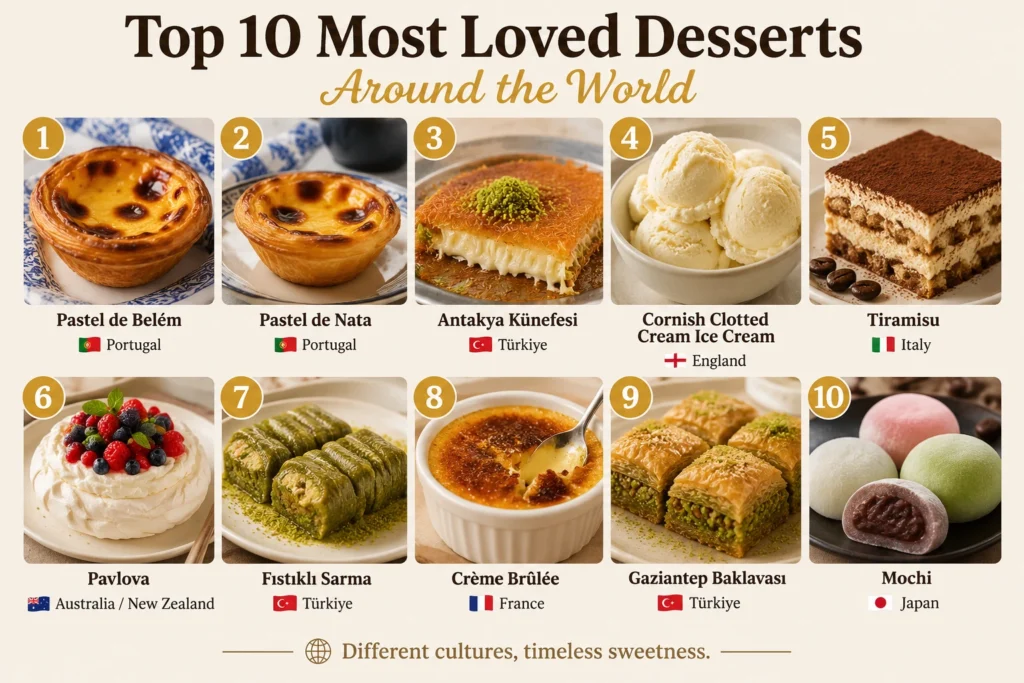
1. Pastel de Belém, Portugal
Pastel de Belém takes the #1 spot, and its origin story is genuinely unique among desserts at this level of fame: it can only be legally made at one location — the historic Fábrica Pastéis de Belém bakery in Lisbon — using a recipe that’s remained a closely guarded secret since 1837. The custard tart was originally created by monks at the nearby Jerónimos Monastery, who developed the recipe using leftover egg yolks from other convent uses (egg whites were historically used to starch nuns’ habits).
That exclusivity is part of what makes it distinct from its close relative, Pastel de Nata (see #2) — while nearly identical in appearance, only tarts made at this specific bakery, following this specific unpublished recipe, can legally carry the Pastel de Belém name.
Where to try it: Fábrica Pastéis de Belém, Lisbon (the only legal source). What it is: Custard tart with flaky pastry and a caramelized top.
2. Pastel de Nata, Portugal
Pastel de Nata takes the #2 spot as the broader, more widely available version of Portugal’s iconic custard tart — essentially the same style of tart, but produced by countless bakeries across Portugal and, increasingly, around the world, rather than restricted to a single historic bakery.
Its global reach has become genuinely remarkable: Pastel de Nata has become one of Portugal’s best-known culinary exports, with dedicated Pastel de Nata bakeries now operating in cities across Europe, Asia, and beyond — a level of international spread that few other single desserts on this list can match.
Where to try it: Bakeries throughout Portugal and increasingly worldwide. What it is: Custard tart, the widely available counterpart to Pastel de Belém.
3. Antakya Künefesi, Türkiye
Antakya künefesi claims the #3 spot, representing the first non-Portuguese entry on the list. It’s made from finely shredded pastry (similar in texture to shredded phyllo) filled with unsalted cheese, baked until the exterior turns crisp, then soaked in sweet syrup — delivering a genuinely distinctive contrast between crunchy exterior and warm, gooey, cheese-filled center.
The dessert takes its name from Antakya (historic Antioch) in southern Türkiye, a region renowned for künefe specifically, and it’s traditionally served warm, straight from the pan, which is part of why trying it locally is considered a meaningfully different experience than a reheated or exported version.
Where to try it: Antakya and the broader Hatay region, Türkiye. What it is: Shredded pastry with cheese filling, baked and soaked in syrup.
4. Cornish Clotted Cream Ice Cream, England
Cornish clotted cream ice cream earns the #4 spot, built around Cornwall’s famous clotted cream — a thick, rich dairy product traditionally made by gently heating unpasteurized milk to encourage cream to rise and thicken. When churned into ice cream, it delivers an exceptionally smooth, dense texture that distinguishes it clearly from standard ice cream recipes.
Its regional specificity mirrors several other entries on this list — the dessert’s quality is tied directly to Cornwall’s specific dairy tradition, making a visit to the region itself part of the appeal for dessert-focused travelers rather than something easily replicated elsewhere.
Where to try it: Cornwall, England. What it is: Rich ice cream made with clotted cream for an exceptionally smooth texture.
5. Strudel, Trentino-Alto Adige, Italy
Strudel takes the #5 spot, representing a region of Italy — Trentino-Alto Adige, particularly the Val di Non valley — that most people don’t immediately associate with the dessert, despite it being a defining regional specialty there. The flaky, paper-thin pastry requires genuine skill developed over years of practice to roll and stretch properly.
The region’s renowned apple production shapes the classic filling: strudel con le mele, typically made with Golden Delicious apples (chosen partly because they’re available year-round), combined with raisins, sugar, butter, cinnamon, and pine nuts, and traditionally served warm with a generous dusting of powdered sugar.
Where to try it: Trentino-Alto Adige, particularly the Val di Non valley, Italy. What it is: Flaky pastry filled with apples, raisins, cinnamon, and pine nuts.
6. Gelato al Pistacchio, Italy
Gelato al pistacchio claims the #6 spot as one of Italy’s most beloved gelato flavors, typically made with pistachios sourced from Sicily, where the nuts are grown in volcanic soil that’s widely credited with giving them a particularly intense, distinctive flavor compared to pistachios grown elsewhere.
Gelato’s fundamental production differences from standard ice cream — lower fat content, less air incorporated during churning — give it a denser, more intensely flavored result, which is part of why pistachio specifically has become one of the flavors most closely associated with genuinely high-quality gelato in Italy.
Where to try it: Sicily and gelaterias throughout Italy. What it is: Dense, intensely flavored pistachio gelato.
7. Fıstıklı Sarma, Türkiye
Fıstıklı sarma earns the #7 spot as Türkiye’s second entry in the global top 10, representing a pistachio-filled variation of baklava wrapped in a thin layer of phyllo pastry. Where standard baklava is typically layered, sarma’s rolled presentation gives it a distinctive shape and, often, a different textural balance between pastry and filling.
Its close relationship to Gaziantep baklavası (see #9) reflects Türkiye’s deep, region-specific baklava tradition — the country doesn’t have just one baklava, but a whole family of related pastries distinguished by regional technique, filling, and shape.
Where to try it: Türkiye, particularly regions known for baklava production. What it is: Rolled, pistachio-filled baklava variation.
8. Tembleque, Puerto Rico
Tembleque takes the #8 spot, and it’s the first entry on this list from the Caribbean — a coconut milk pudding topped with cinnamon that’s especially associated with celebrations and holiday gatherings in Puerto Rico. Its name, roughly translating to “wobbly” or “shaky” in Spanish, directly describes its distinctive jiggly texture.
Its simplicity is part of its appeal: built from just a handful of core ingredients — coconut milk, sugar, cornstarch, and cinnamon — tembleque delivers a genuinely different flavor and texture profile than most of the pastry-heavy entries elsewhere on this list.
Where to try it: Puerto Rico, particularly during holiday celebrations. What it is: Coconut milk pudding topped with cinnamon.
9. Gaziantep Baklavası, Türkiye
Gaziantep baklavası claims the #9 spot, representing Türkiye’s third entry in the global top 10 and arguably its most famous single dessert export. Gaziantep, a city in southeastern Türkiye, is widely regarded as the baklava capital of the country, and its version is considered by many baklava specialists to be the definitive standard against which other regional variations are measured.
The city’s baklava tradition is built specifically around high-quality Antep pistachios (grown in the surrounding region), layered with precisely thin phyllo and soaked in a syrup balance that Gaziantep bakers have refined over generations — a level of specialization that’s earned the dessert its own recognized culinary identity distinct from baklava made elsewhere.
Where to try it: Gaziantep, Türkiye. What it is: Pistachio baklava, considered the definitive regional standard.
10. Crêpes Sucrées, France
Crêpes sucrées round out the global top 10, representing France’s contribution to the list with thin, sweet crêpes that can be filled with virtually anything — sugar, chocolate cream, fruit, or jam — while their thin, delicate texture remains the defining feature regardless of filling choice.
Their versatility is central to their global popularity: unlike many of the more regionally restricted desserts on this list, crêpes have spread widely precisely because the basic technique adapts easily to local ingredients and preferences wherever they’re made, from Parisian street stalls to home kitchens worldwide.
Where to try it: Throughout France, especially Brittany (crêpes’ historic home region). What it is: Thin, sweet crêpes with a wide range of possible fillings.
Important Statistics Table
| Rank | Dessert | Country | What It Is | Availability |
| 1 | Pastel de Belém | Portugal | Custard tart | Only at one bakery in Lisbon |
| 2 | Pastel de Nata | Portugal | Custard tart | Widely available in Portugal and globally |
| 3 | Antakya Künefesi | Türkiye | Cheese-filled pastry in syrup | Antakya/Hatay region |
| 4 | Cornish Clotted Cream Ice Cream | England | Rich clotted-cream ice cream | Cornwall |
| 5 | Strudel (Trentino-Alto Adige) | Italy | Apple-filled flaky pastry | Val di Non valley region |
| 6 | Gelato al Pistacchio | Italy | Pistachio gelato | Sicily and throughout Italy |
| 7 | Fıstıklı Sarma | Türkiye | Rolled pistachio baklava | Türkiye |
| 8 | Tembleque | Puerto Rico | Coconut milk pudding | Puerto Rico |
| 9 | Gaziantep Baklavası | Türkiye | Pistachio baklava | Gaziantep |
| 10 | Crêpes Sucrées | France | Sweet thin crêpes | Throughout France |
Source: TasteAtlas “100 Best Desserts in the World” 2025/26 rankings, published July 2026, based on more than 160,000 submitted ratings (nearly 108,000 recognized as legitimate).
Step-by-Step: How to Actually Try These Desserts
- Prioritize the location-restricted desserts if you’re traveling. Pastel de Belém is legally only made at one bakery in Lisbon — visiting in person is the only way to try the true original.
- Distinguish the closely related pairs before ordering. Pastel de Belém and Pastel de Nata look nearly identical; ask specifically if you want the original recipe versus the broader widely available version.
- Time your visit around regional specialties. Strudel is best in Trentino-Alto Adige during apple season; künefe is traditionally best served warm and fresh, not reheated.
- Look for regional origin markers when shopping elsewhere. Gaziantep baklava and Sicilian pistachio gelato are both tied to specific growing regions — genuine versions typically reference this origin directly.
- Try the simpler, less pastry-heavy options if you want variety. Tembleque offers a genuinely different texture and flavor profile from the pastry-dominant entries elsewhere on this list.
- Check TasteAtlas’s full Top 100 for deeper regional options. The full list includes far more countries and traditions than the top 10 alone, including strong showings from Greece, Brazil, Poland, Peru, and the Netherlands.
Pros and Cons Table
| Dessert | Pros | Cons |
| Pastel de Belém | Genuinely unique, single-source authenticity | Only available at one location worldwide |
| Pastel de Nata | Widely available, consistent quality | Less “original” than Pastel de Belém specifically |
| Antakya Künefesi | Distinctive texture contrast, best fresh | Best experienced warm, harder to enjoy exported |
| Cornish Clotted Cream Ice Cream | Exceptionally rich, distinctive regional dairy | Regionally specific, harder to find authentic version elsewhere |
| Strudel (Trentino-Alto Adige) | Skilled craftsmanship, classic flavor combination | Requires genuine technique to make well |
| Gelato al Pistacchio | Intense flavor, widely available in Italy | Quality varies significantly outside Sicily-sourced versions |
| Fıstıklı Sarma | Distinctive rolled presentation | Less internationally known than standard baklava |
| Tembleque | Simple ingredients, distinctive texture | Less globally exported than pastry-based desserts on this list |
| Gaziantep Baklavası | Considered the definitive baklava standard | Best versions require specific Antep pistachios |
| Crêpes Sucrées | Extremely versatile, widely available globally | Simplicity means quality varies enormously by maker |
Comparison Table: Best Dessert by What You’re Craving
| Your Craving | Best Pick | Runner-Up | Why |
| Rich custard/cream | Pastel de Belém | Cornish Clotted Cream Ice Cream | Egg-yolk-based custard vs. dairy-based richness |
| Crunchy-meets-gooey texture | Antakya Künefesi | Fıstıklı Sarma | Crisp exterior with warm, soft interior |
| Classic fruit-filled pastry | Strudel | Crêpes Sucrées | Apple-cinnamon flaky pastry tradition |
| Frozen/ice cream-based | Gelato al Pistacchio | Cornish Clotted Cream Ice Cream | Intense, dense pistachio flavor |
| Nut-forward dessert | Gaziantep Baklavası | Fıstıklı Sarma | Considered the definitive pistachio baklava standard |
| Something dairy-free/lighter | Tembleque | Crêpes Sucrées (plain) | Coconut milk base, simpler ingredient list |
| Widely available/easy to find | Pastel de Nata | Crêpes Sucrées | Both have spread globally beyond their home country |
| Rare/hard-to-find original | Pastel de Belém | Antakya Künefesi | Single-bakery exclusivity vs. regional specificity |
2026 News and Trends
The clearest 2026 headline is Portugal’s unprecedented top-two sweep, with Pastel de Belém and Pastel de Nata claiming both the #1 and #2 spots on the same global ranking — a first that TasteAtlas specifically highlighted in its July 2026 announcement, based on more than 160,000 submitted ratings.
Türkiye’s three-dessert showing (Antakya künefesi at #3, Fıstıklı sarma at #7, Gaziantep baklavası at #9) stands out as the strongest multi-entry performance by any country besides Portugal, reflecting the country’s deep, regionally specific baklava and pastry traditions rather than reliance on a single signature dessert.
The broader Top 100 list continues to demonstrate genuine global diversity beyond the top 10: Italy features repeatedly through regional specialties including tiramisù, multiple gelato flavors, and brioche con gelato; France appears through crème brûlée, chocolate soufflé, and kouign-amann; and Greece, Brazil, Poland, and Peru each earned multiple entries — while the Netherlands showed particular range with Nonnevot, Appeltaart, Stroopwafel, and Poffertjes all making the list.
The global desserts market itself continues expanding rapidly, valued at roughly $143.63 billion in 2024 and projected to reach $193.56 billion by 2030, with the frozen dessert segment specifically hitting an estimated $136 billion in 2025 — growth that reflects both rising global demand and increasing international interest in regionally specific, traditional desserts like the ones topping this year’s rankings.
Conclusion
Portugal’s historic top-two sweep, led by the exclusive Pastel de Belém and its widely loved sibling Pastel de Nata, headlines TasteAtlas’s 2025/26 world dessert rankings — but with Türkiye placing three desserts in the top 10 and entries spanning Italy, England, Puerto Rico, and France, the list is a genuine reminder of just how much dessert diversity exists across the world.
Whether you’re planning a trip around the original Pastel de Belém or simply looking for your next favorite sweet, this year’s top 10 offers a genuinely global starting point.
References
- TasteAtlas – 100 Best Desserts in the World (Official 2025/26 Rankings): https://www.tasteatlas.com/best-rated-desserts-in-the-world
- Taste Atlas – Best Desserts List: https://www.tasteatlas.com/best/desserts
- Travel Tomorrow – TasteAtlas Names the World’s 100 Best Desserts, with Portugal Taking the Top Two Spots: https://traveltomorrow.com/tasteatlas-names-the-worlds-100-best-desserts-with-portugal-taking-the-top-two-spots/
- Vibe List – 20 Best Desserts in the World Ranked (2026): https://vibelist.net/food-drink/desserts/the-20-greatest-desserts-on-earth-and-the-obsessive-accidental-and-occasionally-violent-stories-behind-them/
- PetitChef – The 12 Best Desserts in the World According to TasteAtlas: https://en.petitchef.com/articles/is-your-favorite-dessert-on-the-list-here-is-the-tasteatlas-world-top-list-aid-10924
FAQs
Pastel de Belém, Portugal’s original custard tart, holds the #1 spot on TasteAtlas’s 2025/26 world dessert ranking, based on more than 160,000 submitted user ratings. Its close relative, Pastel de Nata, took #2.
Pastel de Belém can only be legally made at one bakery, Fábrica Pastéis de Belém in Lisbon, using a closely guarded recipe dating to 1837. Pastel de Nata is the broader, widely available version of the same style of custard tart, made by countless bakeries in Portugal and worldwide.
TasteAtlas crowdsources ratings from its global user base — more than 160,000 for the 2025/26 dessert list — then filters out suspected bot activity and local patriotic voting, while giving additional weight to ratings from users the platform’s system identifies as knowledgeable about food.
Portugal led with two entries (Pastel de Belém and Pastel de Nata, #1 and #2), while Türkiye had three entries across the full top 10 (Antakya künefesi at #3, Fıstıklı sarma at #7, and Gaziantep baklavası at #9) — more than any country besides Portugal.
No. TasteAtlas explicitly states its rankings are intended to celebrate local food traditions and promote regional pride and curiosity, rather than deliver a single definitive conclusion about which dessert is objectively “best” worldwide.
Only at Fábrica Pastéis de Belém in Lisbon, Portugal — it’s the sole location legally permitted to produce the original recipe. Pastel de Nata, the closely related #2-ranked dessert, is available much more widely.
The global desserts market was valued at roughly $143.63 billion in 2024 and is projected to reach approximately $193.56 billion by 2030, with the frozen dessert segment alone estimated at around $136 billion in 2025.



GIPHY App Key not set. Please check settings