 kiruthika
Hook Introduction
A film made on a $10 million budget in 1968, featuring almost no dialogue for its first 25 minutes, still tops the American Film Institute’s official ranking of the greatest science fiction films ever made, ahead of Star Wars, Alien, and every superhero blockbuster combined.
We anchored this list to AFI’s official “10 Top 10” science fiction ranking, cross-checked against Rotten Tomatoes and IMDb data, to explain not just which films made the cut, but why they’ve endured for decades.
Key Highlights (Quick Facts)
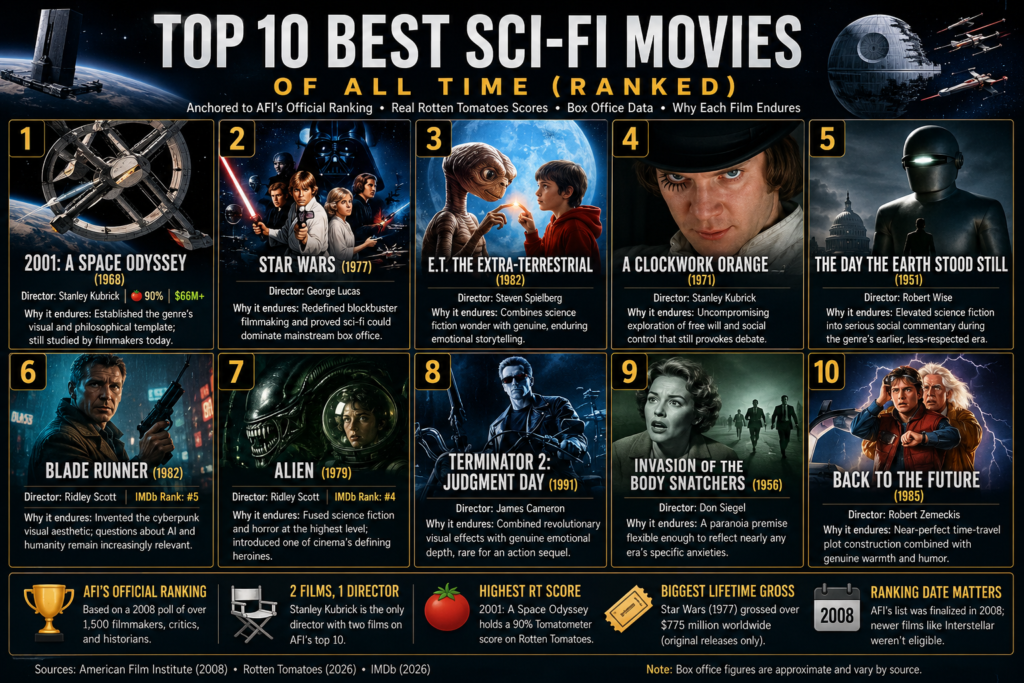
- 2001: A Space Odyssey (1968) tops the American Film Institute’s official ranking of the greatest science fiction films of all time, a list AFI compiled in 2008 as part of its “10 Top 10” project covering ten film genres.
- The film cost roughly $10–12 million to make and earned about $56.8 million during its original theatrical run, with a lifetime gross exceeding $66 million after numerous re-releases — modest by modern blockbuster standards, but it holds a 90% Tomatometer score on Rotten Tomatoes from 165 critic reviews.
- Stanley Kubrick directed two films on AFI’s official top 10 list — 2001: A Space Odyssey at #1 and A Clockwork Orange at #4 — a distinction no other director matches.
- The Matrix (1999), despite winning four Academy Awards and redefining action filmmaking with “bullet time,” is notably absent from AFI’s official top 10, illustrating how different ranking methodologies can produce genuinely different results.
- IMDb’s user-rated top 5 for the genre — 2001: A Space Odyssey, The Terminator, Planet of the Apes, Alien, and Blade Runner — overlaps with AFI’s list on three titles but ranks them in a different order, reflecting the gap between critical/historical consensus and pure audience voting.
- George Lucas has publicly credited 2001: A Space Odyssey as a direct inspiration for Star Wars, meaning the AFI’s #1 and #2 films share a direct creative lineage.
- Rotten Tomatoes does not maintain an official numbered ranking of its “150 Essential Sci-Fi Movies” list, instead presenting it as an unranked curated collection — a methodological choice worth knowing if you’re comparing sources.
- Several films now considered genre-defining, including Blade Runner 2049, Arrival, Inception, and Interstellar, were released after AFI’s 2008 list was compiled and are therefore not reflected in its official rankings.
How This Ranking Was Built
This list is anchored to the American Film Institute’s official “10 Top 10” science fiction ranking, compiled in 2008 through a poll of over 1,500 filmmakers, critics, and historians — one of the most methodologically rigorous “greatest films” surveys ever conducted for the genre, and still the closest thing to an authoritative, citable top 10 available.
We’ve supplemented AFI’s list with Rotten Tomatoes scores, box office context, and IMDb comparison data to show where different ranking methods agree and where they genuinely diverge — since, as this list demonstrates clearly, “greatest of all time” depends heavily on who’s doing the ranking and what criteria they’re using.
The Top 10 Best Sci-Fi Movies of All Time
1. 2001: A Space Odyssey (1968)
Stanley Kubrick’s adaptation of Arthur C. Clarke’s short story tops AFI’s official ranking, and it’s hard to overstate its influence on everything that followed in the genre. Its portrayal of a mysterious black monolith connecting humanity’s past and future, alongside the chillingly calm rogue AI HAL 9000, established visual and thematic templates that filmmakers are still working from more than 55 years later.
The film holds a 90% Tomatometer score from 165 critic reviews and an 88% audience score from over 250,000 ratings on Rotten Tomatoes, with critics’ consensus describing it as “one of the most influential of all sci-fi films.” Made for roughly $10–12 million, it earned about $56.8 million in its original run, with a lifetime gross exceeding $66 million after numerous theatrical re-releases, proof that its reputation has only grown with time.
RT Score: 90%. Box office (lifetime): $66 million+. Why it endures: Established the genre’s visual and philosophical template; still studied by filmmakers today.
2. Star Wars (1977)
George Lucas’s space opera claims AFI’s #2 spot, and its influence on popular culture arguably exceeds every other film on this list combined, spawning a franchise, merchandising empire, and fundamental shift in how Hollywood approached blockbuster filmmaking. Lucas has publicly credited 2001: A Space Odyssey as direct inspiration, making AFI’s top two films creatively linked.
Its blend of mythic storytelling structure, groundbreaking visual effects, and genuinely accessible space-adventure plotting proved that science fiction could achieve massive mainstream commercial success without sacrificing the genre’s imaginative ambition, a combination that paved the way for nearly every blockbuster sci-fi film that followed.
AFI Rank: #2. Why it endures: Redefined blockbuster filmmaking and proved sci-fi could dominate mainstream box office.
3. E.T. the Extra-Terrestrial (1982)
Steven Spielberg’s story of a young boy befriending a stranded alien takes AFI’s #3 spot, distinguishing itself from the harder-edged science fiction elsewhere on this list through genuine warmth and emotional sincerity. Its central relationship between Elliott and E.T. became one of the most emotionally resonant pairings in film history.
More than 40 years after release, the film continues to be cited as a benchmark for combining genuine emotional storytelling with science fiction premise, proof that the genre doesn’t need to be dark or dystopian to achieve lasting cultural impact.
AFI Rank: #3. Why it endures: Combines science fiction wonder with genuine, enduring emotional storytelling.
4. A Clockwork Orange (1971)
Stanley Kubrick’s second appearance on AFI’s list, adapted from Anthony Burgess’s novel, takes the #4 spot with its unflinching, controversial exploration of free will, violence, and social control in a dystopian near-future Britain. Its stylized ultraviolence and morally complex protagonist, Alex, made it one of the most debated films of its era.
Kubrick’s willingness to sit with genuinely uncomfortable questions about state control and rehabilitation, rather than offering easy answers, has kept the film part of ongoing cultural and philosophical conversation for over five decades.
AFI Rank: #4. Why it endures: Uncompromising exploration of free will and social control that still provokes debate.
5. The Day the Earth Stood Still (1951)
The oldest film on AFI’s official top 10, this Cold War-era first-contact story follows an alien visitor who arrives on Earth with a stark warning about humanity’s capacity for self-destruction. Its restraint and moral seriousness distinguished it from many of its 1950s B-movie contemporaries.
Its influence on the “wise alien visitor” archetype persists throughout science fiction to this day, and its direct engagement with real Cold War anxieties gave it a cultural weight that helped legitimize science fiction as a genre capable of serious social commentary, not just spectacle.
AFI Rank: #5. Why it endures: Elevated science fiction into serious social commentary during the genre’s earlier, less-respected era.
6. Blade Runner (1982)
Ridley Scott’s adaptation of Philip K. Dick’s “Do Androids Dream of Electric Sheep?” takes AFI’s #6 spot, and its rain-soaked, neon-lit vision of a dystopian future essentially invented the cyberpunk aesthetic that countless films, games, and other media have drawn from since. IMDb’s user rankings place it even higher, at #5 on their list.
Its central questions about what separates humanity from artificial life feel, if anything, more urgent today than at release, and its visual influence remains so pervasive that “Blade Runner-esque” has become a genuine shorthand for a specific, instantly recognizable aesthetic across the entire entertainment industry.
AFI Rank: #6 (IMDb: #5). Why it endures: Invented the cyberpunk visual aesthetic; questions about AI and humanity remain increasingly relevant.
7. Alien (1979)
Ridley Scott’s second appearance among the genre’s elite, Alien takes the #7 spot on AFI’s list by fusing science fiction with pure horror filmmaking more effectively than perhaps any film before or since. IMDb ranks it even higher at #4, and it remains a genre-defining reference point for the “haunted spaceship” premise.
Sigourney Weaver’s Ripley became one of cinema’s first genuinely great action heroines, and the film’s slow-building dread, rather than constant action, set a template for tension-driven sci-fi horror that filmmakers continue to study and emulate.
AFI Rank: #7 (IMDb: #4). Why it endures: Fused science fiction and horror at the highest level; introduced one of cinema’s defining heroines.
8. Terminator 2: Judgment Day (1991)
James Cameron’s sequel takes the #8 spot on AFI’s list, and it’s frequently cited as one of the rare sequels that genuinely surpassed its already-acclaimed original. Its groundbreaking liquid-metal CGI effects for the T-1000 villain pushed visual effects technology forward in ways that influenced blockbuster filmmaking for the following decade.
Beyond its technical achievements, the film’s genuinely emotional core, reframing Arnold Schwarzenegger’s Terminator as protector rather than villain , gave it a heart that elevated it well beyond a typical action sequel, helping secure its lasting place in the genre’s upper tier.
AFI Rank: #8. Why it endures: Combined revolutionary visual effects with genuine emotional depth, rare for an action sequel.
9. Invasion of the Body Snatchers (1956)
This Cold War-era paranoia thriller about alien seed pods replacing townspeople with emotionless duplicates takes AFI’s #9 spot. Its central metaphor has proven remarkably durable and adaptable, widely interpreted at the time as commentary on either McCarthyist conformity or the spread of communism, depending on the viewer’s political lens.
Its “trust no one, anyone could be replaced” premise has been remade multiple times since and remains one of the most frequently referenced paranoia-thriller templates in the genre’s history, a testament to how effectively its core concept translates across different eras’ anxieties.
AFI Rank: #9. Why it endures: A paranoia premise flexible enough to reflect nearly any era’s specific anxieties.
10. Back to the Future (1985)
Robert Zemeckis’s time-travel comedy rounds out AFI’s official top 10, distinguishing itself from the more serious, dystopian, or philosophically heavy films elsewhere on the list through pure, well-crafted entertainment and genuine wit. Michael J. Fox’s Marty McFly and Christopher Lloyd’s Doc Brown became one of the most beloved on-screen pairings in film history.
Its tightly constructed time-travel plotting, which carefully sets up and pays off its own internal rules, is still cited by screenwriters as a model example of how to handle time-travel logic clearly without confusing an audience — a genuinely difficult needle to thread that many subsequent time-travel films have struggled with.
AFI Rank: #10. Why it endures: Near-perfect time-travel plot construction combined with genuine warmth and humor.
Important Statistics Table
| AFI Rank | Movie | Year | Director | RT Score / IMDb Note |
| 1 | 2001: A Space Odyssey | 1968 | Stanley Kubrick | 90% RT; IMDb #1 |
| 2 | Star Wars | 1977 | George Lucas | Directly inspired by 2001 |
| 3 | E.T. the Extra-Terrestrial | 1982 | Steven Spielberg | Emotional benchmark of the genre |
| 4 | A Clockwork Orange | 1971 | Stanley Kubrick | Kubrick’s 2nd film on this list |
| 5 | The Day the Earth Stood Still | 1951 | Robert Wise | Oldest film on AFI’s official list |
| 6 | Blade Runner | 1982 | Ridley Scott | IMDb ranks it #5 |
| 7 | Alien | 1979 | Ridley Scott | IMDb ranks it #4 |
| 8 | Terminator 2: Judgment Day | 1991 | James Cameron | Landmark CGI achievement |
| 9 | Invasion of the Body Snatchers | 1956 | Don Siegel | Cold War-era paranoia classic |
| 10 | Back to the Future | 1985 | Robert Zemeckis | Model time-travel plot construction |
Source: American Film Institute’s official “10 Top 10” Science Fiction ranking (2008), compiled from a poll of over 1,500 filmmakers, critics, and historians. Rotten Tomatoes and IMDb data cross-referenced from current 2026 listings; these figures can shift slightly as new reviews and ratings are added.
Step-by-Step: How “Greatest of All Time” Film Rankings Actually Work
- Check who’s doing the ranking. AFI polls industry professionals (filmmakers, critics, historians); IMDb aggregates user ratings; Rotten Tomatoes aggregates published critic reviews — each method produces genuinely different results.
- Note the ranking’s compilation date. AFI’s list was finalized in 2008, meaning any film released after that year, however acclaimed, simply couldn’t be considered for it.
- Understand that “Certified Fresh” and “ranked” aren’t the same thing on Rotten Tomatoes. Their sci-fi lists are typically curated and unranked collections, not numbered top 10s, unlike AFI’s methodology.
- Recognize that absence doesn’t mean low quality. The Matrix isn’t on AFI’s official top 10 despite four Academy Awards and massive influence — a reminder that even excellent, hugely influential films can miss a specific list’s cutoff.
- Cross-reference multiple sources for the fullest picture. Comparing AFI, IMDb, and Rotten Tomatoes together, as this article does, reveals where genuine consensus exists (2001, Alien, Blade Runner) versus where opinion genuinely diverges.
- Treat any single “definitive” ranking with healthy skepticism. As this list itself demonstrates, no single methodology captures every valid perspective on what makes a science fiction film truly great.
Pros and Cons Table
| Movie | Pros | Cons |
| 2001: A Space Odyssey | Unmatched influence, still visually stunning | Slow pacing and minimal dialogue can challenge modern viewers |
| Star Wars | Massive cultural impact, hugely rewatchable | Effects have been repeatedly altered in later re-releases |
| E.T. the Extra-Terrestrial | Genuine emotional resonance, broad accessibility | Less thematically ambitious than harder sci-fi on this list |
| A Clockwork Orange | Provocative, still-relevant themes | Content is genuinely disturbing and not for all viewers |
| The Day the Earth Stood Still | Historically important, morally serious | Pacing and effects show its age more than newer entries |
| Blade Runner | Visually stunning, philosophically rich | Original theatrical cut’s studio-mandated narration is divisive |
| Alien | Masterful tension, genre-defining heroine | Slower pace than its more action-heavy sequel, Aliens |
| Terminator 2: Judgment Day | Groundbreaking effects, genuine emotional core | Some effects show their age compared to modern CGI |
| Invasion of the Body Snatchers | Flexible, enduring central metaphor | 1950s production values may feel dated to some viewers |
| Back to the Future | Nearly flawless plot construction, broad appeal | Lighter tone than the more philosophically ambitious films here |
Comparison Table: Best Sci-Fi Film by What You Want
| Your Priority | Best Pick | Runner-Up | Why |
| Most influential on the genre overall | 2001: A Space Odyssey | Blade Runner | Set the template nearly every subsequent sci-fi film draws from |
| Best blend of spectacle and mainstream appeal | Star Wars | Back to the Future | Proved sci-fi could dominate the box office without losing ambition |
| Most emotionally resonant | E.T. the Extra-Terrestrial | Terminator 2: Judgment Day | Genuine, enduring emotional core beyond genre spectacle |
| Best sci-fi/horror hybrid | Alien | — | Fused tension-driven horror with science fiction at the highest level |
| Most visually influential | Blade Runner | 2001: A Space Odyssey | Invented the cyberpunk aesthetic still referenced today |
| Best social/political commentary | A Clockwork Orange | Invasion of the Body Snatchers | Uncompromising engagement with real societal anxieties |
| Best time-travel plot construction | Back to the Future | — | Widely cited by screenwriters as the genre’s cleanest time-travel logic |
| Best technical/visual effects achievement | Terminator 2: Judgment Day | 2001: A Space Odyssey | Landmark CGI that reshaped blockbuster filmmaking |
Modern Sci-Fi Films Reshaping the Conversation
AFI’s list, compiled in 2008, naturally can’t account for everything that’s come since — and several genuinely acclaimed films have entered the broader “greatest sci-fi” conversation in the years after. The Matrix (1999), despite predating the AFI poll and winning four Academy Awards, notably didn’t make their official top 10 at all, a reminder that even hugely influential films can miss a specific list.
More recent contenders frequently cited alongside AFI’s official picks include Inception (2010) and Interstellar (2014), both directed by Christopher Nolan and praised for combining ambitious concepts with genuine emotional stakes; Arrival (2016), Denis Villeneuve’s cerebral first-contact film that reinvigorated serious, thoughtful science fiction; and Blade Runner 2049 (2017), a sequel widely regarded as a rare example that lived up to a genre-defining original. None of these were eligible for AFI’s 2008 ranking, but all four appear consistently across contemporary “best sci-fi” discussions from Rotten Tomatoes, IMDb communities, and critics today.
Conclusion
2001: A Space Odyssey’s position atop both AFI’s official ranking and IMDb’s user-rated list makes it about as close to a genuine consensus pick for greatest sci-fi film ever made as exists — though The Matrix’s notable absence from AFI’s top 10 is a useful reminder that no single list captures everyone’s definition of “greatest.” Whether you’re drawn to Kubrick’s philosophical ambition, Spielberg’s emotional warmth, or Cameron’s technical spectacle, this list offers a genuinely defensible starting point for the ongoing conversation.
References
- American Film Institute – AFI’s 10 Top 10: Science Fiction (Official 2008 Ranking): https://en.wikipedia.org/wiki/AFI%27s_10_Top_10
- ScreenRant – Stanley Kubrick’s $66 Million Box Office Hit Named Best Sci-Fi Of All Time In 15-Year-Old Poll, Beating Star Wars: https://screenrant.com/afi-greatest-sci-fi-movie-2001-space-odyssey-stanley-kubrick/
- Ireland Observer – Best Sci-Fi Movies: Top 10, No. 1, and Greatest: https://irelandobserver.com/tech/best-sci-fi-movies/
- Rotten Tomatoes – 2001: A Space Odyssey (Tomatometer and Audience Score): https://www.rottentomatoes.com/m/1000085-2001_a_space_odyssey
- Rotten Tomatoes – 150 Essential Sci-Fi Movies: https://editorial.rottentomatoes.com/guide/essential-sci-fi-movies-of-all-time/
- MovieWeb – The Best Sci-Fi Movies According to Rotten Tomatoes: https://movieweb.com/top-sci-fi-movies-all-time-rotten-tomatoes/
FAQs
According to the American Film Institute’s official ranking, 2001: A Space Odyssey (1968) holds the #1 spot. However, IMDb’s user-rated list also places it first, making it one of the few films where critical and audience consensus genuinely align.
AFI’s ranking was compiled in 2008 by polling over 1,500 filmmakers, critics, and historians, and The Matrix (1999) simply didn’t place within their final top 10, despite winning four Academy Awards and having enormous cultural influence. This illustrates how even widely beloved films can miss a specific ranking’s cutoff.
2001: A Space Odyssey holds a 90% Tomatometer score from 165 critic reviews. Rotten Tomatoes doesn’t maintain an official numbered ranking of its broader “150 Essential Sci-Fi Movies” collection, presenting it instead as a curated, unranked list.
Stanley Kubrick is the only director with two films on the list — 2001: A Space Odyssey at #1 and A Clockwork Orange at #4.
Yes. Films like Inception, Interstellar, Arrival, and Blade Runner 2049 were all released after AFI’s 2008 poll and frequently appear in contemporary “greatest sci-fi” discussions, even though they weren’t eligible for that specific official ranking.
IMDb’s user-rated top 5 — 2001: A Space Odyssey, The Terminator, Planet of the Apes, Alien, and Blade Runner — overlaps with AFI’s list on three titles but ranks them differently, and includes The Terminator and Planet of the Apes, neither of which appears in AFI’s official top 10.
The film earned about $56.8 million during its original run against a roughly $10–12 million budget — solid but not spectacular by the standards of the time. Its influence grew over decades through critical reassessment, repeated theatrical re-releases, and its foundational impact on how later filmmakers approached visual effects, pacing, and philosophical ambition in science fiction.



GIPHY App Key not set. Please check settings