 Sakthi Varna
Introduction
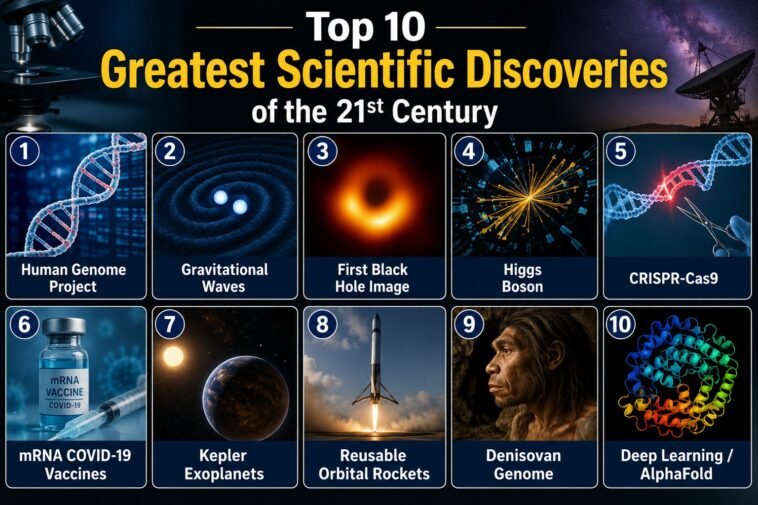
The 21st century has barely finished its first quarter, and science has already rewritten textbooks in genetics, physics, astronomy, and medicine. These are not incremental improvements. These are the kind of discoveries that change what humanity actually knows about itself and the universe.
We pulled the discoveries that consistently top expert rankings from major science publications and institutions, then dug into the real details behind each one: who made the discovery, when, and why it mattered. Here are the ten greatest scientific discoveries of the 21st century.
Table of Contents
- Key Highlights
- What Actually Makes a Discovery “Great”
- The Top 10 Greatest Scientific Discoveries of the 21st Century
- Important Statistics Table
- How Major Scientific Discoveries Get Verified (Step-by-Step)
- Pros and Cons Table (Benefits and Open Concerns)
- Comparison Table: Top 10 Discoveries by Field
- Current Trends Building on These Discoveries
- FAQs
- References
Key Highlights (Quick Facts)
- The Human Genome Project mapped all roughly 3 billion base pairs of human DNA, with a rough draft completed in 2000 and the final sequence finished in 2003.
- LIGO’s 2015 detection of gravitational waves confirmed a prediction Albert Einstein made in 1916, and the discovery earned a Nobel Prize in Physics the following year.
- The first-ever image of a black hole, captured in 2019 by the Event Horizon Telescope, showed the supermassive black hole at the center of galaxy M87, located 53 million light-years away.
- CRISPR-Cas9 gene editing, developed as a precise genetic tool in 2012, earned Jennifer Doudna and Emmanuelle Charpentier the Nobel Prize in Chemistry in 2020.
- mRNA COVID-19 vaccines were developed and authorized in under a year, built on decades of prior mRNA research that later earned its own Nobel Prize in 2023.
- NASA’s Kepler space telescope, launched in 2009, confirmed thousands of exoplanets, including Kepler-452b, often nicknamed Earth’s closest known cousin.
- SpaceX achieved the first successful landing of an orbital-class reusable rocket booster in December 2015, fundamentally changing the economics of spaceflight.
- Genome sequencing from a single finger bone found in Siberia’s Denisova Cave in 2010 revealed an entirely new group of ancient humans, the Denisovans, previously unknown to science.
Real scientific progress is rarely a single flash of insight. Almost every discovery on this list came from decades of groundwork by earlier researchers, which is exactly what makes the eventual breakthrough moment so significant.
What Actually Makes a Discovery “Great”
Before ranking the list, here’s what separates a genuinely field-changing discovery from an incremental research finding.
It Confirms or Overturns a Major Theory
The best discoveries either validate a long-standing prediction, like gravitational waves confirming Einstein’s relativity, or force scientists to rewrite existing models entirely.
It Opens an Entirely New Field of Research
Discoveries like CRISPR gene editing or reusable rockets didn’t just answer one question. They created whole new areas of ongoing research and application that didn’t meaningfully exist before.
It Has Measurable Real-World Impact
Some of the discoveries on this list, particularly in medicine, have directly and measurably saved millions of lives, which sets them apart from purely theoretical advances.
It Withstands Independent Verification
Genuine breakthroughs get replicated and confirmed by independent research teams using different methods, which is part of why some discoveries take years between initial detection and formal announcement.
The Top 10 Greatest Scientific Discoveries of the 21st Century
Here is our researched, detailed ranking of the most significant scientific discoveries made so far this century.
1. The Human Genome Project
When: Working draft completed in 2000; final sequence completed in 2003 Who: An international, publicly funded scientific consortium, alongside a parallel private effort led by Celera Genomics
The Human Genome Project mapped and sequenced all of the roughly 3 billion base pairs that make up human DNA, essentially producing the complete instruction manual for building a human being. The project took 13 years and cost approximately $2.7 billion, involving research institutions across the United States, United Kingdom, Japan, France, Germany, and China.
The completed genome map became the foundation for virtually every advance in modern genetics that followed, including personalized medicine, genetic disease screening, and the gene-editing tools that arrived a decade later. It remains one of the largest scientific collaborations in history.
A DNA double helix rendered in blue and glowing detail — the mapping of the human genome laid the technical foundation for nearly every genetic breakthrough that followed.
2. Detection of Gravitational Waves
When: Detected September 14, 2015; publicly announced February 11, 2016 Who: The LIGO Scientific Collaboration, led by researchers including Rainer Weiss, Kip Thorne, and Barry Barish, who shared the 2017 Nobel Prize in Physics for the discovery
The Laser Interferometer Gravitational-Wave Observatory detected tiny ripples in the fabric of space-time caused by the collision of two black holes located 1.3 billion light-years away. This confirmed a prediction Albert Einstein made in his general theory of relativity back in 1916, a full century before it was finally observed directly.
The discovery opened an entirely new field called gravitational-wave astronomy, giving scientists a fundamentally new way to observe violent cosmic events, like black hole and neutron star collisions, that emit no light and were previously undetectable by any telescope.
3. The First Image of a Black Hole
When: Captured April 2019; released to the public in April 2019 Who: The Event Horizon Telescope Collaboration, an international network of radio telescopes coordinated across multiple continents
Using a network of eight ground-based radio telescopes working together as one Earth-sized virtual instrument, the Event Horizon Telescope collaboration captured the first-ever direct image of a black hole’s silhouette, located at the center of the galaxy M87, roughly 53 million light-years from Earth.
Prior to this image, black holes existed only as mathematical predictions and indirect observational evidence. Seeing an actual visual confirmation of the object’s event horizon, the boundary beyond which nothing can escape, was a milestone many scientists, including researchers at NASA, once doubted would ever be achievable.
A dark circular void surrounded by a glowing ring of orange light — the first image of a black hole’s silhouette confirmed decades of theoretical predictions in a single photograph.
4. The Discovery of the Higgs Boson
When: Announced July 4, 2012 Who: Researchers at CERN’s Large Hadron Collider, working across the ATLAS and CMS experiments
Physicists at the Large Hadron Collider confirmed the existence of the Higgs boson, a fundamental particle first theorized in 1964 by physicist Peter Higgs and several colleagues. The particle is central to explaining why other fundamental particles have mass at all, completing the last missing piece of the Standard Model of particle physics.
Finding it required smashing protons together at nearly the speed of light inside a 17-mile circular tunnel beneath the Swiss-French border, then sifting through enormous volumes of collision data for a signature the particle would leave for only a fraction of a second. Peter Higgs and François Englert shared the 2013 Nobel Prize in Physics for the underlying theoretical prediction.
5. CRISPR-Cas9 Gene Editing
When: Developed as a precision gene-editing tool in 2012 Who: Jennifer Doudna and Emmanuelle Charpentier, who shared the 2020 Nobel Prize in Chemistry for the discovery
CRISPR-Cas9 is a gene-editing system adapted from a naturally occurring bacterial immune defense mechanism, repurposed by Doudna and Charpentier into a programmable tool capable of precisely cutting and editing DNA at specific locations. Unlike earlier gene-editing methods, CRISPR is comparatively fast, cheap, and accurate.
The technology has since been used to develop treatments for genetic blood disorders like sickle cell disease, is being explored for cancer therapies and crop improvement, and has become one of the most widely adopted laboratory tools in modern biology. It also reopened serious ethical debates around gene editing in human embryos.
6. mRNA COVID-19 Vaccines
When: Authorized for emergency use in December 2020 Who: Pfizer-BioNTech and Moderna, building on decades of foundational mRNA research by scientists including Katalin Karikó and Drew Weissman, who won the 2023 Nobel Prize in Physiology or Medicine
The rapid development of mRNA-based COVID-19 vaccines in under a year stands as one of the fastest vaccine development timelines in medical history. Rather than using a weakened or inactivated virus, mRNA vaccines deliver genetic instructions that teach human cells to produce a harmless piece of the virus’s spike protein, training the immune system to recognize the real thing.
The technology itself was decades in the making, with Karikó and Weissman’s earlier research solving key problems that had stalled mRNA vaccine development for years before the pandemic made rapid deployment an urgent global priority. The platform is now being adapted for other diseases, including certain cancers and seasonal flu.
A researcher in a laboratory examining a vial under controlled lighting — the mRNA vaccine platform developed during the pandemic is now being adapted for treatments well beyond COVID-19.
7. Thousands of Confirmed Exoplanets
When: Kepler space telescope launched in 2009; ongoing discoveries continue today Who: NASA’s Kepler mission team, along with follow-up missions like TESS
NASA’s Kepler space telescope was purpose-built to search for planets orbiting distant stars by detecting the tiny dip in starlight that occurs when a planet passes in front of its host star. Over its operational lifetime, Kepler confirmed thousands of exoplanets, transforming the search for potentially habitable worlds from speculative theory into a data-rich field of active research.
Among its most notable finds was Kepler-452b, announced in 2015 and often described as one of the closest known matches to an Earth-like planet, orbiting within its star’s habitable zone. The sheer volume of confirmed exoplanets fundamentally shifted scientific consensus on how common planetary systems actually are throughout the galaxy.
8. Reusable Orbital Rockets
When: First successful landing achieved December 21, 2015 Who: SpaceX, led by its rocket engineering team
SpaceX achieved the first successful landing and recovery of an orbital-class rocket booster with its Falcon 9 rocket, a feat that had never been accomplished at that scale before. Rather than discarding an enormously expensive rocket stage after a single use, the booster returned to Earth, landed upright, and was refurbished for additional flights.
This single technical achievement fundamentally altered the economics of spaceflight, dramatically lowering the cost of reaching orbit and enabling a much higher cadence of launches. It paved the way for the broader commercial space industry that followed, including satellite mega-constellations and renewed momentum toward crewed missions beyond low Earth orbit.
9. The Denisovans and New Branches of Human Ancestry
When: Genome sequenced and announced in 2010 Who: Svante Pääbo and his research team, who sequenced ancient DNA from a small finger bone
Researchers extracted and sequenced DNA from a tiny finger bone fragment discovered in Siberia’s Denisova Cave, revealing an entirely new group of ancient humans previously unknown to science, now called the Denisovans. Genetic evidence later showed that Denisovans interbred with both Neanderthals and early modern humans, with traces of Denisovan DNA still present in some present-day populations, particularly in parts of Asia and Oceania.
This discovery, part of the broader field of paleogenomics pioneered largely by Pääbo, who won the 2022 Nobel Prize in Physiology or Medicine for his work on ancient human genomes, fundamentally rewrote the human family tree. It proved that multiple distinct human species coexisted and interbred far more recently and extensively than scientists had previously assumed.
An ancient cave interior with natural rock formations partially lit by daylight — a single finger bone recovered from a Siberian cave revealed an entirely new branch of the human family tree.
10. Deep Learning and Modern Artificial Intelligence
When: Major breakthroughs accelerating from the early 2010s onward, including AlphaFold’s 2020 protein structure results Who: Researchers across multiple institutions, including DeepMind’s AlphaFold team
Breakthroughs in deep learning, neural networks, and large-scale machine learning transformed artificial intelligence from a largely theoretical academic field into technology capable of outperforming humans on specific complex tasks. One of the clearest scientific milestones was DeepMind’s AlphaFold system, which in 2020 effectively solved a 50-year-old grand challenge in biology: predicting a protein’s precise 3D structure directly from its amino acid sequence.
That achievement alone has already accelerated research into disease mechanisms and drug discovery worldwide, since understanding a protein’s exact shape is often the critical first step in designing treatments that interact with it. Beyond biology, the broader deep learning revolution has reshaped image recognition, language processing, autonomous systems, and scientific research methodology across nearly every discipline.
Important Statistics Table
| Discovery | Year | Field | Key Achievement |
|---|---|---|---|
| Human Genome Project | 2000/2003 | Genetics | Mapped all ~3 billion base pairs of human DNA |
| Gravitational Waves | 2015 | Physics/Astronomy | Confirmed a 1916 Einstein prediction |
| First Black Hole Image | 2019 | Astronomy | Direct visual confirmation of a black hole’s event horizon |
| Higgs Boson | 2012 | Particle Physics | Completed the Standard Model of particle physics |
| CRISPR-Cas9 | 2012 | Biotechnology | Enabled precise, programmable gene editing |
| mRNA COVID-19 Vaccines | 2020 | Medicine | Fastest major vaccine development in history |
| Kepler Exoplanets | 2009-ongoing | Astronomy | Confirmed thousands of planets beyond our solar system |
| Reusable Orbital Rockets | 2015 | Aerospace Engineering | Transformed the economics of spaceflight |
| Denisovan Genome | 2010 | Paleogenomics | Revealed a previously unknown ancient human group |
| Deep Learning / AlphaFold | 2020 | Computer Science/Biology | Solved the 50-year protein folding challenge |
How Major Scientific Discoveries Get Verified (Step-by-Step)
- Initial detection or observation occurs, often requiring years of instrument development before data collection even begins, as was the case with both LIGO and the Event Horizon Telescope.
- Data analysis and internal review takes place within the research team, frequently taking months to rule out instrument errors, background noise, or statistical flukes.
- Independent replication by separate research groups, where possible, helps confirm the finding isn’t the result of a single team’s methodology or equipment quirks.
- Peer review and publication in an established scientific journal subjects the findings to scrutiny from outside experts before formal publication.
- Public announcement typically follows peer-reviewed publication, sometimes held back for months, as with the gravitational wave detection, to ensure complete confidence before going public.
- Ongoing validation continues for years afterward, as other researchers build on, test, and sometimes extend the original discovery in follow-up work.
Pros and Cons Table (Benefits and Open Concerns)
| Discovery | Pros | Open Concerns |
|---|---|---|
| Human Genome Project | Foundation for modern genetic medicine | Raises ongoing genetic privacy and discrimination concerns |
| Gravitational Waves | Opened an entirely new field of astronomy | Detectable events remain extremely rare and hard to capture |
| First Black Hole Image | Confirmed decades of theoretical physics | Required years of processing and cross-continent coordination |
| Higgs Boson | Completed the Standard Model of physics | Doesn’t yet explain dark matter or other unresolved physics gaps |
| CRISPR-Cas9 | Fast, affordable, precise gene editing | Raises serious ethical questions around human embryo editing |
| mRNA Vaccines | Fastest vaccine platform in history | Requires cold-chain storage, limiting access in some regions |
| Kepler Exoplanets | Reframed how common planetary systems are | No confirmed detection of life on any exoplanet yet |
| Reusable Rockets | Dramatically lowered spaceflight costs | Raised new environmental and space debris concerns |
| Denisovan Genome | Rewrote the human evolutionary family tree | Based on extremely limited physical fossil evidence |
| Deep Learning/AlphaFold | Accelerated biology and drug discovery research | Raises broader concerns around AI safety and misuse |
Comparison Table: Top 10 Discoveries by Field
| Discovery | Primary Field | Nobel Prize Connection | Real-World Application |
|---|---|---|---|
| Human Genome Project | Genetics | No direct Nobel tied to the project itself | Genetic testing, personalized medicine |
| Gravitational Waves | Physics | 2017 Nobel Prize in Physics | New astronomical observation method |
| First Black Hole Image | Astronomy | No direct Nobel tied to the image itself | Confirmed general relativity predictions |
| Higgs Boson | Particle Physics | 2013 Nobel Prize in Physics | Foundational particle physics research |
| CRISPR-Cas9 | Biotechnology | 2020 Nobel Prize in Chemistry | Gene therapy, agricultural science |
| mRNA COVID-19 Vaccines | Medicine | 2023 Nobel Prize in Physiology or Medicine | Pandemic response, emerging vaccine platforms |
| Kepler Exoplanets | Astronomy | No direct Nobel tied to Kepler itself | Search for habitable worlds |
| Reusable Orbital Rockets | Aerospace Engineering | No Nobel category applies | Commercial spaceflight, satellite deployment |
| Denisovan Genome | Paleogenomics | 2022 Nobel Prize in Physiology or Medicine | Human evolutionary and ancestry research |
| Deep Learning/AlphaFold | Computer Science/Biology | No Nobel category applies (as of writing) | Drug discovery, AI-assisted research |
A radio telescope array pointed toward a starry night sky — coordinated international instruments made several of this century’s biggest discoveries possible.
Current Trends Building on These Discoveries
Each of these breakthroughs continues to shape active research today, and a few clear patterns stand out.
Gene Editing Is Moving From Lab to Clinic
CRISPR-based therapies have moved from theoretical promise to real approved treatments for conditions like sickle cell disease, with research now expanding into cancer and other genetic conditions.
mRNA Platforms Are Expanding Beyond COVID-19
The same mRNA technology behind COVID-19 vaccines is now being tested for flu vaccines, certain cancers, and other infectious diseases, treating the pandemic-era breakthrough as a foundational platform rather than a one-time solution.
Gravitational-Wave Astronomy Keeps Detecting New Events
Since the first 2015 detection, LIGO and its partner observatories have confirmed dozens of additional black hole and neutron star collision events, steadily building out an entirely new observational field.
AI Is Becoming a Core Scientific Research Tool
Following AlphaFold’s success, machine learning tools are increasingly used directly inside scientific research itself, from drug discovery to astronomical data analysis, rather than existing as a separate field entirely.
Commercial Spaceflight Continues Scaling Rapidly
Reusable rocket technology has enabled a dramatic increase in annual orbital launches, supporting everything from satellite internet constellations to renewed plans for crewed missions to the Moon and Mars.
FAQs About the Greatest Scientific Discoveries of the 21st Century
What is considered the single greatest scientific discovery of the 21st century so far? Opinions vary, but the Human Genome Project, the detection of gravitational waves, and CRISPR gene editing are the three most consistently cited as the most significant, each having opened entirely new fields of ongoing research.
Why did it take a century to confirm Einstein’s gravitational wave prediction? Gravitational waves are extraordinarily faint by the time they reach Earth, requiring detector sensitivity capable of measuring distortions thousands of times smaller than a proton, a level of precision that took decades of technological development to achieve.
Is CRISPR gene editing currently used in humans? Yes, in limited, approved medical contexts. CRISPR-based therapies have received regulatory approval for treating certain genetic blood disorders, though broader applications remain in clinical trials or research stages.
How fast were mRNA COVID-19 vaccines actually developed? The vaccines were authorized for emergency use less than a year after the virus was first identified, though this speed was possible because of decades of prior mRNA research that had already solved key technical challenges.
What made the first black hole image such a big deal if scientists already knew black holes existed? Indirect evidence for black holes had existed for decades, but the 2019 image provided the first direct visual confirmation of a black hole’s event horizon, something many researchers doubted could ever actually be captured.
Are Denisovans still considered a mystery in human evolution research? Largely yes. Because the discovery is based on extremely limited physical remains, primarily genetic material, much of what’s known about Denisovans comes from DNA analysis rather than a complete fossil record.
Has AI made any other major scientific discoveries besides AlphaFold? AlphaFold remains the clearest single milestone, but AI and machine learning tools are increasingly credited as contributing tools across astronomy, drug discovery, and materials science research more broadly.
Conclusion
The 21st century has already delivered scientific breakthroughs that rival, and in some cases exceed, entire prior centuries of discovery. From mapping the complete human genome to capturing the first image of a black hole, from editing DNA with CRISPR to developing vaccines in record time, these ten discoveries share a common thread: each one opened doors to research that simply didn’t exist before. And with gene editing, AI, and commercial spaceflight all still accelerating, the biggest discoveries of this century may still be ahead.
References
- National Human Genome Research Institute — The Human Genome Project Overview
- LIGO Scientific Collaboration — Detection of Gravitational Waves, Official Announcement
- Event Horizon Telescope Collaboration — First Image of a Black Hole
- CERN — Discovery of the Higgs Boson, Official ATLAS and CMS Results
- The Nobel Prize — Jennifer Doudna and Emmanuelle Charpentier, Chemistry 2020
- The Nobel Prize — Katalin Karikó and Drew Weissman, Physiology or Medicine 2023
- NASA — Kepler Mission Overview and Exoplanet Discoveries
- National Geographic — The Biggest Scientific Breakthroughs of the Last 25 Years
- The Nobel Prize — Svante Pääbo, Physiology or Medicine 2022
- DeepMind — AlphaFold Protein Structure Prediction Announcement
- BBC Science Focus Magazine — The 25 Most Powerful Ideas of the 21st Century
- BBC Sky at Night Magazine — Amazing Space and Astronomy Discoveries and Achievements


GIPHY App Key not set. Please check settings