 Sakthi Varna
Introduction
Being big in tech doesn’t automatically mean being innovative. Some of the world’s most valuable companies haven’t shipped a genuinely new idea in years, while smaller, faster-moving companies keep reshaping entire industries with a single product launch.
We pulled from Fast Company’s authoritative Most Innovative Companies rankings, industry analyst reports, and verified company achievements to rank the ten most genuinely innovative tech companies in the world right now, based on what they actually built, not just their market value.
Table of Contents
- Key Highlights
- What Actually Counts as “Innovative” in Tech
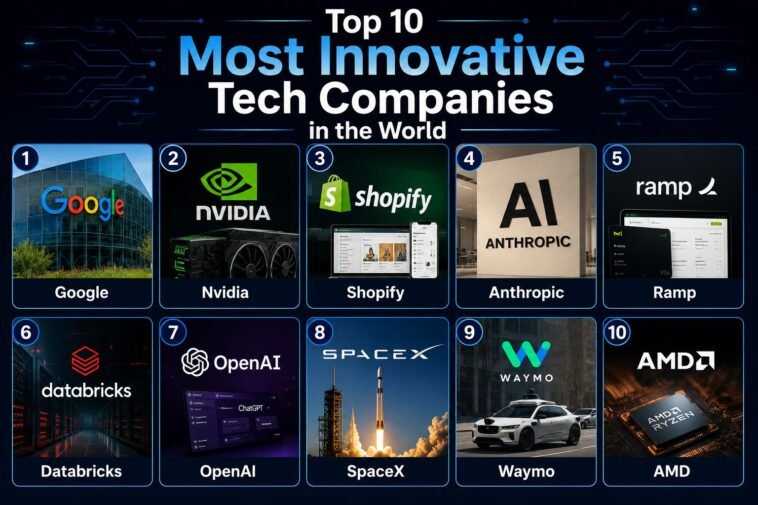
- The Top 10 Most Innovative Tech Companies in the World
- Important Statistics Table
- How Innovation Rankings Are Actually Determined (Step-by-Step)
- Pros and Cons Table
- Comparison Table: Top 10 Innovative Tech Companies
- Current Trends Shaping Tech Innovation
- FAQs
- References
Key Highlights (Quick Facts)
- Google ranked No. 1 on Fast Company’s 2026 list of the World’s 50 Most Innovative Companies, driven partly by its Willow quantum chip achieving a verified real-world quantum computing advantage.
- Nvidia ranked No. 2 overall, with its GB300 NVL72 AI supercomputer platform delivering 50 times the reasoning power of prior systems and already deployed by major cloud providers.
- Anthropic ranked No. 4 overall, with its Claude Code tool now used by companies including Netflix, Spotify, Salesforce, and KPMG since becoming generally available.
- Fintech company Ramp ranked No. 5 overall, now valued at $32 billion, built on AI agents that dramatically streamline financial tasks like expense approval.
- Databricks ranked No. 8 overall, carrying a $134 billion valuation and providing secure AI-ready data infrastructure for Fortune 500 companies.
- Shopify ranked No. 3 overall after opening its platform to agentic AI shoppers, letting customers purchase products directly within ChatGPT.
- Google’s Willow chip performed a benchmark computation in under five minutes that would take today’s fastest supercomputers 10 septillion years to complete.
- Fast Company’s rankings require every honoree to meet four specific criteria: genuine originality, measurable impact, timeliness within the past 12 months, and broader industry relevance.
The truth is, real innovation rarely looks flashy in the moment. Most of the companies on this list earned their spot through specific, measurable achievements from the past year, not just reputation or brand size.
What Actually Counts as “Innovative” in Tech
Before ranking the list, here’s what genuinely separates an innovative tech company from a merely large one.
Genuine Originality
The clearest sign of real innovation is creating something that didn’t meaningfully exist before, rather than making incremental improvements to an existing product category.
Measurable, Verifiable Impact
The strongest innovation claims come with real data behind them, whether that’s revenue growth, user adoption numbers, or documented efficiency improvements customers can point to directly.
Timeliness
A company that innovated five years ago and has coasted since doesn’t belong on a current list. The most credible rankings specifically look for meaningful progress within the past year.
Broader Relevance
The best innovations solve problems that matter beyond just one company’s bottom line, addressing challenges facing entire industries or society more broadly.
The Top 10 Most Innovative Tech Companies in the World
Here is our researched, detailed ranking of the world’s most innovative tech companies right now.
1. Google (Alphabet)
Google topped Fast Company’s 2026 Most Innovative Companies list, driven significantly by its Google Quantum AI division’s Willow chip, a 105-qubit superconducting quantum processor designed and manufactured at the company’s Santa Barbara lab. Willow performed a benchmark computation in under five minutes that would take today’s fastest supercomputers an estimated 10 septillion years, while also demonstrating a critical breakthrough in quantum error correction, with results published in the journal Nature showing error rates dropping exponentially as more qubits are added.
Beyond the quantum breakthrough, Google used Willow in what it describes as the first verifiable quantum advantage with a real-world application, computing molecular structure problems relevant to actual scientific research rather than a purely theoretical benchmark. The achievement, combined with Google’s continued dominance in search, cloud, and AI through its Gemini model family, cemented its position at the very top of the innovation rankings.
A futuristic quantum computing chip housed in a specialized cooling chamber — quantum error correction breakthroughs like Google’s Willow chip represent one of the most significant technical achievements in recent computing history.
2. Nvidia
Nvidia ranked second overall, anchored by its GB300 NVL72 platform, an integrated “AI supercomputer” combining GPUs, CPUs, power, cooling, and networking components that delivers roughly 50 times the reasoning power of prior-generation systems. The platform is already being deployed by major hyperscalers and cloud providers, including CoreWeave and Microsoft Azure, reinforcing Nvidia’s position as the backbone of global AI infrastructure.
Beyond hardware, Nvidia’s GPUs continue to power the vast majority of machine learning model training and data center computing worldwide, making the company less a traditional chipmaker and more the foundational infrastructure layer for the entire modern AI economy.
3. Shopify
Shopify ranked third after making a genuinely bold structural move: opening its e-commerce platform to agentic AI shoppers, allowing customers to complete purchases directly within ChatGPT rather than navigating to a separate website. The company also upgraded Sidekick, its AI merchant assistant, adding voice chat support in more than 20 languages along with visual asset generation and analytics capabilities.
The strategic bet appears to be paying off commercially as well, with Shopify reporting 9% year-over-year revenue growth in its most recent quarter, reaching $1.67 billion, evidence that the AI-commerce integration is translating into real business results rather than just headline-grabbing product announcements.
4. Anthropic
Anthropic ranked fourth overall, driven largely by the explosive adoption of Claude Code, a tool originally built by Anthropic’s own engineers in late 2024 to test how fluently their models could handle computer code. After the team noticed it dramatically sped up their internal software development, they refined it into a standalone product, and it has since been adopted by major companies including Netflix, Spotify, Salesforce, and KPMG, alongside thousands of startups.
Claude Code’s capabilities expanded further with the release of the Claude Opus 4.5 model in November 2025, followed by an additional capability boost with Opus 4.6 in early February 2026, reflecting a pattern of rapid, continuous improvement rather than a single static product launch.
Lines of code displayed across a developer’s monitor in a modern office — AI-assisted coding tools have moved from experimental novelty to mainstream enterprise software development in a remarkably short window of time.
5. Ramp
Ramp ranked fifth overall, now valued at $32 billion, built on a relentless focus on saving its customers time and money through AI-powered financial automation. The fintech company has implemented AI agents that dramatically streamline previously tedious tasks like expense approval, positioning it at the forefront of AI adoption within corporate finance and spend management.
Ramp’s rise reflects a broader pattern among this year’s top innovators: rather than building flashy consumer-facing AI products, some of the most commercially significant innovation is happening in unglamorous but high-value back-office functions that directly save businesses real money.
6. Databricks
Databricks ranked eighth overall, carrying a substantial valuation of $134 billion and serving as critical AI-ready data infrastructure for Fortune 500 companies. The San Francisco-based company answered the industry’s shift toward agentic AI with Agent Bricks, a feature launched in June 2025 that automates the process of creating AI agents directly from an organization’s existing data.
Databricks has built its reputation over years as the trusted, secure place where large enterprises host and make sense of their proprietary data, and its pivot toward agent creation tools reflects how quickly the broader AI infrastructure conversation has shifted from simply storing data to actively acting on it.
7. OpenAI
OpenAI continues to be recognized among the tech industry’s most consequential innovators, credited with redefining how everyday individuals and organizations interact with AI technology at scale through ChatGPT and its underlying model family. The company’s rapid iteration cycle and aggressive push into enterprise and consumer products alike have made it one of the most closely watched companies in the entire technology sector.
Beyond its consumer-facing chatbot, OpenAI’s infrastructure ambitions have grown dramatically, including involvement in the massive Stargate data center project alongside partners like Oracle and Crusoe Energy, signaling a shift toward owning more of the computing infrastructure that its own AI models depend on.
8. SpaceX
SpaceX continues to be recognized as one of technology’s most consequential innovators for fundamentally changing the economics of space access through reusable rocket technology. By developing Falcon 9 boosters capable of landing, being refurbished, and flying again, the company dramatically reduced the cost of reaching orbit compared to traditional single-use rockets.
Beyond launch technology, SpaceX’s Starlink satellite internet service now provides connectivity across regions where traditional infrastructure has historically been limited or unavailable, extending the company’s impact well beyond the aerospace industry into global telecommunications access.
A rocket launching into a clear sky with visible engine exhaust trailing below — reusable rocket technology has become one of the clearest examples of an engineering breakthrough that reshaped an entire industry’s cost structure.
9. Waymo
Waymo was recognized among Fast Company’s most innovative automotive companies for its continued leadership in autonomous vehicle technology, alongside other honorees like Baidu, Hyundai, and Cadillac in the same category. The Alphabet-owned company has continued expanding its robotaxi operations across multiple U.S. cities, representing one of the most advanced real-world deployments of self-driving technology currently operating at meaningful commercial scale.
Waymo’s approach, built on years of accumulated real-world driving data and a cautious, methodical expansion strategy, has positioned it as the most established name in a field where many competitors have struggled to move from demonstration projects to genuine, revenue-generating commercial service.
10. AMD
AMD ranked among Fast Company’s top 50 most innovative companies overall, recognized for its continued push into high-performance AI computing hardware as a genuine competitive alternative to Nvidia’s dominant position in the GPU market. The company’s growing presence in both consumer computing and data center AI infrastructure reflects a broader industry trend toward diversifying away from reliance on a single chip supplier.
AMD’s innovation extends into consumer-facing products as well, with its potent AI-capable computing hardware increasingly featured in next-generation consumer devices, reflecting the company’s strategy of pushing AI capability down from massive data centers into more accessible, everyday computing hardware.
Important Statistics Table
| Company | Fast Company Rank | Valuation/Scale | Key Innovation |
|---|---|---|---|
| Google (Alphabet) | No. 1 overall | Trillions (public company) | Willow quantum chip, verified quantum advantage |
| Nvidia | No. 2 overall | First company to reach $5 trillion valuation | GB300 NVL72 AI supercomputer platform |
| Shopify | No. 3 overall | Public company, $1.67B quarterly revenue | Agentic AI shopping within ChatGPT |
| Anthropic | No. 4 overall | Major AI lab | Claude Code, adopted by Netflix, Spotify, Salesforce |
| Ramp | No. 5 overall | $32 billion valuation | AI agents for financial task automation |
| Databricks | No. 8 overall | $134 billion valuation | Agent Bricks AI infrastructure tool |
| OpenAI | Recognized in AI category | Major AI lab | ChatGPT, Stargate infrastructure project |
| SpaceX | Recognized in aerospace/tech | Major private company | Reusable orbital rockets, Starlink |
| Waymo | Recognized in automotive category | Alphabet subsidiary | Commercial autonomous robotaxi service |
| AMD | Top 50 overall | Public company | AI-capable GPU and computing hardware |
How Innovation Rankings Are Actually Determined (Step-by-Step)
- Companies submit applications or get nominated for consideration, typically detailing specific achievements from the preceding 12 months.
- Editorial teams evaluate submissions against defined criteria, such as Fast Company’s four-part framework of innovation, impact, timeliness, and relevance.
- Independent data sources supplement self-reported claims, with rankings often incorporating outside data platforms like PitchBook to verify company achievements.
- Multiple rounds of internal judging follow, typically involving dozens of editors and writers debating and cross-checking nominations against each other.
- Category and overall rankings get finalized separately, meaning a company can rank highly within its specific industry category while also earning a position on the smaller overall top 50 list.
- Results are published with supporting detail, allowing readers to verify the specific achievements behind each ranking rather than taking the placement at face value.
Pros and Cons Table
| Company | Pros | Cons |
|---|---|---|
| Breadth across quantum, AI, cloud, and search | Regulatory scrutiny continues across multiple markets | |
| Nvidia | Dominant AI hardware position, massive scale | Extremely high valuation carries real correction risk |
| Shopify | Genuinely novel AI-commerce integration | Success still tied heavily to broader e-commerce trends |
| Anthropic | Rapid enterprise adoption of Claude Code | Intensely competitive AI lab landscape |
| Ramp | Clear, measurable ROI for business customers | Fintech sector faces ongoing regulatory complexity |
| Databricks | Deep enterprise trust, high valuation | Competing directly with cloud giants’ own AI tools |
| OpenAI | Massive consumer and enterprise reach | Heavy infrastructure costs and compute demands |
| SpaceX | Transformed launch economics industry-wide | Environmental and space debris concerns growing |
| Waymo | Most mature commercial robotaxi operation | Expansion still limited to specific cities |
| AMD | Genuine alternative to Nvidia’s GPU dominance | Still trails Nvidia significantly in AI market share |
Comparison Table: Top 10 Innovative Tech Companies
| Company | Primary Sector | Headquarters | Core Innovation Area |
|---|---|---|---|
| Search/Cloud/AI | Mountain View, USA | Quantum computing, AI models | |
| Nvidia | Semiconductors | Santa Clara, USA | AI hardware and infrastructure |
| Shopify | E-commerce | Ottawa, Canada | Agentic AI commerce |
| Anthropic | Artificial Intelligence | San Francisco, USA | AI coding and reasoning models |
| Ramp | Fintech | New York, USA | AI-powered financial automation |
| Databricks | Data/AI Infrastructure | San Francisco, USA | Enterprise AI agent tools |
| OpenAI | Artificial Intelligence | San Francisco, USA | Consumer and enterprise AI models |
| SpaceX | Aerospace | Hawthorne, USA | Reusable rockets, satellite internet |
| Waymo | Autonomous Vehicles | Mountain View, USA | Commercial self-driving technology |
| AMD | Semiconductors | Santa Clara, USA | AI-capable computing hardware |
A modern data center corridor lined with server racks and blue ambient lighting — the infrastructure behind AI innovation has become just as significant a competitive battleground as the models and products built on top of it.
Current Trends Shaping Tech Innovation
Tech innovation keeps accelerating, and a few clear patterns stand out in the current landscape.
AI Infrastructure Has Become the Core Battleground
From Nvidia’s AI supercomputer platforms to Databricks’ agent-creation tools, the most valuable innovation right now is happening at the infrastructure layer that makes AI actually usable at enterprise scale, not just in flashy consumer-facing chatbots.
Quantum Computing Is Moving From Theory to Practical Application
Google’s Willow chip achieving a verified real-world quantum advantage marks a genuine shift from purely theoretical quantum computing demonstrations toward computations with actual scientific and commercial relevance.
Agentic AI Is Reshaping Entire Industries
Shopify’s move to let customers shop directly within ChatGPT and Ramp’s AI agents automating financial approval tasks both reflect a broader shift toward AI systems that take autonomous action, not just generate text or answers.
Enterprise Adoption Is Outpacing Consumer Hype
Tools like Anthropic’s Claude Code, now used by major companies including Netflix and Salesforce, show that some of the most significant AI impact is happening quietly inside enterprise workflows rather than in consumer-facing headlines.
Innovation Increasingly Requires Measurable Proof
Modern innovation rankings increasingly demand verifiable data, revenue growth, efficiency percentages, and adoption numbers, rather than accepting bold claims about potential future impact at face value.
FAQs About the Most Innovative Tech Companies
Which tech company is currently considered the most innovative in the world? Google ranked No. 1 on Fast Company’s 2026 Most Innovative Companies list, driven significantly by its Willow quantum chip achieving a verified real-world quantum computing advantage.
What makes Nvidia so central to the current AI boom? Nvidia’s GPUs power the vast majority of AI model training and data center computing worldwide, and its GB300 NVL72 platform delivers roughly 50 times the reasoning power of prior-generation AI infrastructure systems.
How is innovation actually measured in these rankings? Reputable rankings like Fast Company’s evaluate companies against four specific criteria: genuine originality, measurable impact, timeliness within the past 12 months, and broader relevance to industry or society.
Is Anthropic’s Claude Code widely used by real companies? Yes. Since becoming generally available, Claude Code has been adopted by major companies including Netflix, Spotify, Salesforce, and KPMG, alongside thousands of startups.
Why did a fintech company like Ramp rank so highly among tech innovators? Ramp built AI agents that measurably streamline financial tasks like expense approval, and its resulting $32 billion valuation reflects genuine enterprise demand for that kind of practical, back-office AI automation.
Are quantum computing breakthroughs like Google’s Willow chip actually useful yet? Increasingly, yes. While earlier quantum demonstrations were largely theoretical benchmarks, Google has used Willow for what it describes as the first verifiable quantum advantage applied to an actual real-world scientific computation.
Does company size determine how “innovative” a tech company is ranked? Not directly. While several of the largest tech companies rank highly, rankings like Fast Company’s specifically require recent, measurable innovation rather than crediting a company purely for its size or market value.
Conclusion
The most innovative tech companies in the world right now share a common thread: each one shipped something genuinely new within the past year that created measurable, verifiable impact, from Google’s quantum computing breakthrough to Anthropic’s rapid enterprise coding tool adoption. Whether it’s AI infrastructure, quantum computing, or agentic commerce, the innovation happening right now is increasingly practical and enterprise-focused rather than purely experimental. Expect this list to keep shifting fast as AI infrastructure spending and quantum computing both continue accelerating.
References
- Fast Company — The World’s Most Innovative Companies of 2026, Official List
- Fast Company — Fast Company Unveils 2026 Most Innovative Companies List, Led by Google, Nvidia, and Shopify
- Fast Company — The Most Innovative Computing Companies of 2026
- Fast Company — The Most Innovative Artificial Intelligence Companies of 2026
- Fast Company — The Most Innovative Companies in Finance for 2026
- Fast Company — The Most Innovative Companies in North America for 2026
- Fast Company — The Most Innovative Companies in Retail for 2026
- Fast Company — Methodology: 2026 World’s Most Innovative Companies
- ABI Research — The Most Innovative Technology Companies
- LexisNexis Intellectual Property Solutions — Most Innovative Companies 2026, Innovation Momentum Global Top 100
- Dallas Innovates — 7 DFW Companies Land on Fast Company’s 2026 Most Innovative List
- Forbes — The World’s Most Innovative Companies List



GIPHY App Key not set. Please check settings