 kiruthika
Hook Introduction
A bubble tea and ice cream chain most Western consumers have never heard of now operates more stores worldwide than McDonald’s and Starbucks combined.
We compared 2026 revenue, global footprint, and growth data to rank the fast food chains actually dominating the world right now, by scale and by money, which turn out to tell two different stories.
Key Highlights (Quick Facts)
- McDonald’s posted over $34 billion in systemwide sales in Q1 2026 alone, an 11% increase over the same period in 2025, and operates roughly 41,800+ locations across more than 100 countries.
- Mixue Ice Cream & Tea, a Chinese chain most Western consumers have never heard of, has overtaken Subway as the world’s largest fast food chain by location count, operating around 45,000 stores globally.
- Starbucks leads the industry by pure annual revenue at roughly $32.3 billion, with around 40,199 locations worldwide as of 2024.
- KFC reported $9.3 billion in system sales for Q1 2026 alone, with 12% year-over-year growth, and opened 648 new restaurants across 45 countries in that quarter alone.
- China now generates more KFC revenue than the US — 26% of KFC’s Q1 2026 system sales came from China, compared to just 12% from its home country.
- Subway, once the world’s largest chain by location count for years, has been steadily consolidating rather than expanding, dropping to around 36,900 locations as of recent counts, down from its pandemic-era peak.
- Chick-Fil-A posts the highest average sales per individual restaurant location in the industry, at roughly $4.09 million per store annually — more than double McDonald’s US per-store average — despite being closed every Sunday.
- The average McDonald’s US location earns roughly $3.96 million per year, illustrating how per-store efficiency, not just total store count, drives real financial performance across this industry.
How We Ranked These Chains
We weighed three distinct measures that frequently produce different rankings: total global revenue, total number of locations worldwide, and recent growth momentum (year-over-year sales and store expansion). We’ve been explicit throughout about which measure applies to each ranking claim, since a chain that leads on store count (Mixue) isn’t the same chain that leads on revenue (Starbucks or McDonald’s), and neither is necessarily the fastest-growing (KFC).
Figures come from company earnings reports where publicly available; several major chains, including Chick-fil-A and Subway, are privately held and don’t release full quarterly financial disclosures, so their figures rely on industry estimates rather than official filings.
The Top 10 Most Popular Fast Food Chains Worldwide in 2026
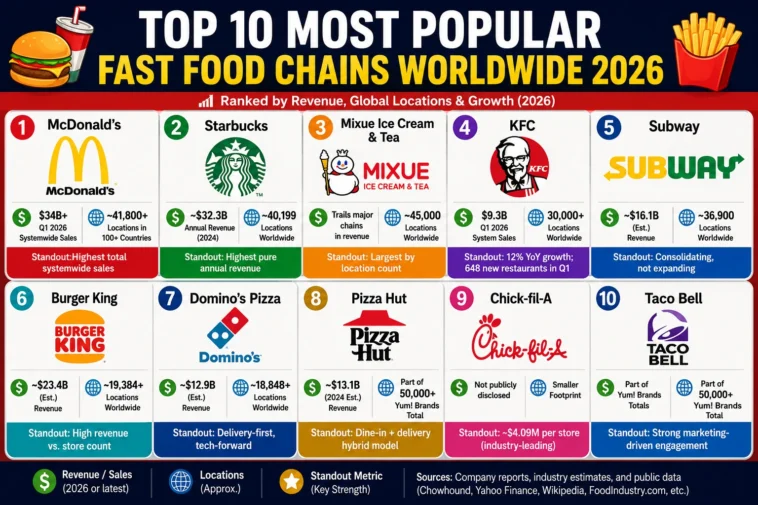
1. McDonald’s
McDonald’s remains the most recognized fast food brand on Earth and the clear leader in Q1 2026 sales, posting over $34 billion in systemwide sales in the first quarter alone — an 11% increase over the same period in 2025. With roughly 41,800+ locations across more than 100 countries, its scale advantage over nearly every competitor remains enormous.
Per-location performance is just as telling as the headline number: the average US McDonald’s location earns approximately $3.96 million annually, reflecting decades of drive-thru optimization, breakfast-daypart expansion, and a franchise model built specifically for consistent, scalable operations across wildly different markets and cultures.
Q1 2026 systemwide sales: $34+ billion. Locations: ~41,800+ in 100+ countries. Standout strength: Highest total systemwide sales of any single chain.
2. Starbucks
Starbucks leads the industry by pure annual revenue, generating roughly $32.3 billion with approximately 40,199 locations worldwide as of 2024, a scale that places it firmly among the two or three largest food-service companies on the planet by revenue, despite technically operating as a coffeehouse chain rather than a traditional fast food restaurant.
Its loyalty program is widely cited as the primary driver of repeat visits and customer retention, and unlike most chains on this list, a majority of Starbucks locations are company-owned rather than franchised, giving it tighter direct control over pricing, quality, and store experience across its global footprint.
Annual revenue: ~$32.3 billion. Locations: ~40,199 worldwide. Standout strength: Highest pure annual revenue of any chain on this list.
3. Mixue Ice Cream & Tea
Mixue is the genuine surprise entry on this list for most Western readers, a Chinese ice cream and bubble tea chain that has quietly become the largest fast food chain in the world by number of locations, operating around 45,000 stores globally, having overtaken Subway for that title.
Mixue’s dominance comes from an entirely different playbook than McDonald’s or Starbucks: extreme store density, very low-cost menu pricing, and small-format outlets that can be profitably placed in far more locations than a typical full-size fast food restaurant. It illustrates a genuinely important 2026 industry pattern — store count and revenue can produce completely different “biggest chain” answers depending on which one you’re measuring.
Locations: ~45,000 worldwide (largest by store count). Revenue: Trails major Western chains significantly despite location lead. Standout strength: Unmatched global store density.
4. KFC
KFC posted $9.3 billion in system sales for Q1 2026 alone, achieving 12% year-over-year growth — among the strongest growth rates of any major chain tracked this year — while opening 648 new restaurants across 45 countries in that single quarter. It operates more than 30,000 restaurants worldwide as the world’s largest fried chicken chain by store count.
The geography of KFC’s revenue is genuinely striking: its country of origin, the United States, accounted for just 12% of total Q1 2026 system sales, putting it in third place behind Europe (13%) and, remarkably, China at 26% — meaning KFC now generates roughly twice as much revenue from China as from the US, with more physical locations in China than in its home country.
Q1 2026 system sales: $9.3 billion. Locations: 30,000+ worldwide. Standout strength: Fastest revenue growth (12% YoY) among major publicly reporting chains.
5. Subway
Subway was the world’s largest fast food chain by location count for many years, but it’s since been overtaken by Mixue and has shifted its strategy toward consolidation and modernization rather than raw expansion. Current location counts sit around 36,900 restaurants, down from earlier pandemic-era peaks, with revenue estimated around $16.1 billion.
The brand’s 2026 strategy centers on operational efficiency — digital menu boards to simplify ordering and highlight premium upgrades, and flexible signage systems that let cost-conscious franchisees modernize without major capital investment — reflecting a broader shift from growth-at-all-costs toward strengthening the existing store base.
Estimated revenue: ~$16.1 billion. Locations: ~36,900 (down from prior peak). Standout strength: Deep brand recognition despite active consolidation phase.
6. Burger King
Burger King posted an estimated $23.4 billion in global revenue with roughly 19,384+ locations as of recent counts — a ranking position some analysts find surprising, given how much smaller its footprint is compared to Subway’s location count, yet its revenue comfortably outpaces several chains with far more physical stores.
That gap between store count and revenue reflects Burger King’s positioning as a full-format, sit-down-adjacent fast food experience with a higher average check size than smaller-format or value-menu-focused competitors, helping it punch well above its store-count weight class financially.
Estimated revenue: ~$23.4 billion. Locations: ~19,384+ worldwide. Standout strength: High revenue relative to a comparatively smaller store footprint.
7. Domino’s Pizza
Domino’s generates an estimated $12.9 billion in global revenue across roughly 18,848+ locations, built almost entirely around a delivery-and-carryout model rather than significant dine-in seating — a structural difference from most other chains on this list.
Domino’s has also positioned itself as a genuine technology leader within the category, investing heavily in digital ordering innovations, from AI-powered order-taking systems to real-time delivery tracking, setting an industry benchmark that competitors across the pizza category have increasingly had to match.
Estimated revenue: ~$12.9 billion. Locations: ~18,848+ worldwide. Standout strength: Delivery-first model with strong digital-ordering technology investment.
8. Pizza Hut
Pizza Hut generated an estimated $13.1 billion in revenue as of 2024 figures, operating as part of Yum! Brands’ broader global portfolio alongside KFC and Taco Bell. As a Yum! Brands property, it benefits from shared operational infrastructure and international expansion expertise across the parent company’s combined 50,000+ restaurants in more than 150 countries and territories.
Pizza Hut’s dual dine-in-and-delivery model differentiates it structurally from Domino’s more delivery-exclusive approach, giving it a somewhat different competitive position within the broader global pizza category even as both chains compete directly in many of the same international markets.
Estimated revenue: ~$13.1 billion. Parent company: Yum! Brands. Standout strength: Combined dine-in and delivery model, backed by Yum! Brands’ global infrastructure.
9. Chick-fil-A
Chick-fil-A stands out for a metric that matters more to franchise economics than any other on this list: average sales per location. At roughly $4.09 million per store annually, it posts the highest per-unit sales figure of any major fast food chain — more than double McDonald’s already-strong US per-store average — despite operating with a smaller total footprint and remaining closed every Sunday.
As a privately held company, Chick-fil-A doesn’t release full quarterly earnings the way publicly traded competitors do, but its per-store efficiency and famously strong customer-service reputation have made it one of the most closely studied operational models in the entire fast food industry, particularly among chains looking to improve unit-level profitability rather than simply chase store count.
Estimated sales per store: ~$4.09 million/year (industry-leading). Ownership: Privately held. Standout strength: Highest per-location sales efficiency of any major chain.
10. Taco Bell
Taco Bell rounds out the top 10 as the third major brand under Yum! Brands’ umbrella alongside KFC and Pizza Hut, contributing to the parent company’s position as the world’s largest restaurant company by system units, with Yum! Brands operating over 50,000 restaurants combined across more than 150 countries.
Taco Bell has built a distinctive marketing identity within the fast food category, leaning heavily on digital signage and bold, attention-grabbing campaigns to promote limited-time menu items, a strategy credited with keeping the brand culturally relevant and driving repeat visits even in a highly saturated quick-service category.
Parent company: Yum! Brands. Standout strength: Strong marketing-driven customer engagement within the Mexican-inspired fast food category.
Important Statistics Table
| Rank | Chain | Revenue/Sales (2026 or latest) | Locations (approx.) | Standout Metric |
| 1 | McDonald’s | $34B+ (Q1 2026 systemwide) | ~41,800+ | 11% YoY growth |
| 2 | Starbucks | ~$32.3B annual | ~40,199 | Highest pure annual revenue |
| 3 | Mixue Ice Cream & Tea | Trails major chains | ~45,000 | Largest by location count |
| 4 | KFC | $9.3B (Q1 2026 system sales) | 30,000+ | 12% YoY growth; 648 new restaurants in Q1 |
| 5 | Subway | ~$16.1B (est.) | ~36,900 | Consolidating, not expanding |
| 6 | Burger King | ~$23.4B (est.) | ~19,384+ | High revenue vs. store count |
| 7 | Domino’s Pizza | ~$12.9B (est.) | ~18,848+ | Delivery-first, tech-forward |
| 8 | Pizza Hut | ~$13.1B (2024 est.) | Part of 50,000+ Yum! Brands total | Dine-in + delivery hybrid |
| 9 | Chick-fil-A | Not publicly disclosed | Smaller footprint | ~$4.09M/store (industry-leading) |
| 10 | Taco Bell | Part of Yum! Brands totals | Part of 50,000+ Yum! Brands total | Strong marketing-driven engagement |
Sources: Chowhound 2026, Yahoo Finance 2026, Student Recipes 2026, Wikipedia (List of Largest Fast Food Restaurant Chains), PosterBooking 2026, DotSignage 2026, FoodIndustry.com. Figures marked “est.” reflect industry estimates for privately held companies or most recently available public data; revenue figures use differing reporting periods across sources.
Step-by-Step: How Fast Food Rankings Are Actually Calculated
- Distinguish revenue from system sales. “Revenue” (what the parent company books) and “systemwide sales” (total sales across all franchised and owned locations) are different figures — McDonald’s and KFC’s headline 2026 numbers above are systemwide sales, not corporate revenue.
- Check whether a chain is public or private. Publicly traded chains like McDonald’s, Starbucks, and Yum! Brands (KFC, Pizza Hut, Taco Bell) file detailed quarterly earnings; privately held chains like Chick-fil-A and Subway rely on industry estimates.
- Separate location count from financial performance. Mixue leads on store count by a wide margin but trails significantly on revenue — the two metrics answer different questions about “biggest.”
- Account for reporting-period differences. Some figures reflect Q1 2026 specifically, others reflect full-year 2024 or 2025 data — always check the period before directly comparing two chains’ numbers.
- Consider per-location efficiency alongside total scale. Chick-fil-A’s per-store sales figure reveals a genuinely different kind of industry leadership than pure store-count or total-revenue rankings capture.
Pros and Cons Table
| Chain | Pros | Cons |
| McDonald’s | Massive scale, strong Q1 2026 growth | Faces intensifying value-menu competition |
| Starbucks | Highest pure revenue, strong loyalty program | Premium pricing vs. traditional fast food competitors |
| Mixue Ice Cream & Tea | Unmatched global store density | Limited brand recognition outside Asia |
| KFC | Strong 2026 growth, major China presence | Heavy reliance on international markets for growth |
| Subway | Deep global brand recognition | Actively consolidating rather than growing |
| Burger King | Strong revenue relative to store count | Smaller footprint than several store-count leaders |
| Domino’s Pizza | Delivery-first efficiency, strong tech investment | Limited dine-in revenue stream |
| Pizza Hut | Backed by Yum! Brands’ global infrastructure | Slower growth than sibling brand KFC |
| Chick-fil-A | Highest per-store sales in the industry | Closed Sundays; smaller total footprint |
| Taco Bell | Strong marketing engagement, Yum! Brands backing | Smaller standalone scale than sibling KFC |
Comparison Table: Biggest by Revenue vs. Biggest by Locations
| Measure | Leading Chain | Runner-Up | Why the Gap Exists |
| Total systemwide sales | McDonald’s ($34B+ Q1 2026) | Starbucks (~$32.3B annual) | Both leverage massive global scale and premium per-visit spend |
| Total locations worldwide | Mixue Ice Cream & Tea (~45,000) | McDonald’s (~41,800+) | Mixue’s small-format, low-cost model enables far denser coverage |
| Fastest year-over-year growth | KFC (12% YoY, Q1 2026) | McDonald’s (11% YoY, Q1 2026) | Both are actively expanding in China and other growth markets |
| Highest per-store sales | Chick-fil-A (~$4.09M/store) | McDonald’s US (~$3.96M/store) | Reflects operational efficiency rather than total footprint |
| Revenue relative to store count | Burger King | Domino’s Pizza | Higher average check size per location than store-count leaders |
2026 News and Trends
The single most important 2026 storyline is the rise of Mixue Ice Cream & Tea as the genuine largest fast food chain in the world by location count — a brand still largely unknown to Western consumers, illustrating how much fast food industry growth is now happening outside traditional US and European media coverage entirely.
China has become a genuine growth engine, not just a market, for several major Western chains. KFC’s Q1 2026 earnings show China now generating 26% of total system sales, more than double the US’s 12% contribution, while McDonald’s and other major brands continue aggressive China expansion alongside domestic Chinese competitors like Mixue and Luckin Coffee.
Digital ordering and AI-powered operations have become standard competitive infrastructure rather than a differentiator, with Domino’s AI-powered order-taking and Subway’s digital menu-board modernization both reflecting an industry-wide shift toward technology-driven efficiency, particularly as franchisees face pressure to modernize without major new capital investment.
Meanwhile, per-store efficiency is drawing increasing attention alongside raw scale. Chick-fil-A’s roughly $4.09 million average sales per location — achieved without Sunday operations — has become a widely studied benchmark in the industry, a reminder that total store count and total revenue don’t always predict which individual restaurant model is actually performing best.
Conclusion
McDonald’s and Starbucks remain the financial giants of the fast food world in 2026, but Mixue Ice Cream & Tea’s rise to the largest chain by location count — largely unnoticed in Western media — shows just how much the industry’s real center of gravity has shifted toward Asia. Whether you’re measuring by revenue, store count, or growth rate, this year’s rankings make one thing clear: “biggest” depends entirely on what you’re counting.
References
- Chowhound – The 3 Fast Food Chains With The Highest Overall Sales In 2026 So Far: https://www.chowhound.com/2183120/highest-sales-fast-food-chains-2026/
- Yahoo Finance – The 3 Fast Food Chains With The Highest Overall Sales In 2026 So Far: https://finance.yahoo.com/markets/stocks/articles/3-fast-food-chains-highest-150500630.html
- PosterBooking – Biggest Fast-Food Chains in the World: https://www.posterbooking.com/signage/explore/biggest-fast-food-chains-in-the-world/
- Student Recipes – The 10 Biggest Fast Food Chains in the World, Ranked by Revenue: https://studentrecipes.com/news/biggest-fast-food-chains-ranked-revenue/
- DotSignage – 15 Top Fast Food Chains in 2026 & Their Digital Menu Board Strategies: https://www.dotsignage.com/blog/top-fast-food-chains-in-the-world/
- Wikipedia – List of the Largest Fast Food Restaurant Chains: https://en.wikipedia.org/wiki/List_of_the_largest_fast_food_restaurant_chains
- Crown TV – Biggest Fast Food Chains Worldwide: Top 10 Global Giants by Revenue: https://www.crowntv-us.com/blog/biggest-fast-food-chains/
- FoodIndustry.com – What is the Biggest Fast Food Restaurant Chain?: https://www.foodindustry.com/articles/what-is-the-biggest-fast-food-restaurant-chain/
FAQs
It depends on the measure. McDonald’s leads on total systemwide sales ($34+ billion in Q1 2026 alone), Starbucks leads on pure annual revenue (~$32.3 billion), and Mixue Ice Cream & Tea leads on total global locations (~45,000 stores).
No. Subway was the world’s largest chain by location count for many years, but it has been overtaken by Mixue Ice Cream & Tea, a Chinese chain now operating around 45,000 locations globally. Subway has also actively shifted toward consolidation rather than expansion in recent years.
KFC posted the strongest recent growth among major publicly reporting chains, with 12% year-over-year system sales growth in Q1 2026 and 648 new restaurants opened across 45 countries in that quarter alone, closely followed by McDonald’s at 11% YoY growth.
Revenue reflects what the parent company itself books, while systemwide sales include total sales across all franchised and company-owned locations combined. A franchise-heavy company like McDonald’s can post enormous systemwide sales figures while its own corporate revenue (from franchise fees and royalties) is comparatively smaller.



GIPHY App Key not set. Please check settings