 kiruthika
Introduction
A cancer vaccine can now be built from a patient’s own tumor. A California neighborhood pushed 51 megawatts back into the power grid using nothing but parked electric cars. This isn’t a decade-away sci-fi pitch, it’s already happening, according to the World Economic Forum’s newly released 2026 report. Below is our full breakdown of the top 10 emerging technologies that will shape the future, and what’s actually moving from the lab bench to real life this year.
Table of Contents
- Key Highlights
- What Makes a Technology “Emerging” vs. Just Hype
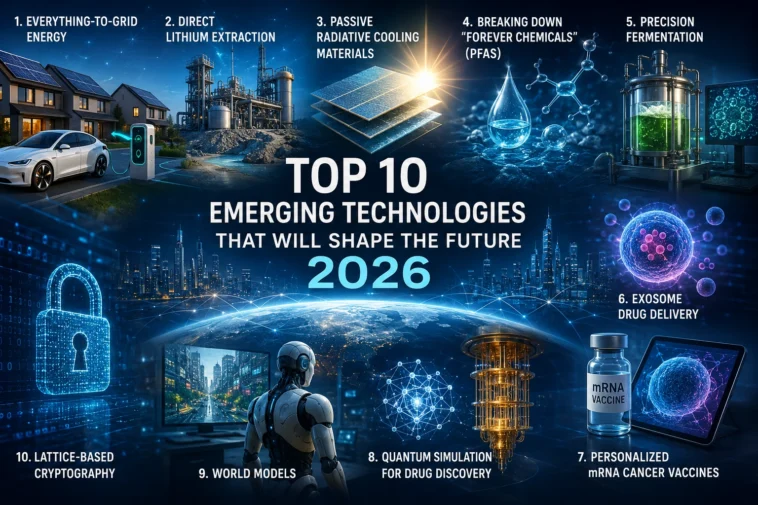
- The Top 10 Emerging Technologies That Will Shape the Future
- Important Statistics Table
- How These Technologies Get Selected (Step-by-Step)
- Pros and Cons Table
- Comparison Table: Top 10 Technologies at a Glance
- Current 2026 Trends in Emerging Technology
- FAQs
- References
Key Highlights (Quick Facts)
- This list of the top 10 emerging technologies that will shape the future is drawn from the World Economic Forum’s official 2026 report, now in its 14th edition, co-published with Frontiers and launched at “Summer Davos” in Dalian, China, on June 23, 2026.
- The 2026 list was narrowed down from more than 1,200 candidate technologies screened through an AI-based nomination workflow, then refined by expert review and an Advisory Council.
- In California, more than 16,000 solar-equipped homes linked into a distributed network pushed 51 megawatts back to the grid during a single 2024 evening demand peak, exceeding the output of several fossil-fuel peaker plants.
- Three-quarters of global lithium production is currently concentrated in China, which is exactly why direct lithium extraction technology is being positioned as a supply-chain diversifier.
- Passive radiative cooling materials reflect roughly 95% of incoming sunlight, with suppliers reporting energy savings of up to 20% in retail and grocery store settings.
- A Daikin Industries UV-based method reportedly destroyed 99.99% of PFAS (“forever chemicals”) during a field trial, tackling a pollution problem previously considered nearly unsolvable.
- A South Carolina melanoma trial combining a personalized mRNA cancer vaccine with immunotherapy showed a 40–50% reduction in the risk of recurrence or death compared to immunotherapy alone.
- The report’s authors identify three overarching trends for 2026: technologies are becoming more personalized (tailored to a single patient or context), more decentralized (produced closer to where they’re needed), and increasingly capable of achieving more with less resource input.
What Makes a Technology “Emerging” vs. Just Hype
Before ranking the list, it’s worth understanding how the World Economic Forum actually separates a genuine breakthrough from a buzzword.
Novelty
The technology has to represent a real scientific or engineering advance, not a rebrand of something that already exists.
Development Progress
It needs demonstrable proof that it works outside a controlled lab setting, whether that’s a pilot plant, a field trial, or early commercial deployment.
Potential Impact
The technology has to carry genuine potential to reshape an industry, a health outcome, or an entire supply chain, not just a niche use case.
Timing Signal
Perhaps most importantly, the technology has to be arriving at a decision point, where choices made now by governments, companies, and researchers will meaningfully shape how it develops from here.
The Top 10 Emerging Technologies That Will Shape the Future
Here’s the full, WEF-sourced ranking of the top 10 emerging technologies that will shape the future in 2026, based on the official Top 10 Emerging Technologies report.
1. Everything-to-Grid Energy
Category: Energy infrastructure
What it does: Electric vehicles, home batteries, and even idle equipment in factories and data centers get mobilized to feed stored electricity back into the grid during peak demand hours, rather than sitting unused.
Why it stands out: In California, more than 16,000 solar-equipped homes linked into a distributed network pushed 51 megawatts back to the grid during a 2024 evening demand peak, output that exceeded several fossil-fuel peaker plants combined, without the emissions.
2. Direct Lithium Extraction
Category: Materials and mining
What it does: Engineered systems using sorbents, membranes, and solvents pull lithium out of brine within hours, instead of the up-to-two-year evaporation process traditional extraction requires.
Why it stands out: With three-quarters of global lithium production currently concentrated in China, this technology diversifies supply by also working with geothermal fluids, oilfield wastewater, and recycled materials. Plants are already operating in Argentina, the United States, and Australia.
Image: Electric vehicles plugged into a solar-connected charging network — everything-to-grid technology turns parked EVs into on-demand power sources during peak hours.
3. Passive Radiative Cooling Materials
Category: Building materials and energy efficiency
What it does: Specially engineered paints, coatings, and films reflect roughly 95% of incoming sunlight, keeping surfaces cooler than the surrounding air without using any electricity.
Why it stands out: Suppliers report energy savings of up to 20% in settings like grocery and retail stores, and cool roof materials are already mandated as part of green building standards in both California and China. UK startup AssetCool has even developed a coating that lets power cables carry 30% more electricity by keeping them cooler.
4. Breaking Down “Forever Chemicals” (PFAS)
Category: Environmental remediation
What it does: New methods superheat water, apply electrical currents, or use UV-driven chemical reactions to break the extremely strong carbon-fluorine bonds that make PFAS chemicals so persistent in the environment.
Why it stands out: A Michigan facility destroying PFAS from landfill runoff has been operational since 2023, and Daikin Industries, one of the world’s largest PFAS producers, reported its UV-based method destroyed 99.99% of PFAS during a field trial.
5. Precision Fermentation
Category: Food and biomanufacturing
What it does: Genetic code for proteins, enzymes, and drugs gets inserted into microbes like yeast or bacteria, which then act as tiny factories producing molecules chemically identical to their natural counterparts, without crops or animals.
Why it stands out: The technology already produces microbe-derived egg proteins and animal-free whey protein at commercial scale, and it’s expanding into cosmetic peptides, pharmaceutical compounds, and chemicals traditionally derived from fossil fuels.
Image: A researcher working in a biotech lab — precision fermentation and mRNA-based medicine represent two of the fastest-moving categories in this year’s emerging technology report.
6. Exosome Drug Delivery
Category: Medicine and drug delivery
What it does: Exosomes are tiny particles that naturally shuttle proteins and genetic material between cells. Loading them with therapeutic drugs lets treatments reach diseased cells without degrading or getting deflected by the body’s immune defenses, a major limitation of many synthetic drugs.
Why it stands out: In a Phase 1 US trial, pancreatic cancer patients with no remaining treatment options were stabilized using engineered exosomes targeting a previously hard-to-treat mutation. The approach is also showing promise for neurological disorders like Alzheimer’s and Parkinson’s.
7. Personalized mRNA Cancer Vaccines
Category: Oncology and immunotherapy
What it does: A patient’s tumor gets sequenced to identify unique mutations and proteins, and a custom mRNA vaccine is then built to train that specific patient’s immune system to recognize and attack their cancer cells.
Why it stands out: In a melanoma trial in South Carolina, patients receiving a personalized mRNA vaccine alongside immunotherapy saw a 40–50% reduction in the risk of recurrence or death compared to immunotherapy alone.
8. Quantum Simulation for Drug Discovery
Category: Computing and pharmaceuticals
What it does: Quantum computing models how molecules behave at the atomic level with far greater accuracy than traditional computational methods, helping researchers predict how drug candidates will actually perform before committing to expensive trials.
Why it stands out: Nine in ten new drugs that enter clinical trials still fail. A 2025 collaboration between IBM and Moderna used quantum computing to run one of the largest simulations of protein folding and mRNA interactions to date, aiming to cut down exactly that kind of costly failure rate.
9. World Models
Category: Artificial intelligence
What it does: Unlike traditional AI that mostly describes or classifies data, world models are trained on video, sensor, and text data to build an internal representation of how the physical world actually behaves, letting them reason about situations they’ve never directly encountered.
Why it stands out: NVIDIA’s Cosmos platform trains robots on vast amounts of physical-world data so they can adapt to new, unfamiliar environments, marking a genuine shift from screen-based AI toward AI that understands physical space, which matters enormously for robotics and climate modeling.
Image: A quantum computing research facility — quantum simulation is now being used to model drug interactions at a scale impossible for classical computers.
10. Lattice-Based Cryptography
Category: Cybersecurity and encryption
What it does: This encryption approach hides data inside complex mathematical structures called lattices, adding small amounts of random “noise” that makes it extremely difficult for even a future quantum computer to distinguish the correct solution from countless false ones.
Why it stands out: Lattice-based cryptography already protects Apple’s iMessage today, and Google plans to build it into Android alongside other encryption techniques, positioning it as one of the leading defenses against the eventual arrival of quantum decryption.
Important Statistics Table
A quick-reference look at the top 10 emerging technologies that will shape the future, along with the key data point behind each one.
| Technology | Category | Key Verified Data Point |
| Everything-to-grid energy | Energy | 51 MW pushed to grid by 16,000+ CA homes (2024 peak event) |
| Direct lithium extraction | Materials | 75% of global lithium production concentrated in China |
| Passive radiative cooling | Building materials | Reflects ~95% of sunlight; up to 20% energy savings |
| PFAS destruction | Environment | 99.99% PFAS destroyed in Daikin field trial |
| Precision fermentation | Food/biotech | Already producing commercial egg and whey proteins |
| Exosome drug delivery | Medicine | Stabilized pancreatic cancer patients in Phase 1 US trial |
| mRNA cancer vaccines | Oncology | 40–50% reduction in recurrence/death risk (melanoma trial) |
| Quantum drug simulation | Computing/pharma | ~90% of new drugs fail trials; IBM-Moderna ran major 2025 simulation |
| World models | AI | Trained on video, sensor, text data (e.g., NVIDIA Cosmos) |
| Lattice-based cryptography | Cybersecurity | Already protects Apple iMessage; coming to Android |
How These Technologies Get Selected (Step-by-Step)
- Frontiers screens more than 1,200 candidate technologies using an AI-based nomination workflow pulling from academic and industry sources worldwide.
- Technologies get filtered for novelty, ruling out incremental updates to existing products or rebranded older concepts.
- Development progress gets verified, checking for pilot plants, field trials, or early commercial deployment rather than purely theoretical research.
- An Advisory Council and expert reviewers refine the shortlist, weighing potential impact across industry, policy, and society.
- The Forum and Frontiers co-author the final report, published annually and launched at a major Forum event, in 2026 at Summer Davos in Dalian, China.
- Interactive Transformation Maps get built on the Forum’s Strategic Intelligence Platform, tracking how each selected technology evolves across sectors afterward.
- The list gets revisited each year, with technologies from prior editions either continuing to scale or fading if development stalls.
Pros and Cons Table
| Technology | Pros | Cons |
| Everything-to-grid energy | Uses existing idle assets, cuts emissions | Requires significant grid infrastructure coordination |
| Direct lithium extraction | Faster, diversifies supply chains | Still scaling; not yet at traditional evaporation-pond volumes |
| Passive radiative cooling | No electricity needed, low-cost retrofit | Effectiveness varies by climate and building type |
| PFAS destruction | Actually destroys rather than just removes PFAS | Energy-intensive processes at current commercial scale |
| Precision fermentation | Consistent output, reduces land/animal use | Consumer acceptance of lab-grown proteins still developing |
| Exosome drug delivery | Better targeting, fewer immune rejections | Still early-stage (Phase 1) for most applications |
| mRNA cancer vaccines | Personalized, strong trial results | Requires individualized production per patient, raising cost |
| Quantum drug simulation | Could cut costly trial failures | Quantum hardware access remains limited and expensive |
| World models | More adaptable AI reasoning | Computationally intensive, still maturing |
| Lattice-based cryptography | Defends against future quantum attacks | Broader rollout across platforms still in progress |
Comparison Table: Top 10 Emerging Technologies at a Glance
| Technology | Primary Sector | Stage of Development | Decentralized? |
| Everything-to-grid energy | Energy | Commercial deployment | Yes |
| Direct lithium extraction | Mining/materials | Multiple plants operating | Yes |
| Passive radiative cooling | Construction | Mandated in some regions | Yes |
| PFAS destruction | Environmental | Commercial-scale facility active | No |
| Precision fermentation | Food/biotech | Commercial production | Yes |
| Exosome drug delivery | Medicine | Phase 1 clinical trials | No |
| mRNA cancer vaccines | Oncology | Clinical trials, strong results | Yes (personalized) |
| Quantum drug simulation | Computing/pharma | Early industry collaboration | No |
| World models | AI/robotics | Active platform deployment | No |
| Lattice-based cryptography | Cybersecurity | Already deployed (iMessage) | No |
Image: A researcher inspecting mRNA vaccine samples in a lab freezer — personalized mRNA cancer vaccines are one of the most clinically advanced technologies on the WEF’s 2026 list.
Current 2026 Trends in Emerging Technology
The WEF’s 2026 report highlights a few overarching shifts worth understanding beyond the individual technologies themselves.
The Shift From Software-First AI to Physical Systems
After years of AI development focused heavily on software, this year’s report shows technologies acting directly on physical systems including power grids, drug pipelines, food production, cooling systems, mining, and robotics.
Personalization Is Becoming the Default, Not the Exception
From mRNA cancer vaccines built from a patient’s own tumor to exosome therapies targeting specific mutations, medicine in particular is moving decisively toward individually tailored treatment rather than one-size-fits-all approaches.
Decentralization Is Reshaping Where Production Happens
Direct lithium extraction, precision fermentation, and everything-to-grid energy all share a common thread: producing raw materials, food, or power closer to where it’s actually needed, rather than relying on centralized, geographically limited supply chains.
Efficiency Gains Are Becoming the Selling Point
Whether it’s space cooling without electricity, food production without animal farming, or reducing the cost of drug discovery through quantum simulation, this year’s technologies are consistently framed around achieving more output with less resource input.
Quantum-Era Security Is Already Underway, Not Hypothetical
Lattice-based cryptography isn’t a future concept — it’s already protecting Apple’s iMessage today, showing that preparation for quantum-era cybersecurity threats has moved from theoretical planning into active deployment.
Conclusion
What stands out most about this year’s top 10 emerging technologies that will shape the future isn’t just the science, it’s how much of it has already left the lab. From electric vehicles quietly powering neighborhoods during peak demand to a melanoma vaccine cutting recurrence risk nearly in half, these aren’t distant possibilities anymore. The technologies shaping the next five years are already running pilot plants, treating real patients, and protecting real data, which is exactly the point the Forum’s authors are making: the decisions made about these ten technologies right now will determine how they actually arrive in the world.
References
- World Economic Forum — Top 10 Emerging Technologies of 2026 (Official Report, June 23, 2026)
- World Economic Forum — “These Are the Top 10 Emerging Technologies 2026”
- World Economic Forum — Preface, Top 10 Emerging Technologies of 2026
- Frontiers — “Tech Race Moves From AI to Factories, Hospitals, and Power Grids”
- Knowledgespeak — “World Economic Forum and Frontiers Identify Top 10 Emerging Technologies for 2026”
- World Economic Forum — Radio Davos Podcast, Top 10 Emerging Tech 2026 Episode
- Sunrun — Investor Press Release on California Distributed Energy Network (2024)
- MD Anderson Cancer Center — AACR Newsroom, Exosome Trial Results
- Medical University of South Carolina (MUSC) — Personalized mRNA Cancer Vaccine Trial Results
- NVIDIA — Cosmos World Foundation Model Platform Launch Announcement
- Sectigo — “What Is Lattice-Based Cryptography?”
- The Innovation Dispatch — Coverage of Dubai Future Foundation and WEF Collaboration
FAQs
The World Economic Forum publishes the report annually in collaboration with Frontiers, a scientific publishing organization, and the 2026 edition marks its 14th year.
Frontiers uses an AI-based workflow to screen more than 1,200 candidate technologies from academic and industry sources, which then get refined through expert review and input from an Advisory Council based on novelty, development progress, and potential impact.
Yes. In California, more than 16,000 solar-equipped homes linked into a distributed network pushed 51 megawatts back to the grid during a 2024 evening demand peak, output that exceeded the capacity of several fossil-fuel peaker plants.
In a South Carolina melanoma trial, patients receiving a personalized mRNA vaccine alongside immunotherapy saw a 40–50% reduction in the risk of recurrence or death compared to immunotherapy alone, though results vary by cancer type and trial stage.
Three-quarters of current global lithium production is concentrated in China, and direct lithium extraction offers a faster, more geographically flexible alternative to traditional evaporation-pond methods, helping diversify battery material supply chains.
A world model is a type of AI trained on video, sensor, and text data to build an internal understanding of how the physical world behaves, allowing it to reason about new situations rather than just recognizing patterns it has already seen.



GIPHY App Key not set. Please check settings