 kiruthika
Hook Introduction
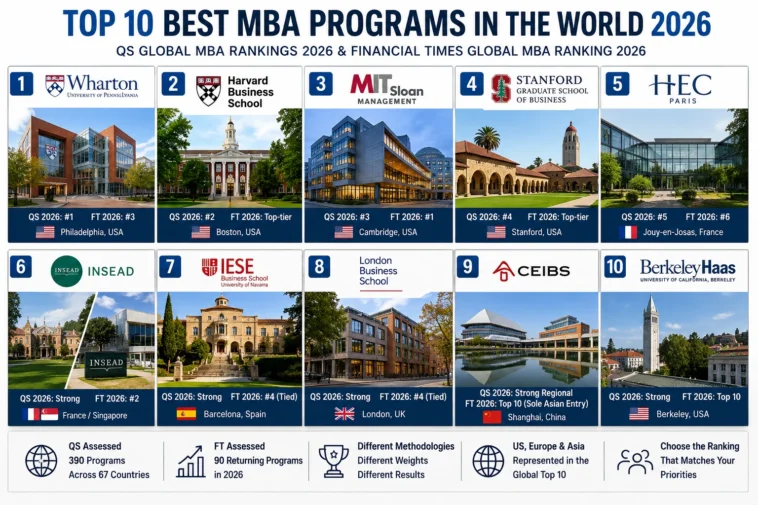
Two of the most trusted MBA rankings in the world published their 2026 results within weeks of each other , and they landed on two completely different #1 business schools.
We anchored this list to the QS Global MBA Rankings 2026, covering 390 programs across 67 countries, and cross-referenced it against the Financial Times’ rival ranking to explain exactly why “the best MBA program in the world” genuinely depends on which methodology you trust.
This guide to the best MBA programs 2026 has to offer is built entirely on verified ranking data from the two most widely cited systems in business education.
Key Highlights (Quick Facts)
- The Wharton School (University of Pennsylvania) tops the QS Global MBA Rankings 2026 — its first time at #1 since 2020 — with the strongest Employability score in the world for the second year running.
- MIT Sloan tops the rival Financial Times Global MBA Ranking 2026 for the first time ever, climbing five places in a single year to dethrone Wharton, which had held the FT’s #1 spot for two consecutive years before this edition.
- Stanford Graduate School of Business dropped from QS’s #1 spot (held for five consecutive years) to #4 in 2026, following declines specifically in its Employability, Value for Money, and Diversity indicator scores.
- HEC Paris posted strong results in both rankings simultaneously — #5 globally in QS 2026 (scoring 98.8/100, placing it in the top 1.3% of the 390 programs assessed) and a historic climb to #6 in the FT 2026 ranking, up three places from the prior year.
- For the first time in the Financial Times ranking’s history, the majority of its top 10 schools are located outside the United States, including five European programs and one Asian program (CEIBS) — a dramatic shift from just a decade ago, when only three European schools cracked the FT top 10.
- INSEAD advanced two spots to #2 in the FT 2026 ranking, continuing a multi-year streak of podium finishes in that specific ranking system.
- Roughly one in four MBA programs that returned to the FT ranking (23 of 90) experienced a double-digit rank change in 2026, with Cranfield School of Management posting the largest single climb (27 places, to #55) and Shanghai University of Finance and Economics posting the steepest fall (21 places, to #36).
- To qualify for the QS MBA ranking at all, a business school must hold accreditation from AACSB, AMBA, or EFMD (EQUIS) — the three globally recognized business-school accrediting bodies.
How This Ranking Was Built (and Why QS and FT Disagree)
This list is anchored to the QS Global MBA Rankings 2026, published by Quacquarelli Symonds, which assessed 390 full-time MBA programs across 67 countries using indicators including employability, alumni outcomes, thought leadership, value for money, and diversity. Among the best business schools 2026 has to offer, QS remains one of the two most frequently cited authorities globally.
It’s genuinely important to know that QS isn’t the only major global MBA ranking, and the two most widely followed systems reached different conclusions in 2026. The Financial Times Global MBA Ranking, one of the other most-cited systems in this space, weights alumni-reported salary outcomes and career progression more heavily in its own methodology, and its 2026 results put MIT Sloan at #1 for the first time in that ranking’s history — a genuinely different answer than QS’s Wharton pick. As one MBA ranking analysis put it bluntly: “which one should you actually trust? The answer is none of them, and all of them.” We’ve built this list around QS’s official top rankings while flagging FT’s contrasting results throughout, so you get the complete picture rather than just one system’s answer.
The Top 10 Best MBA Programs in the World
1. The Wharton School (University of Pennsylvania) — United States
Wharton holds the #1 spot in the QS Global MBA Rankings 2026, its first time topping that specific ranking since 2020. Its position is underpinned by strong scores across the board, including the #1 Employability score in the world for the second consecutive year, alongside top-10 finishes for Alumni Outcomes and Thought Leadership specifically.
In the rival Financial Times ranking, however, Wharton sits at #3 for 2026, having slid down after holding that ranking’s #1 spot for two consecutive years prior. This split placement — QS’s #1 versus FT’s #3 — is the clearest single illustration on this list of how differently these two major ranking systems can weigh the same institution’s strengths.
QS 2026 rank: #1. FT 2026 rank: #3. Location: Philadelphia, USA. Standout strength: #1 global Employability score (QS), two consecutive years at FT’s #1 prior to 2026.
2. Harvard Business School — United States
Harvard Business School holds the #2 position in the QS Global MBA Rankings 2026, reinforcing its position as one of the most globally recognized MBA brands regardless of exact ranking placement in any single system. Its enormous alumni network and case-study-driven teaching method remain defining features of the program.
Harvard’s continued top-tier standing across virtually every major MBA ranking system, not just QS specifically, reflects the sheer breadth and depth of its resources — a scale advantage that few other business schools can fully match simultaneously across research output, alumni reach, and employer recognition.
QS 2026 rank: #2. Location: Boston, USA. Standout strength: Alumni network breadth, case-study teaching methodology.
3. MIT Sloan School of Management — United States
MIT Sloan holds #3 in the QS 2026 ranking, rising one place from the prior year — but it’s worth being direct about the bigger story here: in the rival Financial Times ranking, MIT Sloan claimed the #1 spot for the first time in the ranking’s history, climbing five places in a single year to dethrone Wharton. In 28 years of FT rankings, Sloan had only cracked the top five twice before, in 1999 and 2000.
Analysts have specifically linked Sloan’s historic FT rise to “the rising importance of technology, data, and innovation in business leadership education” — a framing that positions its climb as reflecting a broader shift in what MBA applicants and employers now value, not just a one-off ranking fluctuation.
QS 2026 rank: #3 (up 1). FT 2026 rank: #1 (first time ever, up 5 places). Location: Cambridge, Massachusetts, USA. Standout strength: Technology, data, and innovation-focused curriculum.
4. Stanford Graduate School of Business — United States
Stanford GSB holds the #4 position in QS’s 2026 ranking — a genuinely significant drop after holding that ranking’s #1 spot for five consecutive years prior. QS specifically attributes the decline to weaker scores in Stanford’s Employability, Value for Money, and Diversity indicators, rather than any single dramatic event.
Its continued presence in the global top four, even after this decline, reflects Stanford’s deep ties to Silicon Valley’s technology and venture capital ecosystem, which remains a genuine draw for applicants specifically interested in startup and technology-sector careers over traditional consulting or banking paths.
QS 2026 rank: #4 (down from #1). Location: Stanford, California, USA. Standout strength: Silicon Valley technology and venture capital ecosystem access.
5. HEC Paris — France
HEC Paris delivered one of the standout performances of the entire 2026 MBA ranking cycle, posting strong results in both major systems simultaneously. It ranks #5 globally in QS 2026 — the top European business school in that ranking — scoring 98.8 out of 100 and placing in the top 1.3% of all 390 programs assessed. In the Financial Times ranking, it climbed three places to a historic #6 finish.
Its standout strengths include exceptional internationalization (95% international students, 71% international faculty), a global top-10 finish for international mobility and sector diversity, and 100% of faculty holding doctorates — credentials that reinforce its position as Europe’s clear top MBA program in 2026 across both major ranking systems.
QS 2026 rank: #5 (top European program). FT 2026 rank: #6 (historic climb, up 3). Location: Jouy-en-Josas, France. Standout strength: Internationalization (95% international students), full faculty doctoral coverage.
6. INSEAD — France/Singapore
INSEAD advanced two spots to claim #2 in the Financial Times Global MBA Ranking 2026, continuing a genuine multi-year streak of podium finishes in that specific system. Its distinctive one-year MBA format and dual-campus model (France and Singapore) give it a genuinely different structural profile than most other schools on this list.
INSEAD’s consistently strong FT performance, combined with solid standing across other major ranking systems, reflects its long-established reputation for producing genuinely globally mobile graduates — a natural fit for its historically strong FT scores specifically in international mobility-weighted indicators.
FT 2026 rank: #2 (up 2). Locations: Fontainebleau, France, and Singapore. Standout strength: One-year format, genuine dual-campus international structure.
7. IESE Business School — Spain
IESE Business School, based in Barcelona, tied for #4 in the Financial Times Global MBA Ranking 2026, reinforcing Spain’s position as a genuine European MBA hub alongside France and the UK. Its case-method teaching approach, closely modeled on Harvard’s methodology, has built a strong reputation specifically within European and Latin American business circles.
Its continued strong FT standing reflects the ranking’s broader 2026 finding that European schools are increasingly competitive with, and in several cases now outperforming, historically dominant US programs across the specific indicators FT weights most heavily.
FT 2026 rank: #4 (tied). Location: Barcelona, Spain. Standout strength: Harvard-style case-method teaching, strong Latin American business ties.
8. London Business School — United Kingdom
London Business School tied for #4 in the Financial Times Global MBA Ranking 2026, reaffirming the UK’s position as one of Europe’s most consistently strong MBA markets. Its central London location gives students direct access to major global finance, consulting, and technology employers without needing to relocate for career opportunities during the program.
Its strong, sustained FT performance over many years — one of just three European schools in the FT top 10 a decade ago, now part of a much larger European contingent — illustrates how the broader competitive landscape has genuinely shifted around it, even as its own standing has remained consistently strong.
FT 2026 rank: #4 (tied). Location: London, United Kingdom. Standout strength: Direct access to London’s global finance and consulting employer base.
9. CEIBS (China Europe International Business School) — China
CEIBS holds a top-10 position in the Financial Times Global MBA Ranking 2026, standing as the sole Asian representative in that specific top 10 and a significant marker of the ranking’s broader 2026 shift toward non-US dominance. Its position reflects China’s continued investment in building globally competitive business education infrastructure.
Its FT top-10 standing, alongside strong regional reputation across Asia, positions CEIBS as a genuine bridge institution between Chinese and Western business education models — a distinctive value proposition that’s become increasingly relevant as global business increasingly requires exactly that kind of cross-cultural fluency.
FT 2026 rank: Top 10 (sole Asian representative in FT’s top 10). Location: Shanghai, China. Standout strength: China-West business education bridge, strong regional Asian reputation.
10. UC Berkeley Haas School of Business — United States
UC Berkeley Haas rounds out the Financial Times Global MBA Ranking 2026’s top 10, reinforcing its position as a genuine alternative to the more traditionally dominant East Coast US programs on this list. Its Bay Area location gives it a natural, direct pipeline into Silicon Valley’s technology and venture capital ecosystem, similar in spirit to Stanford’s positioning but with a distinctly different program culture and cost structure.
Its continued top-10 FT standing reflects sustained strength specifically in innovation-focused and technology-adjacent business education, an area where the broader 2026 rankings cycle — including MIT Sloan’s historic FT rise — suggests genuinely growing applicant and employer demand across the board.
FT 2026 rank: Top 10. Location: Berkeley, California, USA. Standout strength: Bay Area technology and venture capital access, distinct from Stanford’s positioning.
Important Statistics Table
| School | QS 2026 Rank | FT 2026 Rank | Country | Standout Strength |
| Wharton (Penn) | #1 | #3 | USA | #1 global Employability (QS) |
| Harvard Business School | #2 | Top-tier | USA | Alumni network, case-study method |
| MIT Sloan | #3 | #1 (first time ever) | USA | Tech/data/innovation focus |
| Stanford GSB | #4 (down from #1) | Top-tier | USA | Silicon Valley VC/tech access |
| HEC Paris | #5 (top European, QS) | #6 (up 3, historic) | France | 95% international students |
| INSEAD | Strong (QS) | #2 (up 2) | France/Singapore | One-year, dual-campus format |
| IESE Business School | Strong (QS) | #4 (tied, FT) | Spain | Harvard-style case method |
| London Business School | Strong (QS) | #4 (tied, FT) | UK | Central London employer access |
| CEIBS | Strong regional (QS) | Top 10 (FT, sole Asian entry) | China | China-West business bridge |
| UC Berkeley Haas | Strong (QS) | Top 10 (FT) | USA | Bay Area tech/VC pipeline |
Source: QS Global MBA Rankings 2026 (Quacquarelli Symonds), Financial Times Global MBA Ranking 2026. QS assessed 390 programs across 67 countries; FT assessed 90 returning programs among its broader pool. The two systems use different weighted methodologies and can produce different results for the same institution, as shown clearly by Wharton’s #1 QS rank versus its #3 FT rank, and MIT Sloan’s #3 QS rank versus its #1 FT rank.
Step-by-Step: How MBA Rankings Are Actually Calculated
- Check accreditation requirements first. To even qualify for the QS ranking, a business school must hold accreditation from AACSB, AMBA, or EFMD (EQUIS) — the three globally recognized business-school accrediting bodies, a baseline quality filter worth knowing about.
- Understand that QS and FT weight different outcomes. QS emphasizes employability, alumni outcomes, and thought leadership; the Financial Times weights alumni-reported salary and career progression more heavily — producing genuinely different results for the same school.
- Look at year-over-year movement, not just the current snapshot. Stanford’s drop from QS’s #1 (held five years) to #4, and MIT Sloan’s five-place FT climb to a historic first-ever #1, both show real ranking volatility even among the world’s most established programs.
- Check for double-digit rank changes across the wider list. In FT’s 2026 edition, 23 of 90 returning programs shifted by ten or more places — a reminder that rankings outside the very top 10 can move even more dramatically than the headline names.
- Weight the ranking’s specific methodology against your own priorities. If pure employability data matters most to you, QS’s methodology may be more relevant; if alumni-reported salary outcomes matter most, FT’s approach may be more directly useful.
- Remember rankings update annually and can shift significantly. MIT Sloan had never held the FT’s #1 spot before 2026, and Stanford had held QS’s #1 for five straight years before dropping this year — no position at the top of these lists is permanently fixed.
Pros and Cons Table
| School | Pros | Cons |
| Wharton | #1 QS rank, #1 global Employability score | Dropped to #3 specifically in FT’s 2026 methodology |
| Harvard Business School | Unmatched global brand and alumni network | Sits at #2 rather than #1 in QS’s specific 2026 methodology |
| MIT Sloan | Historic first-ever #1 FT ranking, strong tech/data focus | Ranks #3, not #1, in QS’s specific methodology |
| Stanford GSB | Deep Silicon Valley/VC ecosystem ties | Dropped from 5 years at QS #1 to #4 in 2026 |
| HEC Paris | Strong in both QS (#5) and FT (#6) simultaneously | Smaller overall scale than the largest US programs |
| INSEAD | One-year format saves time and opportunity cost | Compressed timeline offers less internship/networking runway than 2-year programs |
| IESE Business School | Strong Latin American and European business ties | Smaller global brand recognition outside Europe/Latin America than top US schools |
| London Business School | Direct access to London’s global employer base | High cost of living in London during the program |
| CEIBS | Genuine China-West business bridge positioning | Smaller global recognition outside Asia specifically |
| UC Berkeley Haas | Strong Bay Area tech/VC access | Ranked outside QS’s specific published top tier |
Comparison Table: Best MBA Program by What You Want
Whether you’re comparing the best MBA colleges by employability, salary outcomes, or program format, the table below breaks it down by specific priority rather than a single overall ranking.
| Your Priority | Best Pick | Runner-Up | Why |
| Highest QS 2026 rank overall | Wharton | Harvard Business School | #1 QS rank; #1 global Employability score |
| Highest FT 2026 rank overall | MIT Sloan | INSEAD | First-ever #1 FT finish, five-place climb |
| Best for Silicon Valley/tech careers | Stanford GSB | UC Berkeley Haas | Direct Silicon Valley VC and tech ecosystem access |
| Best European program | HEC Paris | INSEAD | Strong in both QS (#5) and FT (#6) simultaneously |
| Fastest program format | INSEAD | — | One-year MBA structure, dual-campus model |
| Best value/ROI focus | Wharton | HEC Paris | #1 global Employability score (QS) |
| Best China-West business bridge | CEIBS | — | Sole Asian representative in FT’s 2026 top 10 |
| Most dramatic 2026 ranking rise | MIT Sloan (FT) | HEC Paris (FT, up 3) | Climbed 5 places to a historic first-ever #1 |
2026 News and Trends
The clearest 2026 storyline is the genuine divergence between the world’s two most widely followed MBA ranking systems. Wharton’s #1 QS finish and MIT Sloan’s historic first-ever #1 FT finish both represent real, well-documented achievements — both authoritative, both describing the same global MBA landscape in different terms depending on methodology.
European and Asian business schools posted a genuinely historic showing in the Financial Times 2026 ranking specifically. For the first time in that ranking’s history, the majority of its top 10 are located outside the United States, including five European programs and CEIBS from China — a dramatic shift from just a decade ago, when only three European schools (INSEAD, London Business School, and Cambridge Judge) cracked the FT top 10 at all.
Ranking volatility extended well beyond the headline top 10 in 2026. Roughly one in four MBA programs returning to the FT ranking experienced a double-digit rank change, with Cranfield School of Management posting the largest single climb (27 places) and Shanghai University of Finance and Economics posting the steepest fall (21 places) — a reminder that significant movement isn’t confined to the very top of these lists.
Analysts have specifically linked MIT Sloan’s historic rise to broader shifts in what MBA applicants and employers now value. Sloan’s five-place climb to FT’s first-ever #1 has been framed as reflecting “the rising importance of technology, data, and innovation in business leadership education” — a trend also visible in Stanford’s continued strong standing (despite its own QS decline) and UC Berkeley Haas’s FT top-10 finish, both schools with deep technology-sector ties.
Conclusion
Wharton’s QS #1 finish and MIT Sloan’s historic first-ever FT #1 finish both represent genuine, well-earned achievements — the honest takeaway for 2026 is that “best MBA program in the world” has two equally credible answers depending on which ranking methodology you trust more. Among the top business schools in the world, European and Asian institutions posted a historic showing in the FT’s specific top 10, while Stanford’s notable QS decline after five years at the top proves this remains a genuinely competitive, continuously evolving landscape rather than a settled hierarchy.
References
- QS (Quacquarelli Symonds) – Full Time MBA Rankings by QS-Global 2026: https://www.topuniversities.com/mba-rankings/global
- GMAC – QS Global MBA Ranking 2026: Top Business Schools Worldwide: https://www.gmac.com/resources/learners/business-programs/explore-programs/qs-mba-ranking
- Poets&Quants – 2026 Financial Times MBA Ranking: MIT Tops List For The First Time: https://poetsandquants.com/2026/02/16/2026-financial-times-mba-ranking-mit-tops-list-for-the-first-time/
- MBA & Beyond – MBA Rankings 2026: Financial Times vs QS: https://www.mbaandbeyond.com/blog/mba-rankings-2026-financial-times-vs-qs-the-worlds-best-mba-colleges-top-business-schools-revealed
- MBA Grad Schools – Financial Times Ranks the Best MBA Programs for 2026: https://mbagradschools.com/mba-rankings/financial-times-ranks-the-best-mba-programs-for-2026
- QS TopMBA – QS Full Time MBA Rankings – Global 2026: https://www.topmba.com/mba-rankings/global
- HEC Paris – HEC Paris’ Historic Leap to Sixth Worldwide in FT Global MBA Ranking 2026: https://www.hec.edu/fr/l-ecole/actualites/hec-paris-historic-leap-sixth-worldwide-ft-global-mba-ranking-2026
- HEC Paris – HEC Paris MBA Secures #5 Spot Globally in QS Rankings: https://www.hec.edu/fr/node/15250677
FAQs
It depends on which ranking you’re citing. The Wharton School holds the #1 spot in the QS Global MBA Rankings 2026, while MIT Sloan holds #1 in the rival Financial Times Global MBA Ranking 2026 — both are legitimate, authoritative answers using different methodologies.
The two systems weight different outcomes. QS emphasizes employability, alumni outcomes, and thought leadership, while the Financial Times weights alumni-reported salary and career progression more heavily, producing different results for programs like Wharton (QS #1, FT #3) and MIT Sloan (QS #3, FT #1).
QS specifically attributes Stanford’s drop from #1 to #4 in 2026 to declines in its Employability, Value for Money, and Diversity indicator scores, rather than any single dramatic event affecting the program.
MIT Sloan posted the most significant top-tier movement, climbing five places to claim the Financial Times ranking’s #1 spot for the first time in the ranking’s 28-year history. Among all ranked programs, Cranfield School of Management posted the largest single climb overall, rising 27 places to #55.
Within the Financial Times’ specific 2026 top 10, yes — for the first time in that ranking’s history, the majority of its top 10 schools are located outside the US, including five European programs and CEIBS from China. The QS ranking’s very top positions, by contrast, remain dominated by US schools (Wharton, Harvard, MIT Sloan, and Stanford occupy its top four).


GIPHY App Key not set. Please check settings