 kiruthika
Hook Introduction
Two of the biggest names in online learning stopped being separate companies this year. Coursera and Udemy completed a full merger on May 11, 2026 — Udemy shares were delisted from NASDAQ, and the combined company now serves roughly 290 million learners under one roof.
We pulled verified 2026 data straight from company investor filings and official merger announcements to rank the ten online learning platforms actually reshaping global education right now, including exactly what’s changed for two of the sector’s biggest names.
This guide to the top online learning platforms 2026 has to offer is built entirely on primary-source financial disclosures, not marketing claims.
Key Highlights (Quick Facts)
- Coursera completed its acquisition of Udemy on May 11, 2026, in an all-stock deal first announced December 17, 2025. Udemy’s stock was delisted from NASDAQ, and former Coursera stockholders now own approximately 59% of the combined company, with former Udemy stockholders owning approximately 41%.
- The combined Coursera-Udemy company now serves approximately 290 million learners, 18,000 enterprise customers, and 95,000 instructors, according to Coursera’s official May 2026 completion announcement — making it, by these figures, the largest single entity in this list by a wide margin.
- Coursera reported $757 million in full-year 2025 revenue, up 9% year-over-year, according to its investor relations disclosures, prior to the Udemy combination closing.
- The combined Coursera-Udemy company is projected to generate over $1.5 billion in 2025 pro-forma revenue, with leadership targeting approximately $115 million in cost synergies over the following two years.
- Duolingo crossed $1 billion in annual revenue for the first time in 2025 ($1,037.6 million, up 39% year-over-year), a milestone worth noting specifically because it’s a single-subject (language learning) platform, a genuinely different business model than the multi-subject marketplaces topping this list.
- The global eLearning market was valued at $325 billion in 2025 and is projected by Grand View Research to reach $842 billion by 2030, growing at roughly 15% annually — figures we’re citing from one consistent source rather than blending estimates from different market-research methodologies.
- North America accounts for roughly 35–40% of the global online learning market, the largest single region, while Asia-Pacific, at roughly 30%, is the fastest-growing.
A Note on “Registered Learners” vs. Active Users
Before ranking this list, it’s worth being direct about a genuine measurement problem in this category: platform “learner” counts are frequently inflated relative to actual active engagement. Coursera’s widely cited figures include everyone who has ever created an account, going back years — active, currently engaged learners represent a meaningfully smaller fraction of that total. The same caveat applies to the newly combined Coursera-Udemy company’s 290 million figure.
This is similar to the “registered accounts vs. active users” distinction that shows up across streaming and gaming platforms, and it’s a big part of why revenue figures (which require someone to actually pay) often tell a more reliable story about genuine platform strength than raw user counts alone. Anyone comparing online learning platforms 2026 data across sources should keep this distinction in mind before treating any single headline number as definitive. We’ve included both metrics throughout this list and flagged clearly where a headline number reflects lifetime signups rather than current active use.
The Top 10 Best Online Learning Platforms in 2026
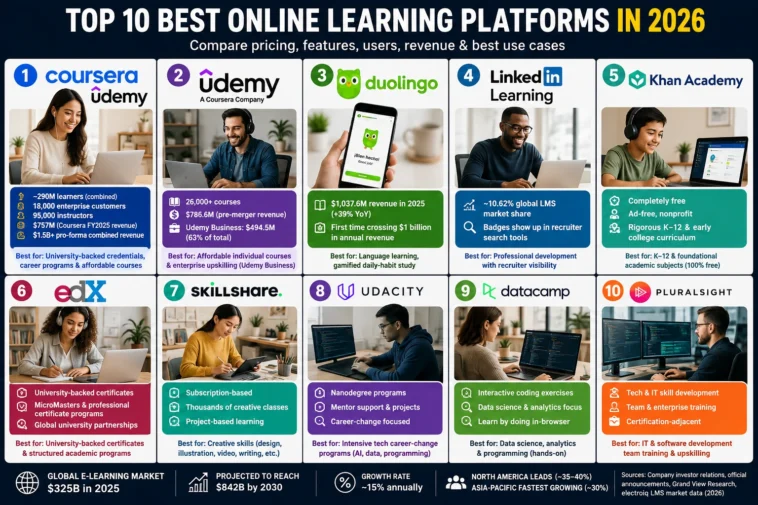
1. Coursera (now including Udemy)
Coursera enters 2026 in a fundamentally different position than it started the prior year: on May 11, 2026, it completed its acquisition of Udemy in an all-stock deal first announced December 17, 2025 and approved by both companies’ shareholders on April 9, 2026. Udemy’s stock has been delisted from NASDAQ, and it now operates as a wholly owned subsidiary of Coursera.
The combined company reports approximately 290 million learners, 18,000 enterprise customers, and 95,000 instructors, with leadership projecting more than $1.5 billion in combined pro-forma 2025 revenue and targeting roughly $115 million in cost synergies over the next two years. Prior to the merger closing, Coursera’s own standalone FY2025 revenue was $757 million, up 9% year-over-year. Coursera CEO Greg Hart described the goal as building “the world’s most comprehensive skills platform for the AI era.” As of this writing, Udemy’s marketplace continues operating under its own brand and pricing structure day-to-day, with deeper platform integration expected to roll out over time.
Combined learners: ~290 million (post-merger). Coursera standalone FY2025 revenue: $757 million. Merger completed: May 11, 2026. Best for: University-backed credentials, structured career-advancement programs, and (via the now-combined Udemy marketplace) affordable individual courses.
2. Udemy (now a Coursera subsidiary)
Udemy is listed separately here because, day to day, it still operates as its own distinct marketplace and brand — even though it’s no longer an independently traded company following Coursera’s completed acquisition on May 11, 2026. Prior to the merger, Udemy’s most recently reported standalone annual revenue was $786.6 million, with Udemy Business (its enterprise arm) generating $494.5 million — about 63% of that total — while its original consumer marketplace side had been contracting.
For learners and instructors, Udemy’s official messaging has been that “today’s announcement does not change your Udemy experience or how you access courses” in the near term, with AI-powered features and a broader shared catalog planned as integration with Coursera continues through 2026 and beyond. It remains one of the largest open marketplaces for independent course creators, with more than 26,000 courses and individual pricing typically running $9.99–$24.99 during frequent sales.
Pre-merger standalone revenue: $786.6 million (most recent full year as an independent company). Corporate status: Wholly owned Coursera subsidiary as of May 11, 2026. Best for: Affordable individual courses and enterprise upskilling via Udemy Business.
3. Duolingo
Duolingo occupies a genuinely distinctive position on this list: it’s a single-subject platform (language learning) that nonetheless crossed $1 billion in annual revenue for the first time in 2025 — $1,037.6 million, up 39% year-over-year, a growth rate that outpaces the broader multi-subject platforms above it on this specific list. It’s worth flagging that this isn’t a fully apples-to-apples comparison, since Duolingo’s single-subject focus and consumer-app business model differ structurally from Coursera and Udemy’s broad course-marketplace approach.
Its freemium, gamified approach (streaks, leaderboards, bite-sized daily lessons) has proven unusually effective at converting casual users into long-term paying subscribers, a retention model that broader multi-subject platforms have generally struggled to replicate at the same scale.
2025 revenue: $1,037.6 million (+39% YoY), first time crossing $1 billion. Best for: Language learning specifically, gamified daily-habit-building study.
4. LinkedIn Learning
LinkedIn Learning holds a genuinely distinctive advantage among the platforms on this list: its completion badges integrate directly with LinkedIn’s recruiter search tools, giving it real hiring-visibility value that generic course-completion certificates from most other platforms don’t carry.
Rather than comparing it directly against the revenue and learner-count figures used for the platforms above (which measure different things), we’re noting its market position separately: it holds roughly 10.62% of the broader global LMS (learning management system) market, narrowly behind Google Classroom’s 10.65% — a measure of enterprise/institutional adoption specifically, not a directly comparable figure to Coursera or Udemy’s consumer-facing revenue and user counts.
Market position: ~10.62% global LMS market share (enterprise/institutional adoption measure, not directly comparable to consumer platform revenue). Best for: Professional development where recruiter visibility and hiring impact genuinely matter.
5. Khan Academy
Khan Academy remains the clearest answer to “what’s the best completely free online learning platform,” offering a comprehensive, ad-free curriculum spanning K-12 and early college-level subjects without any paywall for core content, funded through its nonprofit model and philanthropic support.
Its reputation for genuine educational rigor — built on structured, sequential mastery-based learning rather than a loose marketplace of independently created courses — has made it a staple recommendation across nearly every 2026 “best free learning platform” comparison.
Cost: Completely free. Best for: K-12 and foundational academic subjects, structured mastery-based learning at zero cost.
6. edX
edX carries genuine certificate weight with employers specifically because of its direct university backing — a distinction 2026 comparison guides consistently draw between edX/Coursera-style credentials and more generic completion certificates from open marketplaces.
Its MicroMasters and professional certificate programs, developed directly with partner universities, position it similarly to Coursera in the structured-credential space, though with a comparatively smaller overall user base and narrower marketing reach.
Best for: University-backed certificates and structured academic credential programs.
7. Skillshare
Skillshare has built its specific niche around creative skills — design, illustration, video editing, writing, and similar practical creative disciplines — differentiating itself from the more academic or technical focus of Coursera, edX, and Udacity.
Its subscription-based, project-focused learning model appeals specifically to learners who want ongoing access to a broad creative curriculum rather than committing to single, standalone courses one at a time.
Best for: Creative skills (design, illustration, video, writing) with an ongoing subscription model.
8. Udacity
Udacity has carved out a specific position around intensive, career-focused “Nanodegree” programs in technology fields — data science, AI/machine learning, programming, and similar technical disciplines — built around mentor support and project-based portfolios rather than passive video lectures alone.
Its narrower, more expensive, more intensive program structure positions it differently from the broad, low-cost course marketplaces elsewhere on this list, targeting learners seeking a genuine career-change credential specifically in tech.
Best for: Intensive, mentor-supported tech career-change programs (data science, AI, programming).
9. DataCamp
DataCamp has built a focused reputation specifically around data science, analytics, and programming education, using an interactive, browser-based coding exercise format that lets learners write and run real code directly within lessons rather than just watching video content passively.
Its narrow subject focus, similar in spirit to Duolingo’s single-subject specialization, has helped it build a strong reputation specifically among learners targeting data-focused career paths.
Best for: Data science, analytics, and programming, with hands-on interactive coding exercises.
10. Pluralsight
Pluralsight rounds out the list as a specialist platform for technology and IT professional development specifically, commonly used by software development teams and IT departments for structured skill-building and certification-adjacent training.
Its positioning alongside DataCamp and Udacity in the technical-specialist tier of this list reflects a broader 2026 pattern: as the largest generalist marketplaces consolidate (as seen with Coursera and Udemy), focused technical specialists have carved out durable niches serving specific professional communities directly.
Best for: IT and software development team training, technical certification-adjacent skill-building.
Important Statistics Table
| Rank | Platform | Learners/Users | Revenue (most recent reported) | Category |
| 1 | Coursera (incl. Udemy post-merger) | ~290 million (combined, post-merger) | $757M (Coursera standalone FY2025); $1.5B+ pro-forma combined | University-backed credentials + marketplace |
| 2 | Udemy (Coursera subsidiary) | Included in combined figure above | $786.6M (standalone FY, pre-merger) | Course marketplace + enterprise |
| 3 | Duolingo | Not directly comparable (consumer app) | $1,037.6 million (+39% YoY) | Language learning (single subject) |
| 4 | LinkedIn Learning | Not disclosed separately | ~10.62% global LMS market share (not a revenue figure) | Professional development |
| 5 | Khan Academy | Not disclosed (nonprofit) | Free (donor-funded) | K-12/foundational academics |
| 6 | edX | Not disclosed separately | Not disclosed separately | University-backed certificates |
| 7 | Skillshare | Not disclosed separately | Not disclosed separately | Creative skills subscription |
| 8 | Udacity | Not disclosed separately | Not disclosed separately | Tech career Nanodegrees |
| 9 | DataCamp | Not disclosed separately | Not disclosed separately | Data science/analytics |
| 10 | Pluralsight | Not disclosed separately | Not disclosed separately | IT/software team training |
Sources: Coursera Investor Relations (official merger completion announcement, May 11, 2026), Udemy Investor Relations (pre-merger filings), Duolingo Investor Relations, electroiq LMS market data. “Learners” figures reflect cumulative lifetime signups, not necessarily current active users. LinkedIn Learning’s figure measures LMS market share specifically and is not directly comparable to the revenue/user figures used for other platforms.
Step-by-Step: How to Choose the Right Learning Platform
- Decide whether you need a credential employers will recognize, or just the skill itself. Coursera, edX, and LinkedIn Learning certificates carry more hiring weight; generic Udemy/Skillshare completion certificates have minimal direct hiring impact on their own.
- Check whether your goal is broad or narrow. Broad, general marketplaces (Coursera, Udemy) suit exploring many subjects; specialist platforms (Duolingo, DataCamp, Udacity, Pluralsight) suit committing deeply to one specific skill area.
- Factor in your budget honestly. Udemy’s $9.99–24.99 individual courses during sales are far cheaper than Coursera Plus’s annual subscription, but Coursera’s subscription unlocks unlimited access across its full catalog rather than one course at a time.
- Consider whether your employer already provides access. LinkedIn Learning and Coursera are both extremely common corporate-provided benefits — check before paying out of pocket for something you may already have free access to.
- Start with free tiers or audits before committing financially. Coursera offers a free audit option on many courses; Khan Academy is entirely free; most platforms on this list offer some form of trial before requiring payment.
- Watch how the Coursera-Udemy integration develops if you’re an existing user of either. Since the merger just closed in May 2026, pricing, catalog structure, and account systems may continue changing as the two platforms integrate further.
Pros and Cons Table
| Platform | Pros | Cons |
| Coursera (incl. Udemy) | Now the largest combined platform by learner count; strongest certificate recognition | Integration with Udemy is still in progress; pricing/structure may shift |
| Udemy | Affordable individual courses, large marketplace catalog | No longer an independently traded company; long-term brand structure uncertain |
| Duolingo | Extremely effective gamified retention model | Single-subject only (language learning) |
| LinkedIn Learning | Direct recruiter-search integration | Market share figure isn’t directly comparable to revenue-based rankings |
| Khan Academy | Completely free, rigorous structured curriculum | Limited to K-12/foundational subjects, not professional upskilling |
| edX | Strong university-backed certificate value | Smaller consumer brand recognition than Coursera |
| Skillshare | Broad creative-skills subscription library | Less credential/hiring value than university-backed platforms |
| Udacity | Intensive, mentor-supported career-change programs | Significantly more expensive and time-intensive than casual courses |
| DataCamp | Genuinely hands-on interactive coding practice | Narrow focus limits use outside data/programming careers |
| Pluralsight | Strong fit for IT/software team-wide training | Less relevant for individual, non-technical learners |
Comparison Table: Best Platform by What You Want to Learn
Whether you’re comparing the best online education platforms by price, credential value, or subject focus, the table below breaks it down by specific learning goal rather than a single overall ranking.
| Your Goal | Best Pick | Runner-Up | Why |
| Career-advancing credential | Coursera | edX | Strongest university and corporate partnership network |
| Cheapest way to learn a specific skill | Udemy | Skillshare | $9.99-24.99 individual courses during frequent sales |
| Learning a new language | Duolingo | — | $1B+ revenue built entirely on language learning specifically |
| Boosting recruiter visibility | LinkedIn Learning | Coursera | Badges integrate directly with recruiter search tools |
| Completely free structured learning | Khan Academy | — | Free, rigorous, ad-free curriculum |
| Creative skill-building | Skillshare | Udemy | Subscription model built around ongoing creative curriculum |
| Career change into tech | Udacity | DataCamp | Mentor-supported, portfolio-focused Nanodegree programs |
| Data science specifically | DataCamp | Udacity | Interactive in-browser coding exercises |
| Enterprise/team-wide IT training | Pluralsight | LinkedIn Learning | Built specifically for software/IT team-wide skill programs |
2026 News and Trends
The single biggest 2026 storyline in this sector is the completed Coursera-Udemy merger. First announced December 17, 2025 as an all-stock deal implying a combined equity value of roughly $2.5 billion, the transaction was approved by both companies’ shareholders on April 9, 2026, and officially closed on May 11, 2026 — considerably faster than the “second half of 2026” target originally set at announcement. Udemy’s stock has been delisted from NASDAQ, and the combined entity now trades solely under Coursera’s NYSE ticker (COUR).
The combined company’s stated rationale centers on AI-driven upskilling. Coursera CEO Greg Hart specifically framed the deal around building “the world’s most comprehensive skills platform for the AI era,” combining Coursera’s university-credential strength with Udemy’s marketplace scale and enterprise business. Leadership has projected over $1.5 billion in pro-forma 2025 revenue for the combined company and targeted roughly $115 million in cost synergies over the following two years.
Duolingo’s $1 billion revenue milestone remains a genuine standout for focused, single-subject platforms, even as the broader market consolidates around fewer, larger multi-subject players. Its 39% year-over-year growth rate is a useful data point for the “depth vs. breadth” debate in this sector, though it’s worth remembering Duolingo’s consumer-app business model isn’t directly comparable to course-marketplace platforms.
Market size projections, drawn consistently from Grand View Research’s methodology, show continued strong growth ahead: the global eLearning market, valued at $325 billion in 2025, is projected to reach $842 billion by 2030 — reinforcing that this sector’s growth story remains firmly intact even as its biggest players consolidate.
Conclusion
The completed Coursera-Udemy merger is the defining story of online learning in 2026 — a combination that brings roughly 290 million learners, 18,000 enterprise customers, and both companies’ certificate and marketplace strengths under one roof, even as specialist platforms like Duolingo, DataCamp, and Udacity continue proving that deep focus in one subject can outcompete broad marketplaces on growth alone. Among the best eLearning platforms available today, there’s still no single universal winner — match your choice to your actual goal, whether that’s a recognized credential, a specific technical skill, or simply learning something new, since “best” here still depends entirely on what you’re actually trying to learn.
References
- Coursera Investor Relations – Coursera Completes Combination with Udemy to Build the World’s Most Comprehensive Skills Platform (May 11, 2026): https://investor.coursera.com/news/news-details/2026/Coursera-Completes-Combination-with-Udemy-to-Build-the-Worlds-Most-Comprehensive-Skills-Platform/default.aspx
- Coursera Investor Relations – Coursera to Combine with Udemy to Empower the Global Workforce with Skills for the AI Era (December 17, 2025): https://investor.coursera.com/news/news-details/2025/Coursera-to-Combine-with-Udemy-to-Empower-the-Global-Workforce-with-Skills-for-the-AI-Era/default.aspx
- Udemy Blog – Udemy and Coursera Agree to Combine: https://blog.udemy.com/udemy-coursera-combine/
- Higher Ed Dive – Coursera to Ac
- quire Udemy to Create $2.5B MOOC Giant: https://www.highereddive.com/news/coursera-to-acquire-udemy-to-create-25b-mooc-giant/808212/
- Class Central – Coursera and Udemy are Finally One. What Happens Next?: https://www.classcentral.com/report/coursera-udemy-merger-complete/
- Inside Higher Ed – Coursera, Udemy Complete Their Merger: https://www.insidehighered.com/news/quick-takes/2026/05/14/coursera-udemy-complete-their-merger
- SQ Magazine – Online Learning Statistics 2026: Users, Revenue & Trends: https://sqmagazine.co.uk/online-learning-statistics/
- SkillScouter – Online Learning Statistics (2026): 60+ Facts on Market Size, ROI & Completion Rates: https://skillscouter.com/online-learning-statistics/
FAQs
Following its completed acquisition of Udemy on May 11, 2026, the combined Coursera-Udemy company is now the largest platform on this list by learner count (approximately 290 million) and offers the broadest combination of university-backed credentials and affordable marketplace courses. Duolingo remains the strongest single-subject specialist, having crossed $1 billion in revenue for the first time in 2025.
Yes. Coursera and Udemy announced a definitive merger agreement on December 17, 2025, which was approved by both companies’ shareholders on April 9, 2026, and officially completed on May 11, 2026. Udemy’s stock was delisted from NASDAQ, and it now operates as a wholly owned Coursera subsidiary.
According to Udemy’s own official messaging at the time of the announcement, the near-term learner and course-access experience was not expected to change immediately. Deeper platform integration, including AI-powered features and a broader shared catalog, is planned to roll out over time as the combined company develops its strategy through 2026 and beyond.
Khan Academy is the clearest answer, offering a comprehensive, ad-free, rigorously structured curriculum for K-12 and foundational academic subjects entirely free, funded through its nonprofit donor model.
It depends heavily on the platform. Certificates from Coursera (especially Google and university-partnered programs) and edX carry meaningful weight with employers, and LinkedIn Learning badges integrate directly with recruiter searches. Generic Udemy and Skillshare completion certificates generally have minimal direct hiring impact on their own.



GIPHY App Key not set. Please check settings