 Sakthi Varna
Introduction
Walk into any pharmacy or scroll any wellness app, and you’ll see hundreds of products promising to melt fat while you sleep. Most of that is marketing, not medicine.
The global weight loss supplements market is now worth an estimated $35.83 billion in 2026, projected to reach $100.24 billion by 2034 at a CAGR of 13.72% (Fortune Business Insights, 2026). That kind of growth tells you two things: people genuinely want help losing weight, and a lot of companies are happy to sell hope without proof.
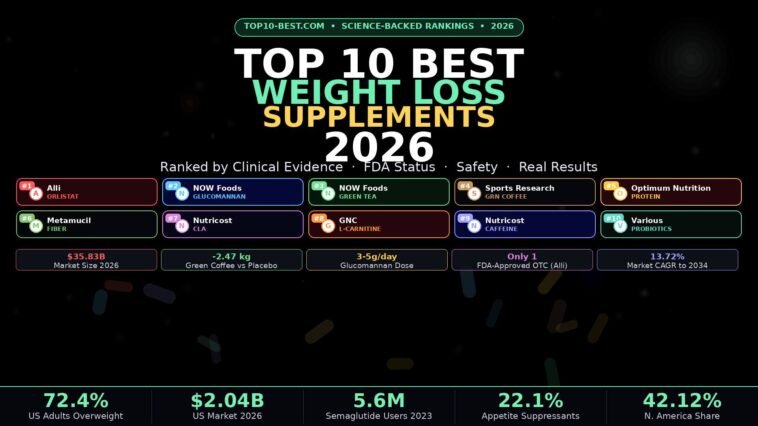
This guide cuts through that. We looked at peer-reviewed research, NIH and FDA data, and real clinical trial results to rank the top 10 best weight loss supplements in 2026 — by actual evidence, not marketing copy. Some will surprise you. None of them are magic.
Medical Disclaimer: Weight loss supplements are not FDA-approved to treat obesity or any medical condition (with the exception of orlistat/Alli). This article is for informational purposes only. Always consult a physician or registered dietitian before starting any supplement.
Image: Weight loss supplement bottles and capsules — evidence-based options ranked for safety and real results in 2026
Table of Contents
- Key Highlights
- Top 10 Best Weight Loss Supplements 2026
- Weight Loss Supplement Market Statistics Table
- How to Choose a Safe Supplement (Step-by-Step)
- Pros & Cons Table
- Comparison Table: Top 5 Supplements by Evidence
- 2026 Trends in Weight Loss Supplements
- FAQ
- References
Key Highlights
- The global weight loss supplements market is valued at $35.83 billion in 2026, projected to reach $100.24 billion by 2034 (Fortune Business Insights, 2026)
- Alli (orlistat) remains the only FDA-approved over-the-counter weight loss product, blocking approximately 25% of dietary fat absorption
- A 2025 meta-analysis found glucomannan supplementation (3–5g/day) was associated with reductions in body weight, BMI, and waist circumference, plus improved gut microbiota composition (Nutrients journal, 2025)
- Green coffee bean extract showed a mean weight difference of -2.47 kg versus placebo in a systematic review, though study quality was rated poor (PMC meta-analysis)
- Americans spent over $2 billion on OTC weight loss supplements in 2019 alone, a figure still climbing (NIH / Market.us, 2026)
- North America held 42.12% of the global weight loss supplements market share in 2025 (Fortune Business Insights, 2026)
- Semaglutide prescriptions reached 5.6 million Americans in 2023 and are projected to hit 24 million by 2035, reshaping the entire weight management category (Mordor Intelligence, 2026)
- Appetite suppressants hold the largest product segment at 22.1% market share in 2025 (Coherent Market Insights, 2026)
- The NIH and CDC report 72.4% of U.S. adults aged 20+ are overweight, including those with obesity, fueling sustained supplement demand
Top 10 Best Weight Loss Supplements 2026 (Ranked by Evidence)
1. Alli (Orlistat 60mg) — Only FDA-Approved OTC Option
Type: Fat absorption inhibitor | Evidence Level: Strong (FDA-approved) | Brand: GSK Consumer Healthcare
Alli stands alone on this list for one important reason: it’s the only weight loss product available without a prescription that has gone through full FDA drug approval, not just dietary supplement registration. The active ingredient, orlistat, blocks roughly 25% of the fat you eat from being absorbed in your gut.
Unlike supplement ingredients backed by small, inconsistent trials, orlistat’s mechanism and effectiveness are documented in large, controlled pharmaceutical trials — the same drug is sold at higher prescription-strength doses as Xenical. The catch is real: eating high-fat meals while taking it commonly causes oily stool, urgency, and digestive discomfort. It works best paired with a genuinely lower-fat diet, which, ironically, is the behavior change that helps regardless.
Best for: People wanting a clinically validated, regulated OTC option Typical dose: 60mg with each fat-containing meal (up to 3x daily) Caution: Reduces absorption of fat-soluble vitamins (A, D, E, K); take a multivitamin separately
2. Glucomannan Fiber — Best Evidence-Based Appetite Reducer
Type: Soluble dietary fiber (from konjac root) | Evidence Level: Moderate-Strong | Common brands: NOW Foods, Nutricost
Glucomannan is a soluble fiber extracted from the konjac plant root, and it has some of the most consistent supporting research on this entire list. It works simply: it absorbs water in your stomach, expands, and makes you feel full on fewer calories.
A 2025 narrative review found glucomannan supplementation at 3–5 grams per day was associated with reductions in body weight, BMI, and waist circumference, along with beneficial changes to gut bacteria composition and increased short-chain fatty acid production (Nutrients, 2025). Earlier meta-analyses have shown mixed results, with some finding no significant difference versus placebo — so individual response varies. It’s inexpensive, has minimal side effects beyond mild bloating, and doubles as a genuine fiber source most people don’t get enough of anyway.
Best for: People who struggle with portion control and snacking Typical dose: 3–5g daily, taken with water before meals Caution: Take with plenty of water to avoid choking risk or esophageal blockage
Image: Green tea extract and natural fiber supplement capsules — clinically studied ingredients for weight management 2026
3. Green Tea Extract (EGCG + Caffeine) — Best for Metabolic Support
Type: Catechin + caffeine thermogenic | Evidence Level: Moderate-Strong | Common brands: NOW Foods, Nutricost, Optimum Nutrition
Green tea extract is one of the most studied weight-management compounds in nutrition science. The active components — EGCG (epigallocatechin-3-gallate) and caffeine — work together to modestly increase calorie burning and fat oxidation.
Research shows that green tea-derived EGCG, in doses of 100–460mg per day, produces measurable weight-loss effects in the majority of studies reviewed, particularly in trials lasting three months or longer. Caffeine doses between 80–300mg per day appear to be an important contributing factor, especially in people without high baseline caffeine intake. The effect size is real but modest — this is a support tool, not a transformation product.
Best for: People who want a mild metabolic boost alongside diet changes Typical dose: EGCG 100–460mg + caffeine 80–300mg daily Caution: Avoid combining with other caffeine sources; can cause jitteriness or sleep disruption
4. Green Coffee Bean Extract — Best for Chlorogenic Acid Benefits
Type: Unroasted coffee bean extract | Evidence Level: Moderate (limited by study quality) | Common brands: NOW Foods, Sports Research
Green coffee bean extract gets its effects from chlorogenic acid (CGA) — a compound largely destroyed during the roasting process used for regular coffee. Because it’s unroasted, green coffee retains significantly more CGA, which is thought to influence glucose metabolism and fat absorption.
A systematic review and meta-analysis of randomized clinical trials found a statistically significant difference in body weight with green coffee extract use, with a mean difference of -2.47 kg compared to placebo (95% CI: -4.23, -0.72). However, the same review noted that all included studies carried a high risk of bias, and the researchers explicitly called for higher-quality trials before drawing firm conclusions. Promising, but treat the result with appropriate caution.
Best for: Coffee lovers wanting an evidence-informed alternative to regular caffeine pills Typical dose: 200–400mg standardized to 45-50% chlorogenic acid Caution: Contains caffeine; quality varies significantly between manufacturers
5. Whey or Plant Protein Powder — Best for Appetite and Muscle Preservation
Type: Macronutrient supplement | Evidence Level: Strong (well-established nutrition science) | Common brands: Optimum Nutrition, GNC, Orgain
This one isn’t flashy, but it might be the single most underrated entry on this list. Protein has the highest satiety value of any macronutrient — it keeps you full longer per calorie than carbs or fat. It also protects lean muscle mass during a calorie deficit, which keeps your metabolism from crashing as you lose weight.
Whey protein (Optimum Nutrition’s Gold Standard line is the most recognized globally) or plant-based options (pea, soy, rice blends) both work. The science here isn’t about a magic compound — it’s about basic nutritional physiology that’s been confirmed across decades of research. Adding 20–40g of protein to breakfast alone has been shown to reduce subsequent daily calorie intake in multiple studies.
Best for: Anyone in a calorie deficit who wants to preserve muscle and control hunger Typical dose: 20–40g per serving, 1–2 servings daily depending on total protein needs Caution: Choose based on dietary needs (lactose intolerance, allergies); watch added sugar in flavored versions
Image: Protein powder and weight management supplements arranged for clinical review — evidence-based weight loss support 2026
6. Soluble Fiber Blends (Psyllium, Inulin) — Best for Gut Health and Fullness
Type: Prebiotic soluble fiber | Evidence Level: Moderate-Strong | Common brands: Metamucil, NOW Foods
Beyond glucomannan, broader soluble fiber supplements — psyllium husk and inulin being the most common — are gaining serious traction in 2026. The mechanism is similar: fiber slows digestion, increases fullness, and feeds beneficial gut bacteria that influence metabolic health.
Market analysts now describe dietary fiber supplements as a $10.2 billion segment as of 2024 within the broader weight management category, reflecting just how mainstream this approach has become (Market Research Future, 2026). The American Heart Association’s 2026 dietary update strongly emphasized fiber and minimally processed nutrition as better long-term health choices — directly influencing this supplement shift away from aggressive “fat burner” marketing toward gut-focused, sustainable formulations.
Best for: People wanting gut health benefits alongside modest appetite control Typical dose: 5–10g daily, increased gradually to avoid digestive discomfort Caution: Introduce slowly; drink adequate water to prevent constipation
7. CLA (Conjugated Linoleic Acid) — Best for Body Composition Support
Type: Fatty acid supplement | Evidence Level: Weak-Moderate | Common brands: NOW Foods, Nutricost
CLA is a naturally occurring fatty acid found in meat and dairy, available in concentrated supplement form. It’s been studied specifically for its potential to support modest fat mass reduction without significant overall weight change — meaning some studies show small shifts in body composition (more muscle, less fat) rather than dramatic scale movement.
The evidence is weaker and more inconsistent than glucomannan or green tea extract, with effect sizes generally small and some trials showing no meaningful difference from placebo. It’s a reasonable, low-risk addition for people already exercising and eating well, but shouldn’t be expected to drive significant weight loss on its own.
Best for: Active individuals focused on body composition rather than scale weight Typical dose: 3,000–4,000mg daily, split across meals Caution: May cause mild digestive upset; evidence remains limited compared to other options on this list
8. L-Carnitine — Best for Exercise-Paired Fat Metabolism
Type: Amino acid derivative | Evidence Level: Weak-Moderate | Common brands: NOW Foods, Nutricost, GNC
L-Carnitine plays a genuine role in transporting fatty acids into cells’ mitochondria for energy production — the biological logic is sound. The question is whether supplementing with it actually increases fat oxidation meaningfully in people who aren’t deficient, and the evidence here is mixed.
It appears most useful when paired with consistent exercise, since carnitine’s fat-transport role becomes more relevant when your body is actively burning fuel during physical activity. As a standalone “fat burner,” the evidence doesn’t support dramatic claims often seen in marketing. It’s commonly included in multi-ingredient thermogenic blends rather than used alone.
Best for: People combining supplementation with a structured exercise routine Typical dose: 500–2,000mg daily Caution: Generally well-tolerated; high doses occasionally linked to a fishy body odor in some users
9. Caffeine Anhydrous (Standalone) — Best Simple, Affordable Option
Type: Stimulant | Evidence Level: Moderate-Strong | Common brands: NOW Foods, Nutricost
Sometimes the simplest option has the best evidence. A systematic review and dose-response meta-analysis of randomized controlled trials found that caffeine intake has a measurable effect on weight loss, functioning through both appetite suppression and a mild increase in metabolic rate (thermogenesis).
Standalone caffeine anhydrous is inexpensive, widely available, and avoids the proprietary-blend guesswork of many “fat burner” products. The effective range studied is typically 80–300mg per dose — roughly equivalent to one to three cups of coffee. If you already drink coffee, you may already be getting most of this benefit for free.
Best for: Budget-conscious users; people who want a no-frills metabolic nudge Typical dose: 100–200mg, 1–2 times daily (avoid evening use) Caution: Tolerance builds quickly; can cause anxiety, jitteriness, and disrupted sleep in sensitive individuals
10. Probiotic & Gut-Health Blends — Best Emerging 2026 Category
Type: Live bacterial cultures + prebiotics | Evidence Level: Emerging | Common brands: Various (category still developing standardization)
This is the newest and fastest-growing category on the list, reflecting a genuine shift in the science. Research increasingly links gut microbiome composition to weight regulation, inflammation, and metabolic health — and supplement companies are racing to formulate products around this.
Industry trend reports note that consumers are now actively preferring prebiotic fiber powders, probiotic blends, and apple cider vinegar formulations over aggressive stimulant-based “fat burners” (Market.us, 2026). The science is younger and less standardized than glucomannan or green tea extract, but the directional research is compelling enough that this category deserves attention going into 2026 and beyond — even if it’s currently more promising than proven.
Best for: People interested in gut-health-first, lower-stimulant approaches Typical dose: Varies significantly by product (look for at least 1–10 billion CFU per serving) Caution: Evidence is still developing; choose brands with published clinical data where possible
Weight Loss Supplement Market Statistics Table (2026)
| Metric | Data | Source |
|---|---|---|
| Global weight loss supplements market (2026) | $35.83 billion | Fortune Business Insights, 2026 |
| Projected market size by 2034 | $100.24 billion | Fortune Business Insights, 2026 |
| Market CAGR (2026–2034) | 13.72% | Fortune Business Insights, 2026 |
| North America market share (2025) | 42.12% | Fortune Business Insights, 2026 |
| U.S. demand for weight loss supplements (2026) | $2.04 billion | Future Market Insights, 2026 |
| Appetite suppressant segment share (2025) | 22.1% | Coherent Market Insights, 2026 |
| U.S. spending on OTC weight loss supplements (2019) | $2+ billion | NIH / Market.us, 2026 |
| Dietary fiber supplements segment value (2024) | $10.2 billion | Market Research Future, 2026 |
| Green coffee extract effect vs placebo | -2.47 kg (95% CI: -4.23, -0.72) | PMC Meta-Analysis, PubMed 20871849 |
| Glucomannan effective dose range | 3–5g/day | Nutrients journal, 2025 |
| EGCG effective dose range | 100–460mg/day | PMC, 2020 review |
| Caffeine effective dose range | 80–300mg/day | Tabrizi et al., dose-response meta-analysis |
| U.S. adults overweight or obese (20+) | 72.4% | CDC NHANES, 2021–2023 |
| Semaglutide prescriptions (2023) | 5.6 million Americans | Mordor Intelligence, 2026 |
| Projected semaglutide users by 2035 | 24 million | Mordor Intelligence, 2026 |
How to Choose a Safe Weight Loss Supplement (Step-by-Step)
Picking a supplement shouldn’t feel like gambling. Here’s a practical framework based on regulatory status and evidence quality.
Step 1 — Understand What You’re Actually Buying Orlistat (Alli) is an FDA-approved drug. Everything else discussed here is a dietary supplement, meaning the FDA does not verify safety or effectiveness before it reaches store shelves. That doesn’t mean it’s automatically unsafe — it means the burden of research is on you.
Step 2 — Check the Label for Named Ingredients and Exact Doses If a label says “proprietary fat-burning blend: 500mg” without breaking down individual ingredients, that’s a red flag. Compare doses against the clinical ranges noted in this article (e.g., glucomannan 3-5g, EGCG 100-460mg).
Step 3 — Look for Third-Party Certification Seals like NSF Certified for Sport, USP Verified, or Informed-Sport confirm independent lab testing for label accuracy and banned substances. This matters even more for athletes subject to drug testing.
Step 4 — Set Realistic Expectations The honest evidence across this entire category points to modest results — typically 1-3 kg of additional weight loss over 8-12 weeks compared to placebo, when combined with diet and exercise. Be deeply skeptical of any product promising rapid, dramatic transformation.
Step 5 — Talk to Your Doctor First This matters most if you take prescription medication, have cardiovascular issues, are pregnant or breastfeeding, or have a BMI that may make you a candidate for prescription-strength options like GLP-1 medications, which have substantially larger clinical effect sizes than OTC supplements.
Pros & Cons Table
| Supplement | Pros | Cons |
|---|---|---|
| Alli (Orlistat) | Only FDA-approved OTC option; proven mechanism | GI side effects with high-fat meals; needs fat-soluble vitamin support |
| Glucomannan | Strong evidence, cheap, doubles as fiber source | Must take with water; mixed results across some studies |
| Green Tea Extract | Well-researched, modest metabolic boost, widely available | Contains caffeine; effects are modest, not dramatic |
| Green Coffee Extract | Promising effect size in trials | Underlying studies rated poor quality; needs more research |
| Protein Powder | Strongest overall nutrition science; preserves muscle | Not a “fat burner”; works through appetite/muscle, not magic |
| Soluble Fiber (Psyllium/Inulin) | Gut health benefits; sustainable; AHA-aligned | Needs gradual introduction; can cause bloating initially |
| CLA | Low risk; may support body composition | Weak, inconsistent evidence; small effect sizes |
| L-Carnitine | Sound biological mechanism; well-tolerated | Limited evidence as standalone; best paired with exercise |
| Caffeine Anhydrous | Cheap, simple, real evidence base | Tolerance builds fast; sleep and anxiety side effects |
| Probiotic Blends | Emerging gut-health science; lower stimulant load | Standardization still developing; fewer large-scale trials |
Comparison Table: Top 5 Supplements by Evidence Strength
| Feature | Alli (Orlistat) | Glucomannan | Green Tea Extract | Green Coffee Extract | Protein Powder |
|---|---|---|---|---|---|
| Regulatory Status | FDA-approved drug | Dietary supplement | Dietary supplement | Dietary supplement | Dietary supplement / food |
| Evidence Strength | Strong | Moderate–Strong | Moderate–Strong | Moderate (poor study quality) | Strong (nutrition science) |
| Typical Effect Size | Significant (clinical trials) | 1–3 kg over weeks | Modest, dose-dependent | -2.47 kg vs placebo | Indirect (via satiety/muscle) |
| Mechanism | Blocks fat absorption | Fiber-based fullness | Thermogenesis + EGCG | Chlorogenic acid | Satiety + muscle preservation |
| Common Side Effects | GI discomfort, oily stool | Bloating if low water intake | Jitteriness, sleep issues | Caffeine-related effects | Minimal (allergy-dependent) |
| Cost (Monthly, approx.) | $50–$80 | $10–$20 | $10–$25 | $15–$30 | $25–$50 |
| Best Paired With | Lower-fat diet | High water intake | Moderate exercise | Regular caffeine tolerance | Calorie deficit + resistance training |
2026 Trends in Weight Loss Supplements
The weight loss supplement world is shifting in some genuinely important ways in 2026 — not just new flavors of fat burner, but real structural change.
GLP-1 drugs are eating into the traditional supplement market. Semaglutide prescriptions hit 5.6 million Americans in 2023 and are projected to climb to 24 million by 2035 (Mordor Intelligence, 2026). The North America weight management supplements market is described by analysts as undergoing “recalibration rather than acceleration” specifically because of this disruption. Traditional thermogenic and appetite-suppression formulations are facing real competitive pressure from pharmaceutical options with dramatically larger effect sizes.
Clean-label, gut-health products are replacing aggressive “fat burners.” Industry trend data shows a clear consumer shift toward prebiotic fiber powders, probiotic blends, and apple cider vinegar formulations, moving away from stimulant-heavy marketing (Market.us, 2026). The American Heart Association’s 2026 dietary update reinforced this by emphasizing fiber and minimally processed nutrition, directly influencing supplement formulation trends.
Regulatory scrutiny is intensifying. The FDA and FTC continue enforcement actions against companies making misleading weight loss claims, and analysts specifically cite “stronger government monitoring and misleading product claims” as factors limiting unchecked market growth (Market.us, 2026). This is a positive development for consumers navigating an historically under-regulated category.
AI-driven personalization is entering supplement formulation. Towards Healthcare’s 2026 market analysis notes that AI is increasingly used to develop personalized supplement formulations and optimize ingredient combinations for individual users, moving the industry away from one-size-fits-all products.
Tariffs are reshaping supply chains. Research and Markets’ 2026 analysis notes that recent tariffs have encouraged local ingredient sourcing and regional manufacturing expansion, creating new opportunities for domestic contract manufacturers in the supplement space.
Image: Natural supplement ingredients and fiber capsules — 2026 trends favor gut-health and clean-label weight management formulas
FAQ
Q1. What is the best weight loss supplement in 2026? There’s no single best option, but glucomannan fiber, green tea extract, and green coffee bean extract carry the strongest evidence among non-prescription products. Alli (orlistat) is the only FDA-approved OTC option.
Q2. Do weight loss supplements actually work? Some do, modestly. Clinical trials show effects in the range of 1-3 kg over 8-12 weeks for the best-evidenced ingredients — meaningful, but far from transformative, and always strongest when combined with diet and exercise changes.
Q3. Is Alli (orlistat) the only FDA-approved weight loss supplement? Yes, among over-the-counter options. It’s technically classified as an FDA-approved drug, not a dietary supplement, which is why its evidence base is more rigorous than most products on this list.
Q4. Are weight loss supplements safe? Safety varies by ingredient and manufacturer. Choose products with named ingredients, exact dosages, and third-party testing certifications (NSF, USP, Informed-Sport). Always consult your doctor first, especially if on medication.
Q5. What is replacing weight loss supplements in 2026? GLP-1 medications like semaglutide and tirzepatide are increasingly preferred for clinical obesity, with prescriptions projected to reach 24 million Americans by 2035 — substantially reshaping demand for traditional OTC supplements.
Q6. Which weight loss supplement ingredient has the strongest evidence? Glucomannan and green tea extract currently have the most consistent supporting evidence among non-prescription ingredients, according to a 2025 review in the Nutrients journal.
Q7. How much do Americans spend on weight loss supplements? Over $2 billion annually in OTC pill-form supplements alone (NIH-cited data), with broader category demand projected to reach $7.25 billion by 2036 in the U.S. market specifically.
Conclusion
The best weight loss supplements in 2026 aren’t the ones with the boldest marketing claims — they’re the ones with actual clinical data behind them. Glucomannan, green tea extract, and protein powder offer modest, genuinely supported benefits. Alli remains the only FDA-approved OTC option for a reason. And if you’re dealing with clinical obesity, talk to your doctor about prescription options with far larger proven effects. No pill replaces a calorie deficit and consistency — but the right supplement, chosen carefully, can make that process a little easier.
References
- Fortune Business Insights — Weight Loss Supplements Market Size | Global Report [2034] — fortunebusinessinsights.com, 2026
- NIH Office of Dietary Supplements — Weight Loss Supplement Fact Sheet — ods.od.nih.gov, 2024
- Market.us — Weight Loss Supplements Market Size, Share | CAGR of 13.9% — market.us, April 2026
- MDPI / Nutrients Journal — Consumer Perceptions Influence Supplement Choice: A Narrative Review of Clinically Studied Weight-Management Supplements in Obesity — mdpi.com, February 2026
- PMC — Current Evidence to Propose Different Food Supplements for Weight Loss: A Comprehensive Review — pmc.ncbi.nlm.nih.gov
- PubMed — The Use of Green Coffee Extract as a Weight Loss Supplement: A Systematic Review and Meta-Analysis — pubmed.ncbi.nlm.nih.gov/20871849
- ScienceDirect — Effects of Glucomannan Supplementation on Weight Loss in Overweight and Obese Adults: Systematic Review and Meta-Analysis — sciencedirect.com
- Medical News Today — Best Weight Loss Pills: A Critical Review — medicalnewstoday.com, December 2025
- Mordor Intelligence — North America Weight Management Products Market — Size, Share & Industry Trends — mordorintelligence.com, January 2026
- Towards Healthcare — Dietary Supplements for Weight Loss Market Trends for 2026 — towardshealthcare.com, March 2026
- Coherent Market Insights — Weight Loss Supplements Market Size & Forecast 2026 — coherentmarketinsights.com, 2026
- Future Market Insights — Demand for Weight Loss Supplements in USA | Global Industry Analysis Report 2036 — futuremarketinsights.com, April 2026
- CDC NHANES — National Health and Nutrition Examination Survey: Adult Obesity and Overweight Prevalence — cdc.gov, 2021–2023
- Research and Markets — Weight Loss Supplements Market Report 2026 — researchandmarkets.com, 2026
- FDA — Dietary Supplement Labeling and Marketing Compliance Guidance — fda.gov, 2024



GIPHY App Key not set. Please check settings