 kiruthika
Hook Introduction
Roughly 790 million people worldwide live with a mental health condition, and most of them will never see a psychiatrist — the US alone has about 30,000 psychiatrists for 330 million people. As a result, many people are turning to the best mental health apps, best therapy apps, and mental health apps for anxiety to access support anytime, anywhere.
Apps have filled part of that gap, but not all of them are backed by real evidence. We reviewed 2026 clinical research, FDA designations, and independent evaluations to find out which best mental health apps are actually worth your time — and which ones are just polished marketing.
Key Highlights (Quick Facts)
- The global mental health apps market was valued at $7.48 billion in 2024 and is projected to keep growing at roughly 14–15% annually through 2033, per Grand View Research and SkyQuest data.
- Wysa holds FDA Breakthrough Device Designation for an AI-led conversational CBT tool — one of the few AI mental health products with that specific regulatory recognition — and reports over 6.5 million users globally.
- A landmark Dartmouth-led randomized controlled trial of the Therabot chatbot, published in NEJM AI in March 2025, found a 51% average reduction in major depression symptoms among 210 adults with clinically significant depression, anxiety, or eating disorder risk.
- A broader meta-analysis of depression and anxiety apps found a medium effect size (g=0.43) — meaningful, but well short of a cure-all.
- Woebot, once used by over 1.5 million people and a pioneer in the category, shut down its consumer app on June 30, 2025, pivoting entirely to enterprise and healthcare-system partnerships.
- Calm and Headspace together account for roughly 90% of active mental health app users, and Calm alone has surpassed 100 million downloads worldwide.
- BetterHelp is not HIPAA compliant and was fined by the FTC in 2023 for sharing sensitive user data with advertisers — a fact worth knowing before signing up.
- The U.S. mental health app segment specifically (Calm, Talkspace, and BetterHelp combined) has grown into a $2 billion market segment within the broader $118 billion U.S. mental health treatment industry.
A Note Before You Start
This article is for general educational purposes and isn’t a substitute for professional medical or mental health advice. These apps are designed to support mild-to-moderate stress, anxiety, or low mood, and to complement — not replace — professional care for more serious conditions.
If you are having thoughts of suicide or self-harm, or are in crisis, please don’t rely on an app. In the US, call or text 988 (Suicide & Crisis Lifeline) any time, day or night. In the UK, contact Samaritans at 116 123. If you’re elsewhere, please reach out to your local emergency services or crisis line. None of the apps in this article are designed or equipped to handle emergencies.
If you’re managing a diagnosed condition, are a caregiver choosing an app for someone else, or are unsure whether self-guided tools are appropriate for your situation, talk to a doctor or licensed mental health professional first.
How We Ranked These Apps
We weighed four things: published clinical evidence (randomized controlled trials, peer-reviewed studies, FDA designations where applicable), independent reviewer scoring, privacy and data-handling practices, and real-world accessibility including cost and free-tier availability.
We also confirmed current availability — the mental health app space moved fast in 2025–2026, and at least one former category leader (Woebot) no longer offers a consumer product, which we’ve flagged rather than recommended.
The Top 10 Best Mental Health Apps in 2026
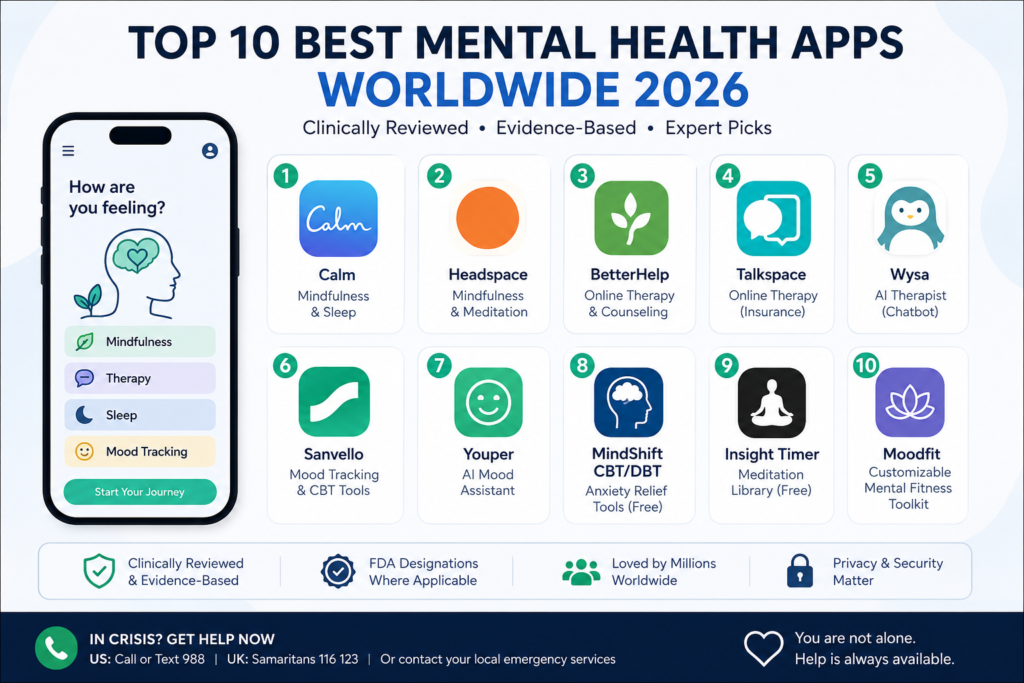
1. Calm
Calm remains the most widely used mindfulness and sleep app in the world, having surpassed 100 million downloads since its 2012 launch. Its flagship Sleep Stories, celebrity-narrated content, and cinematic, nature-themed design have made it one of the highest-grossing wellness apps globally.
It’s important to be clear about what Calm is and isn’t: Simply Psychology’s 2026 review notes it’s “not a mental health treatment,” but rather a daily mindfulness and stress-support tool — genuinely useful for that purpose, with research on the specific app lagging behind mindfulness research generally. Calm also expanded into enterprise wellness through its 2022 acquisition of Ripple Health Group, rebranded as Calm Health, targeting workplace mental health programs.
Best for: Sleep support, daily mindfulness practice, stress relief as a wellness habit rather than clinical treatment.
2. Headspace
Headspace takes a more structured, curriculum-based approach than Calm, using animated characters and progressive courses rather than a large content buffet. It merged with Ginger in recent years to expand into actual therapy and coaching offerings, moving beyond pure meditation into a hybrid self-guided-plus-professional-support model.
Alongside Calm, Headspace accounts for roughly 90% of active mental health app users combined, according to industry tracking. Its emphasis on evidence-based mindfulness and healthcare/employer partnerships has helped it build deeper clinical credibility than most pure meditation apps.
Best for: Users who want structured, curriculum-style learning rather than an open library; workplace mental health programs.
3. BetterHelp
BetterHelp connects users with licensed therapists via messaging, live chat, phone, or video, and is one of the largest online therapy platforms in the world. It’s frequently the fastest way to reach a licensed therapist — some services report matching within 48 hours.
Two important facts to weigh before signing up: BetterHelp is not HIPAA compliant, and the company was fined by the FTC in 2023 for sharing sensitive customer data with advertisers, according to Forbes Health’s 2026 comparison. It has since added encrypted communication and HITRUST-certified security protocols, and does not accept insurance — costing $70–$100 per week depending on location and therapist availability, payable via FSA/HSA funds.
Best for: Fast access to a licensed therapist without waiting for insurance authorization, flexible communication styles (text, audio, video).
4. Talkspace
Talkspace competes directly with BetterHelp but differentiates on two fronts: it does accept certain insurance plans and Employee Assistance Program (EAP) benefits, and unlike BetterHelp, it maintains HIPAA compliance, per Forbes Health’s 2026 side-by-side comparison.
It offers text, audio, and video messaging with licensed providers, and its insurance acceptance can make it meaningfully cheaper out-of-pocket than BetterHelp for eligible users — though coverage varies significantly by specific insurance provider and plan.
Best for: Users with insurance coverage that includes teletherapy, anyone specifically requiring HIPAA-compliant communication.
5. Wysa
Wysa stands apart on regulatory credibility. It holds FDA Breakthrough Device Designation — granted after an independent, peer-reviewed clinical trial published in JMIR found it effective for managing chronic pain and associated depression and anxiety, performing comparably to in-person psychological counseling in that specific trial population.
Important context: this designation applies specifically to an AI-led CBT tool for adults with chronic musculoskeletal pain and associated depression/anxiety — it is not a blanket approval covering every use case. Wysa reports 6.5 million-plus users globally and is deployed by the UK’s NHS, employers, and health insurers as a first-line, low-acuity support tool. Sessions are anonymous with no login required, and the company acquired two healthcare firms (April Health and Kins) in 2025 to bridge physical and mental health care.
Best for: Anonymous, judgment-free AI-guided CBT support; users wanting the strongest regulatory/clinical backing among AI chatbots.
6. Sanvello
Sanvello combines mood tracking, CBT-based tools, and community support features, and consistently rates as one of the stronger paid options in independent 2026 reviews — scored 7.5/10 in a clinician-authored comparison, ahead of several competitors on completeness of tracking features.
Its structured approach — combining daily tracking, guided journeys, and coping tools — makes it a solid fit for users who specifically want to see patterns in their mood and triggers over time, rather than just having conversations with an AI chatbot.
Best for: Structured self-tracking of mood and anxiety patterns, users who want data-driven insight into their own triggers.
7. Youper
Youper is an AI-powered emotional health assistant offering structured CBT tools and mood tracking, with early clinical studies showing some benefit, according to research published via ScienceDirect. It has fewer independent, peer-reviewed studies behind it than Wysa or the now-discontinued Woebot, which is worth knowing if clinical evidence is a priority for you.
Reviewer opinion on Youper is notably mixed: while it has real functionality, some 2026 reviews rate it as poor value compared to alternatives, describing the experience as feeling more corporate or less personalized than competitors like Wysa.
Best for: Users wanting a low-cost AI mood-tracking companion, though it’s worth comparing directly against Wysa given the evidence gap.
8. MindShift CBT/DBT Coach
MindShift is a free, anxiety-specific app built around CBT and DBT techniques, and it’s frequently recommended as a first stop for users whose primary concern is anxiety specifically, rather than general mood or stress. It doesn’t include an AI chatbot or therapist marketplace — it’s a focused, skills-based tool.
Being free removes a real barrier for people who want evidence-informed anxiety tools without a subscription commitment, which matters given how much the broader digital mental health market skews toward paid tiers.
Best for: Anxiety-specific CBT/DBT skill-building at no cost, users who want a tool rather than a chatbot or therapist connection.
9. Insight Timer
Insight Timer offers one of the largest free meditation libraries available anywhere, with contributions from thousands of teachers worldwide. It’s consistently recommended in 2026 reviews as the strongest free alternative to paid mindfulness apps like Calm and Headspace.
Its scale and variety come at the cost of the polished, structured experience Calm and Headspace offer — it’s more of an open library than a guided program — but for cost-conscious users, it removes the subscription barrier entirely.
Best for: Free access to a large, varied meditation library, users who don’t need a structured curriculum.
10. Moodfit
Moodfit rounds out the list as a customizable mental fitness toolkit, letting users build a personalized combination of mood tracking, CBT exercises, gratitude journaling, and breathing tools rather than following one fixed program.
It’s positioned as a flexible, DIY-style option for users who’ve tried more rigid apps and want to assemble their own combination of evidence-informed tools, appealing to people who know roughly what helps them and want the freedom to combine techniques.
Best for: Users who want to build a customized toolkit rather than follow a single fixed program.
Important Statistics Table
| App | Category | Notable Evidence/Status | Cost | Free Tier |
| Calm | Mindfulness/sleep | 100M+ downloads | ~$14.99/mo or $69.99/yr | Yes, limited |
| Headspace | Mindfulness/structured | 90% of active users (w/ Calm) | ~$12.99/mo | Yes, limited |
| BetterHelp | Licensed therapy | Not HIPAA compliant; FTC-fined 2023 | $70–$100/week | No (free consult only) |
| Talkspace | Licensed therapy | HIPAA compliant; accepts insurance | Varies by plan/insurance | No (free consult only) |
| Wysa | AI CBT chatbot | FDA Breakthrough Device Designation | Freemium | Yes, core chat free |
| Sanvello | CBT + tracking | Rated 7.5/10 in 2026 clinical review | Freemium/subscription | Yes, limited |
| Youper | AI mood assistant | Early studies; evidence gap vs. Wysa | Freemium/subscription | Yes, limited |
| MindShift CBT/DBT | Anxiety skills tool | Free, evidence-informed | Free | Fully free |
| Insight Timer | Meditation library | Largest free library | Free/premium upsell | Yes, extensive |
| Moodfit | Customizable toolkit | DIY combination of CBT tools | Freemium/subscription | Yes, limited |
Sources: Simply Psychology 2026, Forbes Health 2026, Wysa clinical evidence page, MedSpurs 2026 clinical review. Pricing and features change frequently — verify current details directly on each app’s website before subscribing.
Step-by-Step: How to Choose the Right App for You
- Identify your primary need first. Anxiety and stress favor MindShift or Wysa; sleep favors Calm; structured therapy access favors BetterHelp or Talkspace; mood tracking favors Sanvello.
- Check your insurance situation. If you have insurance that may cover teletherapy, check Talkspace before BetterHelp, since BetterHelp doesn’t accept insurance at all.
- Weigh evidence level against cost. Wysa currently has the strongest independent regulatory backing among AI chatbots; free tools like MindShift and Insight Timer remove cost as a barrier entirely.
- Review privacy practices before entering personal information. BetterHelp’s FTC data-sharing history and lack of HIPAA compliance are worth factoring into your decision, especially for sensitive disclosures.
- Start with a free tier or trial. Nearly every app on this list offers some free access — test the actual experience before committing to a subscription.
- Reassess if your needs change. An app suited for daily stress management isn’t a substitute for professional care if symptoms worsen or persist — check in with a doctor or therapist if that happens.
Pros and Cons Table
| App | Pros | Cons |
| Calm | Huge content library, excellent sleep content | Not a clinical tool; less structured than Headspace |
| Headspace | Structured curriculum, evidence-based approach | Less variety than Calm’s content buffet |
| BetterHelp | Fast therapist matching, flexible communication | Not HIPAA compliant; FTC-fined for data sharing; no insurance |
| Talkspace | HIPAA compliant, accepts insurance/EAP | Coverage varies significantly by provider |
| Wysa | FDA Breakthrough Device Designation, anonymous | Designation covers a specific use case, not all features |
| Sanvello | Strong tracking features, well-reviewed | Subscription needed for full feature set |
| Youper | Low-cost AI support | Weaker independent evidence base; mixed reviews |
| MindShift CBT/DBT | Completely free, anxiety-focused | No chatbot or therapist connection |
| Insight Timer | Massive free library | Less structured than paid alternatives |
| Moodfit | Highly customizable | Requires more self-direction to be effective |
Comparison Table: Best Mental Health App by Need
| Your Need | Best Pick | Runner-Up | Why |
| General stress and sleep | Calm | Headspace | Largest sleep-content library, huge user base |
| Structured mindfulness learning | Headspace | Calm | Curriculum-based courses vs. open buffet |
| Fast licensed therapy access | BetterHelp | Talkspace | Matches quickly; no insurance wait required |
| Insurance-covered therapy | Talkspace | BetterHelp | HIPAA compliant, accepts insurance/EAP |
| AI chatbot with strongest evidence | Wysa | Youper | FDA Breakthrough Device Designation |
| Mood and anxiety tracking | Sanvello | Moodfit | Highest independent review score (7.5/10) |
| Free anxiety-specific tool | MindShift CBT/DBT | Insight Timer | Fully free, evidence-informed CBT/DBT |
| Free meditation library | Insight Timer | Calm free tier | Largest free content library available |
| Build-your-own toolkit | Moodfit | Sanvello | Fully customizable combination of tools |
2026 News and Trends
The defining event of this category was Woebot’s exit from the consumer market. Once used by over 1.5 million people and holder of its own FDA Breakthrough Device Designation for postpartum depression treatment, Woebot Health shut down its direct-to-consumer app on June 30, 2025, pivoting entirely to enterprise and healthcare-system partnerships, according to STAT News’ 2025 reporting. The company’s founder cited AI moving faster than regulators as a driving factor — a cautionary reminder that even clinically validated apps aren’t guaranteed to stay available.
Clinical evidence in the category also took a major step forward. The Dartmouth Therabot trial, published in NEJM AI in March 2025, remains the most rigorous randomized controlled trial in the space to date, finding a 51% average reduction in depression symptoms among participants — though researchers caution the trial used a highly optimized, tightly controlled version of the technology, not necessarily representative of consumer apps generally.
Regulatory scrutiny is intensifying elsewhere too. A Brown University study cited in 2026 industry reporting found that some AI chatbots “systematically violate mental health ethics standards,” adding pressure on the sector to formalize safety and disclosure standards as generative AI models increasingly power these tools.
On the access side, mental health app usage keeps expanding globally — the mental health app segment created by Calm, Talkspace, and BetterHelp alone now represents a $2 billion slice of the $118 billion U.S. mental health treatment market, with over 61 million Americans (more than one in five adults) now experiencing some form of mental illness, per Marketdata LLC’s 2026 industry report.
Conclusion
The best mental health app in 2026 depends entirely on what you need it for — sleep support, anxiety skills, mood tracking, or a licensed therapist. Wysa currently leads on regulatory evidence among AI tools, Calm and Headspace dominate mindfulness, and BetterHelp and Talkspace remain the fastest paths to real professional support.
Whatever you choose, treat these apps as one part of a broader approach to your mental health, not a replacement for professional care when you need it — and don’t hesitate to reach out to a real person if things feel bigger than an app can hold.
References
- Grand View Research – Mental Health Apps Market Size, Share | Industry Report, 2030: https://www.grandviewresearch.com/industry-analysis/mental-health-apps-market-report
- SkyQuest – Mental Health Apps Market Size, Share, and Growth Analysis: https://www.skyquestt.com/report/mental-health-apps-market
- Wysa – Clinical Evidence & Research: https://www.wysa.com/clinical-evidence
- STAT News – Why Woebot, a Pioneering Therapy Chatbot, Shut Down: https://www.statnews.com/2025/07/02/woebot-therapy-chatbot-shuts-down-founder-says-ai-moving-faster-than-regulators/
- Woebot Health – Official FAQ on App Retirement: https://woebothealth.com/faq/
- Simply Psychology – AI Therapy Chatbots: What the 2026 Research Actually Shows: https://www.simplypsychology.com/articles/ai-therapy-chatbots-research-review
- Simply Psychology – Calm App Review 2026: Is It Worth the Subscription?: https://www.simplypsychology.com/articles/calm-app-review-2026
- Forbes Health – Talkspace vs. BetterHelp: Which Is Best?: https://www.forbes.com/health/mind/talkspace-vs-betterhelp/
- BuildMVPFast – Mental Health AI Chatbots: Clinical Evidence for Woebot & Wysa: https://www.buildmvpfast.com/blog/mental-health-ai-chatbots-woebot-wysa-therapeutic-effectiveness-2026
- MedSpurs – Best Mental Health Apps 2026: Therapist-Recommended Tools Based on Clinical Evidence: https://medspurs.com/online-therapy-and-mental-health-apps-review/
- Nubia Magazine – Top 10 Best Mental Health Apps in the World 2026: https://nubiapage.com/top-10-best-mental-health-apps-in-the-world/
- GM Insights – Mental Health Apps Market Size, Forecasts Report 2026-2035: https://www.gminsights.com/industry-analysis/mental-health-apps-market
- Business Wire/ResearchAndMarkets – U.S. Mental Health Treatment Market Report and Directory 2026: https://www.businesswire.com/news/home/20260113967219/en/
FAQs
There’s no single best app — it depends on your need. Wysa currently has the strongest regulatory backing among AI chatbots (FDA Breakthrough Device Designation), Calm and Headspace lead mindfulness and sleep, and BetterHelp or Talkspace are best for direct access to licensed therapists.
No. These apps are designed to support mild-to-moderate stress, anxiety, or low mood, and to complement professional care, not replace it. For moderate-to-severe symptoms, a licensed therapist or doctor is the appropriate standard of care.
No. Woebot Health shut down its consumer app on June 30, 2025, and pivoted to enterprise and healthcare-system partnerships. Access now generally requires a code from a partner organization rather than a public download.
Most are not formally FDA-cleared as medical devices. Wysa holds FDA Breakthrough Device Designation for a specific chronic-pain-related CBT tool, and Woebot previously held similar designation for a postpartum depression program before discontinuing its consumer app.
BetterHelp uses encrypted communication and HITRUST-certified security protocols today, but it is worth knowing it is not HIPAA compliant and was fined by the FTC in 2023 for sharing sensitive user data with advertisers. Review its current privacy policy carefully before sharing sensitive information.
Don’t rely on an app. In the US, call or text 988 (Suicide & Crisis Lifeline) at any time. In the UK, contact Samaritans at 116 123. If you’re elsewhere, contact your local emergency services or crisis line immediately.
Evidence varies by app and condition. A broad meta-analysis found a medium effect size (g=0.43) for depression/anxiety apps generally, while the most rigorous single trial to date (Dartmouth’s Therabot study) found a 51% reduction in depression symptoms in a controlled research setting. Real-world results for consumer apps are typically more modest than optimized research trials.



GIPHY App Key not set. Please check settings