 Balakumar L
Introduction
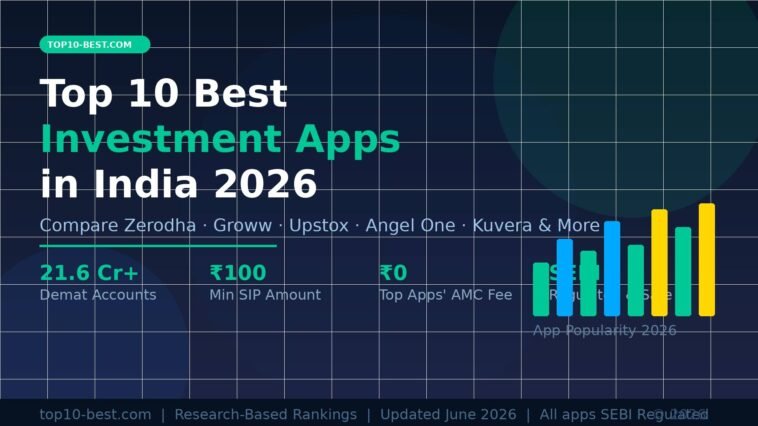
Millions of Indians are investing through apps right now — and if you are not, you are probably leaving real money on the table. India crossed 21.6 crore demat accounts as of early 2026, and a huge chunk of that growth came from people who discovered they could start with as little as ₹100 on their phone. But here is the problem: not all apps are equal. Some charge hidden fees. Some crash during peak market hours. And some are just plain confusing for a first-time investor.
So, which are the best investment apps in India worth your trust in 2026? We tested them, compared fees, checked SEBI registration, and ranked them below.
Table of Contents
- Key Highlights / Quick Facts
- Why Investment Apps Matter in India Right Now
- Top 10 Best Investment Apps in India (2026)
- Important Statistics Table
- How to Choose the Right Investment App (Step-by-Step)
- Pros and Cons Table
- App Comparison Table
- 2026 Trends in Indian Investment Apps
- Frequently Asked Questions
- References
Key Highlights / Quick Facts
- 21.6 crore+ demat accounts exist in India as of January 2026 (NSE data)
- India has approximately 12.7 crore unique registered investors as of January 2026
- SIP inflows hit a record ₹26,688 crore in May 2025 (AMFI)
- 73% of NSE’s daily volume is now in F&O — making research tools essential
- All top apps use 256-bit SSL encryption and SEBI-registered frameworks
- Beginners can start investing with as little as ₹100–₹500 per month
- Discount brokers charge ₹20 flat or 0.03% per intraday/F&O order — far cheaper than full-service brokers
- India’s demat account base grew 250% between 2020 and 2025 (NSE)
Why Investment Apps Matter in India Right Now
India’s retail investing story has been nothing short of extraordinary. From roughly 4 crore demat accounts in FY20, the number exploded to over 21 crore by early 2026. That is millions of people who skipped the traditional broker and went straight to an app.
The RBI cut interest rates by 50 basis points in FY26, making fixed deposits less attractive. That pushed a lot of savers into equities and mutual funds — and investment apps made that shift easy. You no longer need a sub-broker, a pile of paperwork, or a savings of lakhs to start. You need a phone and a PAN card.
But with so many apps out there, picking the wrong one can cost you real money in fees, bad execution, or poor support when things go wrong.
Enrich Money
Enrich Money is a leading wealth-tech and online trading platform in India, empowering investors with smart, technology-driven investment solutions. Through its ORCA platform, users can access stocks, mutual funds, IPOs, bonds, ETFs, and advanced market analysis tools in one place. As a SEBI-registered stockbroker and member of NSE, BSE, MCX, and CDSL, Enrich Money is committed to making investing simple, accessible, and data-driven for every investor.
Top 10 Best Investment Apps in India (2026)
India’s best investment apps for stocks, mutual funds, SIPs, and more — ranked by features, safety, fees, and user experience.
1. Zerodha Kite — Best Overall for Self-Directed Investors
Key Detail: ₹0 delivery brokerage | ₹20 flat intraday | 1.3 crore+ active clients
Zerodha is India’s largest discount broker by active clients, and Kite is its trading app. The platform is clean, fast, and reliable — even during high-volume market sessions. Zerodha charges zero brokerage on equity delivery trades, which means you pay nothing when you buy and hold stocks. For intraday and F&O, it is ₹20 flat per executed order or 0.03%, whichever is lower.
What really separates Zerodha is Varsity — its free financial education platform. For a first-time investor who wants to learn while doing, this combination is hard to beat. The Demat AMC is ₹300 per year. Account opening is free.
Best for: Confident self-directed investors who want professional tools and low costs.
2. Groww — Best for Beginners
Key Detail: ₹0 AMC | ₹0 account opening | 9.5 million+ active clients
Groww has arguably become the most popular investing app in India among millennials and first-time investors. The interface is about as simple as it gets — you can be set up and making your first SIP investment within 15 minutes. It covers stocks, mutual funds, digital gold, ETFs, IPOs, and fixed deposits all in one place.
Groww went public in November 2025 (listed as Billionbrains Garage Ventures), adding a layer of transparency and accountability. The free Demat AMC is a genuine advantage for small investors just getting started.
Best for: First-time investors who want simplicity and zero maintenance fees.
3. Upstox — Best for Speed and Active Trading
Key Detail: ₹0 account opening | ₹20 flat brokerage | TradingView-powered charts
Upstox has built a strong reputation among active traders who need speed. The app is backed by Tiger Global and Ratan Tata, which gives it strong credibility. Its charting tools are powered by TradingView — one of the best-in-class charting platforms globally — and the execution speed is consistently fast.
The Demat AMC is ₹300 per year (free for the first year). For intraday traders who execute many orders daily, Upstox’s reliability and cost structure work well.
Best for: Active traders who want fast execution and professional-grade charts.
4. Angel One — Best for Research and Advisory
Key Detail: ₹0 account opening | ₹240 AMC (waived first year) | AI-powered SmartAPI
Angel One (formerly Angel Broking) has been in the Indian market since 1987, so it brings decades of market experience to its app. What sets it apart from pure discount brokers is its AI-driven advisory tools, including the SmartAPI for algo traders and in-house research reports covering equities and commodities.
The app supports stocks, F&O, currency, commodities, mutual funds, and IPOs. It also has a strong offline network of branches — useful for investors who occasionally want face-to-face support.
Best for: Investors who want data-backed research alongside low-cost trading.
India’s stock market trading apps compared — Zerodha, Groww, and Upstox lead the pack for different investor types.
5. Kuvera — Best for Mutual Funds and Wealth Planning
Key Detail: Zero commission on direct mutual funds | Goal-based planning tools | Family account management
Kuvera is not a stock trading app. It is a pure mutual fund investment platform, and it does that one thing exceptionally well. The app offers direct mutual fund plans with zero commission, which means more of your returns stay with you rather than going to a distributor.
The platform includes tax harvesting features (automatically switching funds to save capital gains tax), portfolio rebalancing, and detailed goal-setting tools for retirement, education, and wealth creation. It is also one of the few platforms that supports family account management under one dashboard.
Best for: Long-term investors and HNIs who want professional-grade mutual fund tools at no cost.
6. INDmoney — Best for Global Investing
Key Detail: Indian + US stock markets | Net worth tracker | AI-powered insights
INDmoney stands out because it lets you invest in both Indian markets and US stocks and ETFs from a single app. This matters because, under RBI’s Liberalised Remittance Scheme (LRS), Indian investors can remit up to $250,000 per year abroad — and INDmoney makes using that allowance straightforward, with fractional investing in US equities.
The app also has a net worth calculator that pulls in data from your bank accounts, mutual funds, and stocks to give you a single financial snapshot. For investors thinking beyond India, this is genuinely useful.
Best for: Investors who want Indian and international exposure in one place.
7. Paytm Money — Best for Beginners with Small Budgets
Key Detail: SIPs from ₹100 | Backed by Paytm ecosystem | Covers stocks, MFs, NPS, digital gold
Paytm Money benefits from the trust that comes with the Paytm brand. The app is SEBI-registered, supports direct mutual fund plans, and allows SIP investments starting from just ₹100 — making it one of the most accessible entry points for small investors. It also covers the National Pension System (NPS), which many competing apps skip.
The interface is clean, the KYC process is fast, and the integration with the Paytm wallet makes funding straightforward.
Best for: New investors starting small who are already in the Paytm ecosystem.
8. Dhan — Best for Options Traders
Key Detail: Founded 2021 | TradingView integration | Forever Orders | Options chain analytics
Dhan is the newest serious player on this list, founded in 2021 by Pravin Jadhav — former president of Paytm Money. In a short time it has built a loyal following among options traders for its options chain analytics, payoff graphs, and basket order features that other apps simply do not offer at the same quality.
The deep TradingView integration means you can analyze charts and execute trades from the same screen. The Forever Orders feature lets you place an order that stays active until a target price is hit — no need to babysit a trade.
Best for: Technically sophisticated traders who focus on derivatives and options strategies.
Mutual fund SIP investing through mobile apps has made wealth creation accessible to crores of Indian households.
9. 5paisa — Best for Budget-Conscious High-Volume Traders
Key Detail: Flat fee brokerage model | Stocks + MFs + insurance + robo-advisory | Research tools included
5paisa runs a flat fee per trade model that appeals to high-frequency traders who want predictable costs. The platform covers equities, F&O, currency, commodity, mutual funds, and even insurance — making it a one-stop shop for a certain type of investor.
The included research tools and educational content are a real plus, especially for investors who want data without paying extra. The robo-advisory feature offers automated portfolio suggestions based on your risk profile.
Best for: High-volume traders who want a predictable flat-fee structure and added research tools.
10. ET Money — Best for Goal-Based and Tax-Saving Investing
Key Detail: ELSS tax-saving funds | Expense manager integration | NPS + SIP + insurance
ET Money (part of Times Internet) focuses heavily on goal-based investing and tax planning. The app makes it easy to invest in ELSS funds under Section 80C of the Income Tax Act, manage NPS contributions, set up SIPs, and even track daily expenses — all in one place.
The integration of an expense manager with an investment platform is a smart design choice. It helps users see the link between spending less and investing more. ET Money also offers fund recommendations based on your financial goals and risk tolerance.
Best for: Salaried investors focused on tax-saving investments and long-term goal planning.
Important Statistics Table
| Metric | Data | Source / Year |
|---|---|---|
| Total Demat Accounts in India | 21.6 crore+ | NSE, January 2026 |
| Unique Registered Investors | 12.7 crore | NSE, January 2026 |
| SIP Monthly Inflow (Record) | ₹26,688 crore | AMFI, May 2025 |
| Active SIP Accounts | 9 crore+ | AMFI, 2025 |
| Growth in Demat Accounts (2020–2025) | 250% increase | NSE / Sharekhan |
| F&O Share of NSE Daily Volume | 73% | SEBI, 2026 |
| Retail Share of NSE Cash Market Volume | 45%+ daily | NSE Market Pulse, 2025 |
| SEBI Registered Investment Advisers | ~988 | SEBI, 2026 |
| Flat Brokerage (Discount Brokers) | ₹20/order or 0.03% | Zerodha, Groww, Upstox |
| Minimum SIP Amount | ₹100 | Paytm Money, Groww |
How to Choose the Right Investment App: Step-by-Step
Step 1 — Know your investor type. Are you a complete beginner? Go for Groww or Paytm Money. An active equity trader? Zerodha or Upstox fit better. Into options? Dhan is worth serious consideration.
Step 2 — Check SEBI registration. Before trusting any app with your money, verify it is registered with the Securities and Exchange Board of India (SEBI). All ten apps on this list are SEBI-regulated.
Step 3 — Compare fee structures. Discount brokers charge ₹20 flat or 0.03% per intraday/F&O trade and zero for delivery. Full-service brokers charge 0.3–0.5% per trade on both sides — that is 10–15x more expensive, according to data from StockCalc (2026).
Step 4 — Check what you want to invest in. Stocks, mutual funds, digital gold, US stocks, NPS, bonds? Make sure your chosen app supports the instruments you need.
Step 5 — Test the app before committing big. Most apps offer free account opening. Start with a small SIP or delivery trade to feel the platform before putting large capital in.
Step 6 — Verify security features. Look for 256-bit SSL encryption, two-factor authentication (2FA), and biometric login options.
Pros and Cons Table
| App | Pros | Cons |
|---|---|---|
| Zerodha Kite | Zero delivery brokerage, excellent education (Varsity), stable platform | No in-house research team, ₹300/yr AMC |
| Groww | Zero AMC, beginner-friendly, wide product range | Basic charting tools, limited advisory |
| Upstox | TradingView charts, fast execution, Tiger Global backed | Occasional app glitches reported |
| Angel One | Strong research, AI tools, offline branches | AMC charged after first year |
| Kuvera | Zero commission MFs, tax harvesting, family accounts | No stock trading |
| INDmoney | US + India in one app, net worth tracker | LRS remittance limits apply |
| Paytm Money | SIPs from ₹100, NPS support, simple UX | Limited advanced trading features |
| Dhan | Best options tools, TradingView integration, Forever Orders | Newer platform, smaller support team |
| 5paisa | Flat fee model, research tools, insurance coverage | Less polished UI vs competitors |
| ET Money | Tax-saving focus, goal planning, expense manager | No direct stock trading |
App Comparison Table
| App | Delivery Brokerage | Intraday Brokerage | Demat AMC | Account Opening | Best For |
|---|---|---|---|---|---|
| Zerodha Kite | ₹0 | ₹20 flat | ₹300/yr | Free | Self-directed investors |
| Groww | ₹0 | ₹20 flat | Free | Free | Beginners |
| Upstox | ₹0 | ₹20 flat | ₹300/yr (free yr 1) | Free | Active traders |
| Angel One | ₹0 | ₹20 flat | ₹240/yr (free yr 1) | Free | Research + trading |
| Kuvera | Zero commission | N/A (MFs only) | N/A | Free | Mutual funds |
| INDmoney | ₹0 | ₹20 flat | Varies | Free | Global investing |
| Paytm Money | Zero (direct MFs) | ₹10–₹20 | Varies | Free | Small investors |
| Dhan | ₹0 | ₹20 flat | Varies | Free | Options traders |
| 5paisa | ₹0 | ₹20 flat | ₹200/yr | Free | High-volume trading |
| ET Money | Zero (MFs only) | N/A | N/A | Free | Tax planning + goals |
2026 Trends in Indian Investment Apps
AI-powered advisory is mainstream now. Apps like Angel One, INDmoney, and Univest are embedding AI-driven stock screening and portfolio recommendations directly inside the platform. It is no longer a premium feature — it is becoming the baseline expectation.
Options trading is exploding. SEBI data shows that 73% of NSE’s daily volume in 2026 is in F&O. Apps like Dhan and Zerodha have responded with better options chains, payoff calculators, and strategy builders built right into the mobile experience.
Global investing is getting easier. INDmoney and a few other platforms now make it simple for Indian investors to put money into US stocks like Apple or Amazon, using the RBI’s LRS allowance of up to $250,000 per year.
Budget 2026 STT changes. From April 1, 2026, F&O futures STT was raised to 0.05% and options STT to 0.15%. This has made cost calculators inside apps more important than ever — traders need to know their exact net profit before placing a trade.
Demat account growth is stabilising. After the explosive post-COVID growth (250% from 2020 to 2025), NSE data shows new account openings moderated in 2025. But market experts believe a rally in mid and small caps could reignite retail participation in 2026.
Smallcase and thematic investing. Platforms like Smallcase — which lets you buy curated baskets of stocks built around a theme — are gaining real traction, especially among younger investors who want to invest in ideas rather than individual stocks.
India’s retail investor base is expanding rapidly, making the right investment app choice more important than ever in 2026.
Frequently Asked Questions
Which is the safest investment app in India in 2026?
All ten apps on this list are SEBI-registered and use bank-grade 256-bit SSL encryption. Your shares are held in your name at CDSL or NSDL — not by the broker — so even if a broker collapses, your securities remain safe. Zerodha and Groww are widely considered the most established and trustworthy for most investors.
Can I start investing with ₹100 in India?
Yes. Apps like Paytm Money and Groww allow SIP investments starting at ₹100 per month in mutual funds. For stocks, you need enough to buy at least one share — which can range from under ₹10 (some penny stocks) to several thousand rupees for large-cap stocks.
Is Zerodha or Groww better for beginners?
Groww wins on simplicity and zero AMC — ideal for someone making their first investment. Zerodha is slightly more complex but offers the Varsity education platform and better tools for investors who plan to grow into equities. Many investors start with Groww and later open a Zerodha account.
Are investment apps in India taxed?
Yes. Short-term capital gains (STCG) on equity held under 12 months are taxed at 20% (revised in Budget 2024). Long-term capital gains (LTCG) above ₹1.25 lakh per year are taxed at 12.5%. The app itself does not handle taxes — you need to file returns through your CA or tax platform, though some apps like ET Money and Kuvera offer tax optimization tools.
What is the best app for mutual fund SIP in India?
Kuvera and Zerodha Coin are the top picks for direct mutual fund SIPs with zero commission. Groww and Paytm Money are better for beginners who want hand-holding and a simpler experience. All of them support UPI Autopay for automatic monthly SIP deductions.
Is Dhan good for options trading in India?
Dhan has quickly earned a strong reputation specifically among options traders. Its deep TradingView integration, options chain analytics, payoff graphs, and Forever Orders feature make it one of the most sophisticated platforms for derivatives. That said, it is a newer platform — Zerodha and Upstox have longer track records.
How do I open a demat account in India?
Choose a SEBI-registered app, download it, enter your PAN and Aadhaar details, complete video KYC (takes 10–15 minutes), and your account is typically activated within 24–48 hours. Most apps offer free account opening in 2026.
References
- NSE India — Unique Investor Data, January 2026: https://www.nseindia.com
- SEBI — SEBI-Registered Investment Advisers, 2026: https://www.sebi.gov.in
- AMFI — SIP Inflow Data, May 2025: https://www.amfiindia.com
- Zerodha — Official Charges Page, 2026: https://zerodha.com/charges
- Groww — Platform Overview, 2026: https://groww.in
- Upstox — Official Site, 2026: https://upstox.com
- Inventiva — Top 10 Investment Apps 2026: https://www.inventiva.co.in
- StockCalc — Brokerage Comparison India 2026: https://stockcalc.in
- InvestorGain — Angel One vs Zerodha vs Groww Comparison: https://www.investorgain.com
- Acumen Group — How Many People Invest in India 2026: https://acumengroup.in
- Univest — SEBI Investment Adviser Data, April 2026: https://univest.in
- IntradayLab — Budget 2026 STT Rates and Brokerage Calculator: https://intradaylab.com
- JETIR Research — Post-COVID Surge in Demat Accounts, 2024: https://www.jetir.org
- Outlook Business — Retail Investor Revolution, 2025: https://www.outlookbusiness.com
Conclusion
The best investment app in India for you depends on who you are as an investor. If you are just starting out, Groww makes it almost impossible to get confused. If you want professional tools at low cost, Zerodha is the gold standard. For mutual fund purists, Kuvera is unbeatable. And if derivatives are your thing, Dhan has built something genuinely impressive in a short time.
The good news: all these apps are free to open, SEBI-regulated, and allow you to start with small amounts. The only wrong move is waiting.
For informational purposes only. Not financial advice.



GIPHY App Key not set. Please check settings