 Balakumar L
Introduction
Here’s something that surprises a lot of people: the US dollar isn’t even close to the highest-valued currency in the world. Neither is the euro or the British pound. The real answer sits in the Middle East, where a single Kuwaiti dinar buys more than three US dollars.
We pulled current exchange rate data from Capital.com, Vantage Markets, LiteFinance, and other financial sources to rank the ten highest valued currencies in the world right now, along with exactly what drives each one’s value.
This article is for general informational purposes only and does not constitute financial advice. Exchange rates fluctuate constantly, sometimes within minutes, so treat the figures below as an approximate snapshot rather than a live quote, and always check a current rate before exchanging money.
Table of Contents
- Key Highlights
- What “Highest Valued” Actually Means (And What It Doesn’t)
- The Top 10 Highest Valued Currencies in the World
- Important Statistics Table
- How Currency Value Is Actually Determined (Step-by-Step)
- Pros and Cons Table (Of a High-Valued Currency)
- Comparison Table: Top 10 Currencies at a Glance
- Current Trends in Global Currency Value
- FAQs
- References
Key Highlights (Quick Facts)
- The Kuwaiti Dinar (KWD) is the world’s highest valued currency, with 1 KWD worth approximately $3.25 to $3.26 USD as of mid-2026.
- Gulf currencies dominate the top three positions, with the Kuwaiti Dinar, Bahraini Dinar, and Omani Rial all backed by substantial oil export revenues.
- The Bahraini Dinar (BHD) sits second at approximately $2.65 USD, pegged to the US dollar since 1980.
- The Omani Rial (OMR) ranks third at approximately $2.60 USD, with its dollar peg unchanged since 1986.
- As of mid-2026, only six currencies hold a higher exchange rate than the US dollar: the Kuwaiti, Bahraini, Omani, and Jordanian dinars, plus the British and Gibraltar pounds.
- Unlike most other Gulf currencies, the Kuwaiti Dinar is not pegged directly to the US dollar, but instead to an undisclosed weighted basket of international currencies since 2007.
- The US Dollar, despite ranking only at $1.00 by face value, remains the world’s primary reserve currency, accounting for roughly 56.77% of global foreign exchange reserves.
- A high exchange rate does not mean a country has the largest or strongest economy, but rather reflects confidence, monetary discipline, and often a deliberately managed or pegged exchange rate.
The truth is, currency strength by exchange rate and economic power are two very different things. The countries at the top of this list are stable and often oil-rich, but the list is more about monetary policy and pegs than about the sheer size of an economy.
What “Highest Valued” Actually Means (And What It Doesn’t)
Before ranking the list, here’s an important distinction that trips up most people who research this topic.
Exchange Rate Value, Not Economic Size
“Highest valued” here refers strictly to a currency’s nominal exchange rate against the US dollar. A single unit of a high-valued currency buys more than one dollar, but this says nothing about the total size of that country’s economy.
Not the Same as Most Traded or Most Held
The US dollar is by far the most traded and most widely held reserve currency in the world, yet it ranks well below the top spots by face value. High usage and high per-unit value are completely separate things.
Not the Same as “Most Stable”
The Swiss Franc is widely considered the world’s most stable, safe-haven currency, yet it doesn’t top this list by exchange rate. Stability and raw exchange value are distinct qualities.
Often a Product of Deliberate Policy
Many of the highest-valued currencies hold their position through fixed or managed pegs to the US dollar or a basket of currencies, meaning their value reflects careful central bank management as much as underlying market forces.
The Top 10 Highest Valued Currencies in the World
Here is our researched ranking of the world’s highest valued currencies by exchange rate against the US dollar.
1. Kuwaiti Dinar (KWD)
Value: Approximately $3.25 to $3.26 USD per dinar
What drives it: Kuwait holds among the largest oil reserves in the world, and those export revenues underpin the dinar’s value alongside a conservative fiscal approach, low government debt, and a well-managed sovereign wealth fund run by the Kuwait Investment Authority. Introduced in 1961 after independence, it has been the world’s highest-valued currency for years.
Notable detail: Unlike most Gulf currencies, the Kuwaiti Dinar is not pegged directly to the US dollar. Since 2007, the Central Bank of Kuwait has linked it to an undisclosed weighted basket of international currencies, reflecting the country’s broad trade relationships.
2. Bahraini Dinar (BHD)
Value: Approximately $2.65 USD per dinar
What drives it: Bahrain’s currency is supported by oil exports and an unusually strong banking and financial services sector. The dinar has been pegged to the US dollar since 1980, holding steady at roughly 1 BHD to $2.65 USD, a peg that reduces volatility and supports market confidence.
Notable detail: Saudi Arabian riyals are accepted as legal tender in Bahrain, fixed at a rate of 1 BHD to 10 riyals, reflecting the two countries’ close economic ties.
Image: A row of international banknotes fanned out on a dark surface — a currency’s exchange-rate value against the dollar reflects monetary policy and pegs far more than the physical size of its economy.
3. Omani Rial (OMR)
Value: Approximately $2.60 USD per rial
What drives it: Introduced in 1970, the Omani Rial is supported by the country’s hydrocarbon export revenues and a long-standing fixed exchange rate. The Central Bank of Oman has maintained the peg unchanged since 1986 at 1 OMR to $2.60 USD.
Notable detail: Because the rial is worth so much, Oman issues fractional banknotes in denominations as small as 100 baisa (one-tenth of a rial), a practical necessity for everyday transactions with such a high-value currency.
4. Jordanian Dinar (JOD)
Value: Approximately $1.41 USD per dinar
What drives it: The Jordanian Dinar has been effectively fixed against the US dollar since 1995 at around 1 JOD to $1.41 USD. Notably, Jordan is far less dependent on oil than its Gulf neighbors, so its currency strength comes largely from cautious central bank policy, a dedication to price stability, and ample foreign exchange reserves held to protect against external shocks.
Notable detail: In use since 1950, the dinar has maintained remarkable stability, with its 12-month trading range against the dollar staying within a fraction of a cent through much of 2026.
5. British Pound Sterling (GBP)
Value: Approximately $1.36 USD per pound
What drives it: The pound’s value reflects a mix of Bank of England monetary policy, inflation expectations, economic growth, fiscal policy, and global demand for sterling-denominated assets. As one of the oldest currencies still in use, it draws strength from the UK’s significant financial services sector and political stability.
Notable detail: Unlike the pegged currencies above it, the pound floats freely on the open market and is one of the most actively traded currencies in the world, with the GBP/USD pair nicknamed “cable” among traders.
Image: The exterior of a historic central bank building with classical columns — freely floating currencies like the British pound draw their value from market forces and central bank policy rather than fixed dollar pegs.
6. Gibraltar Pound (GIP)
Value: Approximately $1.36 USD per pound (pegged at par with GBP)
What drives it: The Gibraltar Pound is pegged at exactly one-to-one with the British Pound Sterling, meaning its value tracks the pound precisely. Introduced in 1934, it reflects Gibraltar’s role as a financial hub and its close economic ties to the United Kingdom.
Notable detail: While interchangeable with the pound within Gibraltar, the GIP is not actively traded on global forex markets and functions primarily as a local currency, with external payments typically made in British pounds.
7. Falkland Islands Pound (FKP)
Value: Approximately $1.26 to $1.36 USD per pound (pegged at par with GBP)
What drives it: Like the Gibraltar Pound, the Falkland Islands Pound is pegged one-to-one with British Pound Sterling, tracking its value directly. It serves the small population of this British Overseas Territory in the South Atlantic.
Notable detail: As a currency for a remote territory with a tiny population, the FKP is essentially never traded on international markets and functions purely for local use, backed entirely by its peg to sterling.
8. Cayman Islands Dollar (KYD)
Value: Approximately $1.20 to $1.22 USD per dollar
What drives it: The Cayman Islands Dollar has been pegged to the US dollar since the 1970s at roughly 1 KYD to $1.20 USD. Its value is supported by the territory’s status as one of the world’s major offshore financial centers, home to hundreds of banks and hedge funds, along with tourism from wealthy visitors.
Notable detail: The Caymans’ tax-haven status helps support demand for the currency, though maintaining a peg above the US dollar’s value is genuinely difficult to sustain, requiring careful reserve management.
Image: A tropical financial district with modern office buildings near the coast — several high-valued currencies belong to small territories whose value rests on offshore banking and fixed dollar pegs.
9. Swiss Franc (CHF)
Value: Roughly at or near parity with the US dollar, frequently exceeding it
What drives it: The Swiss Franc is the world’s premier safe-haven currency, prized for its stability rather than a sky-high exchange rate. Switzerland’s strong economy, low unemployment, high GDP per capita, and well-developed banking sector all underpin the franc’s enduring strength and reliability.
Notable detail: The franc famously stood out as a safe haven during the 2008 financial crisis, and investors still flock to it during periods of global uncertainty, which can push its value above the US dollar.
10. Euro (EUR)
Value: Typically slightly above the US dollar, fluctuating around $1.05 to $1.15 USD
What drives it: As the official currency of 20 European Union member states, the euro is the world’s second most held reserve currency after the US dollar. Its value reflects the combined economic weight of the eurozone, European Central Bank policy, and global demand for euro-denominated assets.
Notable detail: The EUR/USD pair is the single most traded currency pair in the entire foreign exchange market, reflecting the enormous economic size of both regions rather than any exceptional per-unit value.
Important Statistics Table
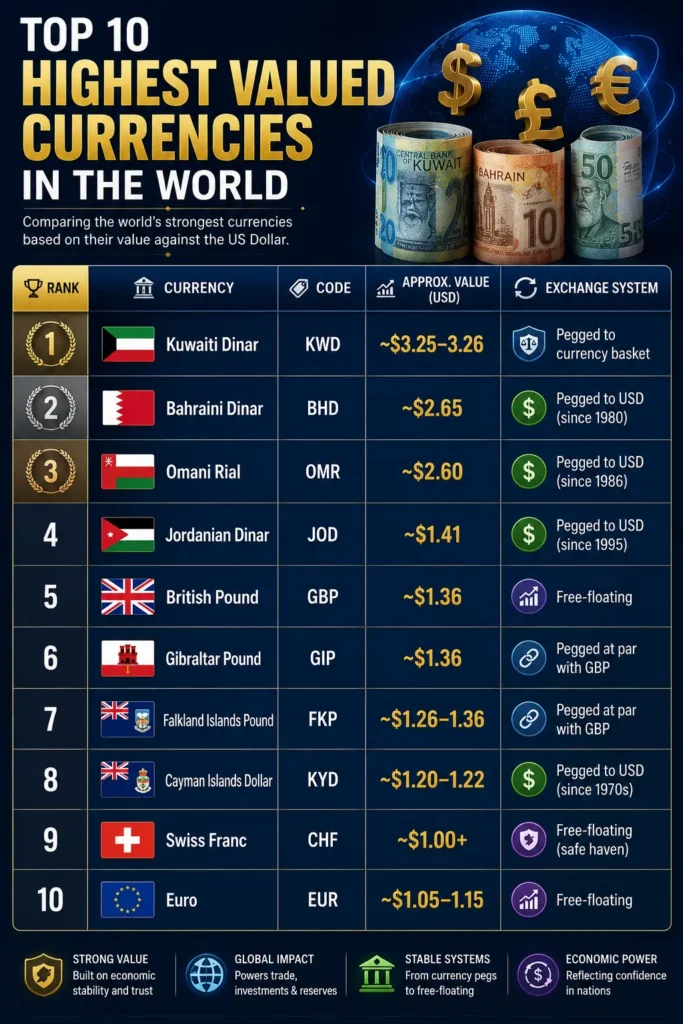
| Rank | Currency | Code | Approx. Value (USD) | Exchange System |
|---|---|---|---|---|
| 1 | Kuwaiti Dinar | KWD | ~$3.25-3.26 | Pegged to currency basket |
| 2 | Bahraini Dinar | BHD | ~$2.65 | Pegged to USD (since 1980) |
| 3 | Omani Rial | OMR | ~$2.60 | Pegged to USD (since 1986) |
| 4 | Jordanian Dinar | JOD | ~$1.41 | Pegged to USD (since 1995) |
| 5 | British Pound | GBP | ~$1.36 | Free-floating |
| 6 | Gibraltar Pound | GIP | ~$1.36 | Pegged at par with GBP |
| 7 | Falkland Islands Pound | FKP | ~$1.26-1.36 | Pegged at par with GBP |
| 8 | Cayman Islands Dollar | KYD | ~$1.20-1.22 | Pegged to USD (since 1970s) |
| 9 | Swiss Franc | CHF | ~$1.00+ | Free-floating (safe haven) |
| 10 | Euro | EUR | ~$1.05-1.15 | Free-floating |
How Currency Value Is Actually Determined (Step-by-Step)
- Supply and demand set the baseline, since a currency’s market value rises when global demand for it, whether for trade, investment, or reserves, exceeds available supply.
- Central bank monetary policy plays a major role, with interest rates, inflation control, and money supply management all directly shaping a currency’s strength.
- Foreign exchange reserves provide stability, since nations with large reserves can better defend their currency against market pressure and maintain any pegs they’ve committed to.
- Fixed or managed pegs anchor many high-valued currencies, deliberately tying a currency’s value to the US dollar or a basket of currencies to ensure consistent, stable demand.
- Economic fundamentals reinforce or undermine value, including GDP growth, government debt levels, political stability, and export revenues, particularly oil for Gulf currencies.
- Market sentiment and geopolitics cause fluctuations, since crises, elections, and global events can shift a currency’s value quickly, especially for freely floating currencies not protected by a peg.
Pros and Cons Table (Of a High-Valued Currency)
| Aspect | Pros | Cons |
|---|---|---|
| Purchasing power | Citizens can buy more foreign goods per unit | Can make the country’s exports more expensive abroad |
| Import costs | Cheaper to import foreign goods and materials | May hurt domestic industries competing with cheap imports |
| Stability signal | Reflects confidence and monetary discipline | High value from a peg requires constant, costly management |
| Travel | Favorable for citizens traveling abroad | Makes the country an expensive destination for tourists |
| Investment | Can attract confidence in the financial system | Doesn’t guarantee a large or fast-growing economy |
Comparison Table: Top 10 Currencies at a Glance
| Currency | Region | Primary Value Driver | Freely Traded Globally? |
|---|---|---|---|
| Kuwaiti Dinar | Middle East (Gulf) | Oil revenue, basket peg | Limited |
| Bahraini Dinar | Middle East (Gulf) | Oil, banking, USD peg | Limited |
| Omani Rial | Middle East (Gulf) | Hydrocarbons, USD peg | Limited |
| Jordanian Dinar | Middle East | Central bank policy, USD peg | Limited |
| British Pound | Europe (UK) | Financial sector, free float | Yes (heavily traded) |
| Gibraltar Pound | Europe (Gibraltar) | Peg to GBP | No |
| Falkland Islands Pound | South Atlantic | Peg to GBP | No |
| Cayman Islands Dollar | Caribbean | Offshore finance, USD peg | Limited |
| Swiss Franc | Europe (Switzerland) | Safe-haven stability | Yes (heavily traded) |
| Euro | Europe (Eurozone) | Combined economic weight | Yes (most traded pair) |
Image: A digital display of live foreign exchange rates showing multiple currency pairs — freely floating currencies shift constantly against the dollar, while pegged currencies hold deliberately stable values.
Current Trends in Global Currency Value
Global currency values keep shifting, and a few clear patterns stand out right now.
Gulf Currencies Continue to Dominate the Top
The top three positions remain firmly held by the Kuwaiti Dinar, Bahraini Dinar, and Omani Rial, all reinforced by oil export revenues, fiscal discipline, and long-standing dollar or basket pegs that keep their values exceptionally high and stable.
Dollar Weakness Has Reshaped the Rankings
Analysts have noted that US tariff policy and broader dollar weakness through 2026 have influenced forex markets, subtly reshaping how various currencies stack up against the dollar even where underlying pegs remain unchanged.
Pegs Remain the Key to Sustained High Value
Nearly every currency in the top ten, apart from freely floating exceptions like the pound and franc, relies on a fixed or managed peg, underscoring that sustained high exchange value is usually a product of deliberate policy rather than pure market forces.
The Dollar Still Rules Despite Its Modest Face Value
Despite ranking well below the top spots by exchange rate, the US dollar remains the world’s dominant reserve currency at roughly 56.77% of global reserves, a reminder that face value and true global influence are very different measures.
Safe-Haven Demand Keeps the Franc and Euro Relevant
The Swiss Franc and Euro continue to hold strong positions driven by stability and economic scale rather than raw exchange value, with safe-haven demand for the franc rising during periods of global uncertainty.
FAQs About the Highest Valued Currencies
What is the highest valued currency in the world? The Kuwaiti Dinar (KWD) is the world’s highest valued currency, worth approximately $3.25 to $3.26 USD per dinar, driven by Kuwait’s substantial oil reserves and disciplined monetary policy.
Why isn’t the US dollar the highest valued currency? The US dollar prioritizes global liquidity, trade dominance, and reserve status over a high per-unit exchange rate. Despite ranking only at $1.00 by face value, it remains the world’s most traded and most widely held reserve currency.
Why are so many of the top currencies from the Middle East? Gulf currencies like the Kuwaiti, Bahraini, and Omani dinars benefit from substantial oil export revenues, large foreign exchange reserves, tight monetary controls, and long-standing pegs to the US dollar, all of which keep their values exceptionally high and stable.
Does a high-valued currency mean a strong economy? Not necessarily. A high exchange rate reflects confidence, monetary discipline, and often a deliberate peg, but it says nothing about the total size of an economy. Many small territories have high-valued currencies despite modest economies.
How many currencies are stronger than the US dollar? As of mid-2026, only six currencies held a higher exchange rate than the US dollar: the Kuwaiti, Bahraini, Omani, and Jordanian dinars, plus the British and Gibraltar pounds, though the Cayman dollar, Swiss franc, and euro also frequently exceed it.
What is the most stable currency in the world? The Swiss Franc is widely considered the world’s most stable currency, prized as a safe-haven asset during times of global uncertainty, though it doesn’t top the list by raw exchange rate value.
Is the Kuwaiti Dinar pegged to the US dollar? No. Unlike most other Gulf currencies, the Kuwaiti Dinar has been pegged since 2007 to an undisclosed weighted basket of international currencies rather than directly to the US dollar, reflecting Kuwait’s broad trade relationships.
Conclusion
The highest valued currencies in the world reveal a truth that surprises most people: raw exchange-rate value has little to do with which currency dominates global trade. The Kuwaiti Dinar, Bahraini Dinar, and Omani Rial top the list through oil wealth and carefully managed pegs, while globally dominant currencies like the US dollar and euro sit far lower by face value despite their enormous influence. Whichever way you measure it, remember that a high exchange rate reflects monetary policy and confidence far more than the sheer size of an economy, and always check a live rate before exchanging money.
References
- Vantage Markets — What Are the Top 10 Strongest Currencies in the World? (June 2026)
- Capital.com — Top 20 Strongest Currencies in the World and What Drives Their Value
- LiteFinance — Top 10 Strongest Currencies in the World, July 2026
- Traders Union — 15 Highest Currencies in the World in 2026
- Strike.money — Top 30 Strongest Currencies in the World Ranked in 2026
- Unbiased — The Top 10 Strongest Currencies in the World (2026)
- Wise — What Are the Strongest Currencies in the World? Top 24 List
- Tavex UK — Strongest Currencies in the World (2026): Value and Stability
- AvaTrade — The Most Valuable Currencies in the World 2026
- Dukascopy Bank — The Most Powerful Currencies in the World in 2026
- Exchange-Rates.org.uk — Live JOD/USD Exchange Rate Data
- BankBazaar — Top 10 Highest Currencies in the World (2026 List)
Structured Data (Schema Markup)
Add the JSON-LD block below inside your page’s <head> or before </body>. This covers the FAQ section as requested.
{
  "@context": "https://schema.org",
  "@type": "FAQPage",
  "mainEntity": [
    {
      "@type": "Question",
      "name": "What is the highest valued currency in the world?",
      "acceptedAnswer": {
        "@type": "Answer",
        "text": "The Kuwaiti Dinar (KWD) is the world's highest valued currency, worth approximately $3.25 to $3.26 USD per dinar, driven by Kuwait's substantial oil reserves and disciplined monetary policy."
      }
    },
    {
      "@type": "Question",
      "name": "Why isn't the US dollar the highest valued currency?",
      "acceptedAnswer": {
        "@type": "Answer",
        "text": "The US dollar prioritizes global liquidity, trade dominance, and reserve status over a high per-unit exchange rate. Despite ranking only at $1.00 by face value, it remains the world's most traded and most widely held reserve currency."
      }
    },
    {
      "@type": "Question",
      "name": "Why are so many of the top currencies from the Middle East?",
      "acceptedAnswer": {
        "@type": "Answer",
        "text": "Gulf currencies like the Kuwaiti, Bahraini, and Omani dinars benefit from substantial oil export revenues, large foreign exchange reserves, tight monetary controls, and long-standing pegs to the US dollar, all of which keep their values exceptionally high and stable."
      }
    },
    {
      "@type": "Question",
      "name": "Does a high-valued currency mean a strong economy?",
      "acceptedAnswer": {
        "@type": "Answer",
        "text": "Not necessarily. A high exchange rate reflects confidence, monetary discipline, and often a deliberate peg, but it says nothing about the total size of an economy. Many small territories have high-valued currencies despite modest economies."
      }
    },
    {
      "@type": "Question",
      "name": "How many currencies are stronger than the US dollar?",
      "acceptedAnswer": {
        "@type": "Answer",
        "text": "As of mid-2026, only six currencies held a higher exchange rate than the US dollar: the Kuwaiti, Bahraini, Omani, and Jordanian dinars, plus the British and Gibraltar pounds, though the Cayman dollar, Swiss franc, and euro also frequently exceed it."
      }
    },
    {
      "@type": "Question",
      "name": "What is the most stable currency in the world?",
      "acceptedAnswer": {
        "@type": "Answer",
        "text": "The Swiss Franc is widely considered the world's most stable currency, prized as a safe-haven asset during times of global uncertainty, though it doesn't top the list by raw exchange rate value."
      }
    },
    {
      "@type": "Question",
      "name": "Is the Kuwaiti Dinar pegged to the US dollar?",
      "acceptedAnswer": {
        "@type": "Answer",
        "text": "No. Unlike most other Gulf currencies, the Kuwaiti Dinar has been pegged since 2007 to an undisclosed weighted basket of international currencies rather than directly to the US dollar, reflecting Kuwait's broad trade relationships."
      }
    }
  ]
}


GIPHY App Key not set. Please check settings