 kiruthika
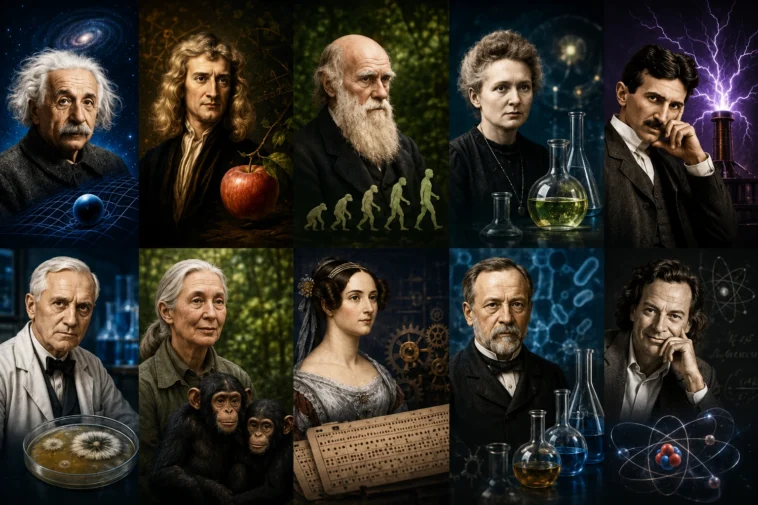
Somewhere right now, your phone is quietly correcting itself using math a patent clerk scribbled out in 1905. A mold that ruined an experiment in 1928 is probably in your medicine cabinet. Science’s biggest wins were rarely dramatic — they were stubborn people refusing to accept “that’s just how it is.” Here are ten of them, and what they actually got right.
Quick Facts Before You Scroll
- Marie Curie is still, over a century later, the only person to ever win Nobel Prizes in two different sciences — Physics in 1903, Chemistry in 1911, per NobelPrize.org.
- Newton wrote down the laws of motion in 1687. Engineers still use his math to design cars, bridges, and rockets — relativity only matters at speeds Newton never had to worry about.
- Einstein didn’t win his Nobel Prize for relativity. He won it in 1921 for the photoelectric effect — a detail most casual fans get wrong.
- Alexander Fleming discovered penicillin because he forgot to clean a petri dish before going on vacation. That’s it. That’s the discovery.
- Ada Lovelace wrote what’s considered the first computer algorithm in 1843 — about a hundred years before an actual computer existed to run it.
- Between 1901 and 2025, the Nobel Prizes have gone out 633 times to 1,026 people, according to the Nobel Foundation’s own count.
- Two Nobel laureates whose work still shapes physics and chemistry classrooms — François Englert and Rudolph Marcus — both died in 2026, a reminder that this “history” is closer than it feels.
How We Picked This List
Let’s be honest about something most “greatest scientist” articles won’t tell you: there’s no scoreboard for this. Nobel Prizes didn’t exist until 1901, so any ranking built purely on medals automatically writes off Newton, Darwin, and Galileo — three names nobody sane would leave off a real list.
So here’s what we actually did. We looked at where a scientist’s name keeps showing up across decades of independent “greatest of all time” rankings — the kind compiled by science historians, not clickbait sites. Then we asked a blunter question: is this discovery still doing work in the world today, unchanged, or did science later move past it? Newton’s laws still design your car’s suspension. That counts. A once-celebrated theory that got quietly disproven doesn’t, no matter how famous its author was.
This isn’t a formula. It’s a judgment call, made the way a science teacher who’s read too many biographies would make it — with the receipts to back it up.
The 10 Scientists Who Changed Everything
1. Albert Einstein — The One Everyone Already Knows, For Good Reason
Here’s the thing about Einstein: the hype is actually earned. His theories of special and general relativity didn’t just tweak physics — they replaced the picture of space and time everyone had been working from since Newton. Gravity, in Einstein’s version, isn’t a force reaching across empty space. It’s mass bending the space around it.
What he actually did: Special and general relativity, plus the photoelectric effect — the work that won him the 1921 Nobel Prize, not relativity itself. Why you should care today: Every GPS satellite has to correct for the fact that time moves slightly differently up there than it does down here. Skip that correction, and your map app would be wrong by miles within a day.
2. Isaac Newton — The Guy Whose Homework Is Still Correct 300 Years Later
Newton wasn’t a warm person by most accounts — he feuded bitterly with rivals and rarely gave credit generously. But Principia Mathematica, published in 1687, is one of the most quietly load-bearing books ever written. Three laws of motion, one law of gravity, and suddenly you can calculate how anything moves.
What he actually did: Laws of motion, universal gravitation, and — alongside Leibniz, in one of history’s pettiest scientific feuds — calculus. Why you should care today: NASA still uses Newtonian mechanics for most spaceflight calculations. Relativity only becomes necessary at speeds Newton’s math can’t keep up with.
3. Charles Darwin — The Idea That Explains Every Living Thing You’ve Ever Seen
Darwin sat on his theory for roughly twenty years before publishing, partly out of fear of the backlash — and he was right to be nervous. On the Origin of Species (1859) proposed that all of life’s staggering variety comes from one unglamorous mechanism: whatever survives long enough to reproduce, wins.
What he actually did: Evolution by natural selection. Why you should care today: Every flu vaccine update, every antibiotic-resistance warning, every conservation strategy is Darwin’s framework running in the background.
4. Marie Curie — The Record Nobody Has Touched in Over 100 Years
Curie didn’t just do groundbreaking science — she did it while being denied lab space, credit, and eventually admission to the French Academy of Sciences because she was a woman. She discovered two new elements, polonium and radium, and pioneered the study of radioactivity, a word she coined.
What she actually did: Discovered radioactivity, polonium, and radium — and remains, to this day, the only person ever to win Nobel Prizes in two separate sciences. Why you should care today: Radiotherapy — a direct descendant of Curie’s research — is still a frontline cancer treatment used on millions of patients a year.
5. Galileo Galilei — The Man Who Got Put on Trial for Being Right
Galileo built himself a better telescope, pointed it at Jupiter, and found four moons orbiting it — proof that not everything in the sky circles Earth. The Catholic Church wasn’t thrilled. He spent his final years under house arrest for insisting the evidence mattered more than tradition.
What he actually did: Telescopic astronomy, early laws of motion, and arguably the whole idea that experiments should settle arguments, not authority. Why you should care today: “Test it and see” is such an obvious approach to knowledge now that it’s easy to forget someone had to fight for it.
6. Nikola Tesla — The Inventor Who Was Right About Almost Everything, Eventually
Tesla’s rivalry with Thomas Edison over which electrical system would power the world — alternating current versus direct current — is one of the great grudge matches in engineering history. Tesla’s AC won, and it’s still the reason your city’s power grid works the way it does.
What he actually did: AC motor and power distribution design, plus early groundwork for radio and wireless transmission. Why you should care today: Flip a light switch anywhere in the world, and there’s a decent chance Tesla’s AC principles are doing the actual work.
7. Louis Pasteur — The Man Who Figured Out Germs Were Real
Before Pasteur, plenty of respected scientists believed maggots and mold appeared out of thin air — “spontaneous generation.” Pasteur proved that idea wrong with a set of swan-necked flasks and relentless experimentation, then went on to invent pasteurization and develop vaccines for rabies and anthrax.
What he actually did: Germ theory of disease, pasteurization, and early vaccine development. Why you should care today: The milk in your fridge, the wine in your cabinet, and the rabies shot your dog gets all trace back to one stubborn Frenchman.
8. Michael Faraday — Proof You Don’t Need a Math Degree to Change Physics
Faraday grew up poor, left school at 13, and never mastered advanced mathematics. None of that stopped him from discovering electromagnetic induction — the principle that lets you generate electricity by moving a magnet near a wire. James Clerk Maxwell later turned Faraday’s hands-on discoveries into the elegant equations physics students memorize today.
What he actually did: Electromagnetic induction — the basis for every electric motor and generator built since. Why you should care today: Your electric car, your kitchen blender, and your city’s power plant all run on a principle Faraday found by trial and error in a cramped lab.
9. Alexander Fleming — The Best Accident in Medical History
Fleming left for a two-week vacation without properly cleaning his lab. He came back to find mold growing in a forgotten petri dish — and the bacteria around it dead. That messy dish became penicillin, the drug that turned once-fatal infections into a course of pills.
What he actually did: Discovered penicillin, kicking off the antibiotic era. Why you should care today: Antibiotics built on Fleming’s discovery still save an estimated millions of lives every year, though rising antibiotic resistance now threatens to undo that progress.
10. Ada Lovelace — The Programmer Who Predated the Computer by a Century
Working from Charles Babbage’s plans for a mechanical calculator called the Analytical Engine, Lovelace wrote a set of instructions in 1843 that’s now recognized as the first published algorithm intended for a machine. She also predicted, decades ahead of anyone else, that machines might one day compose music — not just crunch numbers.
What she actually did: Wrote the first algorithm designed for a general-purpose computing machine, before that machine existed. Why you should care today: Every app on your phone is, in a conceptual sense, a great-grandchild of Lovelace’s 1843 notes.
Fast Facts Table
| Scientist | Field | Signature Discovery | Recognition |
| Albert Einstein | Physics | Theory of relativity | Nobel Prize, Physics, 1921 |
| Isaac Newton | Physics / Math | Laws of motion, gravitation | Knighted, 1705 |
| Charles Darwin | Biology | Evolution by natural selection | Fellow, Royal Society |
| Marie Curie | Physics / Chemistry | Radioactivity, radium, polonium | Nobel Prizes, 1903 and 1911 |
| Galileo Galilei | Astronomy / Physics | Telescopic astronomy, scientific method | Called the “father of modern science” |
| Nikola Tesla | Engineering | AC power systems | Over 300 patents worldwide |
| Louis Pasteur | Microbiology | Germ theory, pasteurization | Founder, Pasteur Institute |
| Michael Faraday | Physics / Chemistry | Electromagnetic induction | Fellow, Royal Society |
| Alexander Fleming | Microbiology | Discovery of penicillin | Nobel Prize, Medicine, 1945 |
| Ada Lovelace | Mathematics | First published computer algorithm | Regarded as the first programmer |
Compiled from NobelPrize.org, Britannica, and independent historical rankings.
What They Actually Invented (Not Just Discovered)
- Einstein — no single gadget, but his physics underpins GPS corrections and made nuclear energy research possible.
- Newton — designed a reflecting telescope layout still used in observatories today.
- Darwin — no invention, but his framework is the reason modern genetics and biotech even work the way they do.
- Curie — built mobile X-ray units, nicknamed “Little Curies,” and personally drove them to WWI battlefields.
- Galileo — refined the telescope and built an early prototype thermometer.
- Tesla — invented the AC induction motor and laid groundwork for early radio.
- Pasteur — invented pasteurization and developed working vaccines for rabies and anthrax.
- Faraday — built the first working electric motor and generator prototypes.
- Fleming — discovered penicillin, which launched the entire modern antibiotic industry.
- Lovelace — wrote the first algorithm ever designed for a computing machine.
Who’s Biggest in Which Field
- Physics: Einstein — no real competition
- Mathematics: Newton, jointly with Leibniz for inventing calculus
- Biology: Darwin, by a wide margin
- Chemistry: Curie or Mendeleev, depending on whether you weigh discovery or organizing principle higher
- Engineering: Tesla
- Microbiology: Pasteur and Fleming, roughly tied — one built the foundation, the other found the weapon
- Early computing: Lovelace, unopposed
- Self-taught science: Faraday, hands down — he barely had formal schooling
Then vs. Now: Does the Discovery Still Hold Up?
| Era | Scientist | What They Changed | Still True Today? |
| 1600s | Isaac Newton | Foundational physics laws | Yes — still runs most engineering math |
| 1700s–1800s | Michael Faraday | Electromagnetism | Yes — every electric motor still uses it |
| 1800s | Charles Darwin | Framework for all biology | Yes — unchanged core principle |
| Late 1800s–early 1900s | Marie Curie | Radioactivity, medical physics | Yes — basis of cancer radiotherapy |
| Early 1900s | Albert Einstein | Relativity, quantum foundations | Yes — GPS, nuclear science |
| 1900s | Alexander Fleming | Antibiotics | Yes, though resistance is a real growing problem |
| 2025 (ongoing) | Clarke, Devoret, Martinis (Nobel Physics) | Macroscopic quantum tunnelling | Yes — active frontier research right now |
The Honest Trade-Offs of Ranking Genius
| What’s good about it | What it gets wrong |
| Makes centuries of science approachable for students | Flattens decades of teamwork into one “hero” name |
| Sparks genuine curiosity and inspires future scientists | Older rankings historically undercount women and non-Western researchers |
| Keeps foundational ideas alive in public memory | Nobel-based lists can’t include anyone before 1901, unfairly |
| Highlights ideas that are still provably useful | Popularity across lists isn’t the same as scientific rigor |
How Scientists Are Judged Today (It’s Not Just Nobel Prizes)
The Nobel committee gets all the headlines, but researchers actually use a handful of other tools to measure real impact:
- Citation counts — how often other scientists cite a paper, tracked through Google Scholar and Web of Science
- H-index — a blended score of how many papers someone published and how often each got cited
- Real-world application — whether the discovery actually turned into usable tech, medicine, or infrastructure
- Durability — whether the original idea still holds, or got quietly replaced by something more accurate
- Nobel Prizes — still the most publicly recognized marker, even though it only covers work done after 1901
What’s Happening in Science Right Now — 2026
The tradition these ten people started hasn’t slowed down. The 2025 Nobel Prize in Physics went to John Clarke, Michel Devoret, and John Martinis for discovering macroscopic quantum tunnelling in electric circuits — the same kind of stubborn, hands-on curiosity that drove Faraday’s lab work two centuries earlier.
The 2025 Nobel Prize in Chemistry went to Susumu Kitagawa, Richard Robson, and Omar Yaghi for developing metal-organic frameworks, while the 2025 Nobel Prize in Physiology or Medicine recognized Mary Brunkow, Fred Ramsdell, and Shimon Sakaguchi for uncovering how the immune system avoids attacking the body’s own organs.
2026 has also been a quieter, sadder reminder of how recent all of this really is. Nobel physicist François Englert passed away in June 2026, and Nobel chemist Rudolph Marcus died in July 2026 at age 102 — proof that “the history of science” is often still within living memory.
Sources
- NobelPrize.org — Marie Curie, official biography and prize record
- NobelPrize.org — All Nobel Prizes, 1901–2025 list
- Britannica — Marie Curie, Isaac Newton, Charles Darwin, Galileo Galilei biographical entries
- Wikipedia — 2025 Nobel Prizes, official category winners
- NobelPrize.org — In Memoriam, 2026 laureate deaths
- Live Science — 2025 Nobel Prize coverage across Physics, Chemistry, and Medicine
- PMC / NIH — Marie Curie: Twice Nobel Laureate and Her Enduring Legacy in Radiation Medicine
- Historical meta-analysis of independent “greatest scientist” rankings compiled by science historians
Final Word
The most influential scientists in history weren’t chasing fame. Most of them were just annoyed that nobody had a good answer to their question yet, so they went and found one. Newton’s laws are still holding up bridges. Fleming’s forgotten petri dish is still saving lives. Ranking them isn’t really about picking a winner — it’s about noticing how much of the world you live in was quietly built by ten stubborn people who refused to stop asking why.
FAQs
Based on decades of independent expert rankings and how well each discovery has held up, the most consistently named scientists are Albert Einstein, Isaac Newton, Charles Darwin, Marie Curie, Galileo Galilei, Nikola Tesla, Louis Pasteur, Michael Faraday, Alexander Fleming, and Ada Lovelace.
Albert Einstein shows up on more “greatest scientist” rankings than anyone else, largely because relativity didn’t just add to physics — it replaced the framework everyone had been using since Newton.
She discovered the elements polonium and radium and pioneered the study of radioactivity, work that later made both nuclear physics and cancer radiotherapy possible.
Einstein didn’t erase Newton — he refined him. Newton’s equations are still accurate enough for nearly all everyday engineering; relativity only becomes necessary at extreme speeds or gravitational strength Newton never had to account for.
Highlights include Einstein’s relativity, Newton’s laws of motion, Darwin’s theory of evolution, Curie’s discovery of radioactivity, Tesla’s AC power system, Pasteur’s pasteurization process, Faraday’s electric motor, Fleming’s penicillin, and Lovelace’s first computer algorithm.
Ada Lovelace, generally. In 1843 she wrote an algorithm intended for Charles Babbage’s proposed Analytical Engine — a full century before any working computer existed to actually run it.

GIPHY App Key not set. Please check settings