 kiruthika
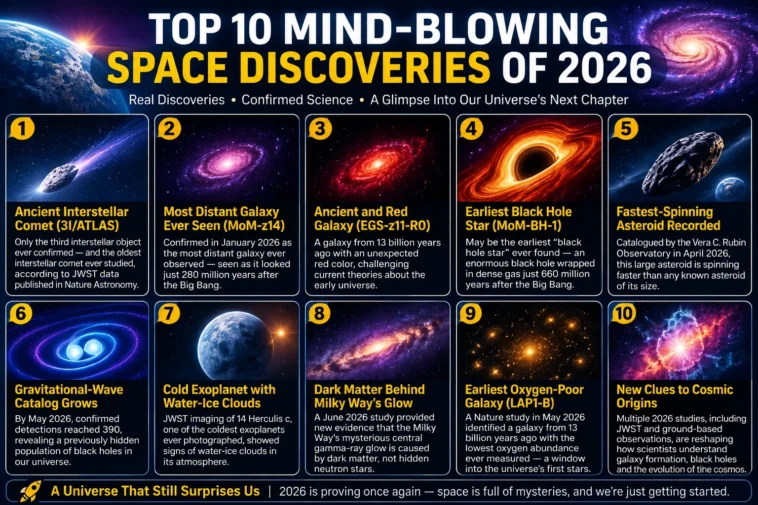
Somewhere past Jupiter right now, a chunk of another star system is quietly leaving ours forever. A telescope not even fully switched on yet has already broken an asteroid record. And in a galaxy so far away its light left before the Earth had oxygen in its own atmosphere, astronomers just found a black hole that shouldn’t exist yet — but does. Here’s what actually happened in 2026, not the exaggerated version.
Key Highlights / Quick Facts
- Comet 3I/ATLAS, only the third interstellar object ever confirmed, turned out to be the oldest interstellar comet ever studied, according to JWST chemistry data published in Nature Astronomy in June 2026.
- MoM-z14 was confirmed in January 2026 as the most distant galaxy ever observed — seen as it looked just 280 million years after the Big Bang.
- The Vera C. Rubin Observatory catalogued over 11,000 new asteroids by April 2026, including the fastest-spinning large asteroid ever recorded — and it hasn’t even started its real 10-year survey yet.
- A May 2026 gravitational-wave catalog pushed total confirmed detections to 390, revealing a previously hidden population of black holes.
- MoM-BH-1*, described in Nature on August 12, 2026, may be the earliest “black hole star” ever found — an enormous black hole wrapped in dense gas just 660 million years after the Big Bang.
- A separate Nature study in May 2026 identified LAP1-B, a galaxy from 13 billion years ago with the lowest oxygen abundance ever measured — a direct window into the universe’s very first generation of stars.
- JWST imaging of 14 Herculis c, one of the coldest exoplanets ever directly photographed, showed signs of actual water-ice clouds in its atmosphere, with fresh analysis continuing into 2026.
- A June 2026 study added new evidence linking the Milky Way’s mysterious central gamma-ray glow to dark matter, rather than hidden neutron stars.
How This List Was Built
Space headlines get exaggerated constantly. Every minor finding gets slapped with “breakthrough,” and half the time nobody checks whether it’s actually new. This list tries not to do that.
Every entry below is a genuine astronomical discovery or observation — something we learned about the universe — that was either directly observed or peer-reviewed during 2026, or formally confirmed and published in 2026 even if the initial spotting happened slightly earlier. We deliberately kept this list to actual discoveries, not missions, launches, or hardware milestones — those get their own short section further down, because a rocket launching and a black hole being found are genuinely different kinds of news.
Where a finding is still preliminary or debated among scientists, we say so plainly instead of dressing it up as settled fact.
The Top 10 Discoveries
1. An Interstellar Comet Turned Out to Be Older Than Our Solar System
Comet 3I/ATLAS was first spotted by the ATLAS survey telescope in Chile on July 1, 2025 — only the third interstellar object ever confirmed passing through our solar system, after ‘Oumuamua in 2017. The real story broke in 2026. Once the comet swung around the Sun and became observable again in December 2025, astronomer Martin Cordiner’s team pointed JWST at it and found a heavy-water and carbon-dioxide signature unlike anything seen in comets that actually formed in our solar system. Published in Nature Astronomy in June 2026, the results suggest 3I/ATLAS came from an ancient, possibly now-vanished region of the galaxy populated by older stars.
Why it’s mind-blowing: we’re not just watching a comet drift by. We’re getting a direct chemical sample from a star system that may not even exist anymore, delivered to our doorstep by pure orbital luck.
2. JWST Confirmed the Most Distant Galaxy Ever Seen
A galaxy nicknamed MoM-z14 broke JWST’s own distance record — again. Confirmed and published in January 2026, its spectroscopic redshift of 14.44 means we’re looking at this galaxy as it appeared just 280 million years after the Big Bang, when the universe was roughly 2% of its current age.
Why it’s mind-blowing: the galaxy is far brighter than early-universe models say it should be. Researchers aren’t shy about admitting this — it’s deepening a real tension between theory and what JWST keeps finding.
3. Astronomers Found a Galaxy That’s Ancient and Weirdly Red
Most early-universe galaxies JWST finds are bright and blue — young, hot stars, barely any dust. EGS-z11-R0, spotted almost by accident when a team led by Giulia Rodighiero was reviewing public JWST data, breaks that pattern. At a redshift of 11.45, it’s the most distant confirmed “red” galaxy on record, which points to either heavy dust content or an unexpectedly old stellar population for how early it appeared.
Why it’s mind-blowing: it’s a small crack in the assumption that the early universe was uniformly young and blue. Galaxy evolution may have moved faster, in more places, than anyone modeled for.
4. A Telescope Still Being Tested Already Found the Fastest-Spinning Asteroid Ever
The Vera C. Rubin Observatory’s first images in mid-2025 weren’t even the real survey — just commissioning data, basically a shakedown run. Even so, astronomers digging through it found 2025 MN45, a 710-meter-wide asteroid spinning once every 1.9 minutes, the fastest rotation ever recorded for something that large. By April 2026, follow-up work on Rubin’s preliminary data had added more than 11,000 newly catalogued asteroids, according to the observatory’s Solar System Lead Scientist, Mario Juric.
Why it’s mind-blowing: this was test data. Rubin isn’t even running its actual 10-year survey yet, and it’s already rewriting the record books.
5. A Massive New Catalog Revealed a Hidden Population of Black Holes
In May 2026, the LIGO-Virgo-KAGRA collaboration released its fifth transient catalog, adding 161 newly confirmed black hole mergers detected between April 2024 and January 2025. Upgraded detectors are now catching three to four gravitational wave signals a week. One event, GW240615, set a new record for the most precisely located gravitational wave source ever detected.
Why it’s mind-blowing: we went from barely detecting a single gravitational wave in 2015 to essentially listening to black holes collide somewhere in the universe multiple times a week.
6. The Milky Way’s Strange Glow Might Finally Have an Explanation
A gamma-ray glow at the center of the Milky Way has puzzled astronomers for over a decade, with two competing explanations: undetected neutron stars, or dark matter particles annihilating each other. A June 2026 analysis added real, meaningful evidence tilting toward the dark matter explanation — though the debate is far from closed.
Why it’s mind-blowing: dark matter makes up roughly a quarter of everything in the universe, and we’ve never directly detected it. Any real evidence, even partial, is a genuinely big deal.
7. JWST Peered Into the Atmosphere of a Planet Hot Enough to Melt Rock
55 Cancri e is a “lava world” so close to its star that its surface is likely partly molten. New JWST data released in July 2026 suggests the planet has a thin atmosphere made partly of vaporized rock — a genuinely alien kind of sky, unlike anything in our own solar system.
Why it’s mind-blowing: it’s direct evidence that some planets don’t just orbit their star. Parts of their surface are actively boiling off into their own atmosphere.
8. JWST Photographed an Exoplanet So Cold It Has Ice Clouds
Most directly imaged exoplanets are scorching hot — hundreds or even thousands of degrees. 14 Herculis c is the opposite: about -3°C, making it one of the coldest planets ever directly photographed, sitting in a chaotic, tilted orbit unlike anything in our own solar system. JWST’s coronagraph imaging found its light signature matches a cloudy atmosphere containing actual water-ice clouds, continuing to draw fresh analysis through 2026.
Why it’s mind-blowing: almost every exoplanet we can currently image is blisteringly hot because heat is easy to spot. Finding a cold one, with weather that might resemble something closer to home, opens up a whole category of worlds we’ve barely been able to see until now.
9. Astronomers May Have Found the Earliest Black Hole Ever Seen
Published in Nature on August 12, 2026, researchers described an object called MoM-BH*-1 — a rapidly growing black hole wrapped in an unusually dense, dust-free envelope of gas, observed just 660 million years after the Big Bang. The team is calling it a “black hole star” because it shows features normally associated with stars, including one of the most extreme light-absorption signatures ever recorded.
Why it’s mind-blowing: it might finally explain one of astronomy’s most stubborn puzzles — how black holes billions of times the mass of our Sun managed to grow so enormous so early, when there simply shouldn’t have been enough time.
10. A Nearly Invisible Galaxy Revealed the Universe’s Earliest Chemistry
Published in Nature in May 2026, an international team led by Kimihiko Nakajima used JWST and a natural gravitational lens to study LAP1-B, an ultra-faint galaxy from 13 billion years ago. Its oxygen abundance came out at roughly 1/240th that of our Sun — the lowest ever measured in a galaxy of its kind, and a rare direct look at a galaxy caught right as the universe’s very first stars were beginning to seed it with heavier elements.
Why it’s mind-blowing: oxygen and carbon don’t exist until stars make them. Finding a galaxy with almost none is like finding a fossil from the exact moment cosmic chemistry as we know it was just getting started.
Discovery Stats Table
| Discovery | Confirmed / Published | Key Number | Source |
| 3I/ATLAS ancient origin | June 2026 | 3rd interstellar object ever found | Nature Astronomy |
| MoM-z14 | January 2026 | Redshift 14.44 | Open Journal of Astrophysics |
| EGS-z11-R0 | March 2026 | Redshift 11.45 | arXiv / Phys.org |
| Rubin asteroid haul | April 2026 | 11,000+ new asteroids | Rubin Observatory / IAU MPC |
| Gravitational wave catalog | May 2026 | 390 total detections | LIGO-Virgo-KAGRA |
| Milky Way gamma-ray glow | June 2026 | Dark matter vs. neutron stars | ScienceDaily |
| 55 Cancri e atmosphere | July 2026 | Rock-vapor atmosphere theory | NASA / JWST |
| 14 Herculis c ice clouds | 2025–2026 follow-up | Coldest directly imaged exoplanets | AAS / ScienceDaily |
| MoM-BH*-1 “black hole star” | August 2026 | 660 million years after Big Bang | Nature |
| LAP1-B primitive galaxy | May 2026 | Oxygen at 1/240th of the Sun | Nature |
Dates reflect confirmation or publication in 2026, even where initial observation happened slightly earlier.
Then vs. Now: How Fast Records Are Falling
| Capability | Before 2026 | As of 2026 |
| Most distant confirmed galaxy | JADES-GS-z14-0, redshift 14.32 (2024) | MoM-z14, redshift 14.44 (confirmed Jan 2026) |
| Earliest known black hole | GN-z11, ~400 million years after Big Bang (2024) | MoM-BH*-1, ~660 million years after Big Bang, “black hole star” type (Aug 2026) |
| Gravitational wave detections (total) | ~262 (early 2025) | 390 (May 2026 catalog) |
| Interstellar objects confirmed | 2 (‘Oumuamua, 2I/Borisov) | 3 (3I/ATLAS added, 2025–2026) |
| Lowest measured galaxy oxygen abundance | Not previously characterized this precisely | LAP1-B, 1/240th solar oxygen (May 2026) |
| Asteroids discovered per year (all observatories) | ~20,000/year average | 11,000+ from Rubin alone, in months of test data |
Why These Discoveries Actually Matter
| Discovery type | What it changes | What’s still uncertain |
| Interstellar objects | Direct chemical samples from other star systems | Only 3 confirmed so far — hard to generalize from |
| Distant galaxy records | Tests our models of how fast galaxies formed | Records get broken almost annually — today’s may not last |
| Gravitational wave astronomy | Lets us “hear” invisible cosmic collisions | Exotic events still challenge current theory |
| Early black hole discoveries | Could resolve how supermassive black holes grew so fast | MoM-BH*-1 is one object — needs more examples to confirm a pattern |
| Dark matter research | Narrows down where and how to look | Still zero direct, confirmed detections as of 2026 |
Major Space Milestones of 2026
A few 2026 space stories aren’t discoveries in the strict sense — they’re missions and hardware — but they set up the discoveries still to come, so they’re worth knowing about separately.
Artemis II launched April 1, 2026, carrying astronauts Reid Wiseman, Victor Glover, and Christina Koch, along with CSA astronaut Jeremy Hansen, on a nearly 10-day free-return trajectory around the Moon. They splashed down safely on April 10, and at their farthest point traveled 252,756 miles from Earth — beating the human spaceflight distance record Apollo 13 had held since 1970. It’s the first crewed mission beyond low Earth orbit in over 50 years, and it directly sets up future lunar landing missions.
NASA’s Nancy Grace Roman Space Telescope finished construction in December 2025 at Goddard Space Flight Center and is targeting a launch as early as fall 2026. Its 300-megapixel Wide Field Instrument can capture a swath of sky roughly 100 times larger than Hubble’s while keeping comparable image sharpness. Over its five-year primary mission, Roman is expected to discover more than 100,000 new exoplanets and observe over 100,000 gravitational lensing events to study dark matter.
ESA’s Ariel mission, built specifically to characterize the atmospheres of hundreds of exoplanets, has a launch window in November 2026.
None of these are discoveries yet. But Roman alone is expected to outproduce most of this entire list within its first year of operation — worth watching closely as 2026 closes out.
References
- NASA Science — Comet 3I/ATLAS
- Sky & Telescope — Interstellar Comet 3I/ATLAS Has Cold, Ancient Origins
- ESA/Webb — Webb finds clues to ancient, distant origin of Comet 3I/ATLAS
- Live Science — JWST breaks its own distance record with MoM-z14
- Phys.org — JWST Reveals Most Distant Red Galaxy at Redshift 11.45
- Rubin Observatory — Record-Breaking Asteroid in Pre-Survey Observations
- Discover Magazine — Rubin Observatory’s 11,000 New Asteroids
- MIT News — New Gravitational-Wave Catalog Doubles Detections
- Simons Foundation — Black Hole Discoveries in LIGO-Virgo Catalog
- Phys.org — Mirage or Miracle? JWST Finds Earliest Known “Black Hole Star” at Cosmic Dawn
- National Astronomical Observatory of Japan — Astronomers Find Most Chemically Primitive Galaxy in Early Universe
- BBC Sky at Night Magazine — Exoplanet 14 Herculis c Captured by JWST
- NASA — Artemis II Mission
- ScienceDaily — Space Exploration News, 2026 coverage
Final Word
What’s striking about this list isn’t any single discovery — it’s how many landed at once. A telescope still in its testing phase is already breaking asteroid records. A comet older than our own sun just flew past Earth and kept going. And somewhere 13 billion years back, astronomers caught a galaxy right as the universe’s chemistry was still figuring itself out. None of this paused for anyone to catch up, and if the rest of 2026 keeps this pace, this list will already be out of date by December.
FAQs
Two events stand out: the confirmation that interstellar Comet 3I/ATLAS is the oldest such object ever observed, and JWST’s confirmation of MoM-z14 as the most distant galaxy ever recorded, seen just 280 million years after the Big Bang.
3I/ATLAS is only the third confirmed interstellar object to pass through our solar system, discovered in July 2025. JWST analysis published in June 2026 found chemical evidence it’s the oldest interstellar comet ever studied.
Since its first images in June 2025, Rubin Observatory has found the fastest-spinning large asteroid ever recorded and catalogued over 11,000 new asteroids as of April 2026 — and that’s before its real 10-year survey has even started.
As of 2026, the most distant confirmed galaxy is MoM-z14, observed at a redshift of 14.44, corresponding to just 280 million years after the Big Bang, confirmed by JWST in January 2026.
A “black hole star” is a term astronomers coined for an unusual object where a rapidly growing black hole is wrapped in a dense, dust-free envelope of gas, giving it star-like light signatures. MoM-BH*-1, described in Nature in August 2026, is currently the earliest known example, dated to about 660 million years after the Big Bang.


GIPHY App Key not set. Please check settings