 kiruthika
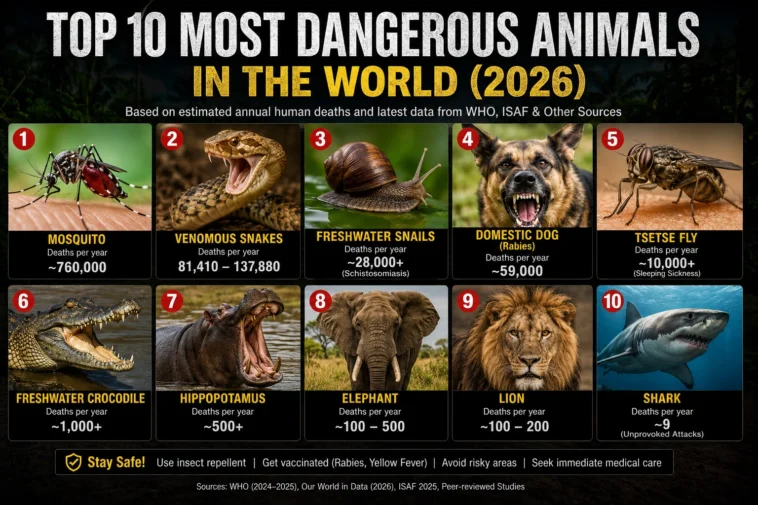
You probably think a shark or a lion tops the list of the most dangerous animals in the world. It doesn’t. The real killer weighs less than a paperclip and lands on your arm without a sound. Here’s the full, source-checked ranking — and it’s not what Hollywood taught you.
Key Highlights / Quick Facts
- Mosquitoes are estimated to cause roughly 760,000 human deaths a year, according to Our World in Data’s 2026 analysis, with malaria responsible for most of them.
- Malaria alone killed 610,000 people in 2024, according to WHO’s December 2025 World Malaria Report — a slight rise from 597,000 in 2023.
- Snakebites kill an estimated 81,410 to 137,880 people every year worldwide, per WHO’s snakebite envenoming fact sheet.
- A nationally representative mortality study cited by WHO India estimates about 45,900 snakebite deaths a year in India, though substantial underreporting is likely.
- Dog-mediated rabies causes around 59,000 deaths a year, with dogs responsible for up to 99% of human rabies transmission, according to WHO.
- The 2025 International Shark Attack File (ISAF) recorded 65 unprovoked bites and 9 fatalities worldwide — near the 10-year average for bites, but fatalities above the recent five-year average of 8.
- Crocodile deaths are widely underreported. Researchers describe the true global toll as likely higher than official figures, since many rural attacks go unrecorded.
- Hippos and elephants are both cited among Africa’s most dangerous large mammals, but newer comparative research cautions against ranking one confidently above the other.
What Makes an Animal “Dangerous”? (Methodology)
Before the list — a fair warning. “Dangerous” doesn’t mean the same thing to every researcher, and comparing a mosquito to a box jellyfish using a single number is misleading.
How this ranking works: it combines estimated annual human deaths, frequency of dangerous encounters, severity of attacks, and geographic exposure. Because these measures aren’t directly comparable — a mosquito kills through disease at massive scale, while a hippo kills through rare but severe direct encounters — this ranking is editorial, not a single scientific formula. We flag which measure drives each placement as we go.
Researchers generally weigh a mix of factors:
- Number of human deaths it causes each year, directly or through disease
- Attack frequency and how often people actually encounter the animal
- Venom or toxicity, if any
- Physical strength, size, and speed
- Aggression or territorial behavior
- How common human-animal encounters actually are in that region
The Top 10 Most Dangerous Animals in the World
1. Mosquito — The World’s Deadliest Creature
Mosquitoes don’t bite you to death. They infect you. Malaria alone killed 610,000 people in 2024, according to WHO’s most recent global malaria report, with 95% of those deaths in the African Region. Add dengue, yellow fever, and Zika, and mosquitoes are estimated to cause roughly 760,000 deaths a year in total, per Our World in Data’s 2026 figures.
Where it lives: Tropical and subtropical regions worldwide, especially sub-Saharan Africa and South Asia. How it attacks: Transmits parasites and viruses through its bite. Danger level: Extreme — the highest of any animal on Earth by death count.
2. Venomous Snakes — Silent Killers of the Tropics
Venomous snakebites kill somewhere between 81,410 and 137,880 people every year, according to the World Health Organization’s snakebite envenoming fact sheet. India has one of the world’s largest snakebite burdens: a nationally representative mortality study cited by WHO estimates about 45,900 deaths a year there, though experts note substantial underreporting is likely.
Where it lives: Nearly every continent except Antarctica; heaviest burden in South Asia, Sub-Saharan Africa, and Southeast Asia. How it attacks: Injects venom that causes paralysis, internal bleeding, or organ failure. Danger level: Very High. Farmers and rural children are most at risk.
3. Freshwater Snails — The Overlooked Disease Vector
This entry needs a caveat most lists skip. The snail doesn’t kill people directly — it’s an intermediate host for the parasitic worms that cause schistosomiasis, a disease that damages internal organs over years of untreated infection. Death estimates linked to schistosomiasis vary widely between sources, so treat any single number here as directional rather than precise.
Where it lives: Freshwater lakes and rivers across sub-Saharan Africa. How it attacks: Hosts parasitic larvae that infect people through contaminated water. Danger level: High in endemic freshwater regions, low elsewhere.
4. Domestic Dog — Man’s Best Friend, Statistically Deadly
This one surprises people every time. Dog-mediated rabies is estimated to cause around 59,000 human deaths a year, according to WHO, with dogs responsible for up to 99% of all human rabies transmission worldwide. Nearly half of victims are children under 15.
Where it lives: Everywhere humans live; the highest burden is in Asia and Africa. How it attacks: Bites transmit the rabies virus, which is almost always fatal once symptoms appear. Danger level: High in regions with low vaccination access.
5. Crocodile — The Ambush Predator
Crocodile mortality is genuinely hard to measure — many attacks in remote, rural regions never make it into formal records. Rather than citing one precise figure, researchers describe crocodiles as responsible for hundreds of documented human deaths a year, with the true global total likely higher due to underreporting.
Where it lives: Rivers, lakes, and estuaries across Africa, South Asia, and northern Australia. How it attacks: Ambushes prey near water, then drags it under in a “death roll.” Danger level: Very High near rural water sources with no barriers.
6. Hippopotamus — Africa’s Most Feared Waterway Resident
Hippos are one of Africa’s most dangerous large mammals, particularly around waterways, and they’re often assumed to out-kill lions and crocodiles combined. Newer comparative research urges more caution here — Our World in Data notes that hippos may actually kill far fewer people overall than elephants or big cats, even though a hippo encounter carries a high chance of a fatal outcome. Treat widely cited figures (commonly around 500 a year) as directional, not precise.
Where it lives: Rivers and lakes across sub-Saharan Africa. How it attacks: Charges boats and people on land with an extremely powerful bite. Danger level: Very High, especially near water at dusk or dawn.
<!– IMAGE: hippopotamus in African river –>
7. African Elephant — Gentle Giant With a Dark Side
Elephants aren’t predators, but size alone makes them lethal. Habitat loss is pushing elephants into farmland more often, and human-wildlife conflict is rising as a result — a trend flagged repeatedly in recent African wildlife reporting. Estimates put elephant-related deaths at several hundred a year.
Where it lives: Savannas and forests of sub-Saharan Africa; Asian elephants across South and Southeast Asia. How it attacks: Tramples or gores when it feels threatened or is defending territory. Danger level: High, mostly tied to land-use conflict rather than predatory behavior.
8. African Lion — The Original “King of Danger”
Lions cause far fewer deaths than most people assume — estimates range from roughly 22 to 250 a year, depending on the source and time period. Still, an adult lion can kill a human in under a minute, and attacks are almost always fatal without rapid intervention.
Where it lives: Grasslands and savannas of sub-Saharan Africa, with a small population in India’s Gir Forest. How it attacks: Ambush hunting, powerful bite to the neck or throat. Danger level: High but geographically limited to lion range countries.
9. Box Jellyfish — Rare but Severe
Severe stings from some box jellyfish species can cause cardiovascular collapse within minutes — a genuinely rare but serious outcome, not a routine one. Its venom is considered among the most potent in the animal kingdom, targeting the heart, nervous system, and skin cells simultaneously.
Where it lives: Warm coastal waters of the Indo-Pacific, especially northern Australia and Southeast Asia. How it attacks: Stings with venom-loaded tentacles that can stretch several meters. Danger level: Extreme on contact, though actual encounters are uncommon.
<!– IMAGE: box jellyfish in ocean water –>
10. Great White Shark — Feared More Than the Data Supports
Sharks have a killer reputation but a tiny body count. The 2025 International Shark Attack File, released by the Florida Museum of Natural History in February 2026, recorded 65 unprovoked shark bites and 9 fatalities worldwide — near the 10-year average of 72 incidents, with fatalities slightly above the recent five-year average of 8.
Where it lives: Coastal and open waters worldwide, notably off the US, Australia, and South Africa. How it attacks: Powerful exploratory or predatory bites, often on surfers and swimmers. Danger level: Moderate in reality, extreme in public perception.
Important Statistics Table
| Animal | Estimated Human Deaths Per Year | Primary Cause | Main Region |
| Mosquito | ~760,000 | Malaria, dengue, Zika | Africa, South Asia |
| Snakes | 81,410–137,880 | Venom (envenoming) | South Asia, Africa |
| Freshwater snails* | Tens of thousands (wide range) | Schistosomiasis host | Sub-Saharan Africa |
| Dogs | ~59,000 | Rabies | Asia, Africa |
| Crocodiles | Hundreds (underreported) | Bite / drowning | Africa, South Asia |
| Hippopotamus | Widely disputed, ~500 commonly cited | Charge / bite | Sub-Saharan Africa |
| Elephants | Several hundred | Trampling / goring | Africa, South Asia |
| Lions | 22–250 | Predatory attack | Sub-Saharan Africa |
| Sharks | 6–9 | Bite | Worldwide coasts |
*Freshwater snails don’t kill directly — they host the parasite responsible for schistosomiasis. Included for completeness, not direct comparison. Data compiled from WHO (2024–2025), Our World in Data, and the International Shark Attack File (February 2026 release).
Most Dangerous Animals by Category
- Deadliest overall (by death count): Mosquito
- Most dangerous large land mammal: Hippopotamus or elephant, depending on the metric used
- Most dangerous marine animal: Box jellyfish
- Most dangerous insect: Mosquito
- Most dangerous reptile: Nile and saltwater crocodile
- Most dangerous snake species: No single answer — inland taipan for venom potency, Russell’s viper and cobras for real-world mortality
- Most dangerous domesticated animal: Dog, via rabies transmission
- Most feared but statistically overrated: Great white shark
Most Dangerous vs. Most Deadly Animals
These two terms get mixed up constantly, but they mean different things.
- Most dangerous usually refers to raw physical threat in a single encounter — venom potency, bite force, speed, and aggression. Think box jellyfish, black mamba, or a charging hippo.
- Most deadly refers to actual human death tolls at population scale, which favors small disease-carrying creatures like mosquitoes and snails over big predators.
A great white shark is arguably more dangerous in a direct encounter than a mosquito. But a mosquito is thousands of times more deadly, simply because of how many people it reaches. Our World in Data draws this same distinction: mosquitoes and snakes dominate death totals, while animals like hippos and sharks are dangerous in a different, encounter-based way. Both framings matter — they just answer different questions.
A Note on Humans
If humans are included in comparisons of animal-caused mortality, homicide places our own species among the largest sources of human death worldwide — well above snakes and dogs, and second only to mosquito-borne disease. Humans are excluded from the numbered ranking above since this is a wildlife-focused list, but the comparison is worth knowing.
Pros and Cons of Studying Wildlife Danger
| Aspect | Benefit | Risk / Trade-off |
| Public health | Helps target malaria and rabies prevention funding | Underfunding leads to rising deaths, as seen in 2024–2025 WHO data |
| Ecotourism | Drives conservation revenue in Africa and Australia | Increases human-wildlife contact and attack risk |
| Conservation | Awareness protects species like sharks and crocodiles | Fear-driven culling still harms populations in some regions |
| Local communities | Education reduces snakebite and hippo-related deaths | Rural areas often lack antivenom and fast medical care |
Comparison Table: Danger Level by Region
| Region | Top Threat | Scale | Notes |
| Sub-Saharan Africa | Mosquito (malaria) | 579,000 deaths in 2024 | 95% of global malaria deaths, per WHO |
| South Asia | Snakes | ~45,900 (India, WHO-cited study) | Among the highest snakebite mortality worldwide |
| Southeast Asia / Australia | Box jellyfish, sharks | Low frequency, high severity | Fast-acting venom, rare encounters |
| North America / Europe | Dogs (non-rabies bites) | Rarely fatal | Rabies largely controlled through vaccination |
| Africa (rivers/lakes) | Hippos, crocodiles | Hundreds combined, contested totals | Rural water access increases exposure |
How to Stay Safe Around Dangerous Animals
- Use mosquito nets and repellent in malaria zones, especially at dawn and dusk when mosquitoes feed most.
- Avoid wading near riverbanks in hippo or crocodile territory, even if the water looks calm.
- Wear closed shoes and watch your step in tall grass or rocky areas where snakes hide.
- Vaccinate pets against rabies and avoid touching stray dogs in high-risk countries; seek prompt treatment after any bite.
- Keep a safe distance from wild elephants and buffalo, especially if they show stress signals like flapping ears or pawing the ground.
- Check local shark advisories before swimming in known hotspots like parts of Australia or Florida.
- Know the nearest hospital with antivenom when traveling in snakebite-heavy regions.
2026 Trends and News
WHO’s December 2025 malaria report confirmed 610,000 malaria deaths in 2024, a troubling rise from 597,000 in 2023. WHO attributes the continuing malaria burden to a combination of biological, financial, and systemic challenges — including drug and insecticide resistance, climate-related changes, conflict, and funding gaps, rather than any single cause.
Shark attack data for 2025, released by the International Shark Attack File in February 2026, recorded nine unprovoked fatalities worldwide, compared with a recent five-year average of eight. Australia alone accounted for more than half of global shark-related fatalities that year.
Meanwhile, hippo mortality events tied to anthrax outbreaks have been reported in the Republic of the Congo as recently as April 2025, according to wildlife conservation researchers, raising fresh concern about disease spillover risk to nearby human communities.
References
- World Health Organization — Malaria Fact Sheet, 2025, who.int
- World Health Organization — Snakebite Envenoming Fact Sheet, who.int
- World Health Organization — Snakebite Envenoming, India, who.int
- World Health Organization — Rabies Fact Sheet, who.int
- World Health Organization — Malaria progress under threat, December 2025, who.int
- Our World in Data — What Are the World’s Deadliest Animals?, ourworldindata.org
- International Shark Attack File, Florida Museum of Natural History — Yearly Worldwide Shark Attack Summary, floridamuseum.ufl.edu
- BBC Science Focus / Discover Wildlife — Deadliest Animals to Humans
- Statista — Deadliest Animals to Humans, 2024–2025
- Nature Communications — Global Mortality of Snakebite Envenoming, 1990–2019
- PLOS Neglected Tropical Diseases — Snakebite Envenoming Systematic Review
- Reuters — Malaria Deaths Rise Globally in 2024: WHO Report
Conclusion
The truth about the most dangerous animals in the world isn’t what movies show. It’s not the shark circling your boat or the lion roaring in the dark — it’s a mosquito you barely notice landing on your arm, or a dog bite that goes untreated. Real data from WHO, ISAF, and Our World in Data shows that disease-carrying creatures and everyday encounters cause far more harm than the predators we fear most. Knowing these numbers isn’t about living in fear — it’s about knowing exactly where to take real precautions.
FAQs
By human death toll, the mosquito is the most dangerous animal, causing roughly 760,000 deaths a year through malaria and other mosquito-borne diseases, according to WHO and Our World in Data.
Mosquitoes kill the most humans of any animal each year, followed by venomous snakes, and then disease vectors such as freshwater snails and dogs.
Hippos and crocodiles are both considered among Africa’s most dangerous large animals, particularly around waterways, though exact rankings vary by source and region.
The box jellyfish is often cited as the ocean’s most dangerous animal, because severe stings from some species can cause cardiovascular collapse within minutes, even though sharks receive far more media attention.
There is no single answer. The inland taipan is known for exceptionally potent venom, while species such as Russell’s viper, kraits, and cobras cause substantial human mortality because of their wide distribution and frequent encounters with people.
Not statistically. The 2025 International Shark Attack File recorded nine unprovoked shark fatalities worldwide, far below deaths linked to mosquitoes, snakes, or dogs.
The inland taipan is generally recognized as having the most toxic venom of any land snake, while the box jellyfish is considered among the most venomous animals overall based on how fast its venom affects the human body.



GIPHY App Key not set. Please check settings