 kiruthika
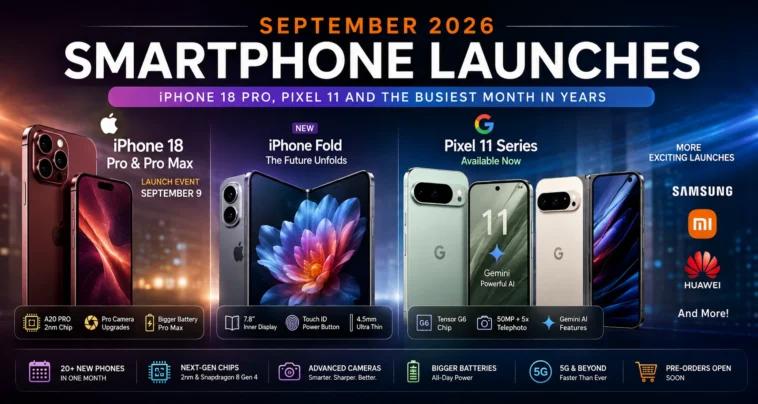
If you blinked over the last few weeks, you missed a lot. September 2026 has turned into the most crowded smartphone launch window in recent memory — more than twenty new phones from nearly every major brand, packed into a single four-week stretch. Part of that is Apple shaking up a launch rhythm it’s kept for over a decade. Part of it is Huawei jumping ahead of its own usual November slot. And part of it is just timing: a new Qualcomm flagship chip and Xiaomi’s first in-house silicon both landed at the same moment, and every brand wants to be first with it. Here’s a proper, phone-by-phone breakdown of what’s actually happening, what’s confirmed, and what’s still leak territory.
Apple
iPhone 18 Pro and Pro Max — September 9
Apple has confirmed its “Surprise and shine” keynote for Wednesday, September 9, at Apple Park, starting at 10am Pacific. It’s the headline event of the month, and also the first keynote under new CEO John Ternus, which adds a bit of extra scrutiny to everything on stage.
The real twist this year is what’s not in the room. For the first time, Apple is reportedly splitting the iPhone 18 lineup across two separate launches. The iPhone 18 Pro and Pro Max land now, in September, while the standard iPhone 18 and a budget iPhone 18e are pushed all the way to spring 2027. That’s a genuine break from Apple’s usual “four phones, one day” pattern, and it means anyone hoping for a new non-Pro iPhone this month is going to be waiting a while longer.
What the Pro models are expected to bring:
- Chip: Apple’s first 2-nanometer silicon, the A20 Pro, paired with 12GB of RAM — a meaningful jump aimed partly at powering more on-device AI features.
- Design: a roughly 35% smaller Dynamic Island, a slightly thicker and heavier body (~9mm, ~240g) to house a larger camera plateau, a possible unified back-glass design, and a new deep red “dark cherry” color option.
- Camera and connectivity: a variable-aperture main camera and Apple’s own C2 modem on both models, with the Pro Max tipped for a notably larger battery.
- Sizes: 6.3 inches for the Pro, 6.9 inches for the Pro Max — unchanged from the outgoing lineup.
Apple hasn’t confirmed pricing, specs, or even which products it’s announcing — everything above is leak and supply-chain reporting until the keynote. Retail availability is expected around September 18, following Apple’s usual pattern of pre-orders opening a few days after the event.
Apple’s first foldable iPhone
Sharing the stage with the Pro models — and arguably the bigger story — is Apple’s first foldable, unofficially nicknamed the iPhone Fold or iPhone Ultra. Current reports point to a book-style design with a roughly 5.5-inch cover screen and a 7.8-inch inner display when unfolded, built from a mix of titanium and aluminum, and thin enough to land around 4.5mm when open. Two notable trade-offs: Apple is reportedly dropping Face ID in favor of a Touch ID sensor built into the power button, since the Face ID hardware doesn’t fit behind the cover display, and the dual rear camera setup is expected to skip a telephoto lens entirely. None of that is expected to come cheap — estimates put the starting price above $2,000, which would make it Apple’s most expensive phone ever.
Pixel 11 series — already here
Google actually got ahead of Apple this year. The Pixel 11, Pixel 11 Pro, Pixel 11 Pro XL, and Pixel 11 Pro Fold were all announced together at the Made by Google event on August 12 in New York, with wide availability following on August 20 — the first time Google has shipped its foldable alongside the rest of the family instead of making buyers wait weeks longer, as it has in past years.
The lineup runs on Google’s new Tensor G6 chip, and leans harder into Gemini-powered features than any Pixel before it:
- Camera: the Pro models keep a triple setup — 50MP main, 48MP ultrawide with macro, and a 48MP periscope telephoto with 5x optical zoom, stretching to 120x digital zoom. New software includes an improved Cinematic Blur mode, video relighting, 4K/30fps recording, and an Ultra Low Light video mode.
- Software: Rambler, a new voice-to-text engine that smooths out natural speech, and Magic Capture, alongside Proactive Assistance — an evolution of last year’s Magic Cue.
- Display: Pro models are rumored to hit up to 3,600 nits of peak brightness, with a shinier glass camera bar and a new HiLight LED notification light on the back.
- Pricing: the base Pixel 11 starts at $899, up from $799 for the Pixel 10 — a real jump. Leaked first-party listings put the Pixel 11 Pro’s 256GB model at $1,099.
Google also used the event to launch the Pixel Watch 5 (Snapdragon W5 Gen 2 chip, 41mm and 45mm sizes, from $399) and a new item tracker called the Pixel Tag, Google’s answer to Apple’s AirTag.
Pixel 11 isn’t a September launch by the calendar, but it’s very much part of this cycle — it’s the phone every other September launch is being compared against, and the one most people are actually weighing prices against right now.
China’s September Marathon
While Apple and Google get most of the Western headlines, September is arguably an even bigger month in China, where five major brands are launching flagship hardware inside the same few weeks.
Huawei Mate XT2 — September 7
Huawei has confirmed a launch event in China for September 7, two days before Apple even takes the stage, unveiling the Mate XT2 tri-fold alongside HarmonyOS 7. It’s a genuine redesign from the original Mate XT: Huawei is reportedly switching from a Z-shaped fold to an inward-folding, U-shaped mechanism that protects the main display when closed, applied across three panels instead of two. Leaks point to a Kirin 9050 Pro chip, a 6,000mAh-or-larger silicon-anode battery, up to 16GB of RAM, and — new for this generation — a stylus included in the box, positioning it as a genuine laptop and tablet replacement rather than just a large phone. Huawei already outsold Samsung in global foldable shipments in Q2 2026, and the Mate XT2 is the device it’s betting on to extend that lead. Because of US sanctions, it ships without Google services, which keeps it largely confined to China and HarmonyOS-friendly markets.
Xiaomi 18 Fold and Xiaomi 18 series — early and late September
Xiaomi is treating the whole month as a launch marathon. The Xiaomi 18 Fold arrives early in September, built around the company’s first in-house Xring O3 processor and next-generation LPDDR6 memory, with a 7.6-inch inner display, a 6,000mAh battery, 67W wired and 50W wireless charging, and a 200-megapixel main camera. It launches alongside the similarly Xring O3-powered Xiaomi Pad 9 Pro Max. Later in the month, Xiaomi shifts to the standard Xiaomi 18 series, expected to be among the first phones anywhere running Qualcomm’s new Snapdragon 8 Elite Gen 6 platform — a chip that’s also pushing several other Android brands to rush their own launches into the same window.
Vivo X500, Oppo Find X10, Honor Magic9, iQOO 16
Vivo has confirmed the X500 series — the standard X500, X500 Pro, and X500 Pro Max — for a late-September China launch, with an Indian release following around late November. Oppo’s Find X10 series, Honor’s Magic9 series, and iQOO’s 16 series are all expected in the same general window, mostly debuting first in China before a slower international rollout over the following months.
The Affordable End
Not everything launching this month is a $1,000-plus flagship. Poco’s F9 Pro and F9 Ultra went global on September 1, continuing the brand’s tradition of putting out its most loaded phone of the year under the F series name. Confirmed budget and mid-range launches also include the Vivo T5 5G, Poco X8 Power 5G, and Infinix Hot 70 Pro 5G+, all competing less on chipset bragging rights and more on battery capacity, charging speed, and high-refresh displays — the areas where affordable phones have been closing the gap on flagships fastest.
September 2026 Launch Dates at a Glance
| Phone | Brand | Date |
|---|---|---|
| Pixel 11 series | Aug 12 (on sale Aug 20) | |
| Poco F9 Pro / Ultra | Poco | Sep 1 |
| Mate XT2 (tri-fold) | Huawei | Sep 7 |
| iPhone 18 Pro / Pro Max, foldable iPhone | Apple | Sep 9 (event) |
| iPhone 18 Pro retail availability | Apple | ~Sep 18 (expected) |
| Xiaomi 18 Fold | Xiaomi | Early Sep (China) |
| Xiaomi 18 / 18 Pro series | Xiaomi | Late Sep (China) |
| Vivo X500 series | Vivo | Late Sep (China) |
| Oppo Find X10, Honor Magic9, iQOO 16 | Oppo / Honor / iQOO | Sep (China, expected) |
Dates for phones not yet officially confirmed are based on current reporting and leaks, and may shift as brands finalize their events.
Should You Actually Buy One of These Right Now?
The honest answer depends on which ecosystem you’re already in. If you’re an iPhone user due for an upgrade and don’t need a foldable, the iPhone 18 Pro is the safer bet this cycle — skipping the standard iPhone 18 this round likely means Apple’s engineering attention, and its best chip and camera work, goes entirely to the Pro models. If you’ve been eyeing a foldable and don’t mind Android, the Pixel 11 Pro Fold is already out, already reviewed, and beats waiting on an unreleased Apple device that’s rumored to cost more while offering fewer cameras. And if you’re not tied to either ecosystem, it’s worth waiting two more weeks: by late September, Xiaomi, Vivo, and Huawei will all have shown their hands too, and China’s flagship pricing has a habit of making everyone else’s look expensive by comparison.
FAQ
Why isn’t the regular iPhone 18 launching in September? Apple is reportedly splitting the lineup for the first time: the Pro and Pro Max models plus the new foldable arrive in September, while the standard iPhone 18 and a cheaper iPhone 18e move to spring 2027. Apple hasn’t confirmed this officially, but it’s been consistent across multiple supply-chain reports for months.
Is the Pixel 11 a September phone or not? Technically no — it was announced August 12 and went on sale August 20. It’s included here because it’s the phone every other September launch is being compared against, and because Google’s shift to an August date is itself part of the story of how the 2026 launch calendar got so crowded.
Will Apple’s foldable iPhone launch worldwide in September? Reports suggest it debuts alongside the iPhone 18 Pro at the September 9 event, but expect limited initial stock given the complexity of a first-generation folding design — similar to how many first-year foldables from other brands have launched.
Which of the China-first phones will actually reach global markets? Xiaomi’s flagship series typically gets a global release within a few months; the Vivo X500 series already has a confirmed India date for late November. Huawei’s Mate XT2, however, ships without Google services due to US sanctions, which keeps it largely limited to China and other HarmonyOS-friendly markets.



GIPHY App Key not set. Please check settings