 kiruthika
Hook Introduction
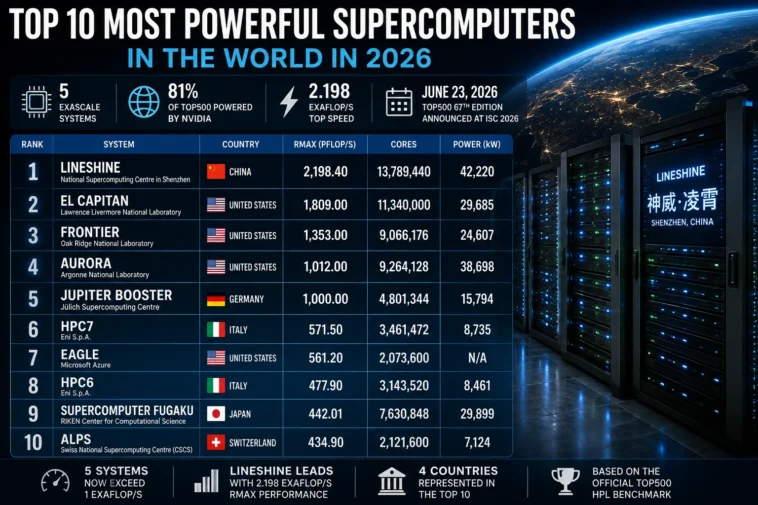
For the first time in seven years, the fastest supercomputer in the world isn’t American. China’s LineShine just seized the No. 1 spot in the June 2026 TOP500 ranking, making it the world’s fastest supercomputer by sustained HPL performance and ending a run that had been dominated by U.S. Department of Energy machines. Here’s the full, official ranking of the top 10 most powerful supercomputers in the world right now, straight from high-performance computing’s most trusted benchmark, the June 2026 TOP500 list.
Key Highlights (Quick Facts)
- China’s LineShine debuted at No. 1 on the 67th edition of the TOP500 list, ending El Capitan’s run and becoming the first China-based system to lead the ranking since Sunway TaihuLight in 2017.
- LineShine achieved 2.198 Exaflop/s on the High Performance Linpack (HPL) benchmark, more than 20% ahead of the No. 2 system, using 13,789,440 cores.
- The TOP500 list, now in its 67th edition, was announced at the ISC 2026 conference in Hamburg, Germany, on June 23, 2026.
- Five systems now deliver more than one exaflop on the HPL benchmark, making this the first list in TOP500 history with five verified exascale systems.
- HPE-built systems claim 6 of the top 10 spots on the June 2026 list, including three of the five verified exascale systems: El Capitan, Frontier, and Aurora.
- NVIDIA technology powers 81% of the entire TOP500, running on more than 400 of the world’s 500 fastest supercomputers, and 90% of the systems newly added to this list.
- LineShine also took over the No. 1 spot on the HPCG ranking with 22.00 Petaflop/s, a separate benchmark that measures real-world application performance rather than pure peak speed.
- Despite the new No. 1, the United States still holds 4 of the top 10 spots (El Capitan, Frontier, Aurora, and Eagle), maintaining deep exascale-class strength even after losing the top position.
How Supercomputers Are Actually Ranked
Before diving into the list, it’s worth understanding exactly what makes the TOP500 ranking the global standard for measuring supercomputing performance and determining the top 10 supercomputers in the world each year.
The HPL Benchmark Is the Deciding Metric
The TOP500 ranks systems using the High Performance Linpack (HPL) benchmark, which measures a system’s maximum sustained floating-point performance, expressed in Exaflop/s or Petaflop/s.
Rmax vs. Rpeak
In any Rmax supercomputer ranking, Rmax reflects the actual, achieved performance during the benchmark run, while Rpeak reflects the theoretical maximum performance the hardware could reach, meaning Rmax is always the more meaningful real-world figure.
Exascale Is the Current Frontier
A system crosses into exascale supercomputers territory once it sustains more than one exaflop, or one quintillion floating-point operations per second, on the HPL benchmark, a threshold only five systems worldwide have crossed as of this list.
The List Updates Twice a Year
TOP500 rankings are published twice annually, once in June at the ISC conference in Germany and once in November at the SC conference in the United States, so rankings shift meaningfully every six months.
Top 10 Most Powerful Supercomputers in the World in 2026
This 2026 supercomputer ranking is based on official TOP500 HPL Rmax performance, making it a reliable comparison of the fastest supercomputers in the world. Here’s the full, official TOP500 supercomputers ranking for June 2026.
1. LineShine
Location: National Supercomputing Centre in Shenzhen (NSCS), China | Built by: Shenzhen Cloud Computing Center
Performance: 2,198.40 PFlop/s Rmax | 2,735.82 PFlop/s Rpeak | 13,789,440 cores | 42,220 kW power
Why it’s No. 1: LineShine is a previously unlisted system that debuted directly at the top of the list, ending a seven-year U.S. dominance streak and marking China’s first No. 1 finish since Sunway TaihuLight in 2017. It runs on the custom “LingKun” platform with 304-core LX2 processors at 1.55 GHz, the proprietary LingQi interconnect, and Kylin OS, and it also claims the No. 1 spot on the separate HPCG ranking.
2. El Capitan
Location: Lawrence Livermore National Laboratory, California, USA | Built by: HPE
Performance: 1,809.00 PFlop/s Rmax | 2,821.10 PFlop/s Rpeak | 11,340,000 cores | 29,685 kW power
Why it’s ranked here: El Capitan held the world’s No. 1 spot before LineShine’s debut and remains the most powerful system in the United States. It runs on the HPE Cray EX255a architecture with AMD 4th Gen EPYC processors and AMD Instinct MI300A accelerators, achieving an energy efficiency of 60.94 Gigaflops/watt.
Image: El Capitan’s server racks fill a massive hall at Lawrence Livermore National Laboratory — the system remains the fastest supercomputer in the United States even after losing the global No. 1 spot.
3. Frontier
Location: Oak Ridge National Laboratory, Tennessee, USA | Built by: HPE
Performance: 1,353.00 PFlop/s Rmax | 2,055.72 PFlop/s Rpeak | 9,066,176 cores | 24,607 kW power
Why it’s ranked here: Frontier holds steady at No. 3, running on the HPE Cray EX235a architecture with AMD 3rd generation EPYC 64-core processors and the Slingshot-11 interconnect. It remains one of the most established exascale systems, having first crossed the exascale threshold years before this list.
4. Aurora
Location: Argonne National Laboratory, Illinois, USA | Built by: Intel
Performance: 1,012.00 PFlop/s Rmax | 1,980.01 PFlop/s Rpeak | 9,264,128 cores | 38,698 kW power
Why it’s ranked here: Aurora is built on the HPE Cray EX platform using Intel Exascale Compute Blades, combining Intel Xeon CPU Max Series processors with Intel Data Center GPU Max Series accelerators, connected through the Slingshot-11 interconnect.
5. JUPITER Booster
Location: EuroHPC / Jülich Supercomputing Centre, Germany | Built by: Eviden (Bull)
Performance: 1,000.00 PFlop/s Rmax | 1,226.28 PFlop/s Rpeak | 4,801,344 cores | 15,794 kW power
Why it’s ranked here: JUPITER remains Europe’s first and only exascale system, built on Eviden’s BullSequana XH3000 direct liquid-cooled architecture using NVIDIA Grace Hopper Superchips. It’s operated by the Jülich Supercomputing Centre at the Forschungszentrum Jülich campus in Germany.
Image: Rows of liquid-cooled server racks represent the kind of dense, high-efficiency architecture found in modern exascale systems like JUPITER and LineShine.
6. HPC7
Location: Eni S.p.A., Italy | Built by: HPE
Performance: 571.50 PFlop/s Rmax | 861.13 PFlop/s Rpeak | 3,461,472 cores | 8,735 kW power
Why it’s ranked here: HPC7 represents Italy’s growing HPC fleet, built on the HPE Cray EX255a architecture with the same AMD 4th Gen EPYC and AMD Instinct MI300A combination found in El Capitan, but at a smaller overall scale.
7. Eagle
Location: Microsoft Azure, United States | Built by: Microsoft Azure
Performance: 561.20 PFlop/s Rmax | 846.84 PFlop/s Rpeak | 2,073,600 cores
Why it’s ranked here: Eagle is one of the only cloud-provider-owned systems in the global top 10, built on Microsoft’s NDv5 platform using Xeon Platinum processors and NVIDIA H100 GPUs, showing that hyperscale cloud infrastructure can now compete directly with dedicated national research supercomputers.
8. HPC6
Location: Eni S.p.A., Italy | Built by: HPE
Performance: 477.90 PFlop/s Rmax | 606.97 PFlop/s Rpeak | 3,143,520 cores | 8,461 kW power
Why it’s ranked here: HPC6 is Eni’s second system in the global top 10, running on the HPE Cray EX235a architecture with AMD 3rd generation EPYC processors and AMD Instinct MI250X accelerators, giving Italy two systems in this year’s top 10.
9. Supercomputer Fugaku
Location: RIKEN Center for Computational Science, Japan | Built by: Fujitsu
Performance: 442.01 PFlop/s Rmax | 537.21 PFlop/s Rpeak | 7,630,848 cores | 29,899 kW power
Why it’s ranked here: Fugaku remains Japan’s flagship supercomputer, built entirely on Fujitsu’s custom A64FX processors and the Tofu interconnect D, without relying on GPU accelerators, a genuinely different architectural approach from most of the rest of the top 10.
Image: RIKEN’s Fugaku supercomputer occupies a purpose-built facility in Japan — it remains one of the only top-10 systems built entirely without GPU accelerators.
10. Alps
Location: Swiss National Supercomputing Centre (CSCS), Switzerland | Built by: HPE
Performance: 434.90 PFlop/s Rmax | 574.84 PFlop/s Rpeak | 2,121,600 cores | 7,124 kW power
Why it’s ranked here: Alps rounds out the global top 10, built on the HPE Cray EX254n architecture using NVIDIA Grace CPUs paired with NVIDIA GH200 Superchips, giving Switzerland a genuinely competitive presence in global high-performance computing.
Important Statistics Table
| Rank | System | Country | Rmax (PFlop/s) | Cores | Power (kW) |
| 1 | LineShine | China | 2,198.40 | 13,789,440 | 42,220 |
| 2 | El Capitan | United States | 1,809.00 | 11,340,000 | 29,685 |
| 3 | Frontier | United States | 1,353.00 | 9,066,176 | 24,607 |
| 4 | Aurora | United States | 1,012.00 | 9,264,128 | 38,698 |
| 5 | JUPITER Booster | Germany | 1,000.00 | 4,801,344 | 15,794 |
| 6 | HPC7 | Italy | 571.50 | 3,461,472 | 8,735 |
| 7 | Eagle | United States | 561.20 | 2,073,600 | N/A |
| 8 | HPC6 | Italy | 477.90 | 3,143,520 | 8,461 |
| 9 | Supercomputer Fugaku | Japan | 442.01 | 7,630,848 | 29,899 |
| 10 | Alps | Switzerland | 434.90 | 2,121,600 | 7,124 |
How the TOP500 List Gets Compiled (Step-by-Step)
- Research labs and companies submit benchmark results to the TOP500 project ahead of each biannual deadline, running the standardized HPL benchmark on their systems.
- Independent verification checks the submitted Rmax scores, ensuring the achieved performance figures are legitimate and comparable across wildly different hardware architectures.
- Systems get ranked purely by Rmax, the actual sustained performance figure, not by Rpeak, which only reflects theoretical maximum capability.
- The list gets finalized and announced twice a year, at the ISC conference in Germany each June and the SC conference in the United States each November.
- Supplementary rankings get published alongside the main list, including the Green500 for energy efficiency and HPCG for real-world application performance.
- New systems can debut directly into the top ranks, as LineShine did this edition, if they’re benchmarked and submitted in time for a given list’s deadline.
- Systems can also be retired or fall off the list entirely, as older hardware gets decommissioned or newer systems push it out of the ranked top 500.
Pros and Cons Table
| System | Pros | Cons |
| LineShine | Highest raw performance, huge core count | High power draw at 42,220 kW |
| El Capitan | Strong energy efficiency, mature exascale system | No longer holds the global No. 1 spot |
| Frontier | Long-proven exascale reliability | Older architecture relative to newest entrants |
| Aurora | Strong GPU-accelerated performance | High power consumption relative to output |
| JUPITER Booster | Europe’s only exascale system, efficient liquid cooling | Lower core count than top 4 systems |
| HPC7 | Efficient AMD-based architecture | Mid-tier performance compared to exascale leaders |
| Eagle | Cloud-based flexibility via Microsoft Azure | Lower Rmax than dedicated national lab systems |
| HPC6 | Second Italian system in the top 10 | Lower performance than sibling system HPC7 |
| Supercomputer Fugaku | No GPU dependency, proven CPU-only design | High power draw for its performance tier |
| Alps | Efficient NVIDIA Grace-based architecture | Lowest Rmax among the top 10 |
Comparison Table: Top 10 Supercomputers at a Glance
| System | Manufacturer | Primary Use | Accelerator Type |
| LineShine | Shenzhen Cloud Computing Center | National research | CPU-only (LX2) |
| El Capitan | HPE | National security simulation | AMD Instinct MI300A |
| Frontier | HPE | Open science research | AMD Instinct MI250X |
| Aurora | Intel | Scientific research | Intel Data Center GPU Max |
| JUPITER Booster | Eviden (Bull) | European research | NVIDIA GH200 Superchip |
| HPC7 | HPE | Energy industry (Eni) | AMD Instinct MI300A |
| Eagle | Microsoft Azure | Cloud AI/HPC workloads | NVIDIA H100 |
| HPC6 | HPE | Energy industry (Eni) | AMD Instinct MI250X |
| Supercomputer Fugaku | Fujitsu | General scientific research | None (CPU-only, A64FX) |
| Alps | HPE | Swiss national research | NVIDIA GH200 Superchip |
Image: Blinking status lights across dense server racks in a modern data center reflect the scale of infrastructure powering today’s top-ranked exascale systems.
Current 2026 News and Trends in Supercomputing
A few clear developments stand out around this year’s TOP500 release.
China Breaks a Seven-Year Drought at the Top
LineShine’s debut at No. 1 ends a run that began when the U.S. retook the lead from China’s Sunway TaihuLight in 2017, and reporting suggests the achievement demonstrates that domestic Chinese innovation can compete at the highest level independent of foreign hardware restrictions.
The Exascale Era Has Genuinely Arrived
With five systems now sustaining more than one exaflop, this list marks the first time in TOP500 history that exascale computing has moved from a rare milestone to an established performance tier with multiple competing systems.
NVIDIA’s Dominance Keeps Deepening
NVIDIA technology now powers 81% of the entire TOP500 list and 90% of newly added systems, cementing its grip on both traditional and AI supercomputers alike, with NVIDIA-accelerated systems across the world’s fastest HPC systems delivering more than double the AI training throughput and nearly triple the AI inference throughput of every other platform combined.
HPE Remains the Dominant System Builder
Despite losing the No. 1 spot to a Chinese CPU-only design, HPE-built systems still claim 6 of the top 10 spots overall, including three of the five verified exascale machines, underscoring just how deeply HPE’s Cray architecture is embedded in global HPC infrastructure.
Cloud Providers Are Breaking Into the Elite Tier
Microsoft Azure’s Eagle system holding a top-10 spot signals that hyperscale cloud infrastructure, historically separate from dedicated national lab supercomputers, is now genuinely competitive with purpose-built exascale research machines.
Conclusion
The June 2026 TOP500 list marks a genuine turning point for the most powerful supercomputers in the world, with China’s LineShine ending seven years of American dominance while five systems worldwide now operate in the exascale tier for the first time in history. Whether it’s HPE’s continued grip on system-building, NVIDIA’s near-total hardware dominance, or Microsoft Azure proving cloud infrastructure belongs in the same conversation as national labs, this list captures the entire field of high-performance computing accelerating on every front at once. Check back in November, since the next TOP500 release could reshuffle this ranking just as dramatically.
References
- TOP500.org — Official June 2026 TOP500 List (67th Edition)
- TOP500.org — LineShine Debuts at No. 1 as the TOP500 Enters a New Global Exascale Era (Press Release)
- HPE Newsroom — HPE Delivers Six Out of Ten of World’s Most Powerful Supercomputers
- NVIDIA Blog — NVIDIA Powers Over 400 of the World’s 500 Fastest Supercomputers
- Mirror Review — China’s LineShine Crowned World’s Fastest Supercomputer in the Top500 List
FAQs
China’s LineShine is currently the world’s fastest supercomputer and the world’s most powerful computer overall, having debuted at No. 1 on the June 2026 TOP500 list with 2,198.40 PFlop/s Rmax, ending a seven-year stretch of U.S.-led rankings.
Systems are ranked using the High Performance Linpack (HPL) benchmark, which measures maximum sustained floating-point performance, with Rmax reflecting achieved performance and Rpeak reflecting theoretical maximum capability. This methodology is what makes the TOP500 the definitive supercomputer ranking 2026 and every prior edition.
A system reaches exascale status once it sustains more than one exaflop, or one quintillion floating-point operations per second, on the HPL benchmark. Five systems worldwide currently meet that threshold.
The United States holds 4 of the top 10 spots (El Capitan, Frontier, Aurora, and Eagle), the most of any single country, even after China’s LineShine took the overall No. 1 position among the most powerful supercomputers in the world.
he TOP500 list is published twice a year, once in June at the ISC conference in Germany and once in November at the SC conference in the United States.
HPE (Hewlett Packard Enterprise) built 6 of the top 10 systems on the June 2026 TOP500 list, including El Capitan, Frontier, Aurora, HPC7, HPC6, and Alps.



GIPHY App Key not set. Please check settings