 kiruthika
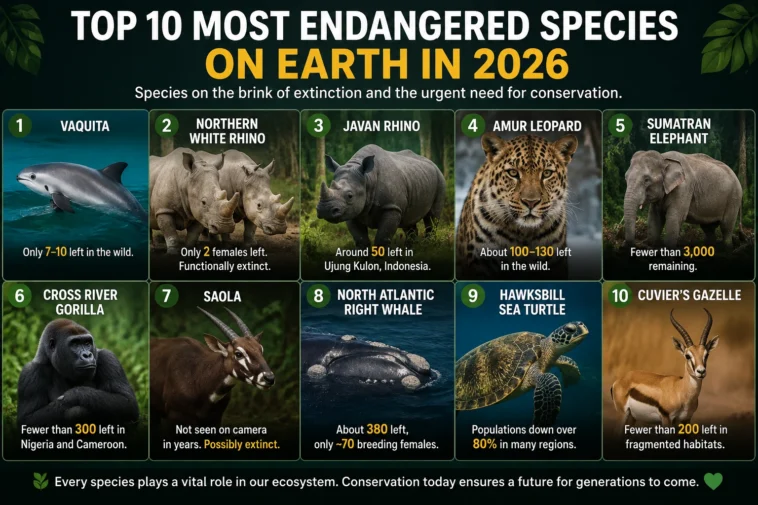
There are fewer than 10 vaquita porpoises left in the entire ocean. Read that again, not 10,000, not 100, just single digits. That’s how close we already are to losing an entire species, and it’s not the only one hanging by a thread.
More than 47,000 species are now classed as threatened with extinction on the IUCN Red List, out of roughly 170,000 assessed so far, according to the IUCN’s early-2026 figures, that works out to about 28% of all assessed species. This article breaks down the ten animals whose survival is the most urgent right now, using the latest verified numbers from IUCN, WWF, NOAA, and the International Rhino Foundation.
Key Highlights / Quick Facts
- Over 47,000 species are threatened with extinction worldwide as of 2026, per the IUCN Red List.
- The vaquita porpoise is down to just 7–10 individuals, making it the world’s rarest marine mammal.
- Only 2 northern white rhinos remain alive globally, and both are female — the subspecies is functionally extinct.
- The Javan rhino population dropped from 76 to around 50 after a poaching gang killed 26 animals inside their only home, Ujung Kulon National Park.
- North Atlantic right whales have crept up to about 380 individuals, with only around 70 breeding females left.
- The Amur leopard has climbed to roughly 100–130 wild cats, one of the few genuine comeback stories on this list.
- Cross River gorillas number fewer than 300, scattered across small forest patches in Nigeria and Cameroon.
- The saola, nicknamed the “Asian unicorn,” hasn’t been confirmed on camera in years and may already be gone.
What Makes a Species “Critically Endangered”
The IUCN doesn’t just guess. According to Britannica’s summary of IUCN criteria, a species classed as Endangered shows a very high risk of extinction from population declines of 50 to more than 70 percent over the previous 10 years or three generations, or a current population size below 250 individuals. Critically Endangered is one step worse — population drops of 80% or more, or even fewer surviving individuals.
Here’s the honest part: habitat loss beats poaching as the number one killer. A recent paper found that unsustainable crop and timber production drives about 40% of total extinction risk for amphibians, birds, and mammals combined, based on IUCN reporting. Poaching, climate change, and bycatch fishing round out the rest.
Why 2026’s Numbers Look Worse Than They Are
Here’s something most articles won’t tell you straight — the “more species are endangered” headline this year is only partly real. It’s also because scientists are simply assessing more species than ever before, so the pool keeps growing even when the underlying biology hasn’t changed much for older listings.
The Top 10 Most Endangered Species in 2026
1. Vaquita (Phocoena sinus)
The vaquita is the world’s smallest porpoise and, right now, its rarest marine mammal. The most recent acoustic and visual survey, run with Sea Shepherd and Mexico’s environment ministry, counted between 7 and 10 individuals left in the northern Gulf of California, with at least one or two calves spotted — a small but genuine sign of hope. Numbers have collapsed from roughly 567 animals in 1997, almost entirely because of illegal gillnets set for the totoaba fish, whose swim bladder sells for thousands of dollars on the Chinese black market.
2. Northern White Rhino (Ceratotherium simum cottoni)
There are exactly two northern white rhinos left on Earth — Najin and her daughter Fatu, both female, both living under armed guard at Ol Pejeta Conservancy in Kenya. With no males remaining, natural reproduction is impossible. Scientists are racing to save the subspecies through IVF using frozen sperm and southern white rhino surrogates, but this is about as close to the finish line as extinction gets.
3. Javan Rhino (Rhinoceros sondaicus)
Every single Javan rhino on the planet lives in one place — Ujung Kulon National Park on the western tip of Java, Indonesia. Numbers had climbed encouragingly to 76 animals by 2022, but that progress unraveled after members of an organized poaching network admitted to killing 26 rhinos for their horns between 2019 and 2023. Current estimates sit closer to 50 individuals, though three calves were reported in 2025, offering a sliver of hope.
4. Amur Leopard (Panthera pardus orientalis)
This is genuinely one of the better stories on this list. The Amur leopard, found in the temperate forests of Russia’s Far East and northeast China, now numbers roughly 100 to 130 wild cats, up from under 40 in the early 2000s. Coordinated anti-poaching work and cross-border protected areas between Russia and China deserve real credit here, even though the species remains Critically Endangered.
5. Sumatran Elephant (Elephas maximus sumatranus)
Fewer than 3,000 Sumatran elephants survive today, squeezed by palm oil and pulpwood plantations that keep eating into their forest range. When elephants raid crops out of desperation, farmers sometimes retaliate with poison or gunfire, so conflict — not just habitat loss — is now a direct driver of decline. Wildlife corridors and compensation programs for affected farmers are the main tools being used to ease that tension.
6. Cross River Gorilla (Gorilla gorilla diehli)
Living in isolated, hilly forest patches along the Nigeria-Cameroon border, the Cross River gorilla population sits at under 300 individuals spread across roughly 11 small subpopulations. Logging roads and bushmeat hunting are the biggest pressures, but community-led patrols in key zones have reportedly cut illegal killings by around half in recent years.
7. Saola (Pseudoryx nghetinhensis)
Nobody has confirmed a live saola sighting through a proper camera trap in years. Discovered only in 1992 in Vietnam’s Annamite Mountains, the “Asian unicorn” wasn’t hunted directly — it gets caught as accidental bycatch in wire snares set for deer and pangolins. Fewer than 100 individuals are estimated to remain, and no saola has ever survived long in captivity, which makes this one of the most fragile situations on the entire list.
8. Sumatran Rhino (Dicerorhinus sumatrensis)
The world’s smallest and hairiest rhino species is down to somewhere between 34 and 47 individuals, scattered in fragmented forest patches across Sumatra and Indonesian Borneo. Because the survivors are so spread out, they rarely encounter each other to breed naturally, which is exactly why conservationists have shifted toward translocating rhinos into managed breeding sanctuaries — a strategy that has already produced a handful of captive-born calves.
9. North Atlantic Right Whale (Eubalaena glacialis)
The North Atlantic right whale is actually trending upward for the third year running, with the latest NOAA estimate putting the population at about 380 to 384 whales. That sounds like progress, but only roughly 70 of those whales are reproductively active females, so the margin for error is razor-thin. Ship strikes and fishing-gear entanglement remain the two leading causes of death, which is why vessel speed limits and ropeless fishing gear trials are now central to recovery plans.
10. Cao Vit Gibbon (Nomascus nasutus)
Confined to a single limestone forest straddling the Vietnam-China border, the Cao Vit gibbon population stands at roughly 74 individuals. Decades-old war damage and inbreeding within such a tiny, isolated group compound the threat. Reforestation projects and dedicated nest-guarding teams have helped stabilize numbers slightly, but this species has almost no room for further loss.
Endangered Species Population Statistics Table
| Species | Estimated Wild Population (2026) | IUCN Status | Primary Range |
| Vaquita | 7–10 | Critically Endangered | Gulf of California, Mexico |
| Northern White Rhino | 2 | Functionally Extinct | Kenya (captive protection) |
| Javan Rhino | ~50 | Critically Endangered | Ujung Kulon, Indonesia |
| Amur Leopard | ~100–130 | Critically Endangered | Russia’s Far East / NE China |
| Sumatran Elephant | <3,000 | Critically Endangered | Sumatra, Indonesia |
| Cross River Gorilla | <300 | Critically Endangered | Nigeria–Cameroon border |
| Saola | <100 (unconfirmed) | Critically Endangered | Annamite Mountains, Vietnam/Laos |
| Sumatran Rhino | 34–47 | Critically Endangered | Sumatra & Borneo, Indonesia |
| North Atlantic Right Whale | ~380 | Critically Endangered | Western North Atlantic |
| Cao Vit Gibbon | ~74 | Critically Endangered | Vietnam–China border |
Figures compiled from IUCN Red List, NOAA Fisheries, Save the Rhino International, and the International Rhino Foundation, current to 2026.
Pros and Cons of Current Conservation Efforts
| Pros | Cons |
| Species like the Amur leopard and North Atlantic right whale show real, measurable recovery | Funding is heavily skewed toward a few “flagship” species while thousands of smaller ones get ignored |
| International bans (CITES) restrict trade in horns, tusks, and body parts | Enforcement is inconsistent — Javan rhino poachers operated undetected for years |
| Captive breeding and IVF offer a lifeline for near-extinct subspecies like the northern white rhino | Captive-born animals often struggle to survive if released, as seen with the saola |
| Community patrol programs have cut poaching in some regions by up to 50% | Habitat loss from agriculture still outpaces protection efforts in most tropical regions |
| Acoustic and satellite monitoring gives more accurate population counts than ever | More accurate counts sometimes reveal populations are worse off than assumed |
Comparison Table: Threat Level by Species
| Species | Main Threat | Population Trend (Last 5 Years) |
| Vaquita | Illegal gillnet bycatch | Declining, slight stabilization in 2025–26 |
| Northern White Rhino | Extinction of breeding males | No natural reproduction possible |
| Javan Rhino | Organized poaching | Declined after 2023 poaching case |
| Amur Leopard | Historic poaching, habitat fragments | Increasing |
| Sumatran Elephant | Palm oil deforestation, conflict | Declining |
| Cross River Gorilla | Logging, bushmeat hunting | Stable to slightly declining |
| Saola | Snare bycatch | Unknown, possibly near-extinct |
| Sumatran Rhino | Habitat fragmentation, low fertility | Declining slowly |
| North Atlantic Right Whale | Ship strikes, entanglement | Slowly increasing |
| Cao Vit Gibbon | Habitat isolation, inbreeding | Stable |
Step-by-Step: How Scientists Track a Critically Endangered Species
- Field surveys — Researchers use camera traps, aerial counts, or boat-based transects to physically spot and count animals, as done for Javan rhinos in Ujung Kulon.
- Acoustic monitoring — For hard-to-see species like the vaquita, hydrophones pick up echolocation clicks to estimate numbers without a single visual sighting.
- Genetic sampling — DNA from droppings, hair, or tissue helps confirm individual identities and check for dangerous inbreeding, as done with the Sumatran rhino.
- Data submission to IUCN — Verified population estimates go into the Red List assessment process, which assigns or updates the species’ threat category.
- Policy and funding response — Governments and NGOs use that classification to direct anti-poaching patrols, habitat protection laws, and breeding programs.
2026 Conservation Trends and News
A few real developments are shaping this year’s outlook. Mexico’s government is weighing a proposal to shrink the vaquita’s protected “zero-tolerance area” in the Gulf of California, a move conservationists warn could undo years of gillnet-reduction progress. On the brighter side, NOAA reported the North Atlantic right whale population growing for a third consecutive year, helped by vessel speed rules and new ropeless fishing gear trials along the U.S. East Coast.
Meanwhile, the IUCN’s own 2026 Red List update flagged a fresh concern most people haven’t heard of: deep-sea mining is now threatening more than half of mollusk species that depend on hydrothermal vents, showing that the endangered-species crisis is expanding into ecosystems we rarely think about. Not every update is bad news, though — the Australian numbat’s status actually improved this year thanks to decades of sustained conservation work, proof that recovery is possible when funding and enforcement stay consistent.
References
- IUCN Red List of Threatened Species — https://www.iucnredlist.org/
- IUCN Red List News — https://www.iucnredlist.org/news
- WWF — 10 of the World’s Most Endangered Animals — https://www.wwf.org.uk/learn/wildlife/endangered-animals
- NOAA Fisheries — North Atlantic Right Whale — https://www.fisheries.noaa.gov/species/north-atlantic-right-whale
- NOAA Fisheries — North Atlantic Right Whale Calving Season 2026 — https://www.fisheries.noaa.gov/national/endangered-species-conservation/north-atlantic-right-whale-calving-season-2026
- Save the Rhino International — Rhino Population Figures — https://www.savetherhino.org/rhino-info/population-figures/
- International Rhino Foundation — State of the Rhino Report — https://rhinos.org/about-rhinos/state-of-the-rhino/
- Our World in Data — Rhino Populations — https://ourworldindata.org/rhino-populations
- AWI — New Survey: No More Than Eight Vaquita Remain — https://awionline.org/news/new-survey-no-more-than-eight-vaquita-remain/
- Mongabay — Mexico Considers Shrinking Protected Areas for Vaquita — https://news.mongabay.com/2026/02/mexico-considers-shrinking-protected-areas-for-endangered-vaquita-porpoise/
- CNN — Fewer Than 10 Vaquitas Left: Can the Species Be Saved? — https://www.cnn.com/science/vaquita-extinction-illegal-fishing-c2e-spc
- Britannica — Endangered Species and the IUCN Red List — https://www.britannica.com/science/endangered-species/IUCN-Red-List-of-Threatened-Species
- New England Aquarium — North Atlantic Right Whale Population Update — https://www.neaq.org/about-us/press-room/press-releases/north-atlantic-right-whale-population-continues-slow-growth/
FAQs
The vaquita is considered one of the world’s most endangered animals, with fewer than 10 individuals estimated to remain in Mexico’s Gulf of California.
Only two northern white rhinos remain, and both are female. Scientists are using advanced reproductive technologies to try to preserve the subspecies.
The Amur leopard and North Atlantic right whale are among the endangered species showing encouraging population trends thanks to sustained conservation efforts.
Major threats include habitat destruction, illegal hunting and wildlife trade, fishing bycatch, climate change, pollution, and human-wildlife conflict.
Yes. Strong habitat protection, anti-poaching programs, breeding initiatives, community conservation, and international cooperation have helped several endangered species recover.



GIPHY App Key not set. Please check settings