 Sakthi Varna
Introduction
“Most powerful” is a genuinely tricky claim in quantum computing, and any list that ranks systems purely by qubit count is missing most of the actual story. A machine with a thousand noisy qubits can be less computationally useful than one with a hundred highly accurate ones.
We pulled verified data from peer-reviewed publications, official company announcements, and independent tracking projects to rank the ten most powerful quantum computers in the world right now, weighing qubit count, fidelity, and verified logical qubits, not just the biggest headline number.
Table of Contents
- Key Highlights
- Physical Qubits vs. Logical Qubits: What “Powerful” Actually Means
- The Top 10 Most Powerful Quantum Computers in the World
- Important Statistics Table
- How Quantum Computing Progress Actually Gets Measured (Step-by-Step)
- Pros and Cons Table (By Qubit Technology)
- Comparison Table: Top 10 Systems at a Glance
- Current Trends in Quantum Computing
- FAQs
- References
Key Highlights (Quick Facts)
- Google’s 105-qubit Willow chip completed a benchmark calculation in about five minutes that the company estimates would take the world’s fastest classical supercomputer roughly 10^25 years.
- Google published a landmark Nature paper in October 2025 demonstrating the first verifiable quantum advantage using its Quantum Echoes algorithm, running approximately 13,000 times faster than the best classical algorithm on the world’s fastest supercomputer.
- As of April 2026, only five organizations worldwide have demonstrated verified logical qubits: QuEra (96), Quantinuum (48), Atom Computing (24), Google (1), and Nord Quantique (1).
- Quantinuum’s Helios processor achieved 99.9975% single-qubit gate fidelity and 99.921% two-qubit gate fidelity across all qubit pairs, making it the most accurate commercial quantum computer in the world.
- IBM’s Condor processor holds the highest physical qubit count in a gate-model superconducting system at 1,121 qubits, though D-Wave’s Advantage2 quantum annealing system exceeds 1,000 qubits as well using a fundamentally different approach.
- China’s Jiuzhang 4.0, a photonic processor, generates 1,024 squeezed states and completes photon sampling tasks in 25.6 microseconds, a calculation the developers estimate would take 10^42 years on the world’s most powerful classical supercomputer.
- IonQ became the first pure-play quantum computing company in history to exceed $100 million in annual GAAP revenue, reporting $130 million for fiscal year 2025, up 202% year over year.
- Quantum error correction research accelerated dramatically through 2025, with 120 peer-reviewed papers published in the first ten months of that year alone, more than triple the 36 published in all of 2024.
The truth is, this field is genuinely moving fast enough that any snapshot ranking risks being outdated within months. What matters more than any single number is the trajectory: error rates are dropping, verified logical qubits are climbing, and real commercial revenue is starting to appear for the first time.
Physical Qubits vs. Logical Qubits: What “Powerful” Actually Means
Before ranking the list, here’s the distinction that actually determines whether a quantum computer is genuinely powerful or just has an impressive spec sheet.
Physical Qubits
These are the raw hardware units, the actual quantum bits built into a chip or trapped-ion array. Physical qubit count represents a system’s scale, but noisy, error-prone physical qubits alone don’t translate directly into useful computational power.
Logical Qubits
A logical qubit is a single fault-tolerant qubit assembled from many physical qubits using quantum error correction. Logical qubit count, not physical qubit count, is widely considered the metric that actually governs whether a quantum computer can run useful, reliable algorithms at meaningful scale.
Gate Fidelity
This measures how accurately a quantum operation is performed, expressed as a percentage. Even a small fidelity improvement, say from 99.9% to 99.99%, can dramatically extend how many operations a system can run before errors overwhelm the calculation.
Verified Quantum Advantage
This refers to a demonstrated task where a quantum computer solves a problem that no classical computer can replicate in any practical amount of time, with the result independently verifiable rather than just claimed. As of this writing, only a handful of these demonstrations have been published in peer-reviewed journals.
The Top 10 Most Powerful Quantum Computers in the World
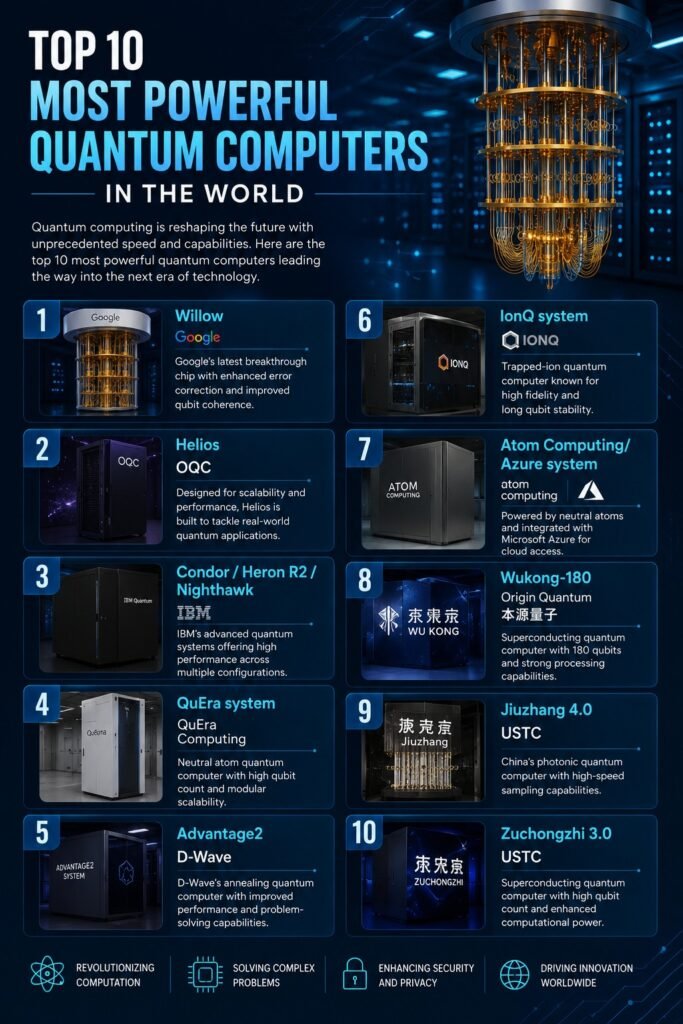
Here is our researched, detailed ranking of the most powerful quantum computers currently in operation, weighing scale, accuracy, and verified real-world results.
1. Google Willow
Qubits: 105 physical qubits (superconducting)
Key achievement: Willow demonstrated below-threshold quantum error correction in December 2024, the first time a logical error rate decreased as the error-correcting code grew larger on superconducting hardware, a result long considered a critical milestone for the entire field.
Why it stands out: In October 2025, Google published a landmark Nature paper demonstrating the first verifiable quantum advantage using its Quantum Echoes algorithm, running approximately 13,000 times faster than the best classical algorithm on the world’s fastest supercomputer. Willow also achieved 99.97% single-qubit gate fidelity and completed nearly 10 billion error correction cycles without failure.
2. Quantinuum Helios
Qubits: 98 fully connected physical qubits (trapped-ion)
Key achievement: Helios achieved 99.9975% single-qubit gate fidelity and 99.921% two-qubit gate fidelity across all qubit pairs, the highest fidelity ever released to the commercial market, alongside 48 verified logical qubits using a highly efficient 2:1 physical-to-logical qubit encoding ratio.
Why it stands out: Quantinuum specifically markets Helios as the most accurate quantum computer in the world, and its predecessor, the H2 system, already breached quantum advantage before Helios’s launch. The company has filed confidential paperwork for a public listing expected to value it above $20 billion.
Image: A specialized laboratory chamber housing delicate quantum computing hardware — trapped-ion and superconducting quantum systems both require extreme environmental control to maintain qubit stability.
3. IBM Condor / Heron R2 / Nighthawk
Qubits: Condor holds 1,121 physical qubits (the highest count in a gate-model superconducting system); Heron R2 operates at 156 qubits as IBM’s current flagship generation; Nighthawk, unveiled in November 2025, runs 120 qubits with 218 next-generation tunable couplers.
Key achievement: IBM achieved a 10x speedup in quantum error correction decoding, a full year ahead of its own public roadmap schedule, while Nighthawk’s tunable coupler architecture enables approximately 30% more circuit complexity than prior IBM systems.
Why it stands out: IBM operates the largest cloud-accessible quantum computing fleet in the world through the IBM Quantum Network, connecting more than 300 partner organizations across industry, government, and academia, and its Qiskit software remains the most widely used quantum programming framework globally.
4. QuEra Computing
Qubits: 448 physical neutral atoms, encoding 96 verified logical qubits
Key achievement: QuEra published a Nature paper in January 2026 confirming 96 logical qubits using high-rate quantum error correction codes, the largest verified logical qubit count of any organization in the world as of this writing.
Why it stands out: QuEra leads the entire quantum logical qubit leaderboard, ahead of Quantinuum, Atom Computing, and Google, positioning it as the current frontrunner specifically on the metric most experts consider the true measure of near-term quantum computing power.
5. D-Wave Advantage2
Qubits: Exceeds 1,000 qubits (quantum annealing architecture)
Key achievement: D-Wave published a simulation-quality benchmark in May 2026 estimating that a specific optimization problem solved by its system would take a million years on the Frontier exascale classical supercomputer.
Why it stands out: D-Wave is the only company in this ranking selling commercially deployed quantum computers directly to enterprise customers, rather than only offering cloud-based access to hardware it retains ownership of. In May 2026, the company signed a non-binding $100 million letter of intent with the US Department of Commerce under the CHIPS Act quantum initiative.
Image: Rows of cryogenic cooling equipment in a quantum computing facility — most quantum hardware architectures require near-absolute-zero temperatures to maintain the delicate quantum states needed for computation.
6. IonQ
Qubits: 64 algorithmic qubits (trapped-ion)
Key achievement: IonQ’s ion-trap hardware achieved a world-record 99.99% two-qubit gate fidelity through its Error Quantum Control technology, matching some of the highest accuracy figures achieved by any quantum computing modality.
Why it stands out: IonQ became the first pure-play quantum computing company in history to exceed $100 million in annual GAAP revenue, reporting $130 million for fiscal year 2025 at 202% year-over-year growth, alongside selection for a $151 billion MDA SHIELD defense procurement program signaling sustained government revenue.
7. Atom Computing / Microsoft
Qubits: 1,180 physical atoms, encoding 24 verified logical qubits (neutral atom)
Key achievement: Atom Computing and Microsoft jointly demonstrated 24 entangled logical qubits in November 2024, the first multi-logical-qubit demonstration made available through a commercial cloud platform, Azure Quantum.
Why it stands out: This partnership represents one of the clearest examples of a major cloud provider directly co-developing quantum hardware rather than simply reselling access, with the two companies targeting a 50-logical-qubit system under the codename Magne by late 2026.
8. Origin Quantum Wukong-180
Qubits: 180 computational qubits (superconducting)
Key achievement: Launched in Hefei, China in May 2026, Wukong-180 achieved 99% two-qubit gate fidelity, succeeding the company’s third-generation 72-qubit system and offering global cloud access through the Origin Pilot platform.
Why it stands out: Origin Quantum is China’s largest independently operated superconducting quantum computer company and the first to deliver a commercial quantum computer built entirely with domestic supply chains, having raised more than $800 million from state funds and strategic investors.
9. Jiuzhang 4.0
Qubits: 1,024 squeezed states across 8,176 optical modes (photonic)
Key achievement: Published in Nature in May 2026, Jiuzhang 4.0 detects up to 3,050 photons and completes photon sampling tasks in just 25.6 microseconds, with the developers estimating that classically simulating an equivalent computation on El Capitan, the world’s most powerful classical supercomputer, would take approximately 10^42 years.
Why it stands out: As a specialized Gaussian boson sampling system rather than a general-purpose gate-model computer, Jiuzhang 4.0 represents one of the strongest quantum advantage demonstrations published to date, reinforcing China’s parallel, independent path in advanced photonic quantum hardware.
Image: Fiber optic cables and precision optical components in a photonics laboratory — photonic quantum computers use light particles rather than electronic circuits to perform quantum calculations.
10. Zuchongzhi 3.0
Qubits: 105 physical qubits (superconducting)
Key achievement: China’s Zuchongzhi 3.0 matches Google Willow’s qubit count and claims a similar quantum supremacy result in random circuit sampling benchmarks, reportedly finishing certain tasks a quadrillion times faster than classical supercomputers.
Why it stands out: As the most direct Chinese counterpart to Google’s Willow chip, Zuchongzhi 3.0 underscores that the intense competition in advanced superconducting quantum hardware is not confined to the United States, with the gap between the two systems’ claimed capabilities remaining a closely watched storyline in the field.
Important Statistics Table
| System | Organization | Physical Qubits | Qubit Technology | Notable Metric |
|---|---|---|---|---|
| Willow | 105 | Superconducting | First verifiable quantum advantage (Quantum Echoes, Oct 2025) | |
| Helios | Quantinuum | 98 | Trapped-ion | 99.921% two-qubit gate fidelity, 48 logical qubits |
| Condor / Heron R2 / Nighthawk | IBM | 1,121 / 156 / 120 | Superconducting | Largest cloud-accessible quantum fleet (300+ partners) |
| QuEra system | QuEra Computing | 448 | Neutral atom | 96 verified logical qubits (highest globally) |
| Advantage2 | D-Wave | 1,000+ | Quantum annealing | Only commercially deployed enterprise systems |
| IonQ system | IonQ | Not disclosed (64 algorithmic qubits) | Trapped-ion | 99.99% two-qubit gate fidelity |
| Atom Computing/Azure system | Atom Computing / Microsoft | 1,180 | Neutral atom | 24 logical qubits via commercial cloud |
| Wukong-180 | Origin Quantum | 180 | Superconducting | 99% two-qubit fidelity, China’s leading system |
| Jiuzhang 4.0 | Jiuzhang Quantum | 1,024 squeezed states | Photonic | Quantum advantage demo (~10^42 years classical equivalent) |
| Zuchongzhi 3.0 | Chinese state research | 105 | Superconducting | Claimed quadrillion-times speedup benchmark |
How Quantum Computing Progress Actually Gets Measured (Step-by-Step)
- Physical qubit count is reported first, representing the raw hardware scale of a given system, though this number alone says little about real computational usefulness.
- Gate fidelity gets independently benchmarked, measuring how accurately single-qubit and two-qubit operations perform, typically expressed as a percentage very close to 100%.
- Coherence time is measured, tracking how long qubits remain in a usable quantum state before environmental noise causes them to decay.
- Quantum error correction is layered on top, combining many physical qubits into fewer, more reliable logical qubits capable of sustaining longer, more complex calculations.
- Results are published in peer-reviewed journals, such as Nature, subjecting the claimed achievement to outside scientific scrutiny before being widely accepted.
- Independent verification and benchmarking follows, where possible, comparing a quantum system’s claimed advantage against the best available classical computing approaches to confirm the result holds up.
Pros and Cons Table (By Qubit Technology)
| Technology | Pros | Cons |
|---|---|---|
| Superconducting (Google, IBM, Origin) | Fast gate speeds, mature manufacturing techniques | Requires near-absolute-zero cooling, more error-prone |
| Trapped-ion (Quantinuum, IonQ) | Highest fidelity of any modality | Slower gate speeds than superconducting systems |
| Neutral atom (QuEra, Atom Computing) | Strong scalability, leading logical qubit counts | Still maturing compared to superconducting hardware |
| Quantum annealing (D-Wave) | Only commercially deployed enterprise-owned systems | Limited to optimization problems, not general-purpose computing |
| Photonic (Jiuzhang, PsiQuantum, Xanadu) | Operates at room temperature, strong for specific sampling tasks | Currently specialized rather than general-purpose |
Comparison Table: Top 10 Systems at a Glance
| System | Country/Region | Best Known For | Commercial Access |
|---|---|---|---|
| Google Willow | USA | Verified quantum advantage | Limited, primarily research |
| Quantinuum Helios | USA/UK | Highest commercial fidelity | Cloud access via major providers |
| IBM Condor/Heron/Nighthawk | USA | Largest cloud quantum network | IBM Quantum Network (300+ partners) |
| QuEra Computing | USA | Most verified logical qubits | Cloud access via AWS Braket |
| D-Wave Advantage2 | Canada | Commercially deployed hardware | Direct enterprise sales |
| IonQ | USA | Highest two-qubit gate fidelity | AWS Braket, Azure, Google Cloud |
| Atom Computing/Microsoft | USA | Commercial cloud logical qubits | Azure Quantum |
| Origin Quantum Wukong-180 | China | China’s leading superconducting system | Origin Pilot cloud platform |
| Jiuzhang 4.0 | China | Strongest photonic quantum advantage demo | Primarily research access |
| Zuchongzhi 3.0 | China | China’s Willow-equivalent competitor | Primarily research access |
Image: A quantum computing dashboard displaying real-time processing data on multiple monitors — cloud-based access has become the primary way most researchers and enterprises actually interact with today’s most powerful quantum systems.
Current Trends in Quantum Computing
The quantum computing field keeps accelerating, and a few clear patterns stand out in the current data.
Error Correction Research Has Hit an Inflection Point
Quantum error correction research accelerated dramatically through 2025, with 120 peer-reviewed papers published in just the first ten months of that year, more than triple 2024’s total, reflecting what one researcher described as an “era of escape velocity” for the field.
Logical Qubits Are Becoming the Metric That Matters Most
As of April 2026, only five organizations have demonstrated verified logical qubits at all, and the leaderboard among them, led by QuEra’s 96, is now considered a far more meaningful measure of progress than raw physical qubit counts.
Real Commercial Revenue Has Finally Arrived
IonQ’s $130 million in fiscal year 2025 GAAP revenue marks the first time any pure-play quantum computing company has crossed the $100 million annual revenue threshold, a genuine milestone separating quantum computing’s earlier purely speculative phase from a nascent but real commercial market.
China and the US Are Racing on Parallel, Independent Tracks
Systems like Zuchongzhi 3.0, Origin Quantum’s Wukong-180, and Jiuzhang 4.0 show that China’s quantum computing progress is advancing largely independently of, and in some specific benchmarks directly rivaling, leading US systems like Google Willow.
Multiple Qubit Technologies Are Maturing Simultaneously
Rather than one technology winning outright, superconducting, trapped-ion, neutral-atom, annealing, and photonic approaches are all posting genuine breakthroughs in parallel, with NVIDIA notably investing across three separate qubit modalities in a single week in September 2025.
FAQs About the Most Powerful Quantum Computers
What is currently the most powerful quantum computer in the world? It depends on the metric. Google’s Willow leads on verified quantum advantage, Quantinuum’s Helios leads on commercial fidelity, and QuEra leads on verified logical qubits, which many experts consider the most meaningful overall measure of near-term power.
What is the difference between physical qubits and logical qubits? Physical qubits are the raw hardware units built into a quantum chip or ion trap, while a logical qubit is a single fault-tolerant qubit assembled from many physical qubits using error correction. Logical qubit count is widely considered the better measure of a system’s genuine, reliable computational power.
Has any quantum computer actually proven “quantum advantage”? Yes, in specific, narrow cases. Google published a peer-reviewed Nature paper in October 2025 demonstrating verifiable quantum advantage using its Quantum Echoes algorithm, and China’s Jiuzhang 4.0 has published a similarly strong photonic quantum advantage demonstration.
Which company has the most verified logical qubits? QuEra Computing currently leads with 96 verified logical qubits, derived from 448 physical neutral atoms, published in a Nature paper in January 2026.
Is D-Wave’s quantum computer as powerful as Google’s or IBM’s? Not directly comparable. D-Wave uses quantum annealing, a specialized approach suited to optimization problems, rather than the general-purpose gate-model architecture used by Google, IBM, and most others on this list, making direct power comparisons difficult.
Are quantum computers actually generating real commercial revenue yet? Yes, though modestly. IonQ became the first pure-play quantum computing company to exceed $100 million in annual GAAP revenue in fiscal year 2025, and D-Wave sells commercially deployed systems directly to enterprise customers.
Is China competitive with the United States in quantum computing? Very much so. Systems like Zuchongzhi 3.0, Jiuzhang 4.0, and Origin Quantum’s Wukong-180 demonstrate that China is advancing multiple quantum computing technologies in parallel, with some benchmarks directly rivaling leading US systems.
Conclusion
Ranking the world’s most powerful quantum computers depends entirely on which metric you trust most, raw qubit count, gate fidelity, verified logical qubits, or demonstrated quantum advantage, and the honest answer is that no single system leads on every measure simultaneously. Google’s Willow, Quantinuum’s Helios, and QuEra’s logical qubit leadership each represent genuine, verified progress toward practical quantum computing, while China’s parallel advances through Zuchongzhi, Jiuzhang, and Origin Quantum confirm this is a genuinely global race. With error correction research accelerating and real commercial revenue finally appearing, this list is likely to look meaningfully different within the next year.
References
- Google Quantum AI — Willow Chip and Quantum Echoes Algorithm, Published in Nature (October 2025)
- Quantinuum — Introducing Helios: The Most Accurate Quantum Computer in the World
- IBM Quantum — Condor, Heron R2, and Nighthawk Processor Specifications and Roadmap
- QuantumZeitgeist — Quantum Logical Qubit Leaderboard 2026: The Definitive Verified Ranking
- EntangledFuture.com — Largest Quantum Computers 2026: Top Systems by Qubit Count
- EntangledFuture.com — Top 25 Quantum Computing Companies 2026 Rankings
- TechDogs — Top 10 Quantum Computing Companies in 2026
- QuantumZeitgeist — Quantum Computing Companies in 2026: The Complete List
- The Quantum Insider — Top Quantum Computing Companies, 2026 Landscape Overview
- WORLDOSTATS — Most Advanced Quantum Computing Systems 2026
- TechVorta — Quantum Computing Explained: Where the World’s Most Powerful Computers Stand in 2026
- D-Wave Systems — Advantage2 Benchmarking and CHIPS Act Quantum Initiative Announcement



GIPHY App Key not set. Please check settings