 Balakumar L
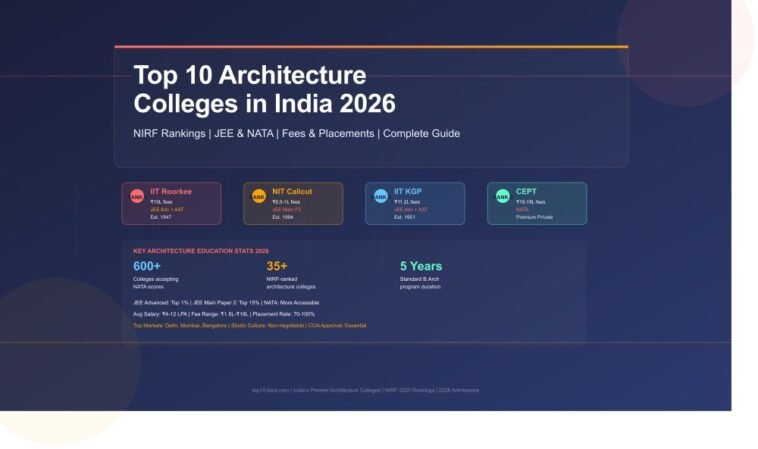
Architecture education in India is at an inflection point. The demand for skilled architects is growing, competition is intense, and the difference between top colleges and average ones is absolutely massive. It’s not just about the ranking—it’s about studio culture, faculty depth, industry connections, and the kind of architect you become. We’ve researched the data so you don’t have to. Here’s everything you need to know about India’s top 10 architecture colleges for 2026.
Table of Contents
- Quick Facts About Architecture Education in India
- The Top 10 Architecture Colleges in India (NIRF 2025)
- Key Differences Between Admission Routes
- Detailed College Profiles
- Important Statistics Table
- Pros and Cons Comparison
- Top 10 Comparison Matrix
- Latest Trends in Architecture Education (2026)
- Frequently Asked Questions
- References and Sources
Quick Facts About Architecture Education in India 📐
- 35+ architecture colleges rank in NIRF frameworks across India
- 600+ colleges accept NATA scores for architecture admissions
- Two main admission routes: JEE Advanced + AAT (for IITs), JEE Main Paper 2 or NATA (for others)
- IIT Roorkee consistently ranks #1 in architecture since NIRF 2018
- Fees range from ₹1.5 lakh to ₹18 lakh for 5-year B.Arch programs
- Average starting salary: ₹4-12 LPA (varies by college and specialization)
- Studio culture is critical—hands-on design learning matters more than lectures
- COA approval is non-negotiable—always verify Council of Architecture approval before applying
- Government colleges remain unbeatable for ROI—₹10-11 lakh total fees vs. ₹15-18 lakh at private universities
- 5-year duration standard—B.Arch is longer than most engineering programs, requiring patience and genuine interest
The Top 10 Architecture Colleges in India (NIRF 2025)
1. Indian Institute of Technology Roorkee (IIT Roorkee)
IIT Roorkee is the undisputed #1 architecture school in India. Founded in 1847, it’s the oldest technical institute in Asia and has maintained the top NIRF architecture rank consistently since 2018. The Department of Architecture and Planning here is legendary.
Key Highlights:
- NIRF Rank: 1 | Established: 1847 | Campus: 365 acres
- Admission: JEE Advanced + Architecture Aptitude Test (AAT)
- Total Fee: ₹10-11 lakh for 5-year B.Arch | ₹2.24 lakh first year
- Seats: 30 B.Arch seats
- Placement: Strong placements with ₹6.5-7 LPA average (architecture is lower than engineering)
- Highest Package: ₹27.94 LPA (across programs)
- Unique Strength: Unmatched studio culture, world-class infrastructure, 175+ years of heritage
Why It Matters: IIT Roorkee isn’t just a rank—it’s a brand that opens doors globally. The alumni network is powerful. If you crack JEE Advanced and AAT, this is where every serious architecture aspirant wants to be. The infrastructure is phenomenal: 23 acres of dedicated architecture campus with state-of-the-art studios, digital labs, and a library with 50,000+ architecture books.
2. National Institute of Technology Calicut (NIT Calicut)
NIT Calicut ranks #2 in NIRF for architecture and is the second-best government option. Located in Kerala, it benefits from the state’s strong design tradition and has excellent faculty-student ratios (1:6.4).
Key Highlights:
- NIRF Rank: 2 | State: Kerala | Established: 1994
- Admission: JEE Main Paper 2 (typically rank below 600-700)
- Fees: Highly subsidized based on income (₹40K-₹1.25L annually for most; free for SC/ST and below ₹1L income)
- Seats: ~60-80 B.Arch seats
- Placement Rate: 70%+ | Average Package: ₹6.5 LPA (per NIRF 2025)
- Unique Strength: Kerala’s design tradition, strong employer network (L&T is main recruiter), affordable fees
Why It Matters: If you can’t crack JEE Advanced, NIT Calicut via JEE Main Paper 2 is your best government college option. The fees are incredibly reasonable (sometimes free for poor families). The placements are solid. The location in Calicut gives you access to growing infrastructure projects across South India.
3. Indian Institute of Technology Kharagpur (IIT Kharagpur)
IIT Kharagpur is the second-largest IIT and its architecture program is among the oldest and most respected in India. Founded in 1951, it has a strong research focus alongside design education.
Key Highlights:
- NIRF Rank: 3 | State: West Bengal | Established: 1951
- Admission: JEE Advanced + AAT
- Fees: ₹11.18 lakh (highest among top 3, but still reasonable for an IIT)
- Seats: ~50 B.Arch seats
- Placement: ₹6-8 LPA average (comparable to IIT Roorkee)
- Unique Strength: Strong research culture, design-build projects, industry partnerships, large alumni network
Why It Matters: IIT Kharagpur offers almost IIT Roorkee-level education with slightly higher fees. It’s excellent if you’re interested in research alongside design practice. The institute encourages students to undertake real projects—designing buildings that actually get built is a huge learning advantage.
4. Jamia Millia Islamia, Faculty of Architecture (Delhi)
Jamia’s architecture program is highly respected and offers excellent value. The faculty is well-qualified (many with international credentials), and the location in Delhi gives students access to the country’s largest architecture market.
Key Highlights:
- NIRF Rank: 4-5 | State: Delhi | Established: 1988
- Admission: NATA (most common) or JEE Main Paper 2
- Fees: ₹1.5 lakh (among the lowest for quality architecture education)
- Seats: ~80-100 B.Arch seats
- Placement: ₹5-8 LPA average
- Unique Strength: Affordable fees, central Delhi location, strong design curriculum, good internship access
Why It Matters: Jamia is the most affordable among top government colleges. For students who can’t score 250+ in NATA or crack JEE Advanced, Jamia offers exceptional value. The Delhi location is huge—you’re in India’s design capital with internships at leading firms just kilometers away.
5. School of Planning and Architecture (SPA) Delhi
SPA Delhi is the oldest dedicated architecture school in India (established 1957) and is known for its rigorous, design-focused curriculum. It’s smaller and more selective than other top colleges.
Key Highlights:
- NIRF Rank: 5-6 | State: Delhi | Established: 1957
- Admission: JEE Main Paper 2 (highly competitive, rank below 500 recommended)
- Fees: ₹3-4 lakh
- Seats: Limited (~60 B.Arch)
- Placement: Strong | ₹6-9 LPA average
- Unique Strength: Pioneering design curriculum, rigorous studio culture, central Delhi location, industry connections
Why It Matters: SPA Delhi is where serious architects are trained. The studio culture here is intense—you’re expected to produce work of exhibition quality. If you love design and can handle pressure, SPA is legendary. The centralized Delhi location means direct access to top architecture firms and projects.
6. Center for Environmental Planning and Technology (CEPT), Ahmedabad
CEPT is India’s premier private architecture university and consistently ranks in top 10. It’s known for innovation, international collaborations, and strong studio culture comparable to architecture schools worldwide.
Key Highlights:
- NIRF Rank: 6-7 | State: Gujarat | Established: 1966
- Admission: NATA (primary) or JEE Main Paper 2
- Fees: ₹15-18 lakh (highest among top 10, but justified by quality)
- Seats: ~100 B.Arch seats
- Placement: ₹8-12 LPA average | Top recruiters: International firms, Indian design consultancies
- Unique Strength: World-class infrastructure, international exchange programs, cutting-edge curriculum, strong design reputation
Why It Matters: CEPT is India’s answer to global architecture schools. If you can afford it, CEPT’s education rivals IITs in quality but with more design focus and fewer engineering subjects. International internships, visiting faculty from Harvard and MIT, and a globally connected alumni network make it special. The average starting salary here is higher than most government colleges despite the premium fees.
7. School of Planning and Architecture (SPA) Bhopal
SPA Bhopal is a newer institution (established 2007) but has quickly gained reputation for quality architecture education and strong placements. It’s one of the few architecture colleges with a focus on Central Indian development.
Key Highlights:
- NIRF Rank: 7-8 | State: Madhya Pradesh | Established: 2007
- Admission: JEE Main Paper 2 or NATA
- Fees: ₹2.5-3.5 lakh (reasonable for a dedicated architecture school)
- Seats: ~50 B.Arch seats
- Placement: ₹5-7 LPA average
- Unique Strength: Growing reputation, focused curriculum, affordable fees, Bhopal’s emerging architecture market
Why It Matters: SPA Bhopal offers a middle ground—better than most colleges but cheaper than CEPT or private universities. The Central India location means exposure to building projects across Madhya Pradesh, Chhattisgarh, and Uttar Pradesh. If you’re not getting into top-tier colleges, SPA Bhopal is a solid choice.
8. School of Planning and Architecture (SPA) Vijayawada
SPA Vijayawada is another strong SPA college with a focus on sustainability and urban planning. Andhra Pradesh’s rapid infrastructure development gives students real project exposure.
Key Highlights:
- NIRF Rank: 8-9 | State: Andhra Pradesh | Established: 2008
- Admission: JEE Main Paper 2 or NATA
- Fees: ₹2.5-3 lakh
- Seats: ~50 B.Arch seats
- Placement: ₹5-7 LPA average
- Unique Strength: Strong design program, Andhra Pradesh location with booming construction industry, good faculty
Why It Matters: Vijayawada’s location in a rapidly developing state means real exposure to architecture practice. The industry development around the city provides internship and project opportunities. Good alternative if you’re in South India and can’t get into top-5 colleges.
9. National Institute of Technology (NIT) Trichy
NIT Trichy’s architecture program is well-regarded within the NIT ecosystem and has strong placements in South India. The college has good infrastructure and a dedicated faculty.
Key Highlights:
- NIRF Rank: 9-10 | State: Tamil Nadu | Established: 1964
- Admission: JEE Main Paper 2
- Fees: Similar to NIT Calicut (highly subsidized, ₹40K-₹1.5L annually)
- Seats: ~60 B.Arch seats
- Placement: ₹6-7 LPA average
- Unique Strength: South India location, strong NIT network, affordable fees, decent placements
Why It Matters: NIT Trichy is a safe government college choice if you miss top-tier colleges. The fees are reasonable, and the placements are consistent. Tamil Nadu’s strong construction industry helps with internships and jobs.
10. Lovely Professional University (LPU), Punjab
LPU is India’s largest private architecture college and offers flexible admission routes (NATA, JEE Main Paper 2, or LPU’s own entrance exam). It’s known for modern infrastructure and diverse specializations.
Key Highlights:
- NIRF Rank: 10-12 (private category) | State: Punjab | Established: 2005
- Admission: NATA, JEE Main Paper 2, or LPUNEST
- Fees: ₹8-10 lakh per year (mid-range for private)
- Seats: 200+ B.Arch seats (largest capacity)
- Placement: ₹6-9 LPA average | 90%+ placement rate
- Unique Strength: Flexible admission, modern campus, diverse specializations, scholarship options, good placements for private college
Why It Matters: LPU is your best bet among private universities if you can’t get into government colleges. The fees are reasonable for a private college, scholarships are available, and the placement rate is high. Three admission routes mean you have flexibility—whether you clear NATA, JEE Paper 2, or neither, you have options.
Key Differences Between Admission Routes
JEE Advanced + AAT (for IITs only):
- Most competitive (top 5% of JEE takers)
- Opens only 4 IIT architecture programs (Roorkee, Kharagpur, BHU, Madras)
- 5-year B.Arch degree
- Median salary: ₹18-20 LPA (best ROI)
JEE Main Paper 2 (NITs, SPAs, some others):
- Moderately competitive (top 15-20% of JEE takers)
- Opens 20+ government college seats
- Requires strong drawing aptitude component
- Median salary: ₹6-8 LPA from government colleges
NATA (CEPT, Jamia, 600+ colleges):
- Easier to qualify than JEE
- More design-focused test (less math)
- Opens access to 600+ colleges
- Salary varies widely (₹4-12 LPA depending on college)
Our Recommendation: If JEE Advanced is within reach, go for it—IITs’ ROI is unmatched. If not, JEE Main Paper 2 for government colleges is your next best option. NATA is more accessible but opens more options for both good and mediocre colleges—choose carefully.
Important Architecture Education Statistics (2026)
| Metric | Data | Source |
|---|---|---|
| Total Architecture Colleges in India | 600+ (accepting NATA) | Architecture Education Database |
| NIRF-Ranked Architecture Colleges | 35+ | NIRF 2025 Official |
| IIT Architecture Programs | 4 colleges | JoSAA Official |
| NIT Architecture Programs | 12+ colleges | JoSAA Official |
| SPA Institutions | 5+ dedicated SPAs | Council of Architecture |
| Total B.Arch Seats Available | 3,000+ per year | NATA & JEE Main Data |
| JEE Main Paper 2 Applicants 2026 | 50,000+ | JEE Statistics |
| NATA Applicants 2026 | 100,000+ | NATA Official |
| Government vs Private Colleges | 60% government, 40% private | COA Database |
| Average Course Duration | 5 years | Standard Curriculum |
| Fee Range Government | ₹1.5-4 lakh total | Official College Data |
| Fee Range Private | ₹8-18 lakh total | Official College Data |
| Average Starting Salary | ₹4-12 LPA | NIRF 2025 Placement Data |
| Top Architecture Markets in India | Delhi, Mumbai, Bangalore | Industry Reports |
| Placement Success Rate Top 5 Colleges | 70-100% | College Reports 2024-25 |
Pros and Cons Comparison: Architecture College Types
| Aspect | Government Colleges (IIT/NIT/SPA) | Private Universities (CEPT/LPU/Others) | Deemed Universities (Manipal/SRM) |
|---|---|---|---|
| Cost | Lowest (₹1.5-4L) | High (₹8-18L) | Medium (₹6-12L) |
| Admission Difficulty | Hardest (JEE) | Easier (NATA) | Medium |
| Faculty Quality | Excellent | Very Good | Good to Excellent |
| Studio Culture | Strong (IIT/SPA) | Excellent (CEPT) | Good |
| Industry Connections | Very Strong | Strong | Good |
| Placements | Consistent 70%+ | High 85%+ | Good 75%+ |
| Infrastructure | Good to Excellent | Excellent | Very Good |
| Flexibility | Rigid curriculum | More flexible | Moderate |
| International Exposure | Limited | Strong (CEPT) | Moderate |
| Location Advantage | Varies | Delhi/Mumbai strong | Pan-India |
| ROI (Value for Money) | Excellent | Poor | Moderate |
| Specialization Options | Limited | Wide | Moderate |
| Scholarships | Limited | Yes | Yes |
Top 10 College Quick Comparison
| College | NIRF Rank | Fees | Admission | Avg Salary | Placement | Best For |
|---|---|---|---|---|---|---|
| IIT Roorkee | 1 | ₹11L | JEE Adv | ₹6.5-7 LPA | Strong | IIT Brand + Studio Culture |
| NIT Calicut | 2 | ₹0.5-1L | JEE Main | ₹6.5 LPA | 70%+ | Affordable + Government |
| IIT Kharagpur | 3 | ₹11L | JEE Adv | ₹6-8 LPA | Strong | Research Focus |
| Jamia Millia Islamia | 4-5 | ₹1.5L | NATA | ₹5-8 LPA | Good | Affordable + Delhi Location |
| SPA Delhi | 5-6 | ₹3-4L | JEE Main | ₹6-9 LPA | Strong | Design Excellence |
| CEPT Ahmedabad | 6-7 | ₹15-18L | NATA | ₹8-12 LPA | Excellent | Private Excellence + International |
| SPA Bhopal | 7-8 | ₹3L | NATA/JEE | ₹5-7 LPA | Good | Affordable SPA |
| SPA Vijayawada | 8-9 | ₹2.5L | NATA/JEE | ₹5-7 LPA | Good | South India Option |
| NIT Trichy | 9-10 | ₹0.5-1.5L | JEE Main | ₹6-7 LPA | Consistent | Government + Affordable |
| Lovely Professional Univ | 10-12 | ₹8-10L | NATA/JEE | ₹6-9 LPA | 90%+ | Private Alternative |
How to Choose the Right Architecture College
Step 1: Assess Your JEE/NATA Score Realistically Your entrance exam score determines your options. If you’re in JEE Advanced top 1,000, IITs are possible. JEE Main top 5,000? Government colleges via Paper 2. High NATA score? You have access to 600+ colleges—now the challenge is filtering.
Step 2: Define Your Non-Negotiables Is location critical? (Delhi, Mumbai have the most opportunities). Do you need affordability? (Government colleges win). Do you want international exposure? (CEPT excels here). Do you prefer a specific region? Choose accordingly.
Step 3: Verify COA Approval This is non-negotiable. Before paying a single rupee to any college, verify it’s on the Council of Architecture’s approved list at coa.gov.in. An architecture degree from a non-COA-approved college is essentially useless in India and abroad.
Step 4: Check Studio Culture & Faculty Visit the college websites and look for faculty credentials (PhDs, international publications). Check if they do design-build projects. Do students participate in national and international competitions? These are better indicators than NIRF rank.
Step 5: Compare Long-Term Value Don’t just compare fees and average salaries. Calculate 5-year ROI. A ₹3L government college producing ₹8 LPA average salary has better ROI than a ₹15L private college giving ₹9 LPA.
Step 6: Trust Your Gut On Studio Culture Architecture is about creativity and passion. If the studio energy doesn’t excite you during a college visit, no ranking will make you happy there. Some students thrive at IIT Roorkee’s regimented environment; others flourish at CEPT’s experimental chaos.
Latest Trends in Architecture Education (2026) 🏗️
1. Sustainability & Climate-Responsive Design Every top college now has dedicated courses on sustainable architecture, green building design, and climate adaptation. This is no longer optional—it’s core curriculum. Climate change is reshaping the built environment, and architects trained in this will be in high demand.
2. Technology & Digital Fabrication Parametric design, 3D modeling, digital fabrication labs, and AI-assisted design are becoming standard. Colleges with updated CAD labs and digital fabrication equipment have an edge. If a college’s equipment list includes a 3D printer, parametric software, and BIM tools, that’s a green flag.
3. Urban Planning Integration More architecture colleges now offer integrated B.Arch+M.Plan programs or have strong planning components. The boundary between architecture and urban planning is blurring—modern architects need both.
4. Global Collaborations Top colleges are increasingly partnering with international universities. Exchange programs, international internships, and collaborative projects are becoming standard. CEPT and IITs lead here, but SPA colleges are catching up.
5. Mental Health & Wellness Awareness Architecture education has historically been brutal—60-hour studio weeks are common. Colleges are now addressing student mental health with counseling, flexible deadlines, and work-life balance initiatives. This is finally getting the attention it deserves.
6. Design-Build & Real Projects Hands-on learning with actual projects (designing buildings that get built, not just presentations) is becoming standard. Colleges with design-build studios where students see their designs realized have enormous pedagogical advantage.
7. Disaster-Resilient Architecture After floods, earthquakes, and cyclones across India, courses on disaster-resistant design and resilience planning are now integral. Students learn to design buildings that survive natural calamities.
8. Affordable Housing Focus With India’s housing shortage, many colleges now emphasize affordable housing design and low-cost construction techniques. This is socially important and increasingly valued by employers and society.
Frequently Asked Questions
NATA is design and aptitude focused—if you’re naturally good at drawing and spatial reasoning, NATA might feel easier. JEE Paper 2 requires stronger mathematics alongside design. Most students appear for both since preparation overlaps. NATA has higher pass rate (60%+) than JEE Paper 2 (30%).
Not quite. Architecture requires strong spatial reasoning and drawing ability. If you can’t visualize 3D spaces or draw to communicate ideas, you’ll struggle. That said, drawing improves dramatically with 5 years of practice—you don’t need to be a natural artist, but you need genuine interest.
For pure career outcomes, IIT Roorkee has better ROI (lower fees, same quality education). For design-focused learning and international exposure, CEPT is better. If you can do both well, IIT Roorkee is the safer bet. If design is your passion, CEPT justifies the expense.
Very important. Delhi and Mumbai have the country’s largest architecture markets. Getting internships and jobs is significantly easier from colleges in these cities. If you’re in a tier-2 city college, you may have to relocate after graduation.
Depends. CEPT’s premium fees are justified by world-class education and international opportunities. Mid-tier private colleges (₹8-12L) are harder to justify unless they have specific strengths or location advantages. Compare total 4-year ROI before deciding.
There are 600+ colleges accepting NATA. Quality varies dramatically. Look for COA-approved colleges in top 50 rankings (Manipal, Chandigarh University, MIT Pune). Many tier-2 colleges produce excellent architects—the college name matters less than your dedication.
Yes, but it’s harder than engineering. Your degree must be from a COA and NAAB-recognized institution (most top Indian colleges are). You’ll need additional qualifications in the destination country (America, UK, Australia have licensing exams). IIT/NIT graduates are more internationally recognized.
Growing. Real estate, construction, corporate campuses, hospitality, and urban development all need architects. Post-COVID, remote design jobs are also expanding. Salaries are lower than engineering (₹4-12 LPA vs. ₹8-25 LPA), but job satisfaction is typically higher.
References and Sources
- National Institutional Ranking Framework (NIRF) 2025 — Ministry of Education, Government of India https://www.nirfindia.org/
- Council of Architecture (COA) Approved Colleges — Official List https://www.coa.gov.in/
- IIT Roorkee Official Website — Architecture Programs https://www.iitr.ac.in/
- National Institute of Technology (NIRF) Rankings Database https://www.nit.ac.in/
- School of Planning and Architecture (SPA) Delhi Official https://www.spa.ac.in/
- CEPT University Ahmedabad Official https://www.cept.ac.in/
- JEE Main & Paper 2 Official Candidate Statistics https://www.nta.ac.in/
- NATA Examination Database — Official Statistics https://nata.in/
- Careers360 Architecture College Placements & Rankings https://www.careers360.com/
- Shiksha.com Architecture Education Database https://www.shiksha.com/architecture-planning/
- ArchiDesign India — Architecture Education News (2026) https://www.architriumphindia.com/
- India’s Urban Development Report 2026 — Ministry of Housing & Urban Affairs https://www.mohua.gov.in/
Final Thoughts
Choosing an architecture college is choosing how you’ll spend 5 intense, creative years and shape your professional identity for decades. The best college for you isn’t necessarily the highest-ranked one. It’s the one where you’ll thrive creatively, connect with good mentors, develop strong design skills, and build lasting professional networks.
IIT Roorkee and CEPT are exceptional—but so are NIT Calicut, SPA Delhi, and Jamia if you know what you’re doing. Studio culture, faculty passion, and your own dedication matter more than the ranking. Choose wisely, work hard, and build something beautiful.



GIPHY App Key not set. Please check settings