 kiruthika
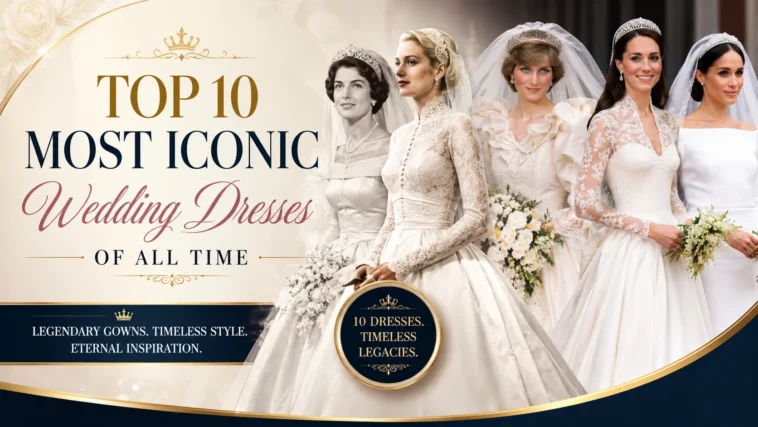
Some wedding dresses stop being just a dress. They become a moment. A cultural marker. The kind of gown people still Google decades later, just to check the designer’s name again.
If you have ever typed “iconic wedding dresses” into a search bar, you already know how deep this rabbit hole goes. From Grace Kelly’s 1956 studio-gifted gown to Meghan Markle’s quiet, boat-neck Givenchy dress in 2018, these gowns did more than dress a bride. They changed what brides everywhere wanted to wear next. This guide breaks down the real history, the real designers, and the real numbers behind the ten most iconic wedding dresses ever made.
Quick Facts
● Grace Kelly’s 1956 gown by Helen Rose used 125-year-old Brussels lace and thousands of hand-sewn pearls.
● Princess Diana’s 1981 train measured 25 feet, the longest ever worn at a royal wedding.
● Jacqueline Bouvier’s 1953 gown by Ann Lowe was made from 50 yards of ivory silk taffeta and took over two months to sew.
● Kate Middleton’s 2011 Alexander McQueen gown featured hand-stitched lace made by the Royal School of Needlework.
● Meghan Markle’s 2018 veil stretched 5 metres (16.4 feet) and was embroidered with flowers from all 53 Commonwealth countries.
● The global wedding dress market is valued at roughly $14.98 billion in 2026, according to The Business Research Company.
● The average American bride spends about $2,100 on her gown in 2026, per The Knot’s Real Weddings Study.
● Only 19% of brides wore a fully custom-made gown in 2025, with most buying off-the-rack or made-to-order styles.
What Makes a Wedding Dress Truly Iconic?
Not every expensive gown earns a spot on a list like this. An iconic wedding dress usually does three things at once: it reflects the culture of its decade, it influences designers who come after it, and it stays recognizable even to people who were not born when it was worn.
That is the real reason Grace Kelly’s gown still gets compared to Kate Middleton’s, more than 55 years apart. It is also why Diana’s silhouette from 1981 keeps showing up in bridal magazines every wedding season. These dresses are not just archived. They are still being copied, reimagined, and referenced by working designers today.
The Common Thread Between Every Dress on This List
Look closely and a pattern shows up. Every gown here was made by a single trusted designer working closely with the bride, not a mass-market label. Fabric choice mattered as much as silhouette — silk taffeta, duchess satin, and hand-applied lace appear again and again. And almost every dress was, at the time, kept a closely guarded secret until the bride actually walked down the aisle.
The Top 10 Most Iconic Wedding Dresses of All Time
Here is the ranked list of the ten iconic wedding dresses that changed bridal fashion, based on cultural influence, craftsmanship, and lasting impact on the industry.
1. Grace Kelly (1956) — Designed by Helen Rose
Key detail: Made from 25 yards of silk taffeta and 100 yards of silk net, with 125-year-old Brussels lace, this gown was an MGM studio gift worth around $60,000 at the time.
Grace Kelly married Prince Rainier III of Monaco on 19 April 1956, and MGM’s own costume designer Helen Rose built the gown using a rounded high neckline, long sleeves, and thousands of hand-sewn pearls. It remains the gown against which nearly every royal wedding dress since has been measured.
2. Princess Diana (1981) — Designed by David and Elizabeth Emanuel
Key detail: A 25-foot train, the longest in royal wedding history, paired with a 153-yard tulle veil.
Diana’s ivory silk taffeta gown was covered in over 10,000 hand-sewn pearls and sequins, with antique Carrickmacross lace that once belonged to Prince Charles’s great-grandmother, Queen Mary. The dress was so secretive that the Emanuels locked it in a safe overnight during production.
3. Jacqueline Kennedy (1953) — Designed by Ann Lowe
Key detail: Fifty yards of ivory silk taffeta, finished with a portrait neckline and a full bouffant “New Look” skirt.
Ann Lowe, an African American couturier, built this gown for Jacqueline Bouvier’s 1953 wedding to future president John F. Kennedy, after a burst water pipe destroyed the original ten days before the wedding and forced her to remake it at her own expense. Lowe was not publicly credited as the designer until decades later.
4. Kate Middleton (2011) — Designed by Sarah Burton for Alexander McQueen
Key detail: A nine-foot train and a lace bodice hand-stitched by the Royal School of Needlework, using French Chantilly and English Cluny lace.
Sarah Burton has said the gown was a “50/50 collaboration” with Kate, who was directly inspired by Grace Kelly’s 1956 dress. The ivory and white satin gazar gown was padded at the hips in McQueen’s signature style and remains one of the most copied wedding dresses in retail bridal history.
5. Meghan Markle (2018) — Designed by Clare Waight Keller for Givenchy
Key detail: A minimalist boat-neck gown built from six seams and double-bonded silk cady, with a five-metre veil embroidered with flowers from 53 Commonwealth nations.
Where Diana and Kate leaned into lace and drama, Meghan’s dress did the opposite. Clare Waight Keller, Givenchy’s first female artistic director, stripped the gown down to clean lines and zero embellishment, which itself became a talking point in bridal fashion circles.
6. Elizabeth Taylor (1950) — Designed by Helen Rose
Key detail: A gift from MGM studios, made of ivory satin with a fitted sweetheart bodice, for Taylor’s first wedding at just 18 years old.
Helen Rose, who would later design Grace Kelly’s gown six years afterward, first built a name for herself in bridal fashion with this dress for Elizabeth Taylor’s marriage to hotel heir Conrad Hilton Jr.
7. Sarah Ferguson (1986) — Designed by Lindka Cierach
Key detail: Ivory duchess satin embroidered with bees and thistles, symbols connected to the Duchess of York’s name and heritage.
Sarah Ferguson’s wedding to Prince Andrew at Westminster Abbey brought a bolder, more decorative approach to royal bridal fashion, contrasting with the softer silhouettes seen before it.
8. Priyanka Chopra (2018) — Designed by Ralph Lauren
Key detail: An off-white custom gown paired with a 75-foot veil embroidered with the names and initials of family members.
Chopra’s Christian wedding ceremony to Nick Jonas in Jodhpur, India, brought global attention to a modern, personalized take on the classic Western bridal gown, blending Hollywood glamour with deeply personal detail.
9. Kim Kardashian (2014) — Designed by Givenchy (Riccardo Tisci)
Key detail: A custom Givenchy Haute Couture gown, worn for her wedding to Kanye West at Fort di Belvedere in Florence, Italy.
Kardashian had reportedly wanted a dress inspired by Kate Middleton’s McQueen gown, but ultimately worked with then-Givenchy designer Riccardo Tisci on an entirely custom couture piece, which cemented the celebrity-to-couture-house pipeline that still shapes red-carpet bridal fashion.
10. Queen Elizabeth II (1947) — Designed by Norman Hartnell
Key detail: Ivory silk duchesse satin embroidered with 10,000 seed pearls and star motifs, inspired by botanical growth and rebirth after World War II.
Princess Elizabeth’s 1947 wedding gown, made just two years after the war ended, required ration coupons to source enough silk. Norman Hartnell’s design set the template for formal royal bridal wear for the rest of the 20th century.
Iconic Wedding Dresses: Statistics Table
| Bride | Year | Designer | Fabric | Signature Detail |
| Grace Kelly | 1956 | Helen Rose (MGM) | Silk taffeta, Brussels lace | 125-yr-old lace, 3-ft train |
| Princess Diana | 1981 | David & Elizabeth Emanuel | Silk taffeta, Carrickmacross lace | 25-ft train (record) |
| Jacqueline Kennedy | 1953 | Ann Lowe | Ivory silk taffeta | 50 yards of fabric |
| Kate Middleton | 2011 | Sarah Burton for McQueen | Satin gazar, Chantilly/Cluny lace | 9-ft train, hand-stitched lace |
| Meghan Markle | 2018 | Clare Waight Keller/Givenchy | Double-bonded silk cady | 5-metre embroidered veil |
| Elizabeth Taylor | 1950 | Helen Rose (MGM) | Ivory satin | Studio-gifted gown |
| Sarah Ferguson | 1986 | Lindka Cierach | Duchess satin | Bee & thistle embroidery |
| Priyanka Chopra | 2018 | Ralph Lauren | Custom bridal fabric | 75-ft embroidered veil |
| Kim Kardashian | 2014 | Givenchy (Riccardo Tisci) | Haute couture fabric | Custom Florence wedding gown |
| Queen Elizabeth II | 1947 | Norman Hartnell | Silk duchesse satin | 10,000 seed pearls |
How a Couture Wedding Gown Comes Together (Step by Step)
Every dress on this list followed roughly the same production path, even decades apart. Here is how a couture-level bridal gown typically gets made, from first sketch to final fitting.
| Step | What Happens |
| 1. Concept & sketches | The designer and bride discuss silhouette, neckline, and inspiration references, then rough sketches are approved. |
| 2. Fabric sourcing | Silk taffeta, satin, or lace is sourced, often from specialist mills; some fabric, like Diana’s silk, is custom-spun. |
| 3. Toile (test garment) | A mock version in cheap fabric is built first to test fit and movement before touching the real fabric. |
| 4. Hand embellishment | Pearls, sequins, or embroidery are hand-applied, the most time-consuming stage, sometimes taking hundreds of hours. |
| 5. Fittings | Multiple private fittings adjust the bodice and hem as the bride’s measurements change closer to the big day. |
| 6. Final construction | Boning, underskirts, and the train are assembled and sewn into the finished gown. |
| 7. Reveal | The dress is kept secret until the wedding day itself, a tradition every dress on this list followed closely. |
Pros and Cons of Choosing a Vintage-Inspired Iconic Gown
| Pros | Cons |
| Timeless silhouette that photographs well for decades | Custom lace and hand embroidery can push costs into the tens of thousands |
| Strong emotional and cultural resonance for guests and family | Long trains and structured bodices can be heavy and hard to move in |
| Easier to find modern designers who reference these classic cuts | Fully custom couture usually needs months of lead time |
| Tends to age better in photos than fast-fashion bridal trends | Vintage-inspired fabric like silk taffeta can be harder to alter later |
Comparison: Royal vs Celebrity Iconic Wedding Dresses
| Feature | Royal Gowns (Diana, Kate, Meghan, Elizabeth II) | Celebrity Gowns (Grace Kelly, Kim K, Priyanka) |
| Typical fabric | Silk taffeta, satin gazar, duchesse satin | Silk taffeta, haute couture blends |
| Design secrecy | Extremely high, kept from the public until the ceremony | High, but sometimes previewed for media |
| Train length | Often longer (Diana: 25 ft; Kate: 9 ft) | Varies widely by personal preference |
| Cost transparency | Rarely disclosed officially | Sometimes reported through industry estimates |
| Cultural impact | Shapes mainstream bridal retail trends for years | Shapes red-carpet and couture bridal demand |
Wedding Dress Trends in 2026
Bridal fashion in 2026 is leaning two directions at once: simplicity and sustainability on one side, personalization on the other. According to The Business Research Company, the global wedding dress market is projected to grow from $14.3 billion in 2025 to nearly $15 billion in 2026, and on to $18.01 billion by 2030, driven partly by demand for eco-friendly fabrics and bridal rental platforms.
At the same time, The Knot’s 2026 Real Weddings Study found that only 19% of brides went fully custom in 2025, with most choosing made-to-order or off-the-rack gowns from a boutique’s existing line. That is a shift away from the ultra-secretive couture model that defined Diana’s and Grace Kelly’s dresses, and toward faster, more accessible bridal shopping.
Minimal necklines, inspired heavily by Meghan Markle’s 2018 Givenchy gown, remain popular in 2026, alongside a steady demand for detachable trains and two-in-one reception dresses, a trend Kate Middleton also popularized with her second McQueen gown for the evening reception.
References
● FIT Fashion History Timeline — Princess Diana’s Wedding Dress (1981) — fashionhistory.fitnyc.edu
● Wikipedia — Wedding Dress of Lady Diana Spencer
● Marie Claire — Grace Kelly’s 1956 Wedding Gown Details
● Wikipedia — Wedding Dress of Grace Kelly
● Wikipedia — Wedding Dress of Catherine Middleton
● Marie Claire — Kate Middleton Wedding Dress Retrospective
● Wikipedia — Wedding Dress of Meghan Markle
● CNN — Meghan Markle’s Wedding Dress by Clare Waight Keller
● Winterthur Museum, Garden & Library — Ann Lowe: American Couturier
● JFK Presidential Library and Museum (Archives.gov) — Jacqueline Bouvier’s Wedding Dress
● The Knot — 2026 Real Weddings Study: Average Wedding Dress Cost
● The Business Research Company — Wedding Dresses Global Market Report 2026
Final thought
The most iconic wedding dresses in history all share the same quiet formula — a trusted designer, honest craftsmanship, and a bride who understood exactly what she wanted the world to remember. Whether it is Grace Kelly’s timeless lace or Meghan Markle’s stripped-back minimalism, these gowns prove that great bridal fashion never really goes out of style, it just gets reinterpreted by the next generation of brides.
FAQs
Grace Kelly’s 1956 Helen Rose gown and Princess Diana’s 1981 Emanuel gown are named most often, since both set bridal trends that lasted for decades and are still referenced by designers today.
British husband-and-wife designers David and Elizabeth Emanuel created the gown, using ivory silk taffeta and antique Carrickmacross lace, with a record-breaking 25-foot train.
Kensington Palace never released an official price, but comparable Givenchy Haute Couture gowns of similar complexity are typically estimated between $200,000 and $400,000 by fashion industry sources.
Silk taffeta and silk satin appear most frequently on this list, chosen for their structured drape and their ability to support intricate lacework and long trains.
Designer Sarah Burton confirmed Kate was directly inspired by Grace Kelly’s 1956 gown. Both share a fitted lace bodice, long sleeves, and a full skirt, which is why the two are constantly compared.


GIPHY App Key not set. Please check settings