 Balakumar L
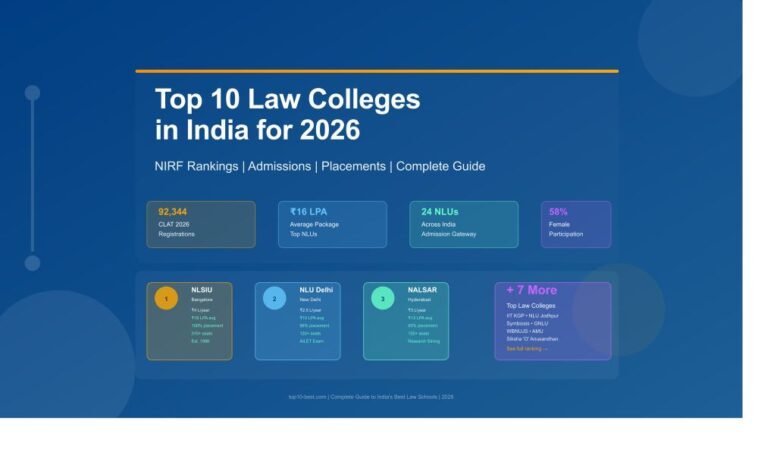
India’s legal education landscape is booming right now. If you’re thinking about studying law, the good news is you’ve got some world-class options to pick from. But here’s the thing: not all law colleges are created equal. Some dominate in placements, others shine in research and academics, and a few are known for their incredible alumni networks. We’ve done the homework so you don’t have to. In this guide, we’re breaking down the top 10 law colleges in India, complete with rankings, fees, placement stats, and everything else that matters for your decision.
Table of Contents
- Quick Facts About Law Education in India
- The Top 10 Law Colleges in India (NIRF 2026)
- Detailed College Profiles
- Important Statistics Table
- Pros and Cons Comparison
- College Comparison Matrix
- Latest Trends in Legal Education (2026)
- Frequently Asked Questions
- References and Sources
Quick Facts About Law Education in India 📊
- 92,344 students registered for CLAT 2026, the highest ever
- 96.83% attendance rate for undergraduate CLAT exams
- 24 National Law Universities (NLUs) across India are admission gateways
- Female participation jumped to 58% of total CLAT 2026 registrants (0.72:1 male-to-female ratio)
- ₹16 LPA average package from top law colleges like NLSIU Bangalore
- 100% placement rate at premier institutions like NLSIU and NLU Delhi
- NIRF Rankings evaluate colleges on teaching, research, placements, and perception
- Law is now among India’s top 3 career aspirations (alongside engineering and medicine)
The Top 10 Law Colleges in India (NIRF 2026)
1. National Law School of India University (NLSIU), Bangalore
NLSIU Bangalore is the gold standard of Indian legal education. Founded in 1986, it’s the country’s first National Law University and consistently ranks #1 in NIRF Law rankings since 2018. Think of it as the “Harvard of the East” — that’s how seriously the legal community takes this institution.
Key Highlights:
- NIRF Rank: 1 | NIRF Score: 80.52
- Admission: CLAT (BA LLB) | NLSAT (LLB, MPP)
- Annual Fee: ₹3.18-4.51 lakh
- Placement Rate: 100% | Average CTC: ₹16 LPA | Median: ₹19 LPA
- Seats: 310+ (BA LLB) | 50+ (LLB) | 25+ (LLM)
- Campus: 23 acres with smart classrooms, modern library, moot courts
- Top Recruiters: AZB & Partners, Cyril Amarchand Mangaldas, Trilegal, Indus Law
Why It Matters: NLSIU’s alumni dominate India’s top law firms and judiciary. The college invests heavily in mooting culture, case study learning, and internships. If you can crack the cutoff (usually AIR 101 for BA LLB), you’re set for a top-tier legal career.
2. National Law University, New Delhi (NLU Delhi)
NLU Delhi stands out because it’s the only major NLU that uses AILET (All India Law Entrance Test) instead of CLAT. Located in India’s capital, it has direct access to the Supreme Court, Parliament, and major policy-making institutions.
Key Highlights:
- NIRF Rank: 2 | NIRF Score: 76+
- Admission: AILET (BA LLB) | CLAT (LLM)
- Annual Fee: ₹2-3 lakh
- Placement Rate: 98%+ | Average CTC: ₹14-16 LPA
- Seats: 120 (BA LLB) | 60 (LLM)
- Campus: Central Delhi location with high-tech facilities
- Specialization: Constitutional law, PIL, and public interest litigation
Why It Matters: NLU Delhi’s location is a massive advantage. Students intern directly with the Supreme Court, government ministries, and think tanks like Observer Research Foundation. The alumni network here is incredibly strong in the judiciary and civil services.
3. NALSAR University of Law, Hyderabad
NALSAR has shown impressive growth in recent years, climbing the rankings and overtaking several competitors. It’s known for strong research output and international collaborations.
Key Highlights:
- NIRF Rank: 3 | NIRF Score: 75+
- Admission: CLAT
- Annual Fee: ₹2.5-3.5 lakh
- Placement Rate: 95%+ | Average CTC: ₹12-15 LPA
- Seats: 130 (BA LLB) | 40 (LLM)
- Research Focus: IP law, environmental law, technology law
- International Programs: Exchange programs with universities in the USA, UK, and Australia
Why It Matters: If you’re interested in research-driven legal education, NALSAR is fantastic. The faculty encourages publication and field research. Plus, Hyderabad’s booming IT industry means lots of internship opportunities in tech law.
4. Indian Institute of Technology Kharagpur, Department of Law
IIT KGP’s law school is unique because it’s embedded within an engineering powerhouse. This gives the college a distinct advantage in technology law, intellectual property, and innovation-focused legal education.
Key Highlights:
- NIRF Rank: 4 | Specialization: Technology Law & IP
- Admission: CLAT
- Annual Fee: ₹3-4 lakh
- Placement Rate: 95%+ | Average CTC: ₹13-15 LPA
- Seats: 60 (BA LLB)
- Unique Feature: Direct access to engineering expertise and tech industry
Why It Matters: If you want to combine law with technology, this is your place. The interdisciplinary approach is rare in Indian law schools. Companies like Microsoft, Google, and Indian tech firms actively recruit here for their legal and IP teams.
5. National Law University, Jodhpur (NLU Jodhpur)
NLU Jodhpur has built a reputation for strong faculty and rigorous academics. Located in Rajasthan, it serves as a hub for legal education in western India.
Key Highlights:
- NIRF Rank: 5 | NIRF Score: 71+
- Admission: CLAT
- Annual Fee: ₹2-2.5 lakh
- Placement Rate: 90%+ | Average CTC: ₹10-13 LPA
- Seats: 120 (BA LLB) | 35 (LLM)
- Strength: Alternative dispute resolution and corporate law
Why It Matters: Jodhpur offers quality education at a lower price point than the top two. Great if you’re budget-conscious but still want a solid NLU degree. The faculty-student ratio is impressive, meaning more one-on-one mentoring.
6. Symbiosis Law School, Pune
Symbiosis is one of India’s top private law colleges and has consistently ranked in the top 10 across various rankings. The infrastructure and industry connections are exceptional.
Key Highlights:
- NIRF Rank: 6 | Private College Excellence
- Admission: SLAT (Symbiosis Law Admission Test)
- Annual Fee: ₹5-6 lakh
- Placement Rate: 98%+ | Average CTC: ₹15-18 LPA
- Seats: 240+ (BA LLB and LLB)
- Campus: Ultra-modern facilities, multiple libraries, dedicated sports complex
- Industry Connections: Strong ties with top law firms and corporations
Why It Matters: If you don’t crack CLAT but want premium education, Symbiosis is the private sector’s best answer. The placement data rivals some NLUs. However, the cost is significantly higher than government colleges.
7. Gujarat National Law University (GNLU), Gandhinagar
GNLU has emerged as a rising star, known for progressive curriculum and emphasis on clinical legal education. The university encourages hands-on learning through legal aid clinics and community outreach.
Key Highlights:
- NIRF Rank: 7 | NIRF Score: 70+
- Admission: CLAT
- Annual Fee: ₹2.5-3 lakh
- Placement Rate: 92%+ | Average CTC: ₹11-14 LPA
- Seats: 140 (BA LLB) | 40 (LLM)
- Unique Feature: Legal clinics and public interest law focus
Why It Matters: GNLU is gaining traction among CLAT toppers who care about social impact. The clinical legal education means you’ll get real-world experience early. Great if you want to eventually work with NGOs or in public interest litigation.
8. West Bengal National University of Juridical Sciences (WBNUJS), Kolkata
WBNUJS is one of India’s older and most respected NLUs, with a legacy spanning decades. Located in Kolkata, it has strong alumni in the judiciary and corporate sector.
Key Highlights:
- NIRF Rank: 8 | NIRF Score: 68+
- Admission: CLAT
- Annual Fee: ₹2-2.5 lakh
- Placement Rate: 92%+ | Average CTC: ₹11-14 LPA
- Seats: 130 (BA LLB) | 40 (LLM)
- Strength: Intellectual property and research-focused curriculum
- Mooting Culture: Strong tradition of moot courts and legal competitions
Why It Matters: WBNUJS has a long-standing reputation in eastern India. The library is massive, and the research culture is strong. If you’re looking for a balance between rigorous academics and good placements, this college delivers.
9. Aligarh Muslim University (AMU), Faculty of Law
AMU has a unique legacy spanning over a century. The law faculty here combines traditional values with modern legal education, offering programs at undergraduate, postgraduate, and doctoral levels.
Key Highlights:
- NIRF Rank: 9 | Legacy Institution (100+ years)
- Admission: CLAT, LSAT
- Annual Fee: ₹1.5-2 lakh (most affordable)
- Placement Rate: 85%+ | Average CTC: ₹8-11 LPA
- Seats: 150 (BA LLB) | 50 (LLM)
- Unique Aspect: Minority institution with diverse student body
- Research Centers: Active legal research and publication programs
Why It Matters: If affordability is key, AMU is unbeatable. The legal education here is solid, and the college has a strong alumni presence in the judiciary. Also, the diverse campus adds cultural value to your education.
10. Siksha ‘O’ Anusandhan (SOA) University, Bhubaneswar
SOA is a rising star in the law education space. Located in Odisha, it offers competitive fees and growing placement records. The institution is known for industry-academic partnerships.
Key Highlights:
- NIRF Rank: 10 | Rising Star Status
- Admission: SOA entrance test / CLAT
- Annual Fee: ₹2.5-3.5 lakh
- Placement Rate: 88%+ | Average CTC: ₹10-13 LPA
- Seats: 180 (BA LLB) | 30 (LLM)
- Strength: Industry partnerships and practical training
- Campus: Modern infrastructure with moot courts and libraries
Why It Matters: SOA is a newer entrant to the top 10 but is catching up fast. If you want an emerging institution with good infrastructure and industry connections at mid-range fees, it’s worth considering.
Important Law Education Statistics Table
| Metric | Data | Source |
|---|---|---|
| CLAT 2026 Total Registrations | 92,344 candidates | Consortium of NLUs |
| CLAT 2026 Attendance Rate (UG) | 96.83% | CLAT 2026 Official Data |
| CLAT 2026 Attendance Rate (PG) | 92.45% | CLAT 2026 Official Data |
| CLAT 2026 Female Participation | 58% (male-female ratio 0.72:1) | CLAT 2026 Statistics |
| Number of National Law Universities | 24 NLUs across 22 states | Ministry of Education |
| Average Fee (Government NLUs) | ₹2-4 lakh per year | NIRF 2025 Data |
| Average Fee (Private Law Colleges) | ₹5-8 lakh per year | Various College Sources |
| Average Placement Package (Top NLUs) | ₹14-18 LPA | NIRF 2025 Placement Report |
| Highest Placement Package (NLSIU) | ₹45 LPA | NLSIU Placement Data 2024 |
| Placement Rate (NLSIU Bangalore) | 100% | NIRF 2025 |
| Number of Law Colleges in India | 500+ across all categories | Bar Council of India |
| Year NLSIU Established | 1986 (first NLU) | Official Records |
| NIRF Law Ranking Updates | Annually in September | Ministry of Education |
Pros and Cons Comparison Table
| Aspect | Government NLUs | Private Law Colleges | Deemed Universities |
|---|---|---|---|
| Cost | Very affordable (₹2-4L) | Expensive (₹5-8L+) | Moderate (₹4-6L) |
| Placement Rate | Excellent (95-100%) | Good (90-98%) | Good (85-95%) |
| Admission Competitiveness | Very competitive (CLAT/AILET) | Less competitive | Moderate |
| Faculty Quality | Highly qualified | Mixed quality | Good to excellent |
| Research Opportunities | Strong research culture | Decent | Good to strong |
| Internship Access | Direct with courts/government | With firms and corporations | Mixed opportunities |
| Alumni Network | Very strong (judiciary, policy) | Strong (corporate) | Growing |
| Infrastructure | Good to excellent | Premium facilities | Very good |
| Diversity | High (merit-based) | Less diverse | Moderate diversity |
| Campus Life | Vibrant with limited campus | Premium campus amenities | Good campus experience |
| Flexibility | Rigid curriculum | More flexibility | Moderate |
| Value for Money | Excellent | Poor | Good |
College Comparison Matrix: Top 5 NLUs at a Glance
| College | NIRF Rank | Admission | Avg Fee | Avg CTC | Placement | Strength |
|---|---|---|---|---|---|---|
| NLSIU Bangalore | 1 | CLAT | ₹4 L | ₹16 LPA | 100% | Corporate law, mooting, all-round excellence |
| NLU Delhi | 2 | AILET | ₹2.5 L | ₹15 LPA | 98% | Constitutional law, PIL, proximity to Supreme Court |
| NALSAR Hyderabad | 3 | CLAT | ₹3 L | ₹13 LPA | 95% | Research, IP law, international programs |
| IIT KGP Law | 4 | CLAT | ₹3.5 L | ₹14 LPA | 95% | Technology law, IP, interdisciplinary approach |
| NLU Jodhpur | 5 | CLAT | ₹2.2 L | ₹12 LPA | 90% | Affordable NLU, strong faculty, ADR focus |
How to Choose the Right Law College for You
Step 1: Check Your CLAT Rank or Score Your rank determines your options. AIR 100-200? You’re looking at NLSIU, NLU Delhi. AIR 500-1000? NALSAR and other top NLUs are realistic. AIR 2000+? Consider GNLU, NLU Jodhpur, or private colleges.
Step 2: Decide Between Government and Private Government NLUs offer unbeatable value and strong placements. Private colleges cost more but offer premium infrastructure. Your budget and preferences matter here.
Step 3: Pick Your Specialization Area Want corporate law? NLSIU and Symbiosis dominate. Interested in IP law? NALSAR and IIT KGP are specialists. Public interest law? GNLU and WBNUJS excel here.
Step 4: Consider Geographic Location Think about where you want to practice law. Bangalore and Delhi have the biggest legal markets. Hyderabad’s IT sector is perfect for tech law. Consider proximity to family too.
Step 5: Evaluate Campus and Alumni Network Strong alumni networks lead to internships and jobs. Check placement records, not just college rankings. Visit campuses if possible.
Step 6: Look at Fees vs. ROI Top NLUs charge ₹2-4 lakh annually; private colleges charge ₹5-8 lakh+. Calculate return on investment based on average placement packages. A ₹18 LPA job from a ₹4L/year NLU is better ROI than ₹16 LPA from an ₹8L/year college.
Latest Trends in Legal Education (2026) 🚀
1. Surge in Female Participation Female candidates now represent 58% of CLAT 2026 participants (0.72:1 male-to-female ratio). This is a huge shift. Law is no longer male-dominated—it’s increasingly female-led. Colleges are responding with better facilities, mentorship programs, and gender-inclusive policies.
2. Technology and Law Integration More colleges are offering courses in cybersecurity law, blockchain, data privacy, and AI ethics. Employers are actively recruiting law graduates for these emerging fields. IIT KGP’s approach is becoming the model other colleges follow.
3. Clinical Legal Education Expansion Legal clinics and pro bono work are now core curriculum, not optional add-ons. Colleges like GNLU are leading this charge. Students graduate with real-world experience, not just theoretical knowledge.
4. Research and Publication Push NIRF rankings now heavily weight research output. Colleges are encouraging students and faculty to publish in indexed journals. This is shifting the culture from exam-focused to research-focused learning.
5. International Collaboration Growth Exchange programs, joint degree programs, and international internships are booming. NALSAR and other top NLUs now have formal partnerships with universities in the US, UK, Australia, and Singapore.
6. Alternative Career Paths Gaining Traction Besides traditional law practice, graduates now pursue careers in mediation, arbitration, policy think tanks, NGOs, and corporate legal departments. Colleges are diversifying their curriculum to support these paths.
7. Digital Learning Tools Online moot court simulations, AI-powered legal research tools, and virtual internships became mainstream post-2020 and are here to stay. Colleges with tech-savvy faculties have an edge.
8. Emphasis on Soft Skills Negotiation, communication, leadership, and emotional intelligence are now as valued as legal knowledge. Colleges with strong co-curricular programs stand out to employers.
Frequently Asked Questions (FAQs)
CLAT is used by most NLUs (National Law Universities) and is conducted by the Consortium of NLUs. AILET is NLU Delhi’s exclusive entrance exam. Both test legal reasoning and aptitude. CLAT is taken by ~92,000 candidates; AILET by ~20,000. AILET has slightly lower competition but is used by only one major NLU.
Technically, yes. Private colleges like Symbiosis use their own entrance tests (SLAT). Some colleges accept board marks instead. However, CLAT-based colleges are considered more prestigious because of their competitive selection. If you miss CLAT, private colleges and deemed universities are your best bets.
Excellent. India’s legal market is growing at 12-15% annually. Demand for lawyers is highest in corporate law, IP law, and litigation. Government jobs (judiciary, civil services) are also competitive. Private sector jobs start at ₹10-15 LPA for NLU graduates, rising to ₹20+ LPA in 5 years.
No. While NIRF is reliable, also check placement data, alumni reviews, faculty quality, and campus culture. Some colleges outside the top 10 but within top 20 might suit your specific goals better. Research thoroughly.
Depends on your CLAT rank and financial situation. If you scored AIR 3000+ and can’t get into your preferred NLU, Symbiosis or JGLS are good alternatives. But if you can make a mid-tier NLU, go there. NLU degree carries more weight in the legal
Very important in the first job, moderately important later. A NLSIU graduate has an edge in landing that ₹18 LPA job initially. But after 5 years of good work, your experience matters more than your college. However, top colleges open doors faster, which can accelerate your career.
Top 5 NLUs need 140-150/150 (95th+ percentile). Top 10 NLUs need 120-140 (85th-95th percentile). Mid-tier NLUs need 100-120 (75th+ percentile). Obviously, these are ballpark figures and vary yearly based on competition and paper difficulty.
Very difficult. Once you’re allotted a seat at a college, switching isn’t allowed within the CLAT-allotment process. You’d have to quit and reappear for the next year’s CLAT, which is impractical. Choose wisely.
Hostel fees range from ₹40,000-80,000 per year at government NLUs (highly subsidized). Private colleges charge ₹1.5-2.5 lakh per year for hostel. This is separate from tuition fees. Many colleges offer scholarships for merit and economically disadvantaged students.
Absolutely. Law is among India’s top 3 career aspirations now, alongside engineering and medicine. Job growth is outpacing supply. Salary growth is steady. However, it’s a demanding field—long hours, competitive environment, high stress initially. Make sure you’re genuinely interested in law, not just picking it because placements are good.
References and Sources
- National Institution Ranking Framework (NIRF) 2025 — Ministry of Education, Government of India https://www.nirfindia.org/
- CLAT 2026 Official Statistics — Consortium of National Law Universities https://www.consortiumofnlus.ac.in/
- National Law School of India University (NLSIU) Bangalore — Official Website https://www.nls.ac.in/
- National Law University, New Delhi — Official Website https://www.nludelhi.ac.in/
- NALSAR University of Law, Hyderabad — Official Website https://www.nalsar.ac.in/
- Symbiosis Law School, Pune — Official Website https://www.sls.edu.in/
- Career360 Law Rankings 2026 — Comprehensive CLAT and Law College Database https://law.careers360.com/
- Shiksha.com Law College Profiles — Educational Database with Real-time Data https://www.shiksha.com/law/
- Bar Council of India — Legal Education Regulatory Body https://www.barcouncilindia.org/
- India Today Ranking 2025 — Independent Educational Rankings https://www.indiatoday.in/education/
- Statista Education Report 2026 — Global and Indian Higher Education Trends https://www.statista.com/
- World Bank Education Statistics — Global Legal Education Context https://data.worldbank.org/
Final Thoughts
Choosing a law college is one of the most important decisions of your educational journey. The data is clear: top NLUs like NLSIU Bangalore, NLU Delhi, and NALSAR Hyderabad deliver world-class legal education at affordable prices. But that doesn’t mean you need AIR 100 to have a brilliant law career.
The truth is, thousands of lawyers practice successfully from colleges ranked outside the top 10. What matters most is your dedication, curiosity, and willingness to put in the work. Your college opens doors; your effort keeps them open.
If you’re serious about law, aim high on CLAT. But also have realistic backup options. And most importantly, choose a college where you’ll be happy—because four years is a long time to be miserable, even at a prestigious institution.
Good luck with your law journey. The profession needs sharp, ethical lawyers who care about justice. We hope this guide helps you find your perfect fit.
Last updated: May 23, 2026 Based on official NIRF rankings, placement data, and college websites



GIPHY App Key not set. Please check settings