 Balakumar L
Introduction
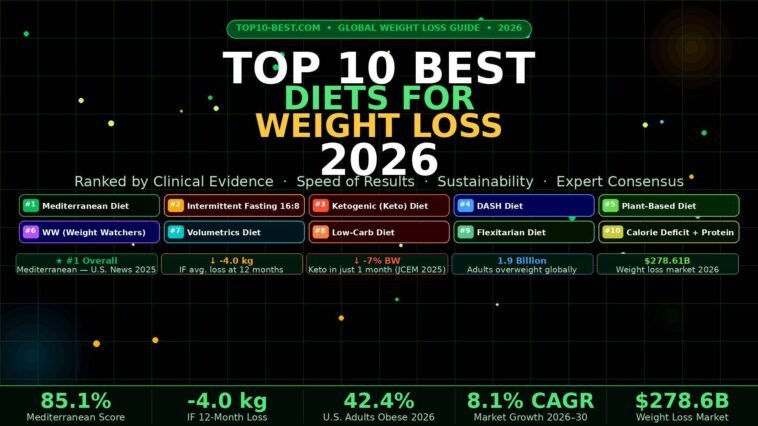
Over 1.9 billion adults worldwide are overweight, and more than 1 billion are living with obesity — those are WHO figures from 2022, and the trend hasn’t reversed. With the global weight loss and diet management market valued at $278.61 billion in 2026 (Research and Markets), everyone from tech startups to century-old pharmaceutical companies is selling you a solution.
But here’s the uncomfortable truth most diet brands won’t say out loud: no single diet is best for everyone. The science is clear on that. What works is a diet that creates a sustainable calorie deficit, fits your lifestyle, and you can actually stick to for more than six weeks.
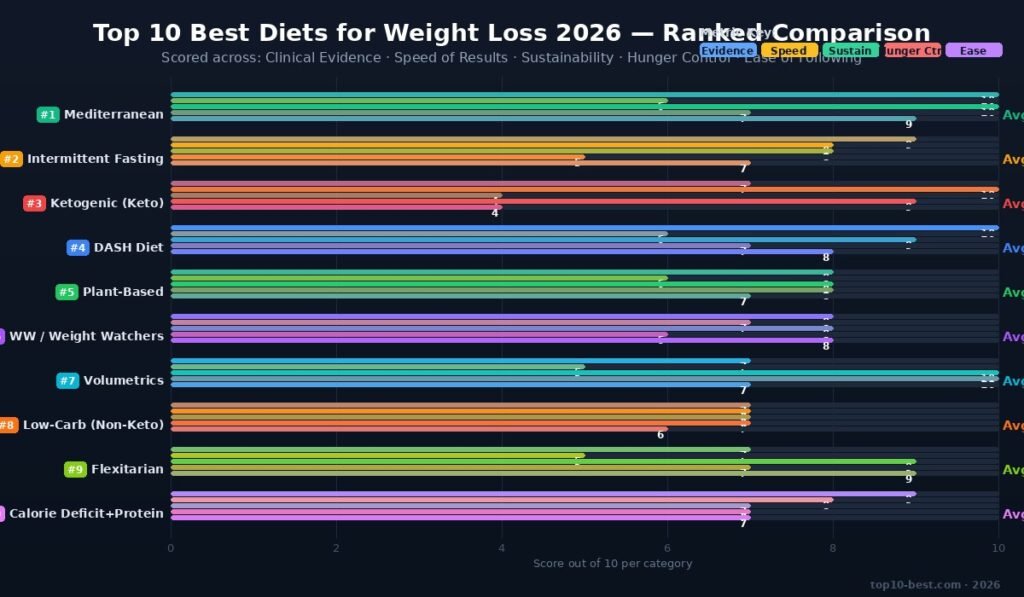
So instead of hype, this guide gives you the top 10 best diets for weight loss in 2026, ranked by clinical evidence, speed of results, ease of adherence, and long-term sustainability. Every ranking is tied to published research or expert consensus — not social media trends.
Medical Disclaimer: This article is for informational purposes only. Consult a registered dietitian or physician before starting any new diet, especially if you have a chronic health condition.
Image: Mediterranean diet — colorful vegetables, fish, olive oil and whole grains — the gold standard diet for weight loss in 2026
Table of Contents
- Key Highlights
- Top 10 Best Diets for Weight Loss 2026
- Weight Loss & Diet Market Statistics Table
- How to Choose the Right Diet (Step-by-Step)
- Pros & Cons Table
- Comparison Table: Top 5 Diets Side-by-Side
- 2026 Diet Trends
- FAQ
- References
Key Highlights
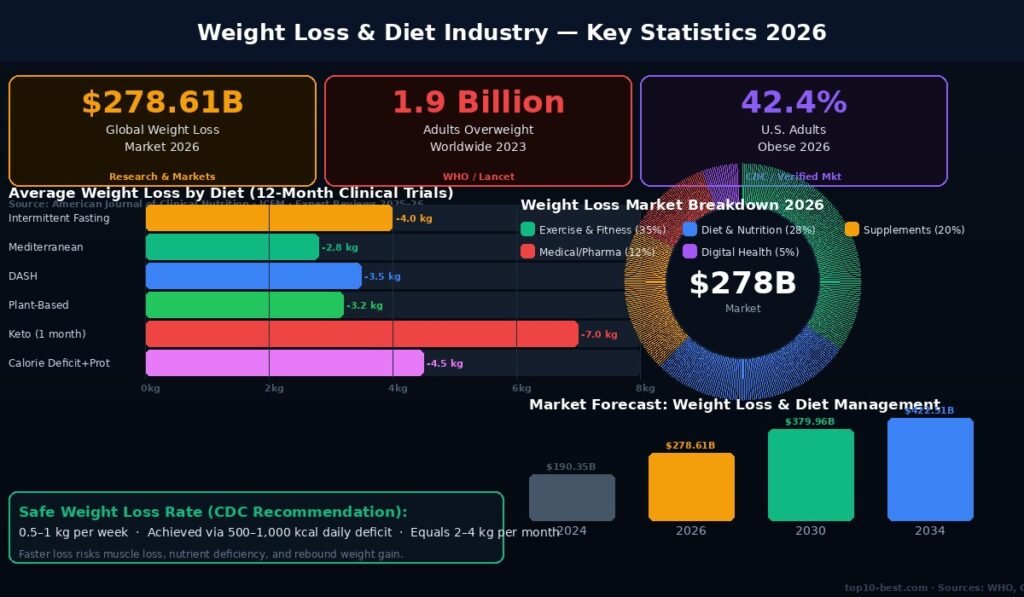
- The global weight loss and obesity management market is valued at $278.61 billion in 2026 (Research and Markets, 2026)
- 1.9 billion adults were overweight worldwide as of 2023, with 650 million classified as obese (WHO / Market Data Forecast, 2026)
- The Mediterranean diet is rated #1 for overall health and sustainability by the U.S. News & World Report expert panel (2025)
- Intermittent Fasting (IF) produced the highest average weight loss of -4.0 kg over 12 months in a real-world clinical trial (American Journal of Clinical Nutrition, 2020)
- 42.4% of U.S. adults were classified as obese in 2026, one of the highest rates globally (Verified Market Reports, 2026)
- The CDC recommends a safe weight loss rate of 0.5–1 kg per week through a daily calorie deficit of 500–1,000 kcal
- A ketogenic diet can cause body weight to decrease by 7% in just one month in women with obesity (Journal of Clinical Endocrinology & Metabolism, 2025)
- Plant-based and low-carb diets are the two fastest-growing dietary segments, driven by environmental and metabolic health awareness
Top 10 Best Diets for Weight Loss 2026
1. Mediterranean Diet — Best Overall for Sustainable Weight Loss
Type: Balanced eating pattern | Speed of Results: Gradual (2–4 kg in 12 months) | Difficulty: Easy
The Mediterranean diet is not a rigid plan — it’s a way of eating inspired by the traditional food habits of countries like Greece, Italy, and Spain. It emphasizes vegetables, fruits, whole grains, legumes, fish, olive oil, nuts, and moderate dairy, while limiting red meat, processed foods, and added sugar.
It was rated the number one diet by health experts in the 2025 edition of U.S. News & World Report: Best Diets Overall, featuring fresh food from the sea and local farms, including fats from olive oil and nuts, vegetables, fruits, eggs, whole grains, low-fat dairy, and herbs and spices for taste. A 12-month clinical trial (American Journal of Clinical Nutrition, 2020) showed Mediterranean diet participants lost an average of -2.8 kg with significant blood pressure reductions. It also reduces risk of heart disease, type 2 diabetes, and cancer.
The truth is, you won’t lose 10 kg in a month on this diet. But two years in, you’ll still be following it — and that’s exactly the point.
Best for: Long-term weight management, heart health, beginners, family-friendly eating Foods to eat: Fish, olive oil, vegetables, whole grains, legumes, nuts, fruits Foods to limit: Red meat, processed foods, refined sugar, fast food
2. Intermittent Fasting (16:8 Method) — Best for Busy Lifestyles
Type: Time-restricted eating | Speed of Results: Moderate–Fast (-4 kg in 12 months) | Difficulty: Moderate
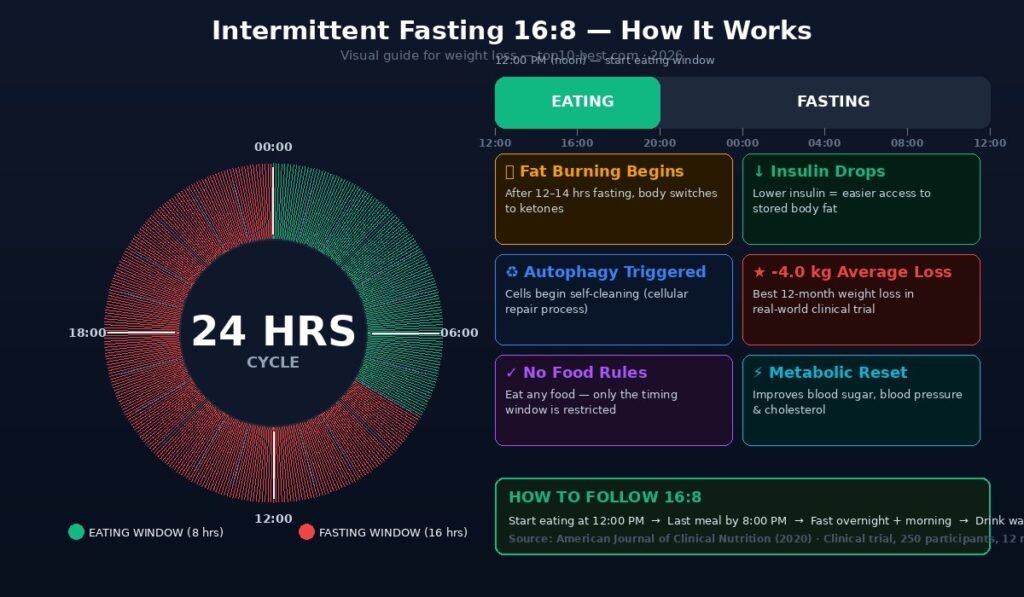
Intermittent Fasting (IF) doesn’t tell you what to eat — it tells you when to eat. The 16:8 method means eating within an 8-hour window (e.g., 12pm–8pm) and fasting for 16 hours, including overnight. No calorie counting required.
At 12 months, weight loss in Intermittent Fasting participants was -4.0 kg (95% CI: -5.1, -2.8 kg), the highest of three diets tested alongside Mediterranean and Paleolithic approaches, in a 250-person real-world clinical trial. A 2026 Cochrane review also confirmed IF as one of the most effective and practised strategies. The mechanism is simple: shortening your eating window naturally reduces total calorie intake for most people, without requiring food restriction.
The challenge? Hunger during fasting windows, and the social awkwardness of skipping breakfast with colleagues.
Best for: People who prefer skipping breakfast, busy professionals, those who dislike calorie counting Protocol: 16 hours fasting / 8 hours eating — eat normally, no food after 8pm Evidence rating: Strong — multiple RCTs and one of the highest real-world adherence rates
3. Ketogenic (Keto) Diet — Best for Fast Initial Results
Type: Very low-carb, high-fat | Speed of Results: Very Fast (5–10 kg in first 1–2 months) | Difficulty: Hard
The Ketogenic diet cuts carbohydrates to under 50g per day (sometimes under 20g), forcing the body into a metabolic state called ketosis. In ketosis, your liver produces ketone bodies from fat as the primary fuel source instead of glucose. The result: your body becomes a fat-burning machine.
A 2025 clinical study published in the Journal of Clinical Endocrinology & Metabolism found that after just one month on a very-low-calorie ketogenic diet, body weight decreased by 7%, reflecting an 8.8% reduction in fat mass in women with obesity. The diet restricts carbohydrates to maximum 50g daily, with moderate protein and 60% to 75% of calories from fat, emphasizing carbohydrate restriction as the primary driver of ketosis.
The catch? Maintaining long-term adherence to the ketogenic diet is difficult because its strict macronutrient restrictions can be hard to follow in daily life — social events, family meals, and the need for constant meal planning often reduce sustainability. It’s also not ideal for people with liver or kidney issues. But for rapid fat loss in the short term, no diet on this list works faster.
Image: Ketogenic diet food — avocado, eggs, meat, and low-carb vegetables for rapid weight loss
Best for: Fast initial fat loss, people with insulin resistance, low-carb food lovers Macros: Fat 60–75%, Protein 15–30%, Carbs under 5–10% Caution: “Keto flu” in first 1–2 weeks; not suitable for people with pancreatic or liver disease
4. DASH Diet — Best for Weight Loss with High Blood Pressure
Type: Balanced, low-sodium eating plan | Speed of Results: Gradual | Difficulty: Easy–Moderate
DASH stands for Dietary Approaches to Stop Hypertension, and it was originally designed to lower blood pressure — not lose weight. But it works for both. The plan emphasizes fruits, vegetables, whole grains, lean proteins, and low-fat dairy while cutting sodium, saturated fats, and added sugars.
The DASH diet is best for high blood pressure among the top-ranked diets in 2026, receiving a score of 75.4% in U.S. News & World Report expert rankings, behind only the Mediterranean diet at 85.1%. Research shows it can lower systolic blood pressure by 8–14 mmHg while supporting steady fat loss through its emphasis on low-calorie-density foods.
If you have both high blood pressure and weight to lose, DASH is the most clinically supported diet you can follow.
Best for: Hypertension, heart disease risk, women over 40, balanced nutrition seekers Daily targets: 4–5 servings vegetables, 4–5 fruit, 6–8 whole grains, 2–3 low-fat dairy, under 2,300mg sodium
5. Plant-Based Diet — Best for Long-Term Weight and Health
Type: Whole food, mostly plant | Speed of Results: Moderate | Difficulty: Easy–Moderate
A plant-based diet doesn’t necessarily mean vegan. It means making plants — vegetables, fruits, legumes, whole grains, nuts, and seeds — the foundation of every meal, while reducing or eliminating animal products. The high fiber content keeps you full, the caloric density is lower, and the micronutrient profile is excellent.
Plant-based diets have good evidence for health benefits in terms of weight management, and the evidence base continues to grow, though low-carb and ketogenic diets have stronger evidence specifically for short-term weight loss. Multiple meta-analyses show that people on whole-food plant-based diets tend to have lower BMI than omnivores, even without counting calories, because fiber-rich food naturally regulates appetite.
Watch out for hidden calorie bombs — avocados, nuts, and plant-based processed foods can rack up calories fast if you’re not mindful.
Image: Plant-based diet — colorful vegetables, legumes, and whole grains for healthy sustainable weight loss
Best for: Environmental consciousness, long-term health, reducing chronic disease risk, ethical eaters Key foods: Lentils, chickpeas, tofu, tempeh, quinoa, leafy greens, berries, sweet potatoes Watch: Ensure adequate protein, B12, Iron, and Omega-3s (supplement if fully vegan)
6. WW (Weight Watchers) Program — Best Structured Accountability System
Type: Points-based structured program | Speed of Results: Moderate | Difficulty: Easy (with app support)
WW — formerly Weight Watchers — has been helping people lose weight since 1963. What makes it effective isn’t any particular food rule; it’s the accountability structure, app-based tracking, and community support. Every food is assigned a point value (PersonalPoints). You get a daily budget. Eat what you want — just stay within it.
Research consistently supports WW’s effectiveness. A Cochrane review of 9 RCTs found that WW participants lost significantly more weight at 12 months than those receiving brief counselling. Healthline’s dietitian-reviewed article (updated May 2026) rates WW among the best weight loss programs available. The app is excellent, and weekly check-ins provide the social accountability most people need to stay on track.
It costs money (around $13–$23/month), but the structure often justifies the investment for people who struggle with self-discipline alone.
Best for: People who want structure, accountability, community; those who’ve failed at solo dieting Cost: Approximately $13–$23/month (subscription-based) App: Excellent — barcode scanning, meal tracking, coaching
7. Volumetrics Diet — Best for Constant Hunger (Eat More, Weigh Less)
Type: Calorie density-based eating | Speed of Results: Gradual | Difficulty: Easy
Created by Penn State nutrition professor Dr. Barbara Rolls, the Volumetrics diet is built on one idea: eat foods with the lowest calorie density for the largest volume. So a massive bowl of vegetable soup keeps you just as full as a small bag of chips — but at a fraction of the calories.
The Volumetrics diet is best for fullness per calorie in weight loss among 2026-ranked diets, according to the expert evaluation framework scoring strength of evidence, nutritional adequacy, and sustainability. Foods are categorized by calorie density: water-rich foods like fruits, vegetables, and broth-based soups sit in Category 1 (very low density), while nuts, cheese, and cookies are Category 4 (very high density). You eat more of Categories 1 and 2.
It’s not a quick-loss diet — it’s a hunger management system. And for people who quit diets because they’re always starving, it’s a complete game-changer.
Best for: People who quit diets due to hunger, chronic overeaters, anyone who hates feeling restricted Core principle: Fill up on water-rich, high-fiber, low-calorie-density foods Evidence: Strong — multiple peer-reviewed publications from Penn State
8. Low-Carb Diet (Non-Keto) — Best Flexible Carb Reduction
Type: Reduced carbohydrate eating | Speed of Results: Moderate–Fast | Difficulty: Easy–Moderate
Not everyone wants to go full keto. The low-carb diet (non-keto) cuts carbohydrates to around 100–130g per day — much less than the standard Western diet of 250–350g, but far more flexible than keto’s 20–50g limit. This allows some fruits, legumes, and occasional whole grains, making it significantly easier to sustain.
A 2023 randomized trial published in Annals of Family Medicine comparing very low-carbohydrate versus DASH diets in overweight adults with hypertension found both approaches produced meaningful weight loss, with the low-carb group showing stronger results for blood glucose control. Low-carb eating reduces insulin spikes, lowers hunger hormones, and typically leads to natural calorie reduction without strict counting.
This is the best middle ground for anyone who knows keto is too extreme but also knows bread and pasta are their biggest dietary weakness.
Best for: Carb-sensitive individuals, people with insulin resistance, moderate dieters Daily carbs: 100–130g (vs 250–350g standard Western, vs 20–50g keto) Foods: Eggs, meat, fish, non-starchy vegetables, cheese, nuts, some legumes
9. Flexitarian Diet — Best for People Who Don’t Want to Quit Meat Entirely
Type: Flexible vegetarian | Speed of Results: Gradual | Difficulty: Very Easy
The Flexitarian diet is exactly what it sounds like — mostly vegetarian, with occasional meat. No foods are banned. The goal is simply to shift the balance of your plate toward more plants and less animal protein, most days of the week.
The Mediterranean and Flexitarian diets are the most flexible and family-friendly options for 2026, adapting well to various cultural food preferences and restaurant dining situations, making them ideal for those with busy social schedules. Research shows flexitarian dieters tend to have lower BMI, better blood sugar control, and reduced cardiovascular risk compared to omnivores — similar to full vegetarians, but without the social and practical friction.
If you know a plant-rich diet is healthier but can’t imagine never eating chicken again, this is your diet.
Best for: Meat lovers wanting to transition, families with mixed dietary preferences, beginners Rule: Make 80% of meals plant-based; enjoy meat or fish 3–4 times per week Weight loss: 0.5–1 kg/month on average, steady and sustainable
10. Calorie Deficit + High Protein Diet — Best for Flexible, Science-First Weight Loss
Type: Calorie controlled, high protein | Speed of Results: Fast and controlled | Difficulty: Moderate
If every diet on this list sounds too restrictive or too complicated, here’s the most honest option: eat less than you burn, and prioritize protein. No food groups eliminated. No eating windows. No points. Just a calorie deficit (typically 500 kcal below your TDEE) combined with high protein intake (1.6–2.2g per kg of body weight) to preserve muscle mass during fat loss.
The calorie deficit approach is the diet plan most compatible with AI calorie tracking in 2026 — requiring no food restriction, only awareness, with a flexible deficit of 300 to 500 calories below TDEE while hitting protein targets. High protein keeps you full, protects lean muscle, and boosts metabolic rate through the thermic effect of food. Tracked via apps like MyFitnessPal, Cronometer, or AI tools, this is the most flexible and customizable approach available.
The CDC recommends aiming for 0.5–1 kg per week as a safe, sustainable rate of loss — achievable with a 500–1,000 calorie daily deficit combined with adequate protein.
Best for: Data-driven individuals, gym-goers, people who’ve tried every diet and want control Protein target: 1.6–2.2g per kg body weight daily Tools: MyFitnessPal, Cronometer, Welling AI, any food tracking app
Weight Loss & Diet Market Statistics Table (2026)
| Metric | Data | Source |
|---|---|---|
| Global weight loss & obesity management market | $278.61 billion (2026) | Research and Markets, 2026 |
| Projected market value by 2030 | $379.96 billion | Research and Markets, 2026 |
| Market CAGR (2026–2030) | 8.1% | Research and Markets, 2026 |
| Global adults overweight (2023) | 1.9 billion | WHO / Market Data Forecast, 2026 |
| Global adults obese (2022) | Over 1 billion | WHO / The Lancet, 2024 |
| U.S. adults classified as obese (2026) | 42.4% | Verified Market Reports, 2026 |
| U.S. adults obese per CDC (2023) | 41.9% | CDC / Market Data Forecast, 2026 |
| Mediterranean diet U.S. News score | 85.1% | U.S. News & World Report, 2025 |
| DASH diet U.S. News score | 75.4% | U.S. News & World Report, 2025 |
| IF weight loss at 12 months (clinical trial) | -4.0 kg average | American Journal of Clinical Nutrition, 2020 |
| Keto body weight reduction (1 month) | -7% of body weight | Journal of Clinical Endocrinology & Metabolism, 2025 |
| Safe weekly weight loss rate (CDC) | 0.5–1 kg/week | U.S. Centers for Disease Control and Prevention |
How to Choose the Right Diet for Weight Loss (Step-by-Step)
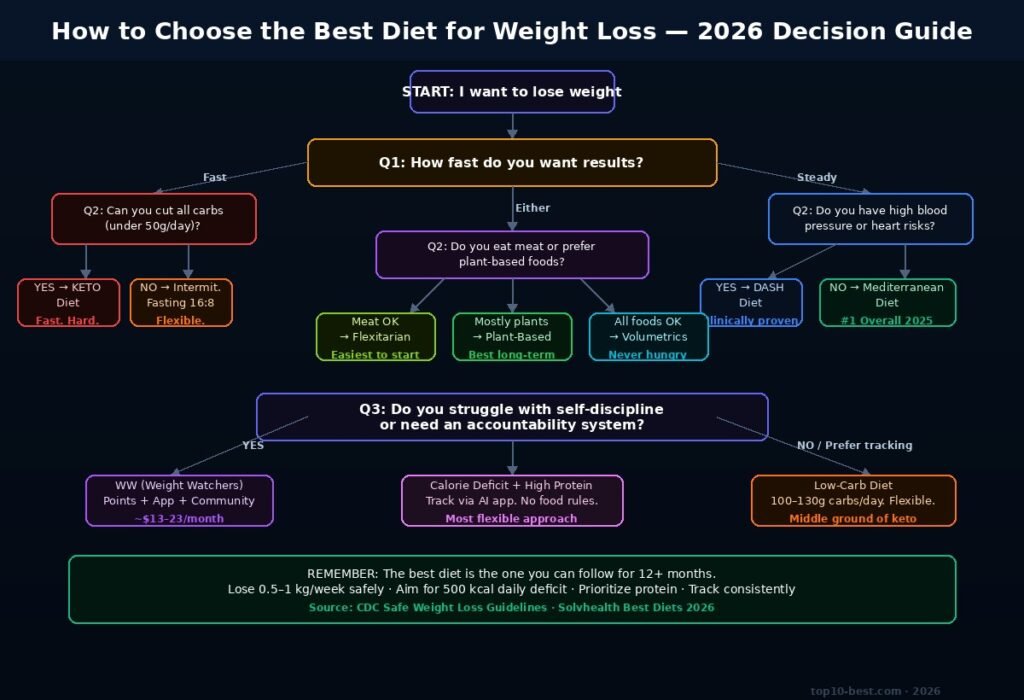
Picking a diet is one of the most personal health decisions you can make. Here’s a practical framework.
Step 1 — Know Your Baseline Calculate your TDEE (Total Daily Energy Expenditure) using any free online calculator. Enter your age, height, weight, and activity level. This gives you your maintenance calories. A deficit of 500 kcal/day = roughly 0.5 kg of fat loss per week.
Step 2 — Identify Your Biggest Eating Problem Do you eat too much at night? Overeat during social situations? Snack mindlessly? The right diet addresses your specific pattern. Night overeaters do well with Intermittent Fasting. Carb-cravers benefit from low-carb or keto. Portion-size strugglers thrive on Volumetrics.
Step 3 — Match the Diet to Your Life A keto diet at an Italian family dinner is a disaster waiting to happen. Pick a diet you can follow on holidays, weekends, and work trips. Mediterranean and Flexitarian are the most socially adaptable. WW’s point system works anywhere.
Step 4 — Consider Your Health Conditions High blood pressure → DASH diet. Insulin resistance or prediabetes → Low-carb or Keto. Heart disease risk → Mediterranean. Gut health issues → Plant-based diet with prebiotics. Always discuss major dietary changes with your doctor first.
Step 5 — Track for 4 Weeks, Then Evaluate Weigh yourself weekly (same time, same day). Track food honestly using an app for at least the first month. If you’re not losing 0.3–0.5 kg per week after 4 weeks, reduce portion sizes by 10–15% or increase daily steps. Adjust — don’t quit.
Pros & Cons Table
| Diet | Pros | Cons |
|---|---|---|
| Mediterranean | #1 ranked, sustainable, heart-healthy, flexible, culturally adaptable | Slower weight loss; no structured meal plan |
| Intermittent Fasting | No food restrictions, highest 12-month loss in clinical trials | Hunger in fasting window; not ideal for diabetics |
| Ketogenic | Fastest fat loss, reduces hunger, lowers insulin | Very hard to sustain; “keto flu”; limits fruit and legumes |
| DASH | Best for BP + weight loss combo, clinically proven | Requires meal planning and sodium tracking |
| Plant-Based | Lower BMI, environmental benefits, high fiber | Risk of B12, iron, Omega-3 deficiency if vegan |
| WW | Structured, app-supported, proven long-term results | Monthly subscription cost; points tracking can feel tedious |
| Volumetrics | No hunger, eat large volumes, good variety | Requires cooking water-rich meals; slower results |
| Low-Carb (non-keto) | Flexible, reduces insulin spikes, no extreme restriction | Still requires discipline; slower than keto |
| Flexitarian | Easy to start, family-friendly, no banned foods | Less structured; can easily drift back to old habits |
| Calorie Deficit + Protein | Maximum flexibility, works for everyone, trackable | Requires logging; no emotional/behavioral support built-in |
Comparison Table: Top 5 Diets Side-by-Side
| Feature | Mediterranean | Intermittent Fasting | Keto | DASH | Plant-Based |
|---|---|---|---|---|---|
| Speed of Loss | Gradual | Moderate–Fast | Very Fast | Gradual | Moderate |
| Avg. Weight Loss (12 mo) | -2.8 kg | -4.0 kg | Up to -10%+ | -3–4 kg | -2–4 kg |
| Food Restrictions | Minimal | Time-based only | Carbs under 50g | Low sodium | No meat (or reduced) |
| Hunger Management | Good | Moderate | Excellent | Good | Very good |
| Sustainability (1–2 years) | Excellent | Good | Poor–Moderate | Good | Good |
| Best Health Benefit | Heart health | Metabolic | Insulin/blood sugar | Blood pressure | Gut & heart health |
| Difficulty | Easy | Moderate | Hard | Easy–Moderate | Easy–Moderate |
| Expert Ranking (U.S. News) | #1 Overall | Top 10 | Mid-tier | #2 Overall | Top 5 |
2026 Trends in Weight Loss Diets
A few things are genuinely shifting how people diet in 2026.
GLP-1 drugs are changing the conversation. Ozempic, Wegovy, Mounjaro, and Zepbound (FDA-approved 2023) have made pharmaceutical weight loss a mainstream option. In 2026, the drugs segment is projected to lead the global weight loss and obesity management market by treatment type, accounting for an estimated 41.1% share. This is pushing the diet industry to compete by offering better personalization and longer-term programming.
AI-powered diet personalization is now real. Apps like Welling, Noom, and AI-augmented MyFitnessPal now analyze your food photos, track macros automatically, and adjust your calorie targets in real time. Diet plans that pair with AI calorie tracking are increasingly considered the most effective approach in 2026, as they require no food restriction — only awareness — and are compatible with any underlying dietary pattern.
Time-restricted eating is mainstream. Intermittent fasting moved from fringe biohacker practice to everyday strategy. In 2026, most nutrition apps include IF scheduling tools. A new Cochrane review (February 2026) confirmed IF as one of the most widely practised and evidence-supported strategies, with results comparable to continuous caloric restriction.
Protein is the macro of the decade. Every major diet trend in 2026 — keto, high-protein deficit, carnivore, and even plant-based — now centers on protein adequacy. The research on protein’s role in satiety, muscle preservation during weight loss, and metabolic health has made high-protein eating a universal recommendation across dietary camps.
The “gut microbiome diet” is emerging. New 2025–2026 research increasingly links gut bacteria composition to weight regulation. Fermented foods (yogurt, kefir, kimchi, sauerkraut), prebiotic fibers, and diverse plant eating are being studied as tools to shift microbiome composition in ways that support fat loss. The Mediterranean and plant-based diets are leading this research front.
Image: Plant-based diet — colourful bowl of vegetables, legumes, and grains — the gut-healthy weight loss diet of 2026
FAQ
Q1. What is the best diet for weight loss in 2026? The Mediterranean diet is the most evidence-backed choice for sustainable long-term weight loss. For faster results, Ketogenic and Intermittent Fasting are clinically proven. The “best” diet is always the one you can maintain consistently.
Q2. Which diet loses weight the fastest? Keto produces the fastest initial results — often 5–10 kg in the first 4–8 weeks, though significant early loss includes water weight. Intermittent fasting produces -4.0 kg at 12 months on average in clinical trials.
Q3. Is the Mediterranean diet good for weight loss? Yes — participants in a 12-month clinical trial lost an average of 2.8 kg without calorie counting. It also reduces heart disease risk, blood pressure, and type 2 diabetes risk simultaneously.
Q4. Is intermittent fasting effective for weight loss? Highly effective. In a 250-person 12-month clinical trial (American Journal of Clinical Nutrition), IF produced more weight loss than both Mediterranean and Paleolithic diets when all were self-selected.
Q5. Can I lose weight on a plant-based diet? Yes — plant-based dieters consistently show lower BMI in population studies. High fiber content naturally regulates appetite. Protein intake requires planning (legumes, tofu, tempeh), and calories still need management.
Q6. How much weight can I lose in a month on a diet? The CDC recommends 0.5–1 kg per week as a safe rate, equating to 2–4 kg per month. Faster loss is possible on aggressive approaches but risks muscle loss and rebound weight gain.
Q7. Which diet is easiest to stick to long-term? Mediterranean and Flexitarian diets rank highest for long-term adherence — no banned foods, adaptable to social situations, and backed by 20+ years of population health data.
Conclusion
The best diet for weight loss in 2026 is the one that fits your life, not the one trending on social media. Mediterranean wins for long-term health and sustainability. Keto and Intermittent Fasting win for speed. Volumetrics wins for hunger control. And if all else fails, the simple combination of a calorie deficit plus high protein works for everyone — no label required. Pick one, track honestly for 4 weeks, and adjust from there. Consistency, not perfection, is what moves the scale.
References
- Research and Markets — Weight Loss and Obesity Management Market Forecast 2026–2033 — researchandmarkets.com, 2026
- Verified Market Reports — Weight Loss Diet Market Size, Growth Trends 2034 — verifiedmarketreports.com, 2026
- Econ Market Research — Global Weight Loss and Weight Management Diet Market 2026–2035 — econmarketresearch.com, March 2026
- WHO / The Lancet — Over 1 Billion Adults Living with Obesity Worldwide (2022) — who.int, March 2024
- Market Data Forecast — Weight Loss & Diet Management Market Size & Share 2033 — marketdataforecast.com, 2026
- U.S. News & World Report — Best Diets Overall 2025 — usnews.com, 2025
- Jospe et al. — Intermittent Fasting, Paleolithic, or Mediterranean Diets in the Real World — American Journal of Clinical Nutrition, 2020 (PubMed: 31879752)
- Basolo et al. — Effects of 1-Month Very-Low-Calorie Ketogenic Diet on 24-Hour Energy Metabolism in Women with Obesity — Journal of Clinical Endocrinology & Metabolism, December 2025
- NCBI / StatPearls — The Ketogenic Diet: Clinical Applications, Evidence-Based Indications — ncbi.nlm.nih.gov, December 2025
- NutritionEd.org — Types of Diets: Evidence-Based Guide 2026 — nutritioned.org, October 2025
- SolvHealth — Best Diets of 2026: What Actually Works — solvhealth.com, January 2026
- Welling AI — Best Diet Plans for 2026: Top Nutrition Strategies Ranked by Science and AI — welling.ai, March 2026
- AOL / Prevention — Dietitians Share the Best Diets for Weight Loss in 2026 — aol.com, 2026
- Healthline — The 5 Best Weight Loss Programs for 2026 — healthline.com, May 2026
- CDC — Healthy Weight, Nutrition, and Physical Activity: Losing Weight — cdc.gov (consulted 2026)



GIPHY App Key not set. Please check settings