 Balakumar L
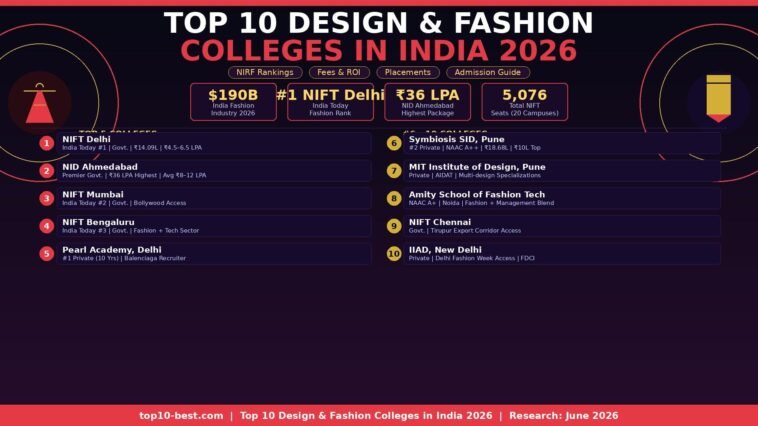
India’s fashion and design industry is worth a projected $190 billion and growing — and yet most students still don’t know which college will actually land them a great career. NIFT and NID are household names. But what about Pearl Academy, Symbiosis, or MIT Institute of Design? Which one gives you the best return on your investment?
This guide answers that honestly. Here are the 10 best design and fashion colleges in India for 2026 — with verified fees, NIRF/India Today rankings, real placement data, and straight talk on who each college is best suited for.
Table of Contents
- Key Highlights & Quick Facts
- Why Design & Fashion Education in India?
- Top 10 Design & Fashion Colleges in India 2026
- Fees Comparison Table
- Rankings & Placements Comparison
- Scholarships Available
- 2026 Trends in Design & Fashion Education
- How to Verify College Claims
- Pros & Cons Table
- Step-by-Step Selection Guide
- Important Statistics & Data Table
- FAQ
- References
- Conclusion
Key Highlights & Quick Facts {#key-highlights}
- India’s textile and apparel market reached USD 248.70 billion in 2025 and is projected to grow at 11.38% CAGR through 2034 (IMARC Group, 2025)
- The Indian fashion industry is on track to hit $190 billion by 2026, with domestic apparel at $105.5 billion and exports at $44.4 billion (Rawshot AI, 2026)
- India’s textile sector employs over 45 million people and contributes ~2% of GDP (IBEF, Feb 2026)
- India is the world’s largest cotton producer and second-largest silk producer globally (IBEF, 2026)
- NIFT Delhi has ranked #1 in India Today’s fashion design college ranking for two consecutive years
- NID Ahmedabad placed 476 students in 2024 with a highest package of ₹36 LPA and lowest of ₹3 LPA (Shiksha, 2024)
- There are 20 NIFT campuses across India with a total intake of 5,076 seats (TopRankers, 2026)
- NIFT fresher salaries range from ₹15,000–₹25,000/month; experienced designers earn ₹5–50 LPA (TopRankers, 2026)
- NID graduates average ₹8–12 LPA, with top offers reaching ₹17–50 LPA (Shiksha, 2026)
- Entrance exams: NIFT Entrance Test, NID DAT, UCEED, CEED, SEED (Symbiosis), Pearl Academy Exam
- NIFT 2026 B.Des total fee is approximately ₹14.09 Lakh (Careers360, 2025)
- Fashion is the first purchase category for 30% of new online shoppers in India (Rawshot AI, 2026)
- Highest-paying fashion roles: Creative Director, Fashion Buyer, Brand Manager — earning ₹20–45 LPA with 10+ years experience (Dheya.com, 2026)
- India’s online fashion retail is projected to hit $43 billion by 2025 — a massive driver for design talent demand (Rawshot AI, 2026)
Why Design & Fashion Education in India? {#why-india}
The scale is hard to ignore. India is the world’s sixth-largest garment exporter, the largest cotton producer, and home to a fashion retail market that’s doubling every decade. Brands from H&M to Zara source from Indian manufacturers. Myntra, Flipkart Fashion, and Ajio collectively serve hundreds of millions of fashion consumers online.
All of this creates real, sustained demand for design talent — not just runway designers, but UX/product designers, fashion merchandisers, textile technologists, retail managers, and brand strategists. The best Indian design schools plug directly into these industries through internships, campus placements, and industry-led projects.
The truth is that India’s fashion and design education system is genuinely world-class at the top. NID Ahmedabad and NIFT Delhi are respected globally — not just regionally. If you get into one of them, doors open.
NIFT Delhi, India’s top-ranked fashion institute, has been producing India’s top fashion design talent since 1986 — with a campus in Hauz Khas, New Delhi.
Top 10 Design & Fashion Colleges in India 2026 {#top-10-list}
1. NIFT Delhi — National Institute of Fashion Technology, New Delhi
Website: nift.ac.in Type: Government (Autonomous under Ministry of Textiles, Govt. of India) Established: 1986 India Today Rank 2025: #1 Fashion Design in India (two consecutive years) Location: Hauz Khas, New Delhi – 110016
Fees: B.Des total fee: approximately ₹14.09 Lakh (4 years). Fee range across all NIFT Delhi courses: ₹64,900 – ₹12,34,000 depending on program. MFM (Master of Fashion Management) total: ₹5.86 Lakh. (Source: Shiksha, Careers360, 2025)
Admission: NIFT Entrance Test conducted by NTA. 2026 exam concluded; next cycle registration opens November 2026. Entrance includes Creative Ability Test (CAT) + General Ability Test (GAT).
Programs Offered: B.Des in Fashion Design, Textile Design, Leather Design, Accessory Design, Knitwear Design, Fashion Communication; B.F.Tech; M.Des; MFM; M.F.Tech.
Placements: Average starting package: ₹4.5–6.5 LPA. Top package: ₹10–15 LPA. Key recruiters: Myntra, Arvind Group, Aditya Birla Fashion, Tommy Hilfiger, Zara, Lifestyle, H&M. (Source: Dheya.com, 2026)
Key Strengths: NIFT Delhi is the undisputed #1 for fashion education in India. The brand carries national and international weight — NIFT Delhi alumni are heading design studios, launching labels, and leading fashion weeks across the country. The campus has dedicated fabric labs, CAD/CAM facilities, photography studios, and direct industry tie-ups. If you can clear the entrance exam, this is the most career-accelerating option in the country.
Honest Note: Competition is intense — thousands apply for limited seats. Starting salaries look modest (₹15K–25K/month for freshers) but career growth in fashion is rapid for those who build a strong portfolio and network.
2. NID Ahmedabad — National Institute of Design
Website: nid.edu Type: Government (Premier Design Institute under DPIIT, Govt. of India) Established: 1961 Location: Paldi, Ahmedabad, Gujarat – 380007
Fees: B.Des: subsidized government fees (exact fee available at nid.edu). M.Des: studio-based program with moderate government fees.
Admission: NID DAT (Design Aptitude Test). B.Des intake across five NID campuses: approximately 425 seats. M.Des: 347 seats across NID Ahmedabad, Bengaluru, and Gandhinagar.
Placements 2024: 476 placement offers made. Highest package: ₹36 LPA. Lowest: ₹3 LPA. Average: ₹8–12 LPA with top offers reaching ₹17–50 LPA. Placement rate: 80–95% consistently. 120–150 companies participated. Top recruiters: Microsoft, Samsung, Google, Adobe, Infosys, SAP, Mahindra & Mahindra, LG Electronics. (Source: Shiksha, TopRankers, Careers360, 2024–2026)
Programs Offered: B.Des in Product Design, Communication Design, Textile Design, Furniture & Interior Design, Ceramic & Glass Design, Animation Film Design; M.Des across 20+ specializations.
Key Strengths: NID is where industrial design, product design, and UX/UI meet fashion and textile design. The NID brand commands a significant premium over NIFT — especially for product design and tech-facing roles. Companies like Google and Microsoft recruit NID graduates for UX and product design roles, pushing top packages well above the fashion-only average. NID alumni have founded companies, led global design teams, and won international design awards. If you’re interested in design thinking beyond just fashion, NID is the superior choice.
Honest Note: Admission is brutally competitive. The NID DAT’s creative assessment tests raw design aptitude — you can’t crack it through textbook preparation alone. Start portfolio-building years in advance.
NID Ahmedabad’s studio-centric campus in Gujarat — where 80–95% of graduates land design roles with companies like Microsoft, Samsung, and Google.
3. NIFT Mumbai — National Institute of Fashion Technology, Mumbai
Website: nift.ac.in/mumbai Type: Government (NIFT campus) Location: Kharghar, Navi Mumbai, Maharashtra India Today Rank 2025: #2 Fashion Design in India
Fees: Same structure as NIFT Delhi; B.Des total ~₹14.09 Lakh (4 years).
Admission: NIFT Entrance Test (NTA). Same national exam as NIFT Delhi — campus allocated by rank and preference.
Placements: Average starting package: ₹4–6 LPA. Top package: ₹9–13 LPA. Recruiters similar to Delhi — Myntra, Arvind, Tommy Hilfiger, Aditya Birla Fashion. (Source: Dheya.com, 2026)
Key Strengths: Mumbai is India’s fashion capital. The Bollywood connection, proximity to luxury retail, and direct access to export garment houses in the city make NIFT Mumbai a unique launching pad. Internship opportunities here are unmatched — students often intern at fashion weeks, film costume departments, and major retail brands during their degree itself.
Honest Note: The Kharghar campus is slightly far from central Mumbai. Transport planning matters if you want to maximize city access. That said, the NIFT brand is strong enough that location within the city is secondary.
4. NIFT Bengaluru — National Institute of Fashion Technology, Bangalore
Website: nift.ac.in/bengaluru Type: Government (NIFT campus) Location: Bengaluru, Karnataka India Today Rank 2025: #3 Fashion Design in India
Fees: B.Des total ~₹14.09 Lakh (4 years). Same national NIFT fee structure.
Admission: NIFT Entrance Test (NTA).
Placements: Average starting package: ₹4–5.5 LPA. Top package: ₹8–12 LPA. Notable for tech company interest — Bengaluru’s tech ecosystem means design graduates are recruited for UI/UX and product design roles alongside traditional fashion. (Source: Dheya.com, 2026)
Key Strengths: NIFT Bengaluru sits in the middle of India’s tech corridor. The intersection of fashion design and tech here is real — graduates who combine fashion design skills with digital tools and UX thinking have a distinct advantage. Bengaluru also has one of India’s strongest garment export bases (it’s a major sourcing hub for international brands), creating strong internship pipelines.
Honest Note: The tech-heavy placement mix means career outcomes differ from Delhi/Mumbai campuses. If you want a pure fashion career, Delhi or Mumbai NIFT is a stronger fit. If you want fashion + tech/digital, Bengaluru is ideal.
5. Pearl Academy, New Delhi (and Mumbai, Bengaluru, Jaipur)
Website: pearlacademy.com Type: Private (India’s leading private design institution) Established: 1993 NAAC: A Grade Rankings: Top positions in Outlook, India Today, and The Week rankings 2025 — ranked #1 among private design institutes for 10 consecutive years (Shiksha, 2026) Location: Multiple campuses: New Delhi (West & South), Mumbai, Bengaluru, Jaipur
Fees: B.Des first year: ₹7.47–7.99 Lakh (Delhi campuses). M.Des total: ₹17 Lakh. Scholarship: NIFT Rank-Based Scholarship — tuition fee waiver for Year 1 based on NIFT entrance rank. Additional: Board Merit & Defence Background scholarships available. (Source: Shiksha, Careers360, 2026)
Admission: Pearl Academy own entrance exam; NIFT scores accepted for scholarship purposes. Portfolio + personal interaction.
Programs Offered: B.Des in Fashion Design, Fashion Communication, Styling, Interior Architecture, Media Design, Jewellery Design, Product Design; M.Des programs.
Placements: Top recruiters: Accenture, Walt Disney, Capgemini, Balenciaga, IBM, TCS, Myntra, Flipkart. Strong luxury brand presence alongside mass-market names. (Source: Shiksha, 2025)
Key Strengths: Pearl Academy is the go-to private design institution in India. The multi-city campus network means industry exposure is city-specific and high-quality. Luxury brand connections — Balenciaga being a recruiter is genuinely rare for an Indian college — reflect the premium positioning of the institute. The fashion weeks, international exchange programs, and brand-led workshop culture set Pearl apart from most private alternatives.
Honest Note: The fees are significantly higher than NIFT or NID. Evaluate ROI carefully — ₹30+ Lakh total (including hostel) for a starting salary of ₹4–6 LPA needs a clear financial plan. The scholarship options partially offset this for high-achieving students.
6. Symbiosis Institute of Design (SID), Pune
Website: sid.edu.in Type: Private (Affiliated to Symbiosis International University) Established: 2002 (operational 2004) NAAC: A++ (SIU) Rankings: #2 Best Private Fashion Design College — India Today & Outlook I-Care 2022; #12 Fashion Design by Collegedunia 2025 Location: Viman Nagar, Pune, Maharashtra
Fees: B.Des total: ₹18.68 Lakh (4 years) for UG. M.Des total: ₹11.23 Lakh (2 years). Fashion Design B.Des specifically: ₹17.60 Lakh total. (Source: Shiksha, Collegedunia, 2026)
Admission: SEED (Symbiosis Entrance Exam for Design). SEED 2026 Round 2 exam held March 22, 2026. Portfolio Review and Personal Interaction (PRPI) is part of the process.
Programs Offered: B.Des in Fashion Design, Fashion Communication, Communication Design, Industrial Design; M.Des.
Placements: Highest package: ₹10 LPA. Average: ₹4 LPA. Recruiters include Infosys, Tata Elxsi, Cognizant, Elephant Design, Onio Design, Leaf Design, Fitch Design. (Source: Collegedekho, 2026)
Key Strengths: SID Pune punches above its weight for a private design school. The SIU ecosystem brings in industry exposure, and the Pune location sits between Mumbai’s fashion scene and Bengaluru’s tech sector — giving students access to both. The NAAC A++ accreditation for Symbiosis International University adds institutional credibility. Studios are modern, and faculty are practicing designers alongside academics.
Honest Note: Average placement at ₹4 LPA is modest for the fee investment. This college suits students who want a creative education environment with reasonable industry access — but set career expectations realistically, especially for the first two years after graduation.
Pearl Academy students at Lakmé Fashion Week — the institute’s industry connections bring students to India’s most prestigious fashion platforms during their degree itself.
7. MIT Institute of Design (MITID), Pune
Website: mitid.edu.in Type: Private (Part of MIT Art, Design and Technology University) Established: 2008 Location: Loni Kalbhor, Pune, Maharashtra
Fees: B.Des programs: mid-to-high private college range. Contact institute for 2026-27 exact fee structure.
Admission: AIDAT (All India Design Aptitude Test) or MITID’s own entrance process; portfolio and personal interaction.
Programs Offered: B.Des in Fashion Design, Communication Design, Industrial Design, Interior Design, Interaction Design, Transportation Design; M.Des programs.
Key Strengths: MIT Institute of Design is frequently mentioned alongside SID Pune as a strong design school option for students who don’t clear NIFT or NID. The MIT-ADT University ecosystem provides strong inter-disciplinary connections between engineering, business, and design. The Interaction Design and Transportation Design programs are especially well-regarded — areas where industry demand is growing fast.
Honest Note: Brand recognition at MITID is still building compared to NIFT, NID, and Pearl Academy. Placement outcomes depend heavily on individual portfolio quality and specialization. Verify NIRF and IIRF ranking data independently.
8. Amity School of Fashion Technology (ASFT), Noida
Website: amity.edu Type: Private (Part of Amity University) Established: 2005 Location: Sector 125, Noida, Uttar Pradesh (and multiple campuses) Accreditation: NAAC A+
Fees: B.Des / B.Sc Fashion Design: ₹2–5 Lakh per year range. Total program fees vary by campus and specialization.
Admission: Amity’s own entrance exam; NIFT scores accepted. Class 12 pass with minimum 50% aggregate.
Programs Offered: B.Sc. Fashion Design, B.Des Fashion Design, MBA in Fashion Management; specializations in apparel, textile, styling, and retail.
Placements: Amity’s large corporate network — across Amity group globally — gives fashion students access to fashion retail, manufacturing, and luxury brand recruiters. Active placement cell with dedicated fashion industry drives.
Key Strengths: Amity’s scale is its biggest advantage. The global network of alumni and corporate partnerships means students have access to placement drives at a volume that smaller design schools can’t match. The Noida campus is well-connected to Delhi-NCR’s fashion retail and export markets. For students who want a balance of fashion education and business management exposure, ASFT is a strong private option.
Honest Note: Amity is a large university group — individual attention varies. The fashion program here is solid but not specialized enough to compete with pure-play design schools like NIFT or Pearl for top fashion brand placements. Best suited if you’re leaning toward fashion management/retail alongside design.
9. NIFT Chennai — National Institute of Fashion Technology, Chennai
Website: nift.ac.in/chennai Type: Government (NIFT campus) Established: 1995 Location: Taramani, Chennai, Tamil Nadu
Fees: Same national NIFT fee structure; B.Des total ~₹14.09 Lakh (4 years).
Admission: NIFT Entrance Test (NTA). Campus allocated by national rank and student preference.
Placements: Average starting package: ₹3.5–5 LPA. Top package: ₹7–10 LPA. Strong in garment export and retail sectors. Key employers: garment exporters from Tirupur, Chennai fashion retail, and pan-India brands. (Source: Dheya.com, 2026)
Key Strengths: NIFT Chennai taps directly into South India’s powerful garment export corridor — Tirupur alone is one of the world’s largest knitwear export hubs. Students get industrial training placements in real export factories and textile companies from their second year. The Tamil Nadu fashion scene is distinct — handloom, knitwear, and export manufacturing are major career tracks here that no other NIFT campus can offer in the same depth.
Honest Note: Starting packages are slightly lower than Delhi/Mumbai campuses. If your career goal is in luxury fashion or international brand design, Delhi or Mumbai NIFT is the stronger option. But for textile technology, export merchandising, or manufacturing-linked design, Chennai NIFT is excellent.
10. IIAD — Indian Institute of Art and Design, New Delhi
Website: iiad.edu.in Type: Private Established: 2013 Location: Lado Sarai, New Delhi
Fees: B.Des programs: ₹3–6 Lakh per year. Specific program fees available at iiad.edu.in.
Admission: IIAD own entrance exam; NIFT/NID scores considered; portfolio and interview.
Programs Offered: B.Des in Fashion Design, Communication Design, Product Design, Interior & Spatial Design; M.Des programs.
Placements: New Delhi location ensures proximity to fashion weeks, luxury retail, media companies, and major fashion events. Active placement cell; recruiting companies include fashion brands, design studios, advertising agencies, and retail chains.
Key Strengths: IIAD has carved a strong niche as a premium private design school in Delhi — the city’s fashion capital advantage gives students direct access to Fashion Design Council of India (FDCI) events, Lakme Fashion Week (Delhi edition), and luxury brand showrooms. Faculty include practicing designers and industry veterans who bring real-world projects into classrooms. The small cohort size means more individual attention than large universities.
Honest Note: IIAD is newer than NIFT or Pearl Academy, so the alumni network is still developing. Brand recognition among mainstream recruiters is building but not yet at Pearl Academy’s level. For students who want a design-focused private college in Delhi without NIFT admission, IIAD is a credible option.
Also Notable
These institutions didn’t make the top 10 but are worth considering for specific programs:
- NIFT Hyderabad — Strong fashion communication & retail management programs; India Today rank #4–5
- Army Institute of Fashion & Design (AIFD), Bengaluru — Government-backed; strong IIRF rankings; top-5 in India Today 2025 for Bangalore
- Sir J.J. Institute of Applied Art, Mumbai — One of India’s oldest art & design schools (est. 1857); excellent for graphic and visual design
- Srishti-Manipal Institute of Art, Design & Technology, Bengaluru — Strong for interdisciplinary design; well-connected to Bengaluru’s creative ecosystem
- JD Institute of Fashion Technology — Multi-city private option; good for students who need a practical, industry-first fashion education
Fees Comparison Table {#fees-comparison}
| College | Type | B.Des / UG Total Fee | Annual Fee (Approx) |
|---|---|---|---|
| NID Ahmedabad | Govt. (Central) | Subsidized (low) | Very low |
| NIFT Delhi | Govt. (Central) | ~₹14.09 Lakh | ~₹3.5 Lakh |
| NIFT Mumbai | Govt. (Central) | ~₹14.09 Lakh | ~₹3.5 Lakh |
| NIFT Bengaluru | Govt. (Central) | ~₹14.09 Lakh | ~₹3.5 Lakh |
| NIFT Chennai | Govt. (Central) | ~₹14.09 Lakh | ~₹3.5 Lakh |
| Pearl Academy Delhi | Private | ₹30 Lakh+ (4 yr total) | ₹7.47–7.99 Lakh/yr |
| Symbiosis SID Pune | Private | ₹18.68 Lakh | ~₹4.67 Lakh |
| MIT Institute of Design | Private | Contact institute | Mid-range |
| Amity School of FT | Private | ₹8–20 Lakh | ₹2–5 Lakh |
| IIAD New Delhi | Private | ₹12–24 Lakh | ₹3–6 Lakh |
Sources: Shiksha, Collegedunia, Careers360, official college websites (2025–2026). Fees exclude hostel unless stated. Always verify on official site.
Rankings & Placements Comparison {#rankings-placements}
| College | India Today Rank | Avg. Package | Highest Package | Key Recruiter |
|---|---|---|---|---|
| NIFT Delhi | #1 India | ₹4.5–6.5 LPA | ₹10–15 LPA | Myntra, Arvind, Tommy Hilfiger |
| NIFT Mumbai | #2 India | ₹4–6 LPA | ₹9–13 LPA | Fashion retail, Bollywood |
| NIFT Bengaluru | #3 India | ₹4–5.5 LPA | ₹8–12 LPA | Tech + fashion companies |
| NID Ahmedabad | Top National | ₹8–12 LPA | ₹36 LPA | Microsoft, Samsung, Adobe |
| Pearl Academy | #1 Private (10 yrs) | ₹4–6 LPA | ₹10+ LPA | Balenciaga, Myntra, Disney |
| SID Pune | #2 Private | ₹4 LPA | ₹10 LPA | Tata Elxsi, design agencies |
| Amity ASFT | NAAC A+ | N/A | N/A | Fashion retail, exporters |
| NIFT Chennai | #4–5 India | ₹3.5–5 LPA | ₹7–10 LPA | Tirupur garment exporters |
| IIAD Delhi | Growing reputation | N/A | N/A | Fashion brands, studios |
| MIT Institute of Design | IIRF listed | N/A | N/A | Design agencies, retail |
Source: Dheya.com, Shiksha, Collegedunia, TopRankers (2025–2026). NID Ahmedabad data from Shiksha placement report 2024.
Scholarships Available {#scholarships}
| College | Scholarship Type | Benefit |
|---|---|---|
| NIFT (all campuses) | Central Govt. SC/ST/OBC | Fee concession; income-based waivers |
| NID Ahmedabad | Govt. merit scholarships | Available for eligible students |
| Pearl Academy | NIFT Rank-Based (2026) | Year 1 tuition fee waiver based on NIFT rank |
| Pearl Academy | Board Merit Scholarship | For 12th board toppers |
| Pearl Academy | Defence Background Scholarship | For armed forces families |
| Symbiosis SID | SIU merit scholarships | Available for SEED toppers |
| Amity ASFT | Amity merit scholarship | Available on the basis of entrance performance |
| IIAD Delhi | Need + merit combined | Contact admissions |
2026 Trends in Design & Fashion Education {#trends-2026}
India’s fashion market accelerating: The India clothing market was valued at USD 116.64 billion in 2025 and is forecast to reach USD 177.70 billion by 2035, growing at 4.30% CAGR (Expert Market Research, May 2026). This means sustained demand for trained fashion professionals throughout this decade.
Textile sector double-digit growth: India’s textile and apparel market reached USD 248.70 billion in 2025 and is projected at 11.38% CAGR through 2034 (IMARC Group, 2025) — driven by rising domestic consumption, export growth, and e-commerce penetration.
India textile exports rising: In FY26 (April–February 2026), total textile and apparel exports stood at $32.63 billion, with Ready-Made Garments accounting for 45% of the total (IBEF, 2026). The government’s PLI scheme of ₹10,683 crore and 100% automatic FDI in the sector are creating more designer roles in export-focused companies.
UX/UI design becoming as important as fashion design: NID graduates entering tech companies (Google, Adobe, Samsung) for product and UX roles is a clear 2026 trend. Design schools are increasingly blending physical and digital design curricula — NIFT’s CAD integration and NID’s interaction design programs reflect this shift.
Sustainable and eco-fashion entering curricula: Leading design schools are adding courses on sustainable textiles, circular fashion, and ethical sourcing. Cosset Clothing’s eco-friendly knitwear launch (November 2024) and government emphasis on sustainable garment exports signal that sustainability is now an industry-standard skill, not a niche specialty.
NIFT 2026 exam concluded: NIFT 2026 exam was conducted for both UG and PG programs. Final results were being announced at time of writing. Next cycle’s registration is expected to open November 2026. Students targeting 2027 admission should start NID/NIFT exam preparation now — particularly the Creative Ability Test component.
How to Verify College Claims {#verify-claims}
Fashion and design college marketing is heavy on glamour and light on hard data. Here’s how to see through it:
1. Check NIRF and IIRF rankings directly: For design colleges, visit nirfindia.org (Art & Design category). Also check IIRF rankings at iirf.edu.in. India Today publishes an annual fashion college ranking that is widely referenced.
2. Placement packages in design are highly variable: A college claiming “average package ₹10 LPA” for a B.Des program needs verification. Ask for NIRF-reported placement data, not marketing page numbers. Even top NIFT campuses average ₹4.5–6.5 LPA for starters.
3. Verify AICTE approval: AICTE approval is mandatory for B.Des programs at private institutions. Check aicte-india.org. Unapproved private colleges put your degree recognition at risk.
4. Portfolio + industry exposure matters more than ranking: In design careers, your final portfolio and internship experience often matter more than the college name. Ask: How many industry live projects are embedded in the curriculum? What fashion weeks or design fairs do students participate in?
5. Alumni outcomes on LinkedIn: Search LinkedIn for graduates from the specific design program you’re considering. Their actual job titles and employers give a clearer picture than any brochure. Look at 3–5 year alumni, not just freshers.
6. Visit the studio spaces in person: Design education depends on physical studio quality — fabric libraries, printing labs, CAD rooms, photography studios. A campus visit before admission pays off enormously.
Pros & Cons Table {#pros-cons}
| Factor | Government Colleges (NIFT, NID) | Private Colleges (Pearl, SID, Amity) |
|---|---|---|
| Fees | Low–Moderate (₹14L total for NIFT) | High (₹18L–₹30L+ total) |
| Brand Value | Nationally & internationally strong | Strong (Pearl) to Good (others) |
| Admission Difficulty | Very high (NIFT/NID entrance) | Moderate (own exams) |
| Studio Infrastructure | Established & well-equipped | Modern; private investment |
| Industry Connections | Deep (decades of partnerships) | City-dependent; strong for Pearl |
| Placement Network | Large-scale national drives | Boutique; niche luxury (Pearl) |
| Campus Life | Focused, intense | Urban, diverse |
| International Exposure | Moderate | Strong at Pearl, SID |
| Curriculum Flexibility | Standardized (NIFT board) | More elective options |
| ROI | Excellent (low fees + strong brand) | Variable (high fees; verify carefully) |
Step-by-Step Selection Guide {#selection-guide}
Step 1: Define your design track. Are you drawn to fashion design (garments, styling, textiles), industrial/product design, communication design (graphic, digital), or interior design? NIFT is strongest for fashion-specific tracks. NID leads in product, industrial, and communication design. Pearl Academy covers fashion + lifestyle design. Your answer determines which entrance exam matters most.
Step 2: Target the right entrance exam. For NIFT → prepare for NIFT Entrance Test (Creative Ability Test + General Ability Test). For NID → NID DAT (two stages: Prelims and Mains). For Symbiosis SID → SEED exam. For Pearl Academy → Pearl’s own entrance (portfolio + personal interaction). Start preparation at least 12 months in advance. The Creative Ability Test at NIFT/NID cannot be cracked through last-minute coaching.
Step 3: Build your portfolio from today. In design admissions, your portfolio is as important as your entrance exam score. Sketch daily. Experiment with materials. Document your creative process. Colleges like NID and IIAD specifically assess design thinking, not just technical execution.
Step 4: Shortlist by career geography. Delhi → NIFT Delhi, Pearl Academy, IIAD. Mumbai → NIFT Mumbai (fashion/film). Bengaluru → NIFT Bengaluru (fashion + tech). Pune → SID, MITID. Ahmedabad → NID. Chennai → NIFT Chennai (export/garment sector). Match your college to the industry ecosystem you want to enter.
Step 5: Calculate total ROI. Add up four years of tuition + hostel + living costs. Compare to realistic starting salary (₹15K–25K/month for freshers; ₹4–6 LPA for NIFT; ₹8–12 LPA for NID average). A private college charging ₹6 Lakh/year for a ₹4 LPA starting salary needs a clear repayment plan.
Step 6: Apply to 3–5 institutions simultaneously. Don’t wait for NIFT or NID results before applying to private colleges — admission timelines overlap. Have a backup plan that you’re genuinely excited about.
Important Statistics & Data Table {#statistics-table}
| Metric | Data | Source | Year |
|---|---|---|---|
| India textile & apparel market size (2025) | USD 248.70 billion | IMARC Group | 2025 |
| India textile market CAGR (2025–2034) | 11.38% | IMARC Group | 2025 |
| India clothing market size (2025) | USD 116.64 billion | Expert Market Research | 2025 |
| India clothing market (2035 forecast) | USD 177.70 billion | Expert Market Research | 2026 |
| India fashion industry (2026 projection) | $190 billion | Rawshot AI | 2026 |
| India textile sector employment | 45 million+ people | IBEF | Feb 2026 |
| India textile sector GDP contribution | ~2% of GDP | IBEF | Feb 2026 |
| India textile exports FY26 (Apr–Feb) | USD 32.63 billion | IBEF | 2026 |
| Ready-Made Garments export share | 45% of total exports | IBEF | 2026 |
| India online fashion retail (2025 projection) | $43 billion | Rawshot AI | 2026 |
| Fashion as first e-commerce purchase | 30% of new online shoppers | Rawshot AI | 2026 |
| Myntra online fashion market share | 60–70% (premium segment) | Rawshot AI | 2026 |
| Total NIFT campuses in India | 20 campuses | TopRankers | 2026 |
| Total NIFT intake (all campuses) | 5,076 seats | TopRankers | 2026 |
| NIFT B.Des total fee (4 years) | ~₹14.09 Lakh | Careers360 | 2025 |
| NIFT Delhi India Today rank | #1 (two consecutive years) | India Today | 2025 |
| NIFT fresher salary range | ₹15,000–₹25,000/month | TopRankers | 2026 |
| NIFT Delhi avg. starting package | ₹4.5–6.5 LPA | Dheya.com | 2026 |
| NIFT Delhi top package | ₹10–15 LPA | Dheya.com | 2026 |
| NID Ahmedabad highest package (2024) | ₹36 LPA | Shiksha | 2024 |
| NID Ahmedabad placement offers (2024) | 476 full-time offers | Shiksha | 2024 |
| NID placement rate | 80–95% consistently | TopRankers | 2026 |
| NID average salary | ₹8–12 LPA | Shiksha | 2026 |
| NID top salary range | ₹17–50 LPA | Shiksha | 2026 |
| NID B.Des intake (5 campuses) | ~425 seats | Shiksha | 2026 |
| Pearl Academy India Today rank | #1 private (10 consecutive yrs) | Shiksha | 2026 |
| SID Pune B.Des total fee | ₹18.68 Lakh | Shiksha | 2026 |
| SID Pune highest package | ₹10 LPA | Collegedekho | 2026 |
| SID Pune average package | ₹4 LPA | Collegedekho | 2026 |
| Fashion fresher salary (premier institutes) | ₹4–6 LPA | IIFT Bangalore | 2026 |
| Creative Director salary (10+ yrs) | ₹20–45 LPA | Dheya.com | 2026 |
| Costume designer salary India | ₹50,000–₹2,00,000/month | ITM.edu | 2026 |
| PLI scheme for textile sector | ₹10,683 crore | Govt. of India | 2026 |
FAQ {#faq}
Q1: Which is the best design and fashion college in India in 2026?
For pure fashion design, NIFT Delhi is the best — ranked #1 in India Today for two consecutive years, with the strongest brand, placement network, and industry connections in the country. For product design, UX, and industrial design, NID Ahmedabad is the superior choice, with average salaries of ₹8–12 LPA and a 2024 highest package of ₹36 LPA from recruiters like Microsoft, Samsung, and Adobe. Among private colleges, Pearl Academy has been India’s #1 private design institution for 10 consecutive years, with luxury brand recruiters including Balenciaga.
Q2: What entrance exams are required for design and fashion college admission in India?
The two most important national entrance exams are NIFT Entrance Test (for all 20 NIFT campuses) and NID DAT (Design Aptitude Test, for all NID campuses). NIFT exam is conducted by NTA and includes a Creative Ability Test and General Ability Test. For private colleges: SEED for Symbiosis SID Pune; Pearl Academy’s own entrance exam with portfolio; UCEED for IIT Bombay’s design programs; IIAD Entrance Exam for IIAD Delhi. The 2026 NIFT exam has concluded; registration for 2027 cycle opens around November 2026.
Q3: How much does a fashion design degree cost in India?
Government colleges are the best value. NIFT B.Des (4 years) costs approximately ₹14.09 Lakh total across all campuses. NID fees are subsidized government rates (significantly lower). Private colleges charge more: Pearl Academy costs ₹7.47–7.99 Lakh per year; Symbiosis SID’s B.Des total is ₹18.68 Lakh; Amity ranges ₹2–5 Lakh per year. Overall, fashion design degrees in India range from ₹2 Lakh to ₹30 Lakh for a full program depending on the institution.
Q4: What is the average salary after a fashion design degree in India?
It depends heavily on the college and specialization. NIFT freshers start at ₹15,000–25,000/month; average starting package is ₹4.5–6.5 LPA for NIFT Delhi graduates. NID graduates average ₹8–12 LPA with top offers reaching ₹17–50 LPA. Experienced designers (3–5 years) earn ₹5–22 LPA. Senior designers and creative directors with 10+ years earn ₹20–45 LPA. Costume designers can earn ₹50,000–₹2 Lakh/month on a project basis. International roles command significantly higher packages.
Q5: Is NID better than NIFT?
They’re different, not directly comparable. NIFT is best if your goal is fashion design, merchandising, retail management, or fashion communication — it’s industry-optimized for the fashion sector with strong fashion brand placement networks. NID is better for product design, industrial design, UX/UI, and communication design — its graduates enter tech companies, design consultancies, and cross-sector industries, often commanding higher starting salaries (₹8–12 LPA vs NIFT’s ₹4.5–6.5 LPA average). If your passion is fashion specifically, go NIFT. If you want design as a broader discipline, NID is superior.
Q6: What careers can I pursue after a fashion design degree in India?
Fashion design graduates work as Fashion Designer, Textile Designer, Merchandise Planner, Retail Manager, Fashion Stylist, Fashion Buyer, Brand Manager, Creative Director, Production Manager, Costume Designer, UI/UX Designer (for NID/design-stream graduates), and Fashion Entrepreneur. Employers include Zara, H&M, Myntra, Flipkart Fashion, Aditya Birla Fashion, Arvind Group, Tata Trent, Bollywood production houses, export garment companies, luxury brands, and design agencies. The highest-paying roles are Creative Director, Fashion Buyer, and Brand Manager — requiring 5–10 years of experience.
Q7: Can I get into NIFT or NID without a creative arts background in 12th?
Yes. Both NIFT and NID accept students from any 12th stream — Science, Commerce, or Arts. There is no mandatory arts background in 12th. What matters is your performance in the entrance exam (NIFT CAT/GAT or NID DAT) and your design portfolio/aptitude. That said, students with arts backgrounds tend to have stronger Creative Ability Test preparation. Students from science or commerce backgrounds can absolutely clear the exam — many NIFT and NID toppers come from non-arts backgrounds — but they typically start portfolio preparation 12–18 months in advance.
References {#references}
- NIRF Rankings — Ministry of Education, Govt. of India. nirfindia.org
- NIFT Delhi Fees 2026 — Shiksha. shiksha.com
- NID Ahmedabad Placement 2024 — Shiksha. shiksha.com
- NIFT Salary & Placement 2026 — Shiksha. shiksha.com
- NID Placements 2026 — TopRankers. toprankers.com
- Top NIFT Campuses India 2026 — TopRankers. toprankers.com
- Fashion Designer Salary India 2026 — Dheya.com. dheya.com
- SID Pune Fees & Placement — Collegedekho. collegedekho.com
- Pearl Academy Delhi Placement & Scholarships — Shiksha. shiksha.com
- India Fashion Industry Statistics 2026 — Rawshot AI. rawshot.ai
- India Textile & Apparel Market 2025 — IMARC Group. imarcgroup.com
- India Clothing Market Forecast 2026–2035 — Expert Market Research. expertmarketresearch.com
- Textile Industry India — IBEF Report — IBEF. ibef.org
- Fashion Careers India 2026 — Curominds. curominds.com
- NIFT vs NID vs Pearl Academy 2026 — DesignFresher. designfresher.com
- Top Fashion Design Colleges India 2025 — Stubard. stubard.com
- NID Placement Analysis — Careers360. design.careers360.com
Conclusion {#conclusion}
India’s design and fashion industry is growing too fast for average talent to get lost in. The colleges on this list — especially NIFT Delhi, NID Ahmedabad, and Pearl Academy — genuinely open doors that smaller institutions can’t. Get into NIFT or NID if you can clear the entrance exam; the ROI on government college fees is unmatched. If you go private, go with your eyes open on fees vs realistic starting salaries. Build your portfolio, nail the entrance exam, and choose the college that aligns with your specific design track — not just the brand name.



GIPHY App Key not set. Please check settings